Tag Archives: Totsuka DXers Circle (TDXC)

Meeting WavViewDX Developer Reinhard Weiß, and Visiting Akihabara With Him (A Totsuka DXers Circle Article by Kazu Gosui)

Many thanks to SWLing Post contributor Nick Hall-Patch, who has kindly provided a translation of this article from the Japanese-language publication PROPAGATION by the Totsuka DXers Circle (TDXC). Here, Kazu Gosui recounts his meeting with WavViewDX developer Reinhard Weiß during his visit to Tokyo .


Meeting WavViewDX developer Reinhard Weiß, and Visting Akihabara With Him

by Kazu Gosui

I first learned about WavViewDX in January of this year on the mailing list of the American radio club IRCA. It was described as “analysis software compatible with I/Q WAV recordings created with almost all SDR software,” so I was intrigued. I quickly downloaded it and tried it out, and I was immediately impressed.

In early February, I emailed the developer, asking, “I’m amazed at how easy it is to use and how powerful it is. It works fine with PERSEUS and AirSpy HF+, but are there any plans to support WiNRADiO’s DDC format?” Reinhard Weiß (hereafter referred to as Reinhard) responded that same day, “I’m actually currently working on adding support for WiNRADiO’s G33DDC. I should be able to send you a test version tomorrow.” The email carefully explained the import procedure and important points to note.

The text, the web page description, and the tone of the expression conveyed a sincere and attentive personality. The next day, I tried out the sample version and reported some concerns. Reinhard quickly fixed them, and where he couldn’t immediately fix them, he supported me by sending files via the cloud or screen capture videos. As I continued to request things like adding a shortcut for switching receive modes, I gradually became fascinated with WavViewDX and, before I knew it, became a heavy user.

The first email also asked, “I’m planning to visit Japan in May or June. Are there any ham or BCL (Broadcast Listener; SWL) events in Japan around that time?” In response, I suggested that if Reinhard could come to Tokyo, we could hold an offline meeting with members of TDXC! Through our exchange, I realized that Reinhard is quite knowledgeable about Japanese affairs. He knows Akihabara very well, and even knows Hard Off as a good place to get BCL radios. He loves hot springs and enjoys talking about Japanese food. When I asked him, “Is your wife Japanese by any chance?” he replied, “Yes.” No wonder he’s so knowledgeable! He should have told me sooner! (lol) So, we made an appointment for an offline meeting in Akihabara, Tokyo, in late May.

On the day, we met at the Electric Town exit of JR Akihabara Station. Our four attendees were Hiroo Nakagawa, Satoshi Miyauchi, Fumiaki Minematsu and myself. When I arrived at the meeting point five minutes early, they were already there. When I asked him, “Excuse me, Reinhard-san?” he replied, “Yes, that’s right,” in Japanese. His Japanese was fluent! Up until now, emails had been in English, as I don’t speak German, so I had no choice but to communicate in English… I was completely surprised because I had been counting on the others and Google Translate on my smartphone to converse in English! You should have told me sooner, Reinhard! (lol) Needless to say, from then on, the entire conversation was in Japanese. The meeting venue was a pub near the station. He could read the Japanese menu, and thanks to his wife, who is apparently a good cook, Japanese food was also OK, so no problem.

We spoke about radio and BCL. Reinhard started medium wave DX about three years ago.  He has been interested in radio since he was a child and actually worked as a BCL radio broadcaster. He has had a long career. His job is developing debuggers for testing and verifying the operation of in-vehicle electronic devices and measuring instruments. He says that both his work and his hobby are focused on developing easy-to-use hardware and software integration. He developed WavViewDX while studying the programming language Python, and runs it at home using two PERSEUS devices.

He said he would be happy if many people use it. Currently, WavViewDX has 200 users, 25 of whom are active worldwide. Incidentally, the mailing list has 102 subscribers (as of June 10, 2025).

Over lunch, we had the opportunity to use WavViewDX on the PC we brought with us, and it was extremely valuable to have the developer himself explain how to use it, provide an overview of its functions, and explain the development concept.  We also received copies of the German BCL magazine “Radio-Kurier” (a radio delivery service?). This magazine apparently publishes an astounding 2,000 copies per month, demonstrating the depth of Germany’s BCL population. The most active BCLs are few, and 80% of the articles are written by one person. That’s impressive.

The second half of the meeting was a tour of Akihabara’s famous shops. We visited the Radio Center rental showcase, Uchida Radio, Radio Department Store, Rocket, Fuji Musen, and Akizuki Denshi. Reinhard has a keen interest in vintage Japanese BCL radios and boomboxes, and his eyes lit up as he looked at rare radios and boomboxes. At Uchida Radio, he even negotiated the price of a radio cassette player he was interested in.    Unfortunately, the deal fell through, but he apparently toured Hard Off stores around Tokyo the next day, so he must be a die-hard enthusiast. He also seemed to love the Fuji Wireless and Akizuki Electronics stores on the second floor, saying, “Their unique products are what keeps them going, and I can see why they’ve survived.” He bought a large breadboard (brand new!) for 50 yen on the second floor of Akizuki and then we took a break for tea in the cafe.

We had a great time chatting there, too. Reinhard is, in a word, a nice guy. A German who speaks Japanese, loves radio and BCL, and develops software for BCL—an extremely rare and valuable person. He’s fluent enough in Japanese to even tell jokes, and he’d laugh along with us at our old-man jokes. He was friendly and fun to talk to, and we shared the same values as fellow enthusiasts. It felt like we were old friends.

He apparently returns to Japan every year with his wife, but he hasn’t done a DX expedition yet. Maybe the next one will be the Chigasaki expedition?! So we parted ways, hoping to see each other again next year.

(l-r: Kazu Gosui, Satoshi Miyauchi, Hiroo Nakagawa, Reinhard Weiß, Fumiaki Minematsu) —Hiroo Nakagawa photo
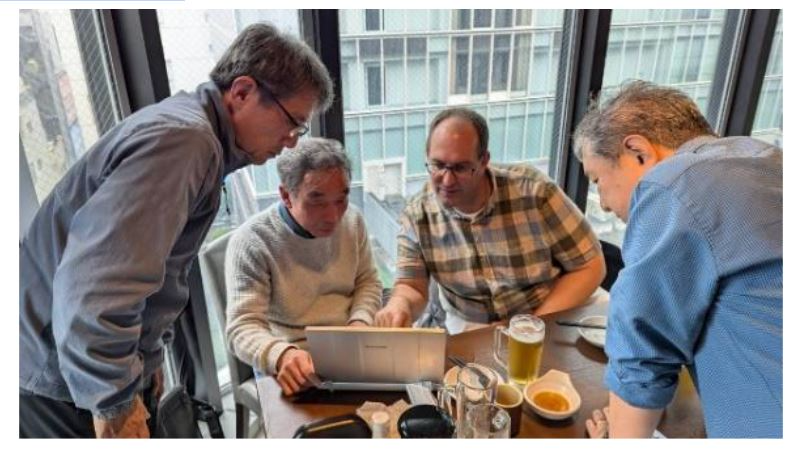
(l-r: Kazu Gosui, Hiroo Nakagawa, Reinhard Weiß, Satoshi Miyauchi) —Fumiaki Minematsu photo


These English translations were prepared for IRCA’s DX Monitor, and are used with the kind permission of  IRCA as well as of the authors and the editor of the Totsuka DXers Circle publication, PROPAGATION.
Ultra Convenient, The Benefits of WavViewDX: Visualizing Reception Conditions (A Totsuka DXers Circle Article by Satoshi Miyauchi)

Many thanks to SWLing Post contributor Nick Hall-Patch, who has kindly provided a translation of this article from the Japanese-language publication PROPAGATION by the Totsuka DXers Circle (TDXC). In this piece, Satoshi Miyauchi explores how WavViewDX can revolutionize SDR analysis by making propagation and reception conditions instantly visible–and shares some remarkable reception examples.


“Ultra” Convenient, The Benefits of WavViewDX: Visualizing Reception Conditions 

by Satoshi Miyauchi

After recording bands using SDR’s such as Perseus or HF Discovery, I was informed by Kazu Gosui via email of a new program that’s “ultra” convenient for analyzing them. When monitoring in real time with Perseus, I have a general memory and notes of what was received at what time.  However, when recording reception data without real-time monitoring, such as during nighttime hours, verifying and analyzing the data across all frequencies takes time. Knowledge and intuition about where to listen are also important elements. While all of this is a skill, I believe that previous tools have been unable to provide a comprehensive view of the day’s conditions. Since I started using WavViewDX, I’ve been using it every morning, efficiently analyzing the SDR recordings I’ve collected.

By the way, recently I’ve been using a timer (the “Scheduler” of SDR Console) to check if the TWR-Africa signal transmitted from Benin, West Africa, is reaching me in the middle of the night. My analysis showed a significant reduction in the time required for confirmation that TWR-Africa was being received before and after WavViewDX was installed, and I’d like to share this with you.

Just to be clear, this article is not intended to be a tedious rehash of the user manual. Rather, it is intended to provide useful, pinpointed tips for use.

  1. I’ll introduce a method I think might be best based on my current setup.
  2. I’ll share some reception reports from my recent morning routine.
  3. I’ll touch on the mysteries of radio wave propagation, a realization I believe is unique to WavViewDX.

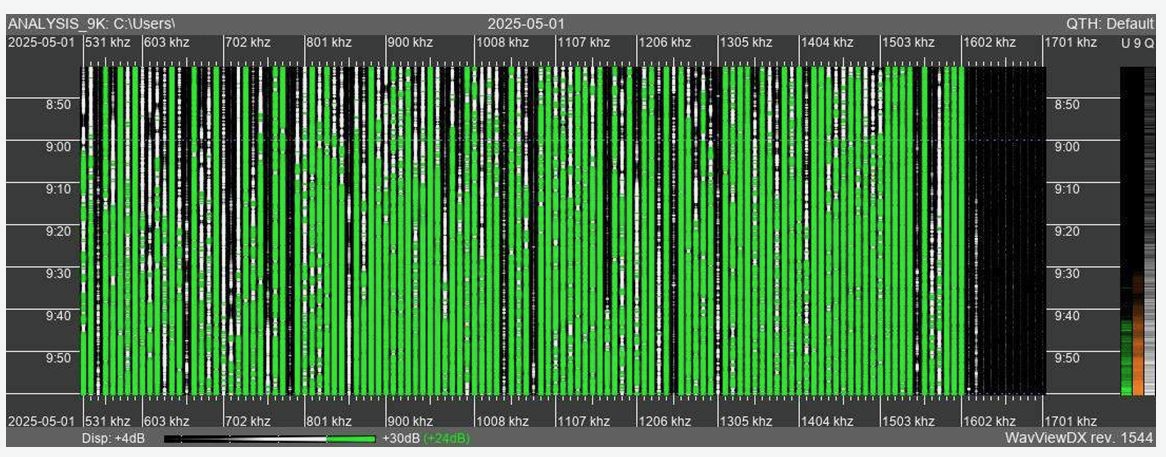
But first, a word about WavViewDX: seeing is believing. As shown in the sample image in Figure 5, it visually displays the status of stations received at each frequency, using green bars or white lines, in chronological order, from the lowest frequency band (left) to the highest (right). You can even customize it to analyze North and South America at 10 kHz intervals for TP reception.

The author is Reinhard Weiß from Germany (please see accompanying related articles).  It is an incredibly easy-to-use and intuitive software. Once you start using it, you’ll definitely want to keep it.

Figure 5

First, let’s assume you’ll be importing and analyzing data into WavViewDX.

1.) Timer Reception Tips, Using SDR Console

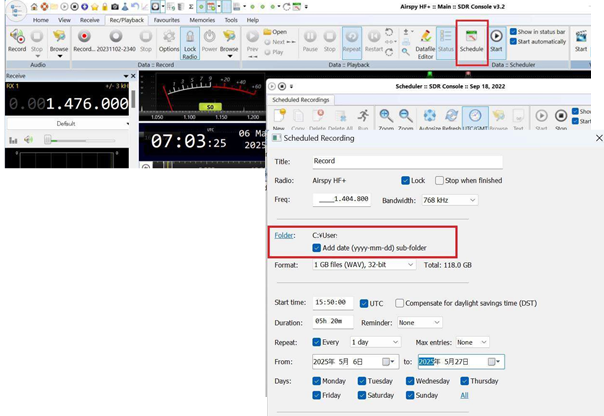
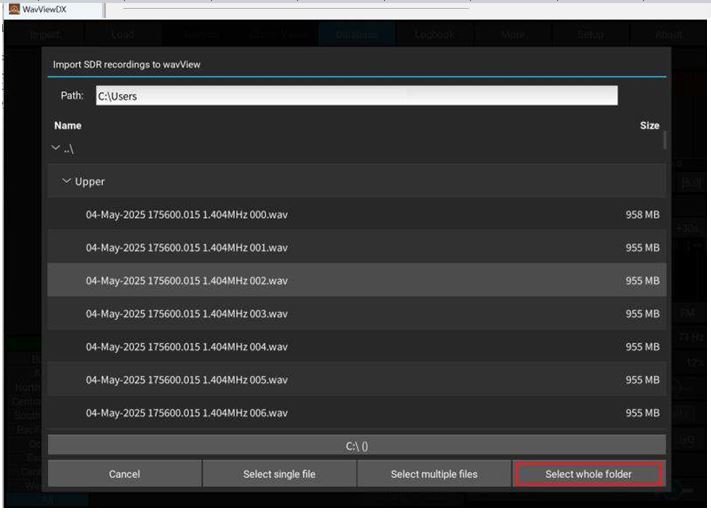
This is a backward-thinking approach based on the fact that WavViewDX can import files in “folders.” The golden rule is simply to store all files from a single session in a single folder. I’ve been using SDR Console as my primary SDR program for a while now, so when I register a scheduler (for timer scheduling), I click “Add date (yyyy-mm-dd) subfolder” under “Folder”, in Figure 6. This allows me to import the entire folder of recording files from that day into WavViewDX, saving me a lot of time. WavViewDX has a “Select Whole Folder” button, which allows me to import files into WavViewDX with a single click (Figure 7). How amazing! Incidentally, I set up bandwidth recording files to be stored in separate 1GB files. The moment I wake up, the files are instantly imported into WavViewDX, allowing me to quickly check the conditions from midnight to dawn before work.

Figure 6

Figure 7

2) TWR-Africa Reception Recording

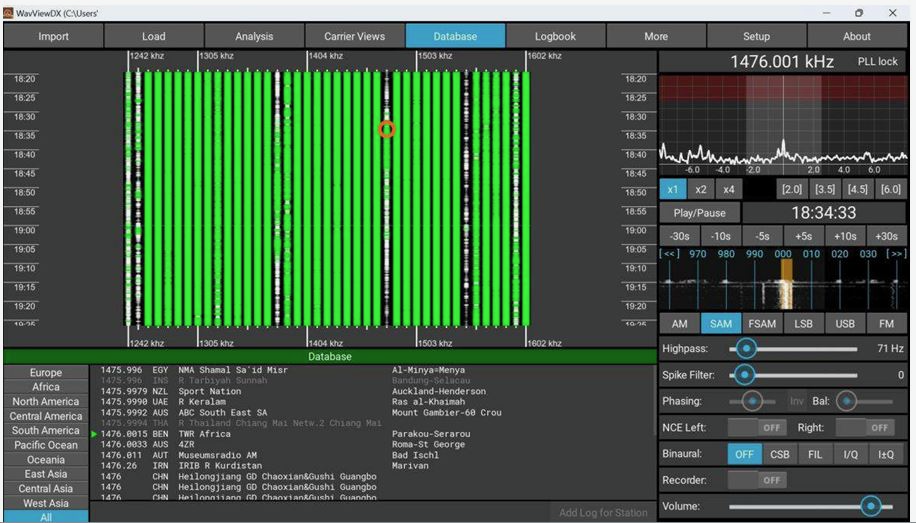
Even on shortwave, it’s rare to see signals from Africa, let alone on mediumwave. Until a few years ago, I thought this was impossible. However, I discovered that I could record pre-dawn signals from Africa on my home K9AY loop, including the VOA of the Sao Tome and Principe relay on 1530kHz, as well as the famous TWR Africa (Benin) on 1476kHz. Of course, it’s not easy to receive signals every day, so I was not motivated to record them regularly However, after installing WavViewDX, I was able to easily grasp the pre-dawn conditions, and I set up a scheduler to record as many times as possible every day.

Then, one morning, right around 3:30 AM, on the morning of the March vernal equinox, I noticed a very clear bar on the 1476kHz using WavViewDX (Figure 8). By working in conjunction with WavViewDX, it automatically checks offsets in exact carrier frequency being received against the MWList database, and the > mark quickly lights up in WavViewDX, indicating that it’s TWR Africa! I was surprised when I heard the audio. I was impressed by the exceptionally clear reception. There was a slight beat, and it seemed like at least one other carrier was also in the mix. How such clear audio managed to reach and be heard across nearly 13,300 km as the crow flies is a mystery, but it’s still a moving experience.

Figure 8

I asked @lft_kashima LFT Kashima Fishing Radio, who regularly posts information on X, and he said that the signal wasn’t as good on that day at his location. Since we’re both in the Kanto region and a little farther apart, perhaps that’s the problem, or perhaps it’s just the antenna. He uses a north-south loop antenna, while I use a vertical AOR SA-7000.

While I don’t know the full reason or answer, one possible guess: – Wasn’t the arrival direction north-south? – Did it arrive through a duct somewhere? However, there’s no way to know why the duct ended up at this receiving point. It’s a wonder that I was able to receive such a DX station at this point in the solar cycle, when the number of sunspots is almost at its maximum and the A/K Index was far from calm. This makes daily reception all the more meaningful. It’s a moment that makes me admire nature, the work of radio wave propagation.  I was able to receive this station again in April, and the links to those two results from 1476kHz – TWR Africa are below:

3) The Mysteries of Radio Wave Propagation Discovered Only with WavViewDX

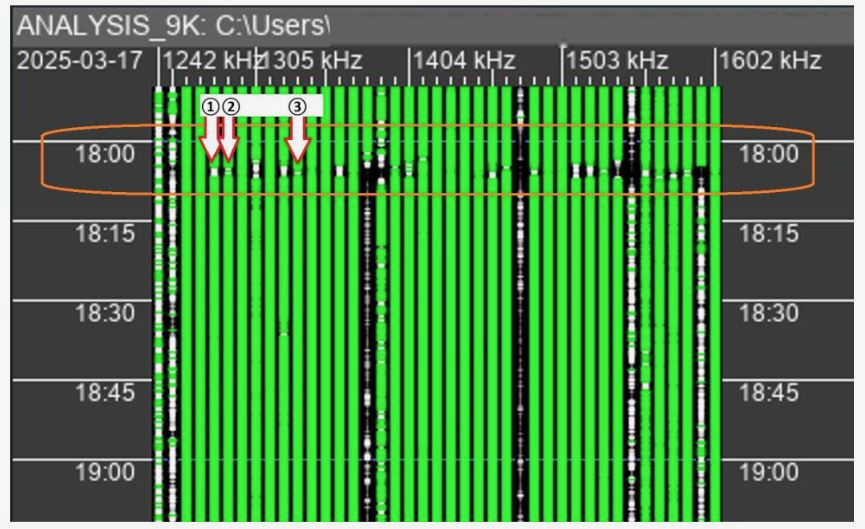
WaveViewDX already clearly shows the reception status on the vertical time axis, but just before the vernal equinox, a phenomenon in which the propagation conditions deteriorated simultaneously across multiple frequencies occurred, albeit for a short period of time. (Audio Sample https://youtu.be/XhXSQFiGQeo) What is this? Figure 9 shows the actual situation at my location on March 17, 2025, after 18:00 UTC.

Figure 9

  1. 1278kHz JOFR Fukuoka RKB Mainichi Broadcasting System 50kw (about 900km distance, 245°)
  2. 1287kHz JOHR Sapporo HBC Hokkaido Broadcasting System 50kw (about 1000km distance, 340°)
  3. 1332kHz JOSF Nagoya Tokai Broadcasting System 50kw (about 270km distance, 270°)

(*Note: The leftmost bar (1242kHz in the Kanto region) is attenuated with a notch filter)

One of the benefits of WavViewDX is that it visually showed the simultaneous drop in signal strength from domestic and international stations, which had been arriving almost smoothly until 18:00 UTC.

I asked Perplexity AI and searched the literature. These possibilities were listed:

“Regarding the phenomenon of simultaneous attenuation of radio signals in all directions for several minutes during nighttime propagation in the medium frequency band (MF band),” it is believed to be primarily caused by the combined effects of the following factors: –

  • Ionospheric Variation Mechanism Sudden E-Layer (Es-Layer) Formation A localized increase in electron density in the upper E-layer of the ionosphere (at an altitude of 100-120 km) at night. This thin ionosphere strongly reflects signals, blocking the normal F-layer reflection path. One measurement data showed signal attenuation of up to 20 dB when the Es layer occurred.
  • F-layer altitude fluctuations: When the F layer (altitude 250-400 km), the main nighttime propagation path, rapidly rises due to thermal expansion, the reflection angle changes, creating a “propagation hole” that causes signals to deviate from the receiving point.
  • Earth’s magnetic field fluctuations disrupt the electron distribution in the ionosphere, causing a sudden increase in absorption.
  • Instantaneous changes in solar activity: The emission of X-rays and charged particles associated with solar flares suddenly changes the electron density in the ionosphere, destabilizing the reflection coefficient and resulting in short-term propagation loss.

Although it was able to provide various possible explanations, I was unable to perform any further verification of these answers myself.


These English translations were prepared for IRCA’s DX Monitor, and are used with the kind permission of  IRCA as well as of the authors and the editor of the Totsuka DXers Circle publication, PROPAGATION.
An Introduction to WavViewDX SDR Playback Software (A Totsuka DXers Circle Article by Kazu Gosui)

Many thanks to SWLing Post contributor Nick Hall-Patch, who has kindly provided a translation of this article from the Japanese-language publication PROPAGATION by the Totsuka DXers Circle (TDXC). In this piece, Kazu Gosui introduces WavViewDX, an impressive SDR file playback and analysis tool developed by Reinhard Weiß of Germany.


About WavViewDX, SDR File Playback Software

by Kazu Gosui

Introduction

“WavViewDX,” developed by Reinhard Weiß of Germany, is SDR file playback software. It maps the received signals from SDR-recorded files into bar graphs, with time on the vertical axis and frequency (channel) on the horizontal axis, for each of the following channel separations: medium wave (9/10 kHz), short wave (5 kHz), and FM (50/100 kHz).  Clicking the cursor (blue crosshair) plays the received audio. By “visualizing the received signal” through mapping (see also the separate article by Satoshi Miyauchi), you can see at a glance the start and end times of broadcasts, fade in, fade out, channels you should listen to, and channels you don’t need to listen to.

Basic Usage and Screen Description

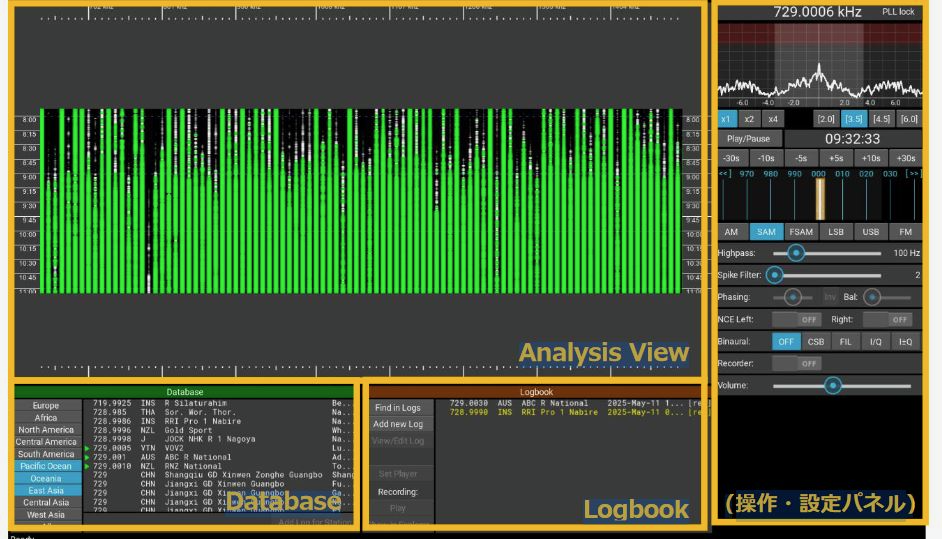
First, download and install WavViewDX from the WavViewDX webpage (https://rweiss.de/dxer/tools.html). The latest version is version was 1544 as of June 8, 2025, when this was written, but version 1662 is available in October 2025. When you launch WavViewDX, the Main Window (Figure 1) will appear, showing Analysis View, the Operation/Settings Panel, Logbook and Database.

Figure 1

To play back recorded files, you must import them. Click Import to display the Import SDR Recording settings screen. Source files can be selected as single or multiple files, or by folder. Set the reception location, time, channel separation, etc., and begin importing. A progress percentage will appear, and green and white bar graphs will appear on the Analysis View screen. Hovering the cursor over a bar graph and clicking will display a red circle, and the audio recorded for that channel and time will play. Scrolling the mouse will allow you to zoom in and out of the Analysis View.

When you import, a WVD format file is created. Once you’ve imported the files, you can simply load the corresponding WVD file at another time, and the files will be available to play immediately.

In addition to Import and Load, the following settings are available at the top of the Main Window.

  • Analysis: Allows you to select the file/folder and frequency separation when importing.
  • Carrier Views: Displays offset frequencies to identify and estimate the received medium wave station.
  • Database: Links with the MWLIST webpage (https://www.mwlist.org/ul_login.php) to identify and estimate the received medium wave station.
  • Logbook: For documenting stations heard, along with creation of audio recordings during playback.
  • More: Allows you to set multiple options, such as manual tuning and contrast setting.
  • Setup: Allows you to set the sound device and select the file format for recording audio clips during playback.
  • About: Allows you to select the software version, Help, etc.

The Main Window also displays the frequency list linked to the aforementioned Database and the Logbook.  The database frequency list can be selected by region, such as Europe or East Asia. The Logbook allows you to record reception records and associate recorded audio files.

The right side of the Main Window contains the operation and settings panel. At the top are the Frequency Display and Spectrum View. Hovering the cursor over Spectrum View allows you to select PBT (Pass Band Tuning) and NOTCH.

Below these are:

  • Spectrum Zoom (x1, x2, x4), which expands the spectrum;
  • Bandpass Bandwidth Presets ([2.5] etc.), which change the reception bandwidth;
  • Player Time Controls (Play/Pause; -30s etc.), which control the playback time;
  • Carrier View, which displays the offset frequency; (+/- 30Hz, and can be shifted above and below the nominal .000 frequency)
  • Demodulator Modes, which change the reception mode.

(Keyboard shortcuts are available for the above functions.)

  • The AF Highpass Filter adjusts the audio frequency passband to improve intelligibility.
  • The Spike Filter reduces popping during reception.
  • Phasing combines two synchronized recording files to reduce same-frequency interference and noise.
  • NCE (Neighbor Channel Eliminator) reduces interference from adjacent channels.
  • Binaural allows you to select the sideband of the AF output during playback.
  • The AF Audio Recorder allows you to record by clicking during playback. Recording formats include WAV, FLAC, and MP3.

As you can see, there are so many features it’s impossible to introduce them all. Detailed adjustments to each function make it even easier to use; it may seem tedious at first, but give the features a try. The user interface is intuitive, so you’ll quickly get used to it. If you’re unsure how to use something, just press the F1 key and refer to the Help.

Actual Usage 

Let’s try it out. The import settings are set to MW 9+10kHz Channel Analysis Configuration. Configuration, and other settings are set to default. (editor’s note:  “SDR Calibration” allows the use of reference carrier frequencies in the data, for those SDRs without a frequency standard, so that each carrier frequency in the passband will be displayed accurately.)   Once the import is complete, a bar graph will appear. Figures 2 and 3 show the analysis view of the actual file import from early May 2025, during the Hachijojima DXpedition showing evening reception; time is UTC.

Figure 2

Figure 3

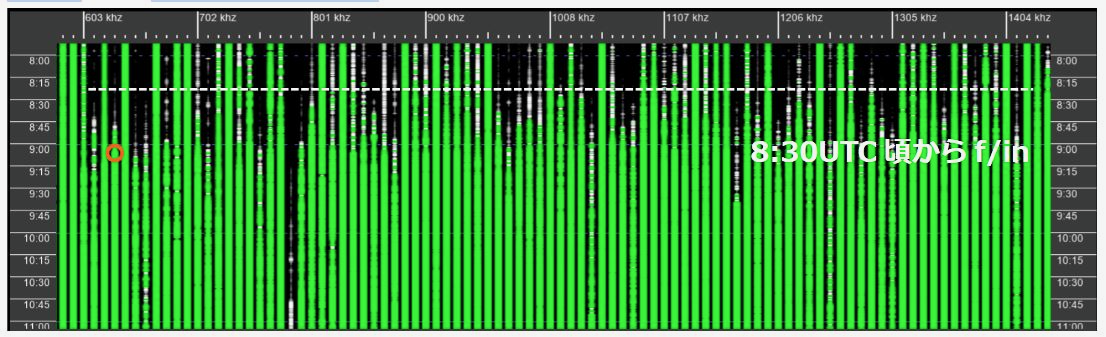
9kHz separation is used in Figure 2. You can hear the audio from 630kHz at the time indicated by a circle. Black areas of the bar graph indicate no signal, while white to green indicates good signal reception. If you miss an ID during reception, press the up arrow key to rewind the time by 5 seconds and listen again.   Click Recording to record the ID.

As you can see, the bar graph color changes from black to white and then white to green over time. This indicates that as the day turns from daytime to evening and then nighttime, channels that previously had no reception begin to receive broadcasts. Sunset on this day was 9:29 UTC (18:29 JST), and the received signal fade in was between 8:30 UTC (17:30 JST) and 9:15 UTC (18:15 JST).

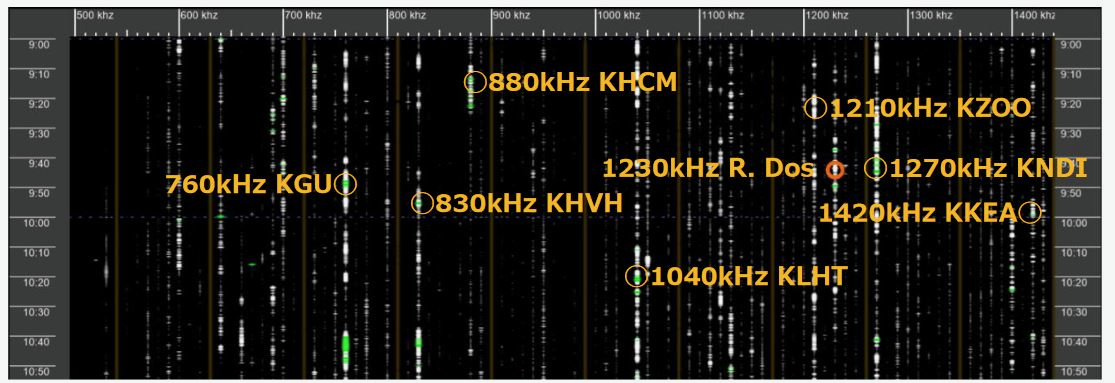
Next, click Analysis and switch to MW 10kHz channel analysis. The Analysis View after switching is shown in Figure 3. This shows the reception status with 10kHz separation. Most channels are black, with a few white spots. There is very little green. In this image, there are certainly no 10kHz channels with good audio, but by clicking on the white, we can see some with faint English talk and music. I checked the database and found that these channels appear to be Hawaiian stations (see orange circle marks in Figure 3) that have been active since around 8:30 UTC.

Also, Latin music was heard on 1230 kHz (Orange circle in Figure 3). This may be Radio Dos from Argentina. By visualizing reception status like this, I was able to determine where to listen and where not to listen. During the Hachijojima expedition in May, I was blessed with outstanding reception conditions from the evening through the early morning hours of the following day, and was able to track 187 overseas medium wave stations, including 165 in Australia, 5 in New Zealand, 2 in Papua New Guinea, Solomon Islands, Tonga, Marshall Islands, Kiribati, Palau, Fiji, Tuvalu, Indonesia, and the Philippines, achieving significant results. Playback and analysis took about a week, which was shorter than usual, thanks to WavViewDX.

Summary 

As mentioned above, WavViewDX has proven to be an efficient tool for analysis, allowing users to discover previously unnoticed stations. Since it can play files recorded with various SDRs, we hope that many DXers will use it. WavViewDX is compatible with multiple PC operating systems, including Windows, Linux, and macOS, and is freeware. According to Reinhard Weiß, additional features and enhancements are planned for the future, so we look forward to seeing its future developments. Finally, we would like to express our gratitude and respect to Reinhard Weiß for developing such useful and excellent software.

Reference Materials 

Table 1. Supported IQ Formats

ELAD FDM-SW2 Generic RAW recordings
GQRX recordings HDSDR
Jaguar Linrad RAW, single and dual-channel
recordings PERSEUS (*.wav)
PERSEUS P22 (*.P22) SDR#
SDR Console SDR Uno
SDRconnect SpectraVue
WiNRADiO DDC WiNRADiO RXW (only for G33)
Winrad

Trying WavViewDX on FM 

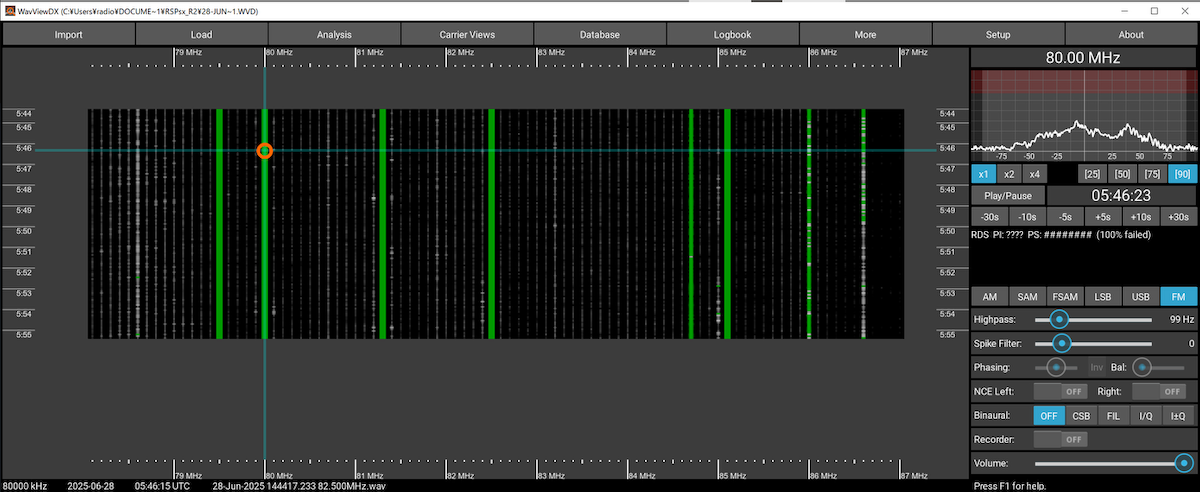
WavViewDX is primarily geared toward medium wave DX, but it seems like it can be used for FM DX as well. The image in Figure 4 shows reception from 79-87MHz using an RSPdx-R2 and an indoor YouTwin antenna. It supports stereo and has good audio quality. With an outdoor antenna, it could also be used for FM DX, such as with sporadic E and other short-lived propagation enhancements.

Figure 4


These English translations were prepared for IRCA’s DX Monitor, and are used with the kind permission of  IRCA as well as of the authors and the editor of the Totsuka DXers Circle publication, PROPAGATION.