Tag Archives: Satoshi Miyauchi

Did the Miyako earthquake affect Medium Wave reception at a Japanese DXpedition?

by Satoshi Miyauchi, JP1SCQ, with Nick Hall-Patch, VE7DXR

Introduction

In early November 2025, several members of our Totsuka DXers Circle in Japan (TDXC  https://www.tdxc.net/abouttdxc/ ) traveled from the Tokyo area to Tanohata village in Iwate prefecture on northern Honshu island in order to take part in a medium wave (MW) DXpedition that took place on the 8th and 9th of the month.  The site was about 500m (1/3 mile) from the Pacific Ocean, overlooking Kitayamazaki cliffs, a very scenic area (Figure 1), but also one from which a great deal of long-haul DX had been heard in the past, including trans-polar WBZ-1030kHz, as well as the farthest possible Antipodes DX such as R. Nacional in Argentina on 870kHz and Radio Monte Carlo in Uruguay on 930kHz.

Figure 1

Our listening post was a meeting room in the Tanohata Nature Training Center, where we set up our receivers, such as Perseus and Airspy HF+discovery, plus our recording gear and accessories (Figure 2).
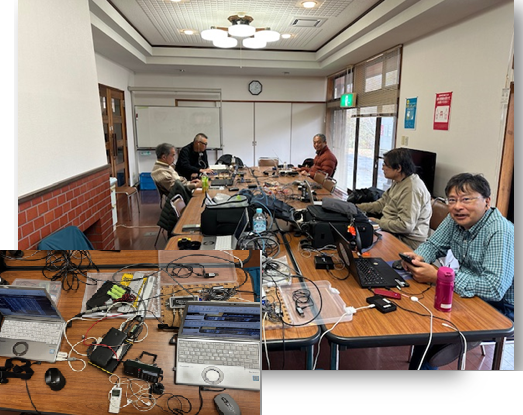
Figure 2

My recording software was SDR Console, but playback and analysis also used WavViewDX.  We set up a TDDF (Twisted Double Delta Flag) antenna with a northeast directional pattern in order to receive medium-wave broadcasts from North America. (Figure 3)
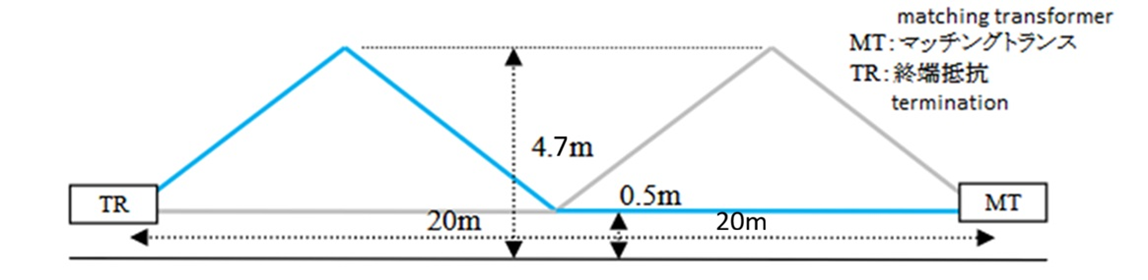
Figure 3 – TDDF antenna; note that low-noise pre-amplifier with bias-T is a must.
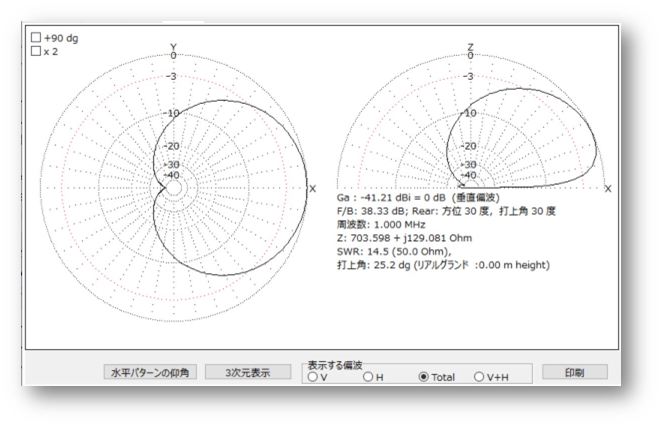
Directional patterns from Kazu GOSUI

On the second evening, November 9th, while enjoying the reception, an emergency earthquake alert was issued, and shaking struck. Inside our building, nearly 200 meters above sea level on the solid bedrock of Kitayamazaki, the shaking felt less intense than the reported magnitude of 6.9, even with an epicenter only 140km away. (Figure 4)
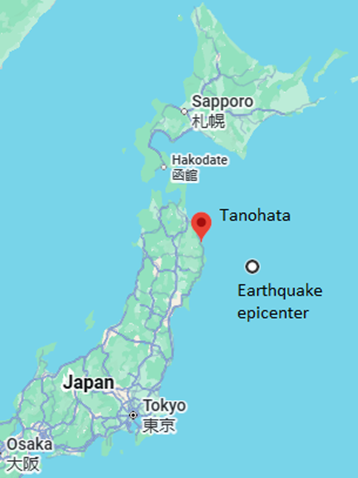
Figure 4

However, since earthquakes had been occurring even before that day and numerous aftershocks were felt afterward, it left us with a vague sense of unease. Later, a tsunami advisory was announced on the radio, plus the Tohoku Shinkansen train back to Tokyo had also stopped, and I myself couldn’t help worrying about whether it might affect my return home the following day. At that moment, I had a conversation with the members there, thinking, “If there’s something related to the earthquake recorded, that would be amazing.” However, during the real-time reception, we were targeting signals from North America in 10kHz steps, and there was no effect noticed upon those receptions.

Unusual Signal Dropouts Observed

I played back the SDR files using WavViewDX (https://rweiss.de/dxer/tools.html), a software with many capabilities, including a choice of displaying all signals across the MW band at 9 or 10kHz channel spacing, but, because I was looking for North American DX, I only realized a week after returning home that the reception conditions for the 9kHz spaced domestic Japanese stations had significantly changed around 0715 to 0745UT (16:15 to 16:45 Japan time) on 9 November, based on our recordings. The dropouts on various channels over 0715 to 0745UT are quite obvious in Figure 5; I had never seen such sudden attenuation before.  For those not familiar with WavViewDX, the green vertical lines on the display represent stronger signals being received on broadcast channels, while gray or black areas represent weak or no signal. (For a more detailed description of WavViewDX and its capabilities, see https://swling.com/blog/2025/10/an-introduction-to-wavviewdx-sdr-playback-software-a-totsuka-dxers-circle-article-by-kazu-gosui
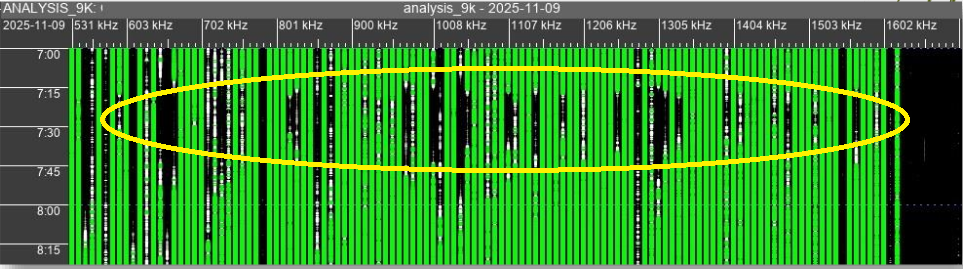
Figure 5 – WavViewDX display of signal dropouts. X-axis is frequency of received signal, Y-axis is time UTC

A first look at the data led to a couple of other observations:

  1. Signals originating north of the receiving site, primarily from the island of Hokkaido, were largely unaffected by the attenuation. (It is true that our antenna’s directionality was northeast, but it also received the stronger domestic stations from southwest of the antenna.)
  2. Regarding signals from North America, even during the same time period, the intense attenuation observed in domestic stations was generally not seen. It is unclear, however, whether some dips in North American signals around that time were due to normal fading or to the same cause that brought about the attenuation in domestic stations.

What Could Have Caused These Dropouts?

Local sunset?

These sudden drops in signal strength corresponded quite closely with local sunset at 0722UT, normally a time of disturbed propagation (see Figure 6), so the most straightforward possibility is simply the well-known change in ionospheric propagation conditions that occurs at sunset.   Was that all that there was to it?  However, we had been listening and recording the previous day as well, and analyzing those recordings with WavViewDX yielded no sign of dropouts in domestic signal strength at sunset on that day.   Examining recordings that had been made at the same site, using similar equipment, on 24 October 2024, also showed no dropouts taking place at local sunset.
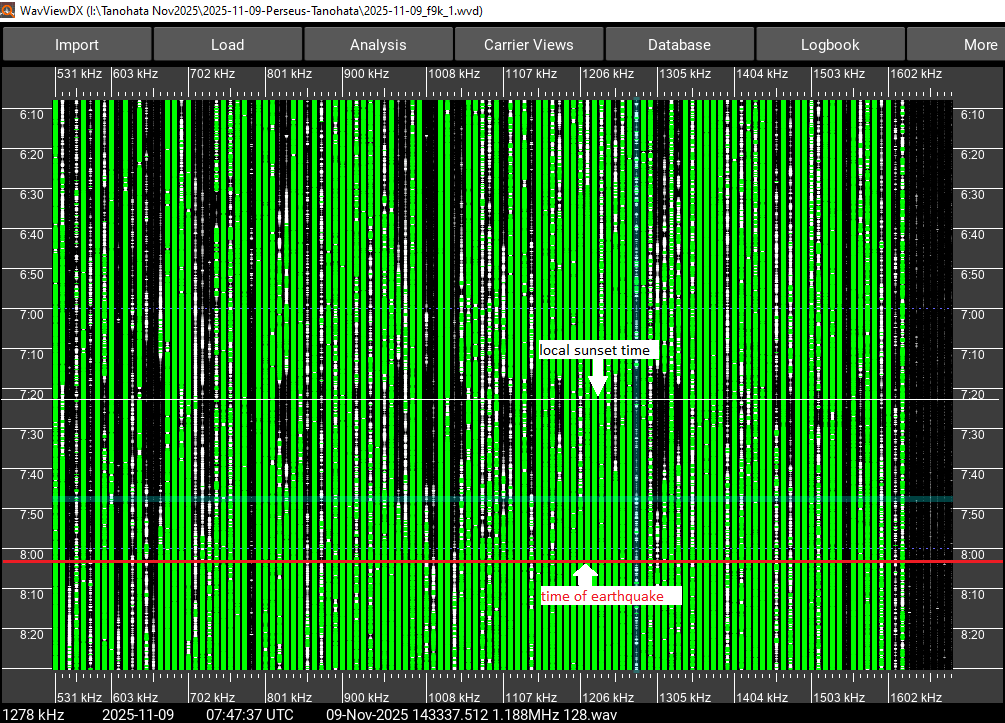
Figure 6

In fact, over many years in Japan, not only at this location but across various areas, records have been accumulated during the same time window, because good trans-Pacific DX occurs around local sunset.  Nowhere in these records has a situation such as observed this time—a significant attenuation of domestic stations at local sunset—been found. Therefore, it seemed unlikely that sunset was the cause of the dropouts, but what else could it have been? Continue reading
Ultra Convenient, The Benefits of WavViewDX: Visualizing Reception Conditions (A Totsuka DXers Circle Article by Satoshi Miyauchi)

Many thanks to SWLing Post contributor Nick Hall-Patch, who has kindly provided a translation of this article from the Japanese-language publication PROPAGATION by the Totsuka DXers Circle (TDXC). In this piece, Satoshi Miyauchi explores how WavViewDX can revolutionize SDR analysis by making propagation and reception conditions instantly visible–and shares some remarkable reception examples.


“Ultra” Convenient, The Benefits of WavViewDX: Visualizing Reception Conditions 

by Satoshi Miyauchi

After recording bands using SDR’s such as Perseus or HF Discovery, I was informed by Kazu Gosui via email of a new program that’s “ultra” convenient for analyzing them. When monitoring in real time with Perseus, I have a general memory and notes of what was received at what time.  However, when recording reception data without real-time monitoring, such as during nighttime hours, verifying and analyzing the data across all frequencies takes time. Knowledge and intuition about where to listen are also important elements. While all of this is a skill, I believe that previous tools have been unable to provide a comprehensive view of the day’s conditions. Since I started using WavViewDX, I’ve been using it every morning, efficiently analyzing the SDR recordings I’ve collected.

By the way, recently I’ve been using a timer (the “Scheduler” of SDR Console) to check if the TWR-Africa signal transmitted from Benin, West Africa, is reaching me in the middle of the night. My analysis showed a significant reduction in the time required for confirmation that TWR-Africa was being received before and after WavViewDX was installed, and I’d like to share this with you.

Just to be clear, this article is not intended to be a tedious rehash of the user manual. Rather, it is intended to provide useful, pinpointed tips for use.

  1. I’ll introduce a method I think might be best based on my current setup.
  2. I’ll share some reception reports from my recent morning routine.
  3. I’ll touch on the mysteries of radio wave propagation, a realization I believe is unique to WavViewDX.

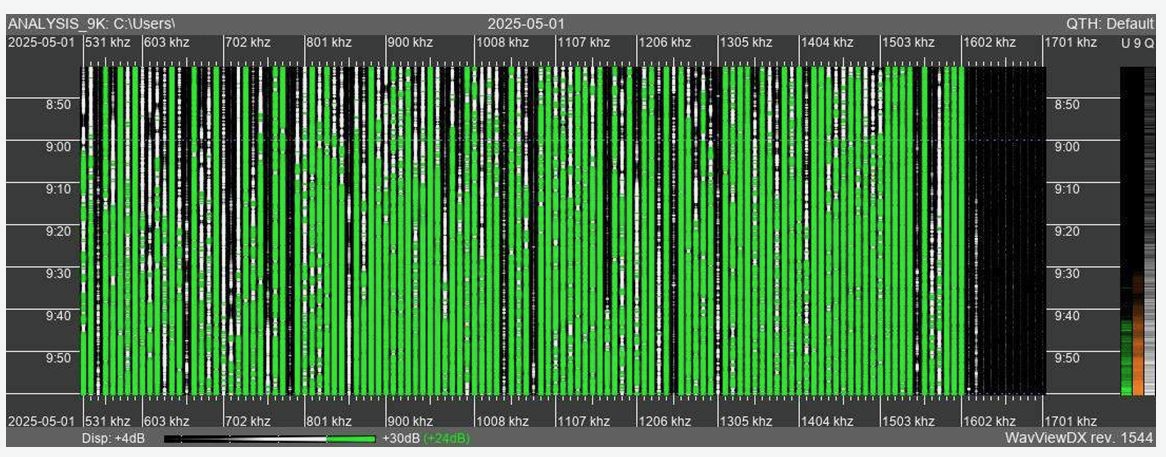
But first, a word about WavViewDX: seeing is believing. As shown in the sample image in Figure 5, it visually displays the status of stations received at each frequency, using green bars or white lines, in chronological order, from the lowest frequency band (left) to the highest (right). You can even customize it to analyze North and South America at 10 kHz intervals for TP reception.

The author is Reinhard Weiß from Germany (please see accompanying related articles).  It is an incredibly easy-to-use and intuitive software. Once you start using it, you’ll definitely want to keep it.

Figure 5

First, let’s assume you’ll be importing and analyzing data into WavViewDX.

1.) Timer Reception Tips, Using SDR Console

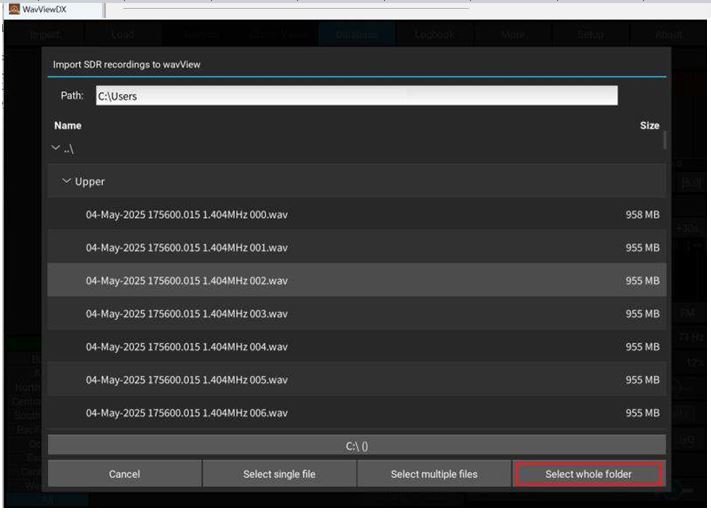
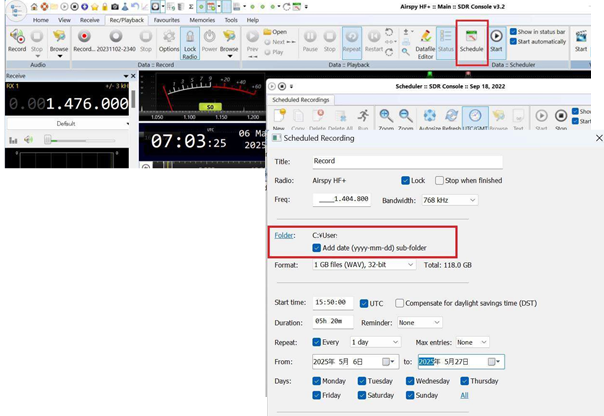
This is a backward-thinking approach based on the fact that WavViewDX can import files in “folders.” The golden rule is simply to store all files from a single session in a single folder. I’ve been using SDR Console as my primary SDR program for a while now, so when I register a scheduler (for timer scheduling), I click “Add date (yyyy-mm-dd) subfolder” under “Folder”, in Figure 6. This allows me to import the entire folder of recording files from that day into WavViewDX, saving me a lot of time. WavViewDX has a “Select Whole Folder” button, which allows me to import files into WavViewDX with a single click (Figure 7). How amazing! Incidentally, I set up bandwidth recording files to be stored in separate 1GB files. The moment I wake up, the files are instantly imported into WavViewDX, allowing me to quickly check the conditions from midnight to dawn before work.

Figure 6

Figure 7

2) TWR-Africa Reception Recording

Even on shortwave, it’s rare to see signals from Africa, let alone on mediumwave. Until a few years ago, I thought this was impossible. However, I discovered that I could record pre-dawn signals from Africa on my home K9AY loop, including the VOA of the Sao Tome and Principe relay on 1530kHz, as well as the famous TWR Africa (Benin) on 1476kHz. Of course, it’s not easy to receive signals every day, so I was not motivated to record them regularly However, after installing WavViewDX, I was able to easily grasp the pre-dawn conditions, and I set up a scheduler to record as many times as possible every day.

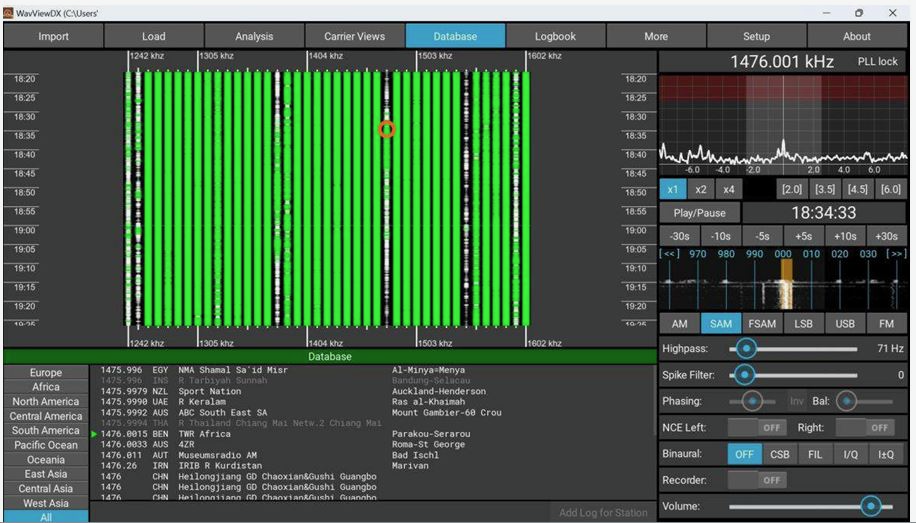
Then, one morning, right around 3:30 AM, on the morning of the March vernal equinox, I noticed a very clear bar on the 1476kHz using WavViewDX (Figure 8). By working in conjunction with WavViewDX, it automatically checks offsets in exact carrier frequency being received against the MWList database, and the > mark quickly lights up in WavViewDX, indicating that it’s TWR Africa! I was surprised when I heard the audio. I was impressed by the exceptionally clear reception. There was a slight beat, and it seemed like at least one other carrier was also in the mix. How such clear audio managed to reach and be heard across nearly 13,300 km as the crow flies is a mystery, but it’s still a moving experience.

Figure 8

I asked @lft_kashima LFT Kashima Fishing Radio, who regularly posts information on X, and he said that the signal wasn’t as good on that day at his location. Since we’re both in the Kanto region and a little farther apart, perhaps that’s the problem, or perhaps it’s just the antenna. He uses a north-south loop antenna, while I use a vertical AOR SA-7000.

While I don’t know the full reason or answer, one possible guess: – Wasn’t the arrival direction north-south? – Did it arrive through a duct somewhere? However, there’s no way to know why the duct ended up at this receiving point. It’s a wonder that I was able to receive such a DX station at this point in the solar cycle, when the number of sunspots is almost at its maximum and the A/K Index was far from calm. This makes daily reception all the more meaningful. It’s a moment that makes me admire nature, the work of radio wave propagation.  I was able to receive this station again in April, and the links to those two results from 1476kHz – TWR Africa are below:

3) The Mysteries of Radio Wave Propagation Discovered Only with WavViewDX

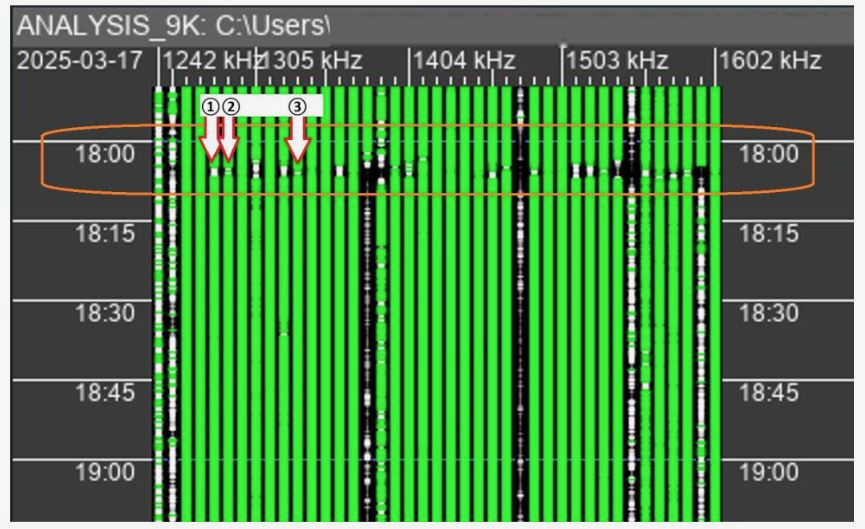
WaveViewDX already clearly shows the reception status on the vertical time axis, but just before the vernal equinox, a phenomenon in which the propagation conditions deteriorated simultaneously across multiple frequencies occurred, albeit for a short period of time. (Audio Sample https://youtu.be/XhXSQFiGQeo) What is this? Figure 9 shows the actual situation at my location on March 17, 2025, after 18:00 UTC.

Figure 9

  1. 1278kHz JOFR Fukuoka RKB Mainichi Broadcasting System 50kw (about 900km distance, 245°)
  2. 1287kHz JOHR Sapporo HBC Hokkaido Broadcasting System 50kw (about 1000km distance, 340°)
  3. 1332kHz JOSF Nagoya Tokai Broadcasting System 50kw (about 270km distance, 270°)

(*Note: The leftmost bar (1242kHz in the Kanto region) is attenuated with a notch filter)

One of the benefits of WavViewDX is that it visually showed the simultaneous drop in signal strength from domestic and international stations, which had been arriving almost smoothly until 18:00 UTC.

I asked Perplexity AI and searched the literature. These possibilities were listed:

“Regarding the phenomenon of simultaneous attenuation of radio signals in all directions for several minutes during nighttime propagation in the medium frequency band (MF band),” it is believed to be primarily caused by the combined effects of the following factors: –

  • Ionospheric Variation Mechanism Sudden E-Layer (Es-Layer) Formation A localized increase in electron density in the upper E-layer of the ionosphere (at an altitude of 100-120 km) at night. This thin ionosphere strongly reflects signals, blocking the normal F-layer reflection path. One measurement data showed signal attenuation of up to 20 dB when the Es layer occurred.
  • F-layer altitude fluctuations: When the F layer (altitude 250-400 km), the main nighttime propagation path, rapidly rises due to thermal expansion, the reflection angle changes, creating a “propagation hole” that causes signals to deviate from the receiving point.
  • Earth’s magnetic field fluctuations disrupt the electron distribution in the ionosphere, causing a sudden increase in absorption.
  • Instantaneous changes in solar activity: The emission of X-rays and charged particles associated with solar flares suddenly changes the electron density in the ionosphere, destabilizing the reflection coefficient and resulting in short-term propagation loss.

Although it was able to provide various possible explanations, I was unable to perform any further verification of these answers myself.


These English translations were prepared for IRCA’s DX Monitor, and are used with the kind permission of  IRCA as well as of the authors and the editor of the Totsuka DXers Circle publication, PROPAGATION.