Author Archives: Thomas

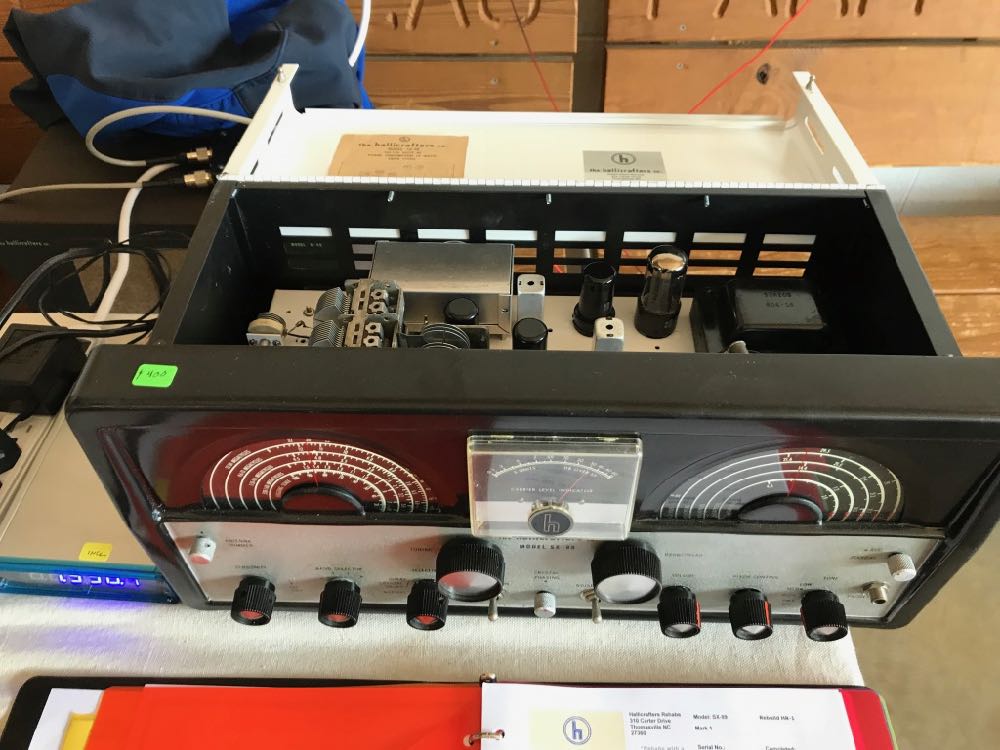
A photo tour of the 2019 WCARS hamfest

Yesterday, I attended the WCARS hamfest in Waynesville, North Carolina, with my friend Sébastien (VA2SLW) who is currently on vacation in the area.

The WCARS hamfest is a smaller regional hamfest, but it attracts a lot of folks from the mountain regions of north Georgia, Tennessee, South Carolina, North Carolina, and beyond.

The WCARS hamfest flea market always has quite a variety of radios, including a number of great vintage models. I’ve been very lucky in the past finding excellent deals, too. This year, I (reluctantly) passed up a few deals knowing I’m also attending the Huntsville Hamfest in August and the Shelby Hamfest in September.

Below, you’ll find a selection of photos from the hamfest. Note that you can click on the image to enlarge it and I attempted to include price tags when possible:


Do you enjoy the SWLing Post?

Please consider supporting us via Patreon or our Coffee Fund!

Your support makes articles like this one possible. Thank you!

SDR Academy presentation videos

Many thanks to SWLing Post contributor, Alexander (DL4NO), who writes:

Parallel to the Hamradio fair in Friedrichshafen, Germany, there are talks and whole conferences. Over the last years, the “Software-Definded Radio Academy” (SDRA) was one of them.

You find the presentations on Youtube: https://www.youtube.com/playlist?list=PL6D0CPBQoIVpMflpSZFqbkmr2Xt_10D_Z

At least most of them are in English.

Thank you for the tip, Alexander! These videos are amazing! Wow–now I just need to find the time to watch them all.

I’ve embedded the videos and links below, for your convenience:

Markus Heller, DL8RDS: SDR-Academy @ HAM-Radio 2019 – A Summary


Dr. Carles Fernandez: An Open Source Global Navigation Satellite Systems Software-Defined Receiver

Mario Lorenz, DL5MLO: The AMSAT-DL/QARS Ground Stations for Qatar-Oscar 100

Mack McCormick, W4AX: FlexRadio: SDR Technology that Will Change How you Operate HF

Christoph Mayer, DL1CH: KiwiSDR as a new GNURadio Source

Manolis Surligas, SV9SFC: SDR Makerspace, Exploid SDR technology for space communications

Michael Hartje, DK5HH: Digital signal processing for the detection of noise disturbances

Prof Dr Joe Taylor, K1JT: Welcome Address and Questions & Answers

DL1FY, DC9OE, DG8MG, DL8GM: Charly25 SDR Transceiver

Alex Csete, OZ9AEC: SDR-Makerspace: Evaluation of SDR boards and toolchains

TX Factor Episode 23

(Source: TX Factor)

In episode 23 of TX factor we explore the process of music audio mastering at Mike Marsh G1IAR’s studio in south Devon. Mike shows us how the latest TX Factor theme tune was mixed and mastered, and demonstrates the process of cutting the audio onto vinyl disc – such nostalgia.

Nick Bennett 2E0FGQ visits the National Radio Centre at Bletchley Park where Noel Matthews G8GTZ and Graham Shirville G3VZV demonstrate how set up and operate over the new geostationary satellite, Oscar 100. Plus, Bob McCreadie G0FGX visits the folks at Icom UK with a full review of Icom’s long-awaited VHF / UHF all-mode transceiver the IC-9700.

Click here to view Episode 23 on TX Factor’s website, or click here to watch on YouTube.

Thanks team for yet another excellent and informative episode, TX Factor!

Review of the C.Crane CC Buds Solo In-Ear Single Earbud (and a chance to win one!)

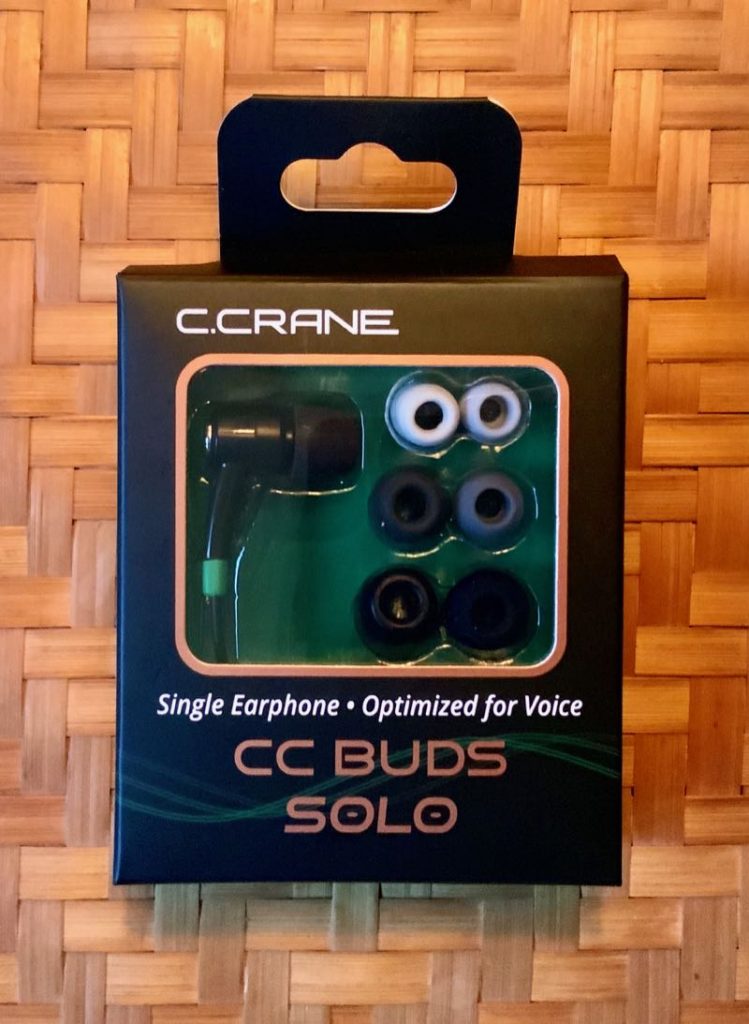
A few weeks ago, C. Crane sent me one of their newest radio accessories: the CC Buds Solo Single Earbud.

Here’s the description from the C.Crane product page:

Single Earbud Optimized For Voice

The CC Buds™ Solo single earpiece provides a unique advantage over traditional earbuds because it allows you to interact better with others while listening to radio, podcasts or audiobooks (your boss will love you). The integrated stereo to mono plug works with smartphones, radios, tablets, and most other audio devices.

The Solo can give you a safety advantage when running, biking, or walking because you are more likely to hear if danger approaches. The cable is Kevlar™ reinforced for maximum durability. It is perfect for scanner radio listening. Can work well for law enforcement when greater awareness is needed.

Audio is tuned for superior voice clarity. Included are three silicone and three compressible foam covers––sized small, medium, and large. The small covers usually fits a small ear comfortably. Standard 3.5 mm headphone jack. Cord Length 48″.

At first blush, the idea of a single earpiece smacks of vintage solid-state radios. I’ve a number of classic portables that were designed around a hard-plastic single earpiece–anyone else remember those?
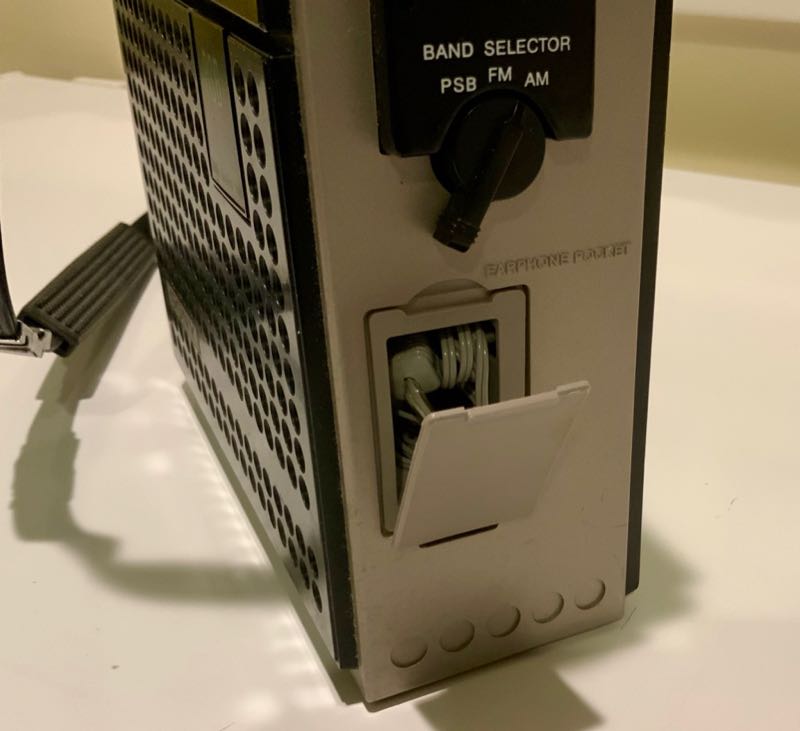
In fact, my Sony ICF-5500W (above) even has a little compartment to house its custom earpiece.
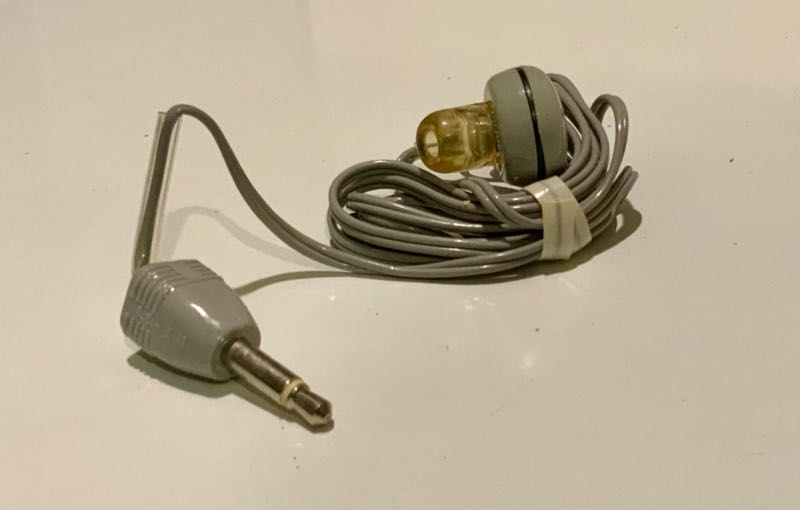
The Sony ICF-550W’s unforgiving 1970s era earpiece.

In my youth, I carried a hard plastic single earpiece with me everywhere, especially at school, because it made listening to the radio and still having some situational awareness possible. [Unfortunately, I was known to listen to the radio during classes…what a renegade I was back then!]

If you, too, used those hard plastic earpieces, I doubt you’d have ever described them as “comfortable.” I never found them even remotely so. Those earpieces were functional, but the audio they produced was tinny and it was always difficult to keep them in my ear.

Think of the CC Buds Solo as the earpiece we all wish we could have had back then!

The Solo includes numerous earpiece options, a carry bag and owner’s manual.

Here are some of the CC Buds Solo pros:

  • The audio quality is superb for spoken word
  • The earpiece is very comfortable (see notes below)
  • The audio plug allows for mono listening on stereo devices (obviously a must in 2019)
  • Features a super-strong Kevlar-reinforced cord
  • Includes a clothing clip that acts as strain relief
  • Ships with a small, soft carry bag

So does the Solo deliver what it promises? Yes, it does.

What I really love is the number of soft silicon and foam earpieces that ship with the Solo: a total of seven options, when including the default earpiece.

If you’ve ever used in-ear earbuds, you’ll understand the importance of swapping out the soft earpieces to a size that best suits your ears––that is, to a size that makes for a comfortable seal.

The Solo might also be useful if your hearing is a bit better in one ear than the other.

Unlike single earpieces of old, it’s actually a pleasure to use the CC Buds Solo earpiece.

Before using the Solo, I would often wear only the right earpiece of my stereo earbuds when I needed to be able to hear the environment around me. This obviously isn’t ideal because the left earpiece would dangle, catch on my shirt or otherwise get in the way, and often lead to jerking out the right earpiece. Not to mention, it led to an awkward muffling (or altogether missing) of some of the sound in that other dangling earbud when stereo sound is split or processed differently for each ear. Clearly, not the best way to listen.
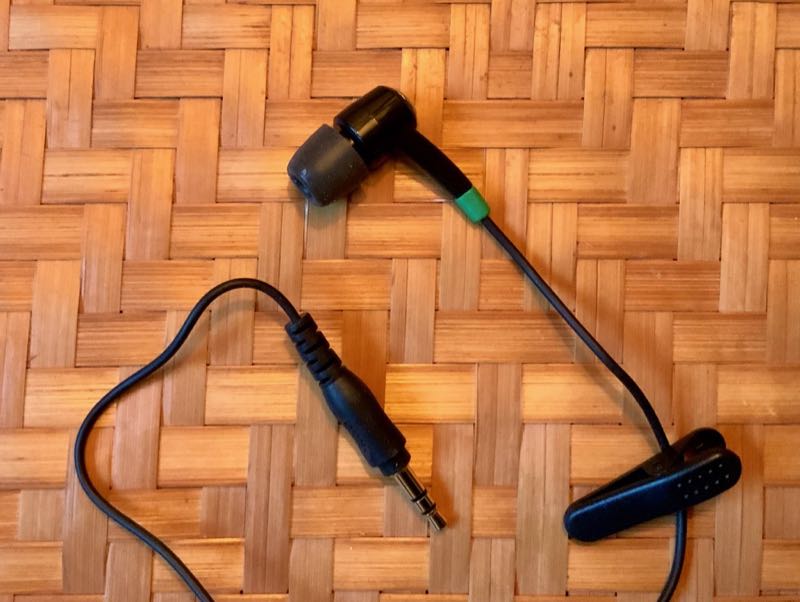
Note the adjustable clothing clip.

Now, when I’m driving, working, or walking, I can use the Solo clipped it to my shirt; it’s a more simple and annoyance-proof solution that allows for greater mobility and permits me to hear all of the intended sound.

I’ve only used the Solo for spoken word; primarily AM/SW broadcast band listening and for listening to podcasts.

These days, while I’ve been at work on a home renovation, podcasts have become an essential part of my day by helping me pass the time while painting, sanding, cleaning, mowing, doing yard work, or carrying out other tedious tasks. A good podcast definitely keeps it fun. The Solo makes podcast listening easy.

And of course, the Solo is also a great solution for listening to audio books, too.

I’ll admit, when I first saw the product announcement for the CC Buds Solo, I was curious if there’d still be a market for a mono earpiece. I suppose I proved it, myself, as I have found it quite useful when I don’t need the total isolation or stereo sound from two in-ear earbuds.

Well played, C.Crane!

Click here to check out the CC Buds Solo Single Earbud at C.Crane.

Win a CC Buds Solo!

C.Crane kindly sent me two samples of the CC Buds Solo at no cost to me. I’ve used one for evaluation purposes and C.Crane is kindly allowing me to give the other away to a lucky SWLing Post reader.

Here’s how you can enter our Solo giveaway!

As I mentioned, I consume a lot of podcasts these days. Here are just a few you might want to check out:

What are your favorite podcasts or radio shows?

Please leave a comment with some of your favorite podcasts or radio shows for a chance to win! Next Tuesday (July 30, 2019) I’ll pick a winner at random from the comments section and ship them a brand new CC Buds Solo single earpiece courtesy of C.Crane!

Click here to leave your comment!

KCRW’s 24-Hour Radio Race: August 10 to 11, 2019

Many thanks to Grace Atlee with KCRW who shares the following announcement:

KCRW’s 7th Annual 24-hour Radio Race begins at 10 a.m. PST August 10 and lasts through 10 a.m. PST August 11. The Radio Race is great way for storytellers of all experience levels to break out of their daily routines and make a four-minute audio piece overnight. Winners get a cash prize, plus other perks like a free year-long membership to AIR and PRX. You’ll have just 24 hours to write, record and edit a four-minute nonfiction radio story. You can join as an individual or as a team of your creation. KCRW will air the top three winning pieces, and this time around, one team’s piece will be chosen to air on our newest podcast Nocturne. And remember: the Radio Race is more than just an overnight competition. It’s an opportunity to produce the most original piece of radio anyone will hear in 2019. Think big, people!

Registration here: kcrw.com/radiorace

Atlas Obscura: Time to update the Spelling Alphabet?

Image by Annie Spratt

Photo by Annie Spratt

Many thanks to SWLing Post contributors, Paul Evans and Eric McFadden, who share this article from Atlas Obscura where author Dan Nosowitz asks if it’s time to update the spelling (a.k.a. phonetic) alphabet:

WHEN SOMEONE ON THE PHONE—THE doctor’s office, the bank, the credit card company—asks for my name, I always offer to spell it out—it’s a pretty uncommon surname. So far as I know, there are somewhere between 10 and 20 Nosowitzes in the world, and they’re all closely related to me. Because it’s uncommon, and because it would be a problem if my bank writes my name down as “Moskowitz,” I err on the side of caution. “N as in Nancy, O, S as in Samuel, O, W, I, T as in Thomas, Z as in Zebra,” I chant.

This uses what is what’s called a “spelling alphabet,” or, confusingly, a “phonetic alphabet.” (The latter is confusing because it has little to do with phonemes, or a unit of sound in a language. Plus there’s the International Phonetic Alphabet, which is something else entirely.) The history of spelling alphabets is fascinating and winding, but it’s notable that there hasn’t been an official update to the most commonly used English version in about half a century. We might be in need of one. As mobile phones have replaced landlines, call quality has, strangely, gone down. The general connectivity of the world—including the ease of international video calls and the use of foreign call centers—means that spelling out a name or word is an increasingly common practice. A modern, updated, globally friendly English spelling alphabet would be pretty useful right now, but getting people to use one might be harder than you’d think.

[…]For about 80 years, governments and corporations futzed with these spelling alphabets, and learned that some stuff didn’t work—it turns out, for example, that “Lima” is also the Malay word for the number five. A tremendous amount of research, time, and money was invested into figuring out the optimal spelling alphabet—at least for the three languages that the International Civil Aviation Organization (ICAO, the United Nations agency that handles air transportation) felt significant enough to have one (English, French, and Spanish). The ICAO scrambled, using researchers across the globe on the problem, and by 1959 had finalized what is today probably the best-known spelling alphabet: Alfa, Bravo, Charlie, Delta, Echo, and so on. (As a side note: “Alfa” is not a typo. The whole “ph equals f” thing is confusing, and reasonably so, for non-English speakers. The same goes for the alphabet’s J—Juliett with a doubled final letter so the French won’t say “Juliay.”)

That is the now the standard alphabet for organizations including NATO (which often lends its name to the alphabet), the Federal Aviation Administration of the United States, the International Amateur Radio Union, and pretty much any international group that wants or needs a standard. It’s certainly the most commonly used spelling alphabet in the world, but it is, as most of these alphabets are, exceedingly Anglocentric.[…]

Click here to continue reading the full article at Atlas Obscura.

Thanks for sharing this, Eric and Paul!

Funny story: Last week, I visited my parents and started cooking a nice dinner. Ten minutes into baking a roasted vegetable dish, the oven’s temperature started rising unexpectedly because the oven’s control board  (turns out) could no longer receive the temperature probe data. Its fail safe was to shut down the oven completely.

After a little online research, I found the parts that had most likely failed, so I pulled the oven away from the wall, disassembled the back panel, evaluated the parts, gathered the model number, and called a local appliance parts store.

When the associate answered the phone I described the problem and the parts I might need. He agreed with my diagnosis, so asked for the oven’s 16 character model number :

Me: LWZTF700…

Him: LWCDF700…???

Me: Sorry, let me try again. Lima Whiskey Zulu Tango Foxtrot…

Him: Excellent! I copy that. Say, were you in the military?

Me: Ha ha… No, I’m a ham radio operator.

Him: I am too! My call sign is….

He then proceeded to give me their best price on the parts.

I’m sure he hears variations of the spelling/phonetic alphabet multiple times a day and appreciates it when his customers use the one most widely accepted!

For your reference, here’s the standard spelling alphabet currently accepted by NATO, the FAA, and the IARU:

(Source: Wikimedia)

Vatican Radio’s Brazilian Portuguese language programming returns

Many thanks to SWLing Post contributor, David Iurescia (LW4DAF), who shares the following news via Zenit.org:

“The Brazilian program of Vatican Radio-Vatican News resumes its short-wave transmissions in the Amazon region,” announced the portal of Vatican News in Brazilian today, Monday, July 15, 2019, given the proximity of the holding of the Synod for Amazonia (October 6-27, on the theme: “New Ways for the Church and For An Integral Ecology.”

“For over 61 years, Brazil has been listening to the Pope’s voice through Vatican Radio. On August 1, after a period of absence, the Brazilian program of the papal station will return to Amazonia in short wave,” announced the same source.

And it adds: “Thus Vatican Radio-Vatican News shows its attention to an important region of Brazil, for which the radio is its main means of communication. The Pope’s voice will be listened to again on radio by more than 25 million people, who live in this lung of the planet. The decision to broadcast in short wave responds to the geographic reality of Amazonia.”

Vatican News recalls: “Created in March of 1958, twenty-seven years after the foundation of Vatican Radio, on February 12, 1931, the Brazilian program has followed seven pontificates, from Pius XII to Francis. At present, the Brazilians of Vatican Radio-Vatican News offer a wide gamut of daily programs in a multi-media style through different platforms: radio, Web and social networks.”

It also recalled: “On the occasion of the 50th anniversary, in March 2008, Benedict XVI expressed his gratitude to the said program for the inestimable service of proclaiming the Gospel and promoting communion between the Church and the people of Brazil.”

Click here to read the full article at Zenit.org.