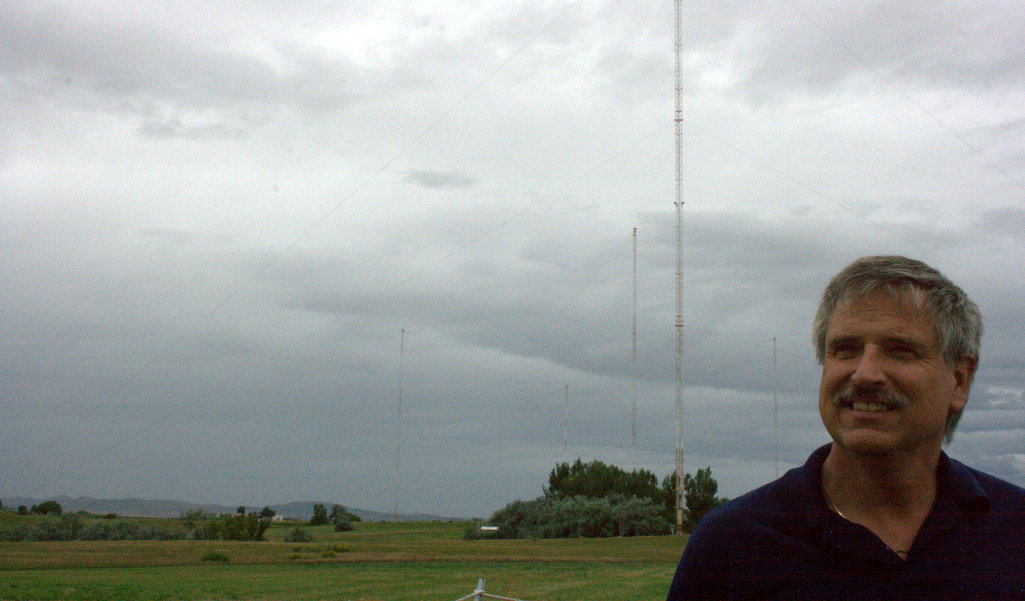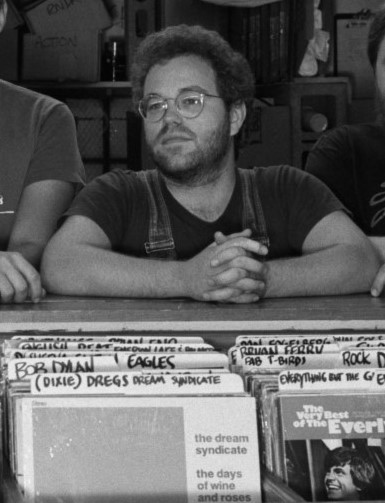
Michael Pool, aka, “The Professor,” circa 1985. The photo was taken at a record shop where, he wrote, ”I really began my journey in music.”
Regretfully, I’ve had to bid farewell to few radio friends in the past few months. But until very recently I never dreamed I’d be saying goodbye to my great friend and radio arts mentor Michael Pool, known to the radio world as “The Professor.”
Michael was an interesting individual, to say the least. His curiosity in humanity had no bounds: he could find the interesting in the so-called mundane. Moreover, he was brilliant, his mind a quirky work of art as well as complex and intricate repository for a broad spectrum of facts, particularly of the radio-related. This was, no doubt, the source of his professorial “title.”
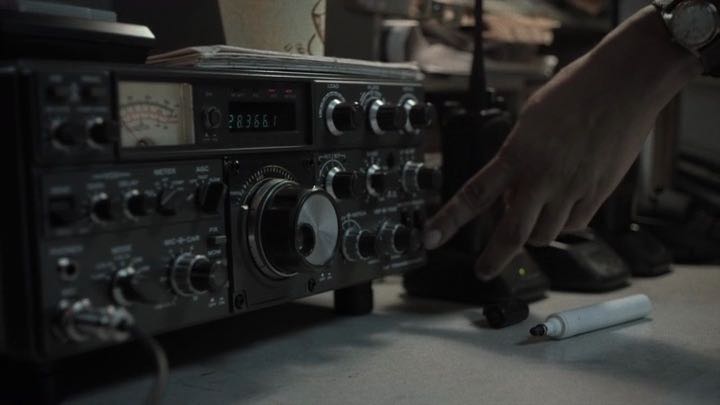
Moreover, Michael’s lifelong interest in radio, and indeed all the radio arts––especially AM broadcasting––led to his becoming an audio and radio archivist; over the years he assembled a vast collection of off-air recordings, band scans, and air checks, a curated collection of audio which he loved sharing with the world. Besides broadcasting, Michael was passionate about music; he could guide you into the depths of almost any genre, but he was especially fond of soul and R&B. I know my own interest in these genres was enhanced by his knowledge of them.
Much like his vintage radio receivers, Michael seemed to have no filter. If he thought it, he said it. And perhaps, partly as a result of his combination of astute observation and frank speech, Michael was also a published poet.
Michael, who was feeling great throughout most of December, admitted himself to the hospital in the latter part of the month when he began noticing that his breathing was labored. Doctors soon found that fluid was building up in his lungs.
When Michael called to tell me he was ill, he broke the news indirectly and thus gently. He had been in the hospital for a week or so already; in his typical lighthearted delivery, he told me how he’d learned to finagle an extra cup of coffee from the nurses, how he managed to save his sleeping pill until he actually wanted to sleep, and how no one there really understood the “spaceship” aspect of his bedside table set up, which included a computer, hard drives, radios, and speakers. He called it his “on-site HQ.” If anything happened to him, it was clear he intended to go out with his boots on.
On the phone, Michael had me laughing pretty hard for a good twenty minutes before I was able to ask, “So what did you have…pneumonia?” He replied, quite casually, “Turns out I have stage four pancreatic cancer.”
I sat in shocked silence, groping for words. Noting my silence, he took up my part of the exchange almost cheerfully. “You know,” he continued lightly, saying what I was unable to voice, “I’m not sure it could be a worse diagnosis.”
Michael was in and out of the hospital for the next few weeks, but somehow remained positive, setting up his HQ wherever he was, writing poetry and long humorous emails to friends. Even when he finally entered a hospice center, he remained positive, somehow at peace with this very unexpected turn of events.
I’ve struggled to pull together this post about Michael.
Like his other friends and his family, I’m still in a bit of shock. There’s no way I can summarize his life. But I can say that my life was richer and more interesting because Michael was in it.
I’m going to miss him.
Michael and I shared a love of archiving off-air radio recordings and he has entrusted me with his collection. I’ll make sure these recordings are curated, archived, and shared online.
Some readers may know Michael as a radio host on WFMU: his show was The Audio Kitchen, in which he featured “an hour of homemade recordings freshly liberated from thrift stores and junk shops, as well as some amateur audio spirited away from the closets and computers of their creators.”
If you want a flavor of what it was like to hang with The Professor, I encourage you to listen to some of the archived shows on WFMU. They’re definitely worth a listen:
https://wfmu.org/playlists/AK
Michael was also a regular contributor here on the SWLing Post, and for many years, hosted his own websites called, appropriately, “The Radio Kitchen” and “The Audio Kitchen.” I have some of his articles in an archive, as well, and plan to post them here over time.
I had planned to visit Michael when I fly to Philly next week. Still, on Saturday morning, I sat down to compose a long newsy email to him, musing on dreaming in other languages and various other audio experiences, among other things. I had just finished writing it and hit “send;” when my inbox refreshed, I found a message from a family friend that Michael had died the previous night.
Michael Pool skipped the light fandango and departed this world on Friday, February 15, 2019. All too soon…But be at peace, my friend.
A post script. In one of Michael’s recent emails, not long after he received his devastating diagnosis, he sent the following poem he’d written. Hopefully, he will not mind my sharing it with you here, because fortunately for me in this moment, it says what I cannot:
A Brief Winter Examination
The future is so hard to find. It’s not yours
And it’s not here. Of course you could go for a walk
And not come back, but the mindless highway has no predictions.
That seeker? That’s me with a measurement problem, almost looking ahead.
The other day as old folks made their way to their bus seats, I realized
they are
Already in the future. Although a decrepit body Is a poor outfit for a
time traveler, it fits.
For me, these days are going somewhere,
But I just have less to say about it. Yesterday I performed
A test. I opened my eyes and noted the time, Not long after
I took another look at the clock. The readout of minutes had increased.
Why I did I think it might be any other way? I had to do the math to be
sure
I wasn’t going back in time. But give me the opportunity and I just
might do just that.
Tonight I’m all Ellington with my orange cat.
I opened the door a few minutes ago, to see the rest of it.
About an inch of snow. I had no idea. But I’m out to enjoy this era
Of surprise. I don’t know or guess or ponder as I have, I let the facts
come to me.
Call me primitive. Or just call me if you get this message. Our
conversation isn’t over.
It never will be, but I’d like to do some more work on it. The
meandering is the best part.