Shortwave listening and everything radio including reviews, broadcasting, ham radio, field operation, DXing, maker kits, travel, emergency gear, events, and more
Many thanks to SWLing Post contributor and noted political cartoonist, Carlos Latuff, who shares his radio log art, this time following coverage of the Russian invasion of Ukraine through Vatican Radio.
Carlos notes:
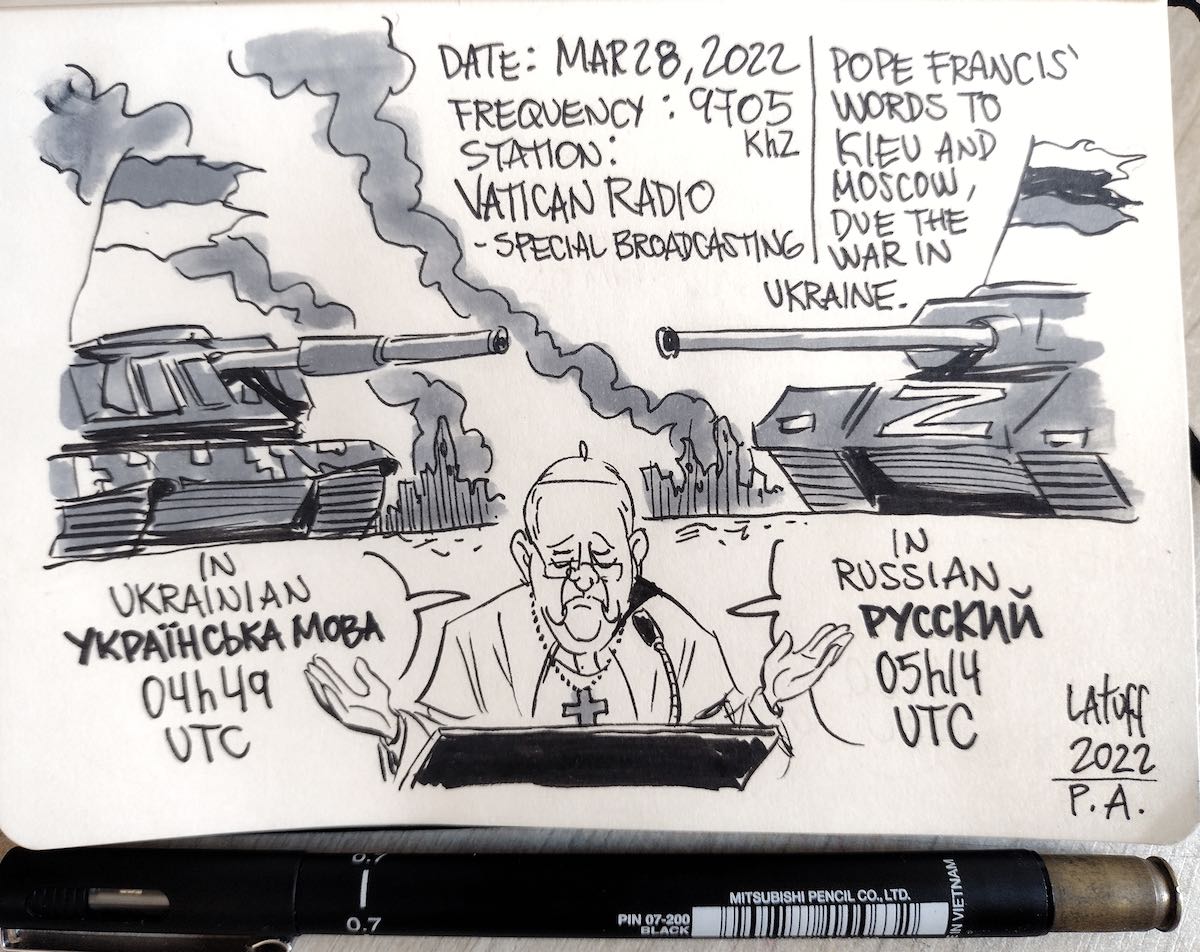
Vatican Radio, 9705 kHz, special broadcasting, message from Pope Francis in Ukrainian and Russian to Kiev and Moscow due the war in Ukraine.
Broadcasting from Santa Maria di Galeria, Italy, listened in Porto Alegre, Brazil. March 28, 2022, 04h49 and 05h14 (UTC).
Many thanks to SWLing Post contributor and noted political cartoonist, Carlos Latuff, who shares his radio log art, this time following coverage of the Russian invasion of Ukraine through Radio Dos and Radio Romania International.
Radio Dos (Rosario, Argentina – Mediumwave)
Carols notes:
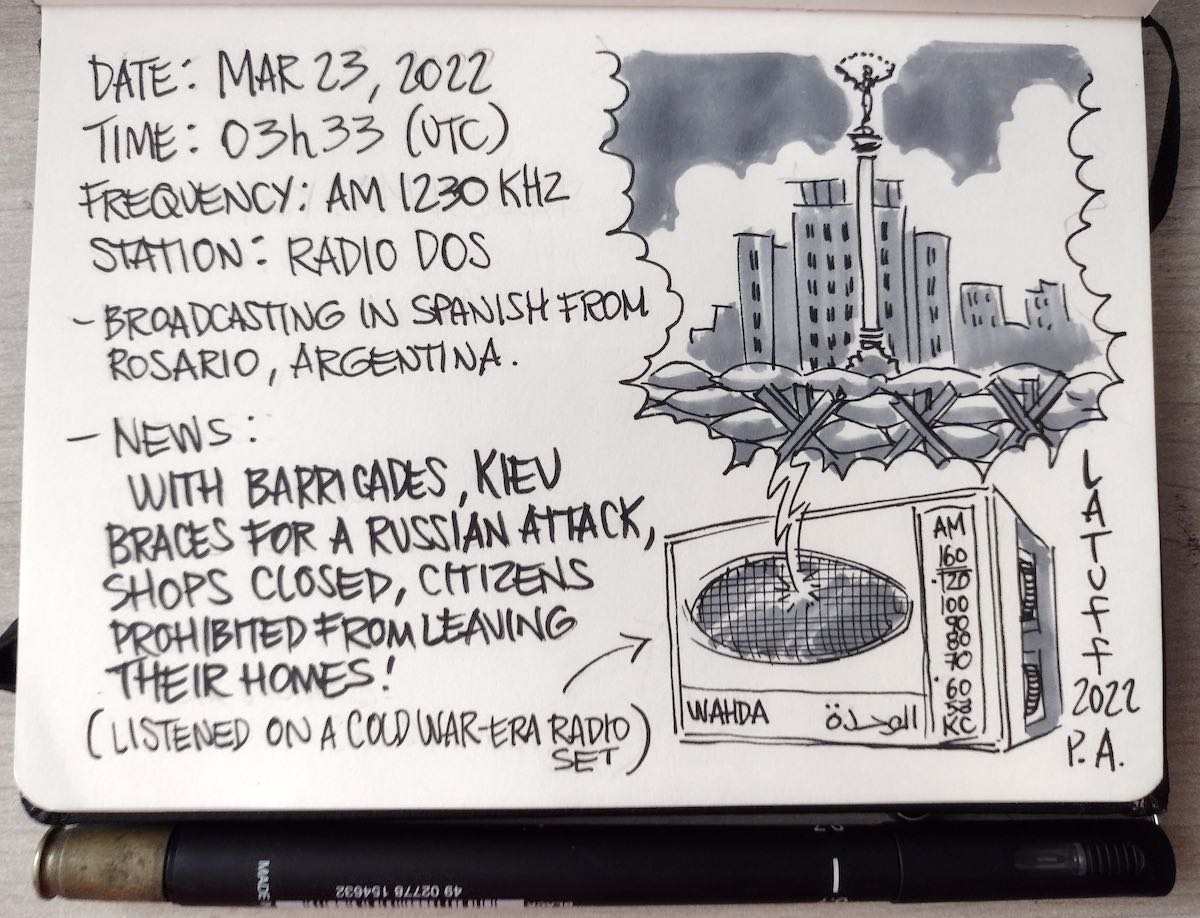
Radio Dos, AM 1230 kHz, broadcasting in Spanish from Rosario, Argentina.
Part of news bulletin.
War in Ukraine
With barricades, Kiev braces for a Russian attack, shops closed, citizens prohibited of leaving their homes.
Many thanks to SWLing Post contributor and noted political cartoonist, Carlos Latuff, who shares his radio log art, this time along with shortwave recordings taking a look at the Russian invasion of Ukraine.
China Radio International and the Voice of America:
Carlos notes:
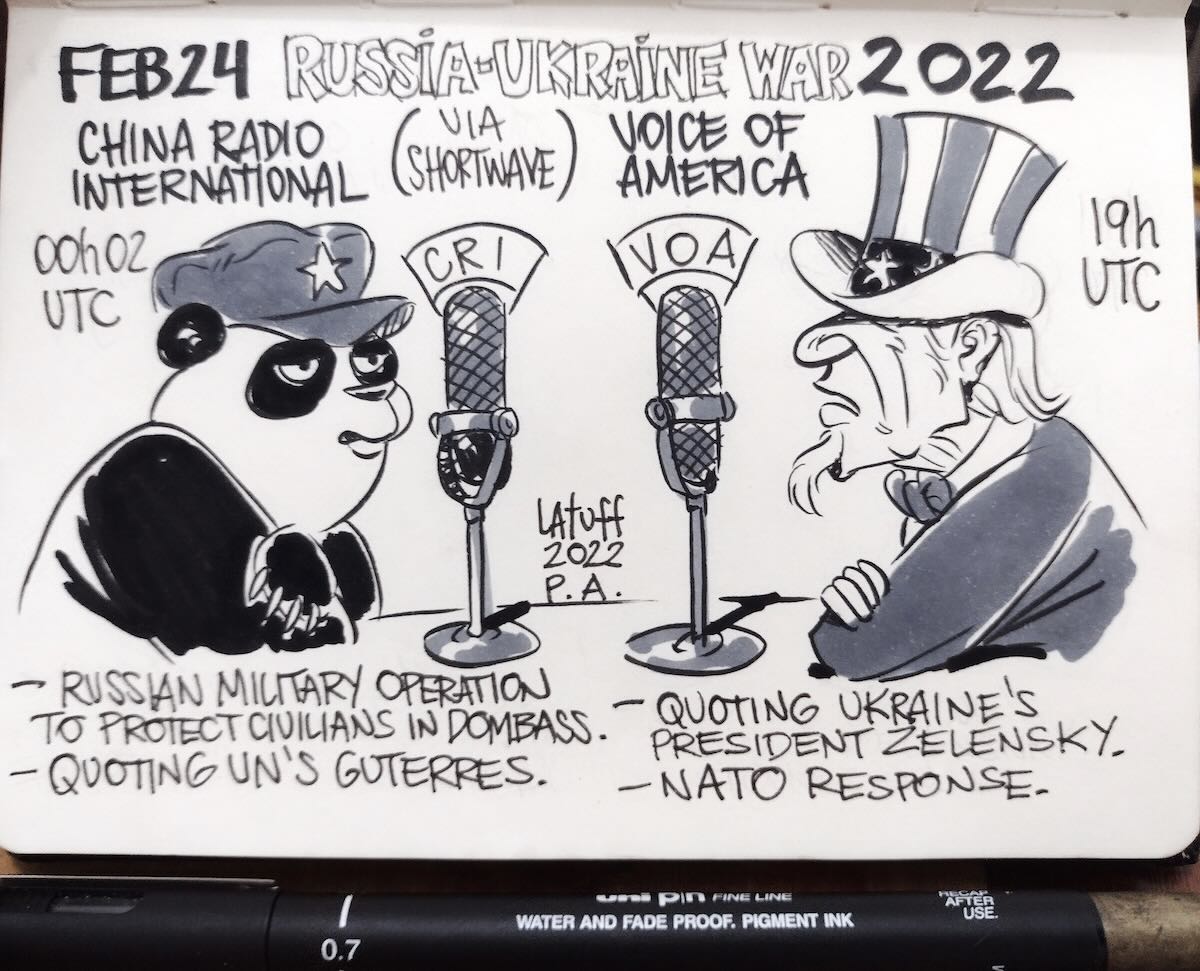
Excerpts from news bulletins of Voice of America (USA) and China Radio International about the beginning of the Russia-Ukraine war on February 24, 2022. Shortwave broadcasts listened in Porto Alegre, Brazil.
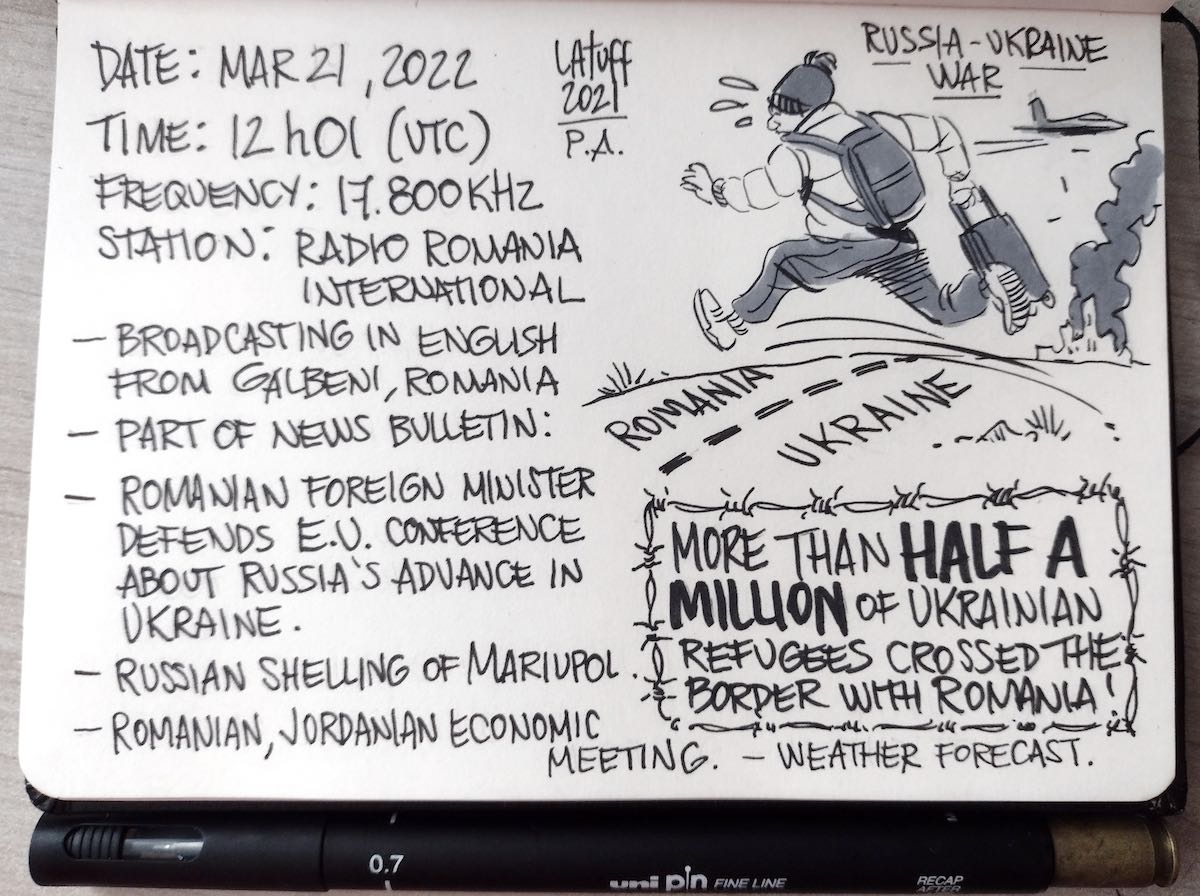
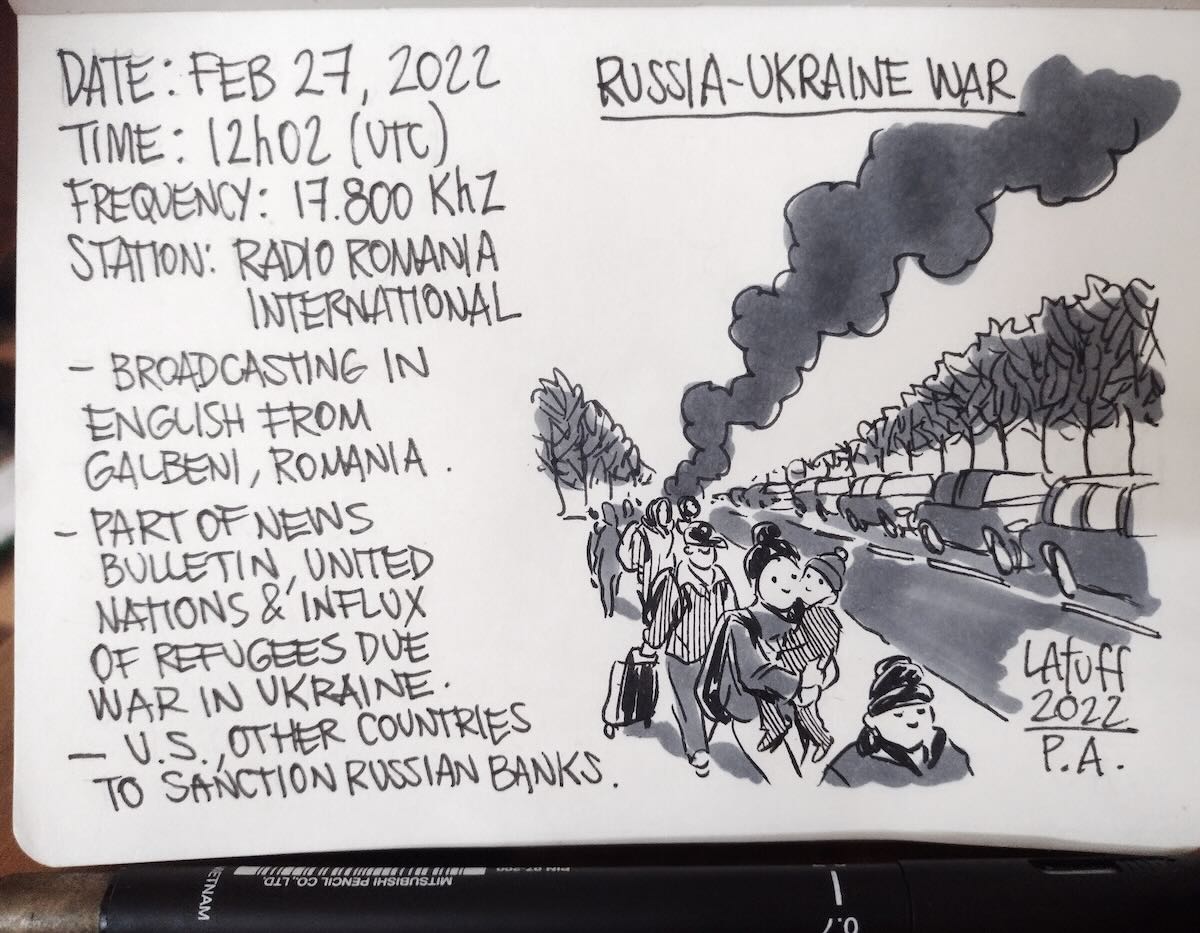
Part of Radio Romania International news bulletin, 17800 kHz, broadcasting in English. – United Nations and influx of refugees due to war in Ukraine. – US and other countries to sanction Russian banks. Broadcast listened in Porto Alegre, Brazil, February 27, 2022, 12h02 pm (UTC).
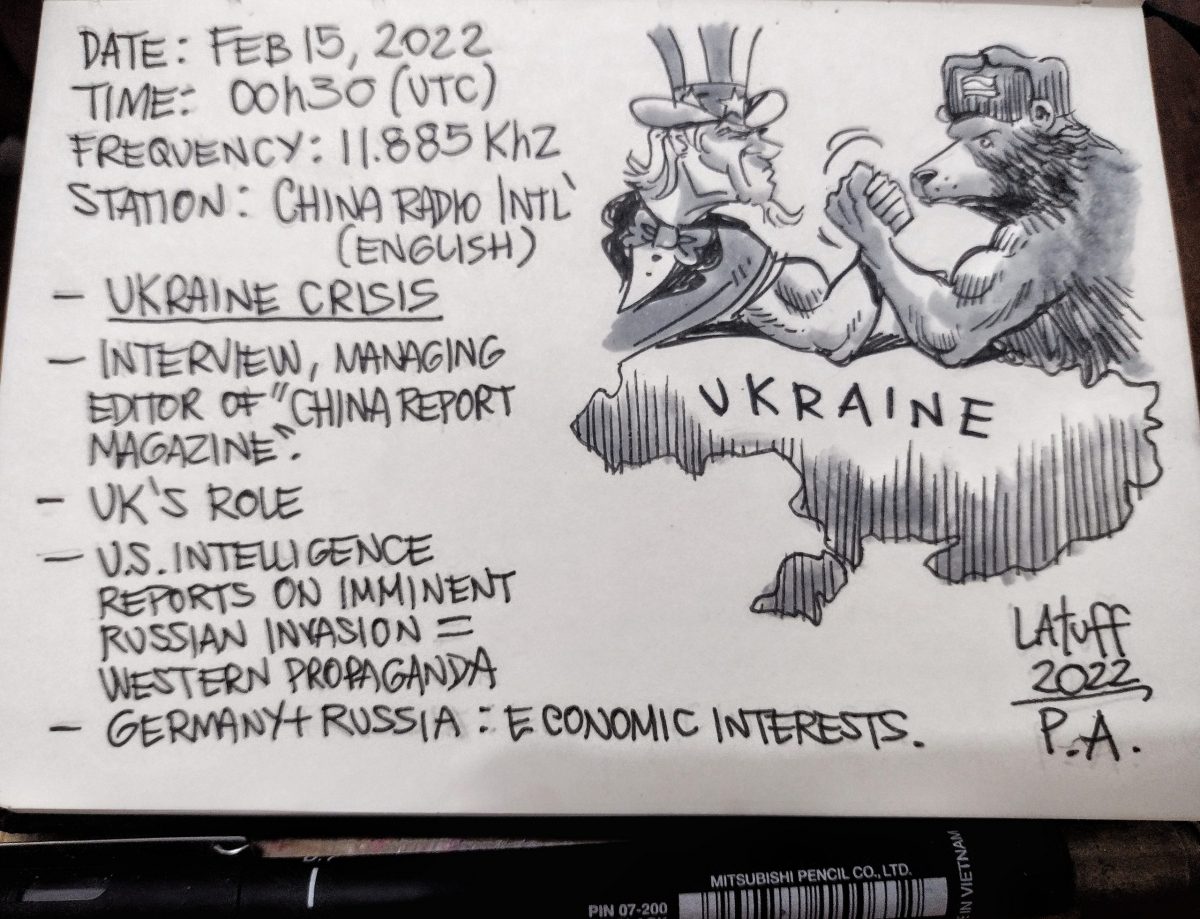
Many thanks to SWLing Post contributor and noted political cartoonist, Carlos Latuff, who shares yet another example of his radio log art, this time for China Radio International. Carlos notes:
China Radio International, 11885 kHz, Xianyang, China.
Ukraine crisis, interview with managing editor of “China Report Magazine”.
UK’s role, US intelligence reports, Germany interests, etc.
Listened in Porto Alegre, Brazil, February 15, 2022, 00h30 (UTC).
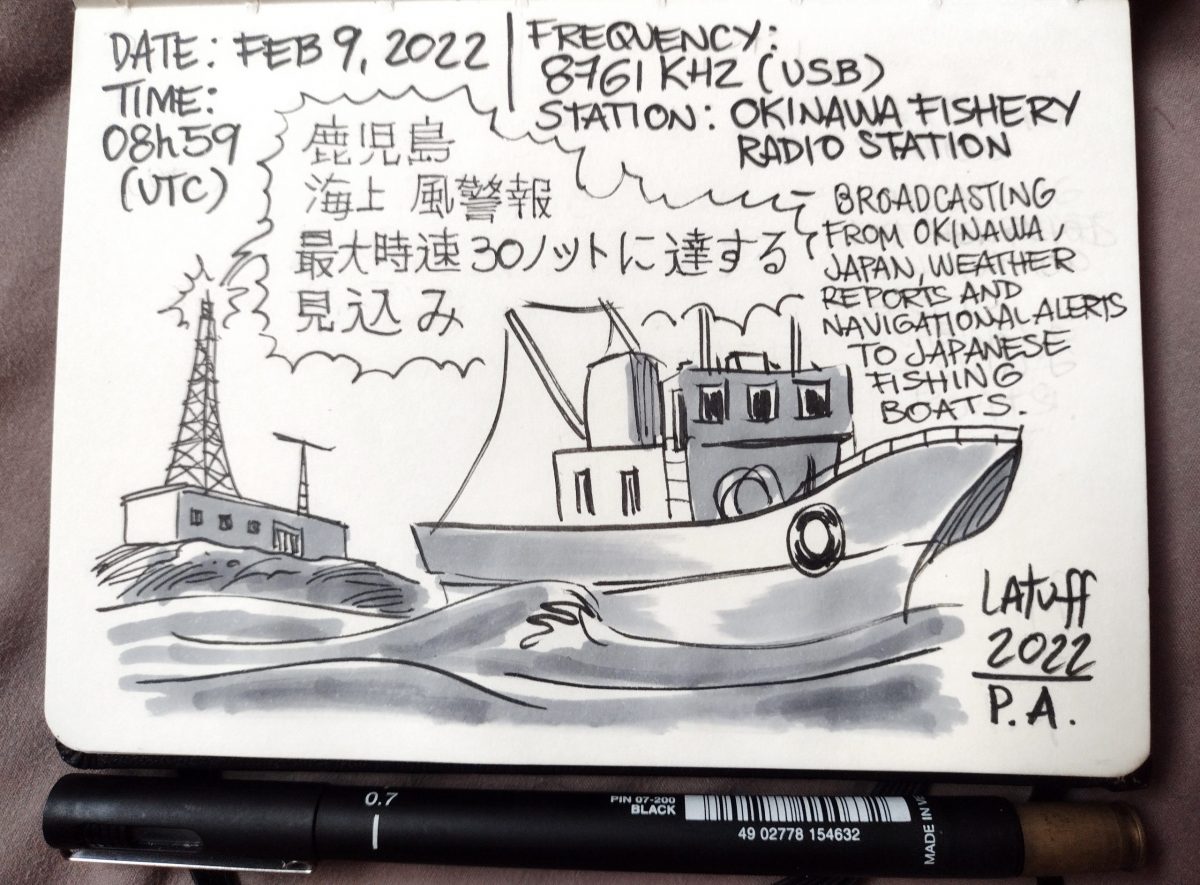
Many thanks to SWLing Post contributor and noted political cartoonist, Carlos Latuff, who shares yet another example of his radio log art, this time for Okinawa Fishery Radio. Carlos notes:
Okinawa Fishery Radio Station, Okinawa, #Japan, 8761 kHz (USB), broadcasting weather reports and navigation alerts to Japanese fishing boats.
Heard in Porto Alegre, Brazil, Feb 9, 2022, 08h59 (UTC).
We encourage you to explore the creative work from over 120 artists and composers.
A great many of these remarkable dynamic works draw on a wide array of recordings from the SRAA; the resulting compositions and soundscapes are rich with sonic textures, evocative collages of sound and memory, which emerge into further sources of inspiration.
Our profound thanks to Cities and Memory––and all of the participating artists––for this truly brilliant collection:
13 February 2022
UNIQUE ARCHIVE OF SHORTWAVE RADIO COMPOSITIONS LAUNCHED TO MARK UNESCO WORLD RADIO DAY
To mark UNESCO World Radio Day on 13 February, a unique collection of compositions built from eight decades of shortwave radio recordings is being released.
Shortwave Transmissions, a project by one of the world’s biggest sound projects Cities and Memory in collaboration with the Shortwave Radio Archive, sees more than 120 artists remix and recompose iconic shortwave recordings to create brand new compositions reflecting on and celebrating our relationship with radio.
Recordings from the mysterious spy radio and “numbers stations” around the world
Coverage of world-changing events such as 9/11, the invasion of Kuwait, Kennedy’s assassination, Tiananmen Square protests, the death of Fidel Castro and many more
Rare international recordings from North Korea, Saudi Arabia, St. Helena, the Falkland Islands and Antarctica
Recordings covering a huge period of time from 1934 through to the present day
Space travel documented including the Sputnik, Apollo and Challenger missions
Recordings of famous voices such as Winston Churchill and King George V
Station IDs, interval signals and final broadcasts from radio stations
Stuart Fowkes, founder of Cities and Memory, said:
“Shortwave radio is one of the most fascinating sonic worlds – each recording is a unique time capsule capturing vital moments in world history as well as the thrill of pirate radio, clandestine radio stations, secretive number stations and military and spy radio.
These are sounds to be treasured: all of humanity is truly out there to be listened to at the turn of a dial – and is source material for some extraordinary compositions.”
Taking the world of shortwave radio to an entirely different place, each recording has been reshaped and reimagined as a creative recomposed sound by more than 120 musicians and sound artists, in turn reflecting on current concerns covering everything from climate change to the Covid-19 pandemic.
Shortwave Transmissions is the latest project from Cities and Memory, a global, collaborative network of sound recordists and artists based in Oxford, UK. Previous global sound projects have included #StayHomeSounds (a global mapping of the sounds of the Covid-19 lockdown), Protest and Politics (the biggest ever collection of the sounds of protest) and Sacred Spaces, the first global survey of the sounds of churches, temples, prayer and worship.
It has more than 5,000 sounds on its global sound map covering more than 100 countries and territories, and more than 1,000 worldwide contributing artists since its launch in 2015.
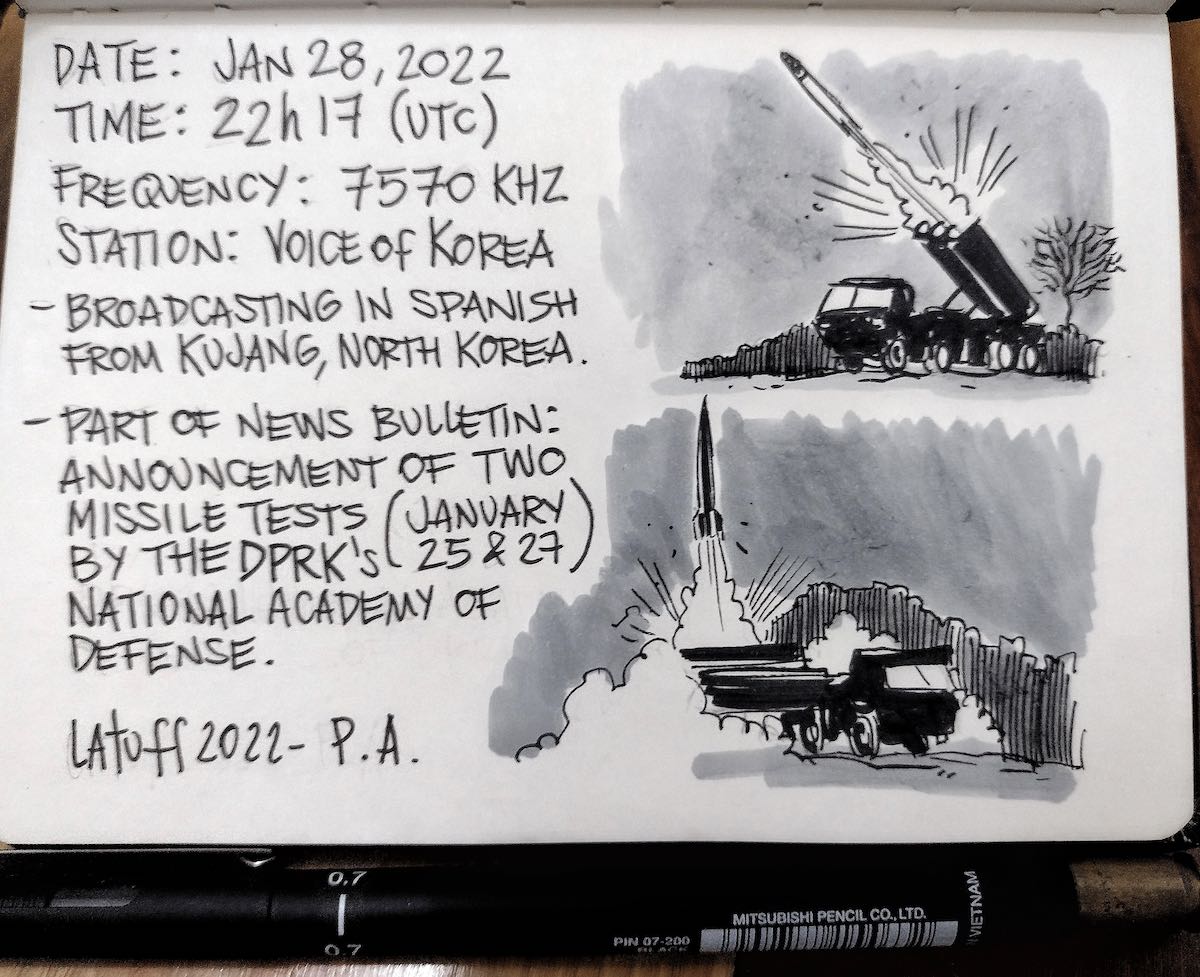
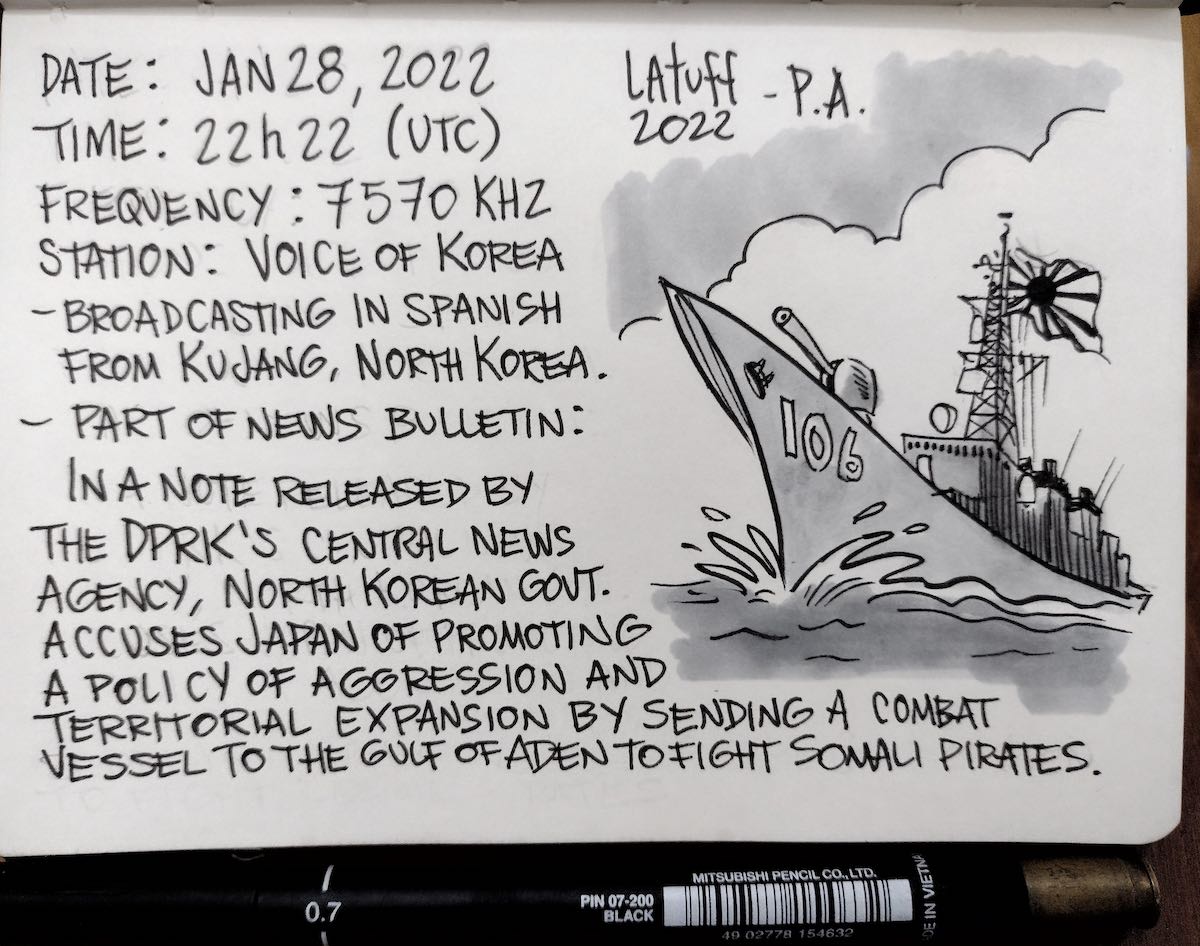
Many thanks to SWLing Post contributor and noted political cartoonist, Carlos Latuff, who shares two shortwave reception illustrations and recordings of The Voice of Korea:
VOK: January 28, 2022 at 22:17 UTC
Carlos notes:
Voice of Korea, 9650 kHz, broadcasting in Spanish from Kujang, North Korea.
From the news bulletin, the North Korean government announces two more missile tests, which took place on January 25 and 27.
Voice of Korea, 9650 kHz, broadcasting in Spanish from Kujang, North Korea.
At the end of the news bulletin, the North Korean government accuses Japan of promoting a policy of aggression and territorial expansionism by sending a combat ship to the Gulf of Aden to fight Somali pirates.
Signal captured in Porto Alegre, 01/28/2022, 19:22, local time.