Fighting cancer with radio waves

John Kanzius, K3TUP (SK)

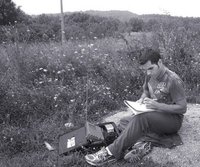
John Kanzius standing next to his Kanzius RF device.

There are few people in the radio world that I admire more than John Kanzius, K3TUP (SK). John took knowledge from his amateur radio hobby and applied it to the medical field–specifically, to fighting cancer.

(Per Wikipedia)

Kanzius RF Therapy is an experimental cancer treatment that employs a combination of either gold or carbon nanoparticles and radio waves to heat and destroy cancer cells without damaging healthy cells.
The specific absorption rate for radio waves by living tissue in the proposed wavelengths and intensity levels is very low. Metals absorb this energy much more efficiently than tissue through dielectric heating; Richard Smalley has suggested that carbon nanotubes could be used to similar purpose. If nanoparticles were to be preferentially bound to cancer sites, cancer cells could be destroyed or induced into apoptosis while leaving healthy tissue relatively unharmed. This preferential targeting represents a major technical challenge. According to a presentation by Dr. Steven Curley, the types of cancer potentially treatable using Kanzius RF therapy include essentially all forms of cancer.

Kanzius built a prototype Kanzius RF device in his home, and formed Therm Med., LLC to test and market his inventions. The device was successfully tested at University of Pittsburgh Medical Center in 2005. As of 2007-04-23, preliminary research using the device at The University of Texas M. D. Anderson Cancer Center and the University of Pittsburgh Medical Center has shown early promise. If federal approval is granted, testing on human patients may follow. An article published in late 2010 illustrates that radiofrequency fields induce intracellular hyperthermia and necrosis in pancreatic tumors without injury to the human pancreatic tissue grafts tested.

Perhaps the reason John has been on my mind today is because, just last week, my wife lost her mother  to a vicious, aggressive form of cancer called carcinosarcoma.  She was only 68, otherwise healthy and in the prime of life, with young grandchildren.  We hold her memorial service today.

Our family supported her as she bravely fought this cancer for more than 4 years, beating the 2 year survival statistics she was quoted by various oncologists. Carcinosarcoma is very resilient to the effects of chemotherapy and spreads so widely through the body that radiation eventually can only be used for palliative purposes. Without the efficacy of chemotherapy and radiation, one does not have other viable treatment options for such an aggressive cancer–at least not currently.

Though we have been learning about cancer and doing research on it for years, there are still so few effective treatments for many patients. Though I’m neither doctor nor researcher and I appreciate the technical complexity of this option, I do believe Kanzius’ research is a step in the right direction because:

  • it uses nano-particles to target specific cancer cells, leaving healthy, normal cells intact
  • the RF radiation used to activate (heat) the nano-particles is absolutely benign to normal, non-infused tissue
  • this therapy could work in lieu of the surgical removal of tumors, which often runs a high risk of harming the patient and further spreading the cancer

Readers may have noted the “SK” after John’s ham radio callsign above. SK stands for “Silent Key.” John passed away on Feb 18, 2009 from pneumonia–a complication brought on by his own battle with cancer. Prior to his death, John established a 501(c)(3) nonprofit, The Kanzius Cancer Research Foundation, to carry on his research and human trials of the Kanzius RF therapy.

Today, my family and our local community will celebrate the life of my mother-in-law, Jean.  Her passion for nature, her knowledge of science, her love of family and her remarkable faith in humanity and Divine power were/are inspiring to everyone she knew.

John Kanzius, I celebrate your life today too, and am happy that your research and vision lives on! May it inspire future cancer treatment.

Silicon Labs Si4734 DSP-based shortwave radios

The Silicon Labs Si4734/35

I have gone through our Shortwave Radio Index (SWRI) and tagged every portable radio that is based on the Silicon Labs Si4734 DSP chipset.

The Si4734 has been one of the biggest innovations to happen to portable receivers in recent years. When implemented well into a receiver design, the Si4734 can give a small portable exceptional selectivity and sensitivty through the power of DSP (Digital Signal Processing).

Simply click on this link to see a list of portable shortwave radios that are designed around the Silicon Labs Si4734:
http://swling.com/db/tag/si4734/

The elusive Kchibo D96L on sale for $47 US

Actually, the price is showing as $46.78 from DinoDirect.

The Kchibo D96L is considered a bargian small radio and always reviews well.  Based on the Silicon Labs Si4734 DSP chip, this receiver has excellent selectivity and sensitivity for a radio in its price range–especially on the AM broadcast or Mediumwave band.

I’ve found that the D96L is hard to find these days. In fact, this is the first time I’ve found one for sale outside of eBay.

I’ve never purchased from DinoDirect, but they claim a 30 day money-back guarantee and free shipping.

Before purchasing, read reviews and check out our entry for the D96L in the Shortwave Radio Index.

Please note: I cannot endorse DinoDirect as I could a regional shortwave radio retailer. I would love feedback if any readers have used them before.

Note: It appears if you enter the promo code “sharkcoupon” you receive an additional 10% discount.

Open Radio for North Korea hopes to contribute to gradual change in North Korea

North Korea

Without a doubt, North Korea is one part of the world that is information starved. Open Radio for North Korea uses the shortwaves to get their messages across the border:

(Source: Deutsche Welle)

The North Korean regime suppresses all forms of free information within the country. “Open Radio for North Korea” broadcasts international news via shortwave and FM from neighboring South Korea for the North. World in Progress talked to the radio station’s founder, Tae Keung Ha, about the role of outside broadcasters for the people of North Korea.

Tae Keung Ha: I find the human rights situation and the media control in North Korea, I think, the most severe, the most serious in the world. Radio is very special for the North Korean people to get outside news, because in North Korea they don’t have any Internet connections. Social network services, Facebook, Twitter are impossible inside of North Korea.

Also, all the calls in North Korea are monitored, strictly wired by the North Korean regime. And their TV system is different from the South Korean system – they cannot watch South Korean TV.
Domestic phonecalls in North Korea are controlled by the government

Internal information is strictly blocked by the regime, so a person in the northern part of North Korea doesn’t know what’s happening in the southern part of North Korea. The North Korean media only broadcast their own propaganda, so we have underground correspondents inside North Korea, 10 to 20, it varies. They offer us news about what’s happening inside North Korea.

Read full transcript/interview at DW-Welle.de

This isn’t the first time we’ve mentioned stations targeting North Korea, click here to read our previous–yet still totally relevant–article. Also, check out this 2009 article from the LA Times.

Public Diplomacy Magazine features array of articles on the state of international broadcasting

It is a rare occurrence when so much attention is given to the topic of international broadcasting. Financial hardship combined with a rapidly changing media landscape set a stage where broadcasters are being forced to a precipice of change. How well they quickly evaluate restructuring their message and the medium they use to deliver it could very well determine the future of broadcasting on the shortwaves.

This issue of Public Diplomacy Magazine covers the scope.

(From: RNW Media Network)

PD Magazine, Summer 2011 of the University of Southern California Center on Public Diplomacy, is devoted to international broadcasting. Its contents include:

Also available is the pdf version.

Thanks to RNW Media Network, Kim Andrew Elliot and Richard Cuff for the tip.

BBC strikes in light of Murdoch

(Source: The Guardian)

Sometimes it’s easy to figure out which side people are on – the strikers and their union, the National Union of Journalists (NUJ) are on one side – as are the other unions in the BBC and outside. At the rallies at the BBC’s Bush House and Television Centre, NUJ General Secretary Michelle Stanistreet read out a strong solidarity statement from her Public and Commercial Services union equivalent Mark Serwotka – one of many messages from other unions. Also on the side of the BBC are Labour MP and chair of the NUJ parliamentary group, John McDonnell, and former MP and NUJ Member of Honour, Tony Benn, who joined NUJ members on the picket line.

On the other side, for quite a long time, has been the Murdoch empire, chipping away at support for the BBC, particularly in parliament. However, the events of the last few days have shown the irony of the closing line of James Murdoch’s 2009 MacTaggart lecture: “The only reliable, durable, and perpetual guarantor of independence is profit.” The craven pursuit of profit by the company of which he’s boss led to the phone hacking scandal that has shocked and disgusted so many and so damaged his family’s empire.

…[T]he NUJ, on the eve of the strike, called for the licence fee deal to be re-examined in the light of revelations surrounding the influence of Rupert Murdoch and his News International executives on David Cameron and senior government ministers.

Read the full article in The Guardian.

WNYC features Leeds Radio

(Source: WNYC)

Now it’s 1952 all over again,” Richard Matthews said with satisfaction, after buffing a small black radio knob to a shiny gleam. “It’s beautiful.”

For those who tinker like it’s 1959, Leed’s Radio is Candyland. This 2,500 square foot warehouse is literally jam packed with an inventory of between three to five million parts, including vacuum tubes, transformers, coils, knobs, switches, light bulbs and just about anything requisite for a radio made before 1965. Some of the stock dates back to 1919, a few years before the original Leeds opened on Manhattan’s Radio Row in 1923.

But with the exception of the hulking 1940s-era Radio Free Europe machine in Matthews’ office, you won’t find a completely assembled radio here. Leeds is a store for people who like to build and tinker with antique technology, not for those who want to purchase pristine relics.

Listen to the full show at the WNYC website and browse Leeds Radio’s website.