Arecibo: Legendary radio telescope hangs in the balance

The Arecibo Radio Telescope, at Arecibo, Puerto Rico. At 1000 feet (305 m) across, it is the second largest dish antenna in the world. (Source: Wikipedia)

Many thanks to SWLing Post contributor, Richard Langley, who shares the following story from Nature:

“Some of the observatories targeted in the review have found potential partners: New Mexico State University in Las Cruces is leading an effort to take over the Dunn Solar Telescope in Sunspot, New Mexico. Others remain in limbo, including the 100-metre radio telescope in Green Bank, West [Virgina], where university partners have offered limited help.”

Click here to read the full article on Nature’s website.

From the Isle of Music, week of January 16-22

From the Isle of Music, Week of January 16-22, 2017
Electronic Cuba – Leonardo Pérez shares more of Una Mecanica Diferente, Jazz saxophonist Emir Santa Cruz shares some of his music, and we are going to explore some of what is happening in Cuban electronic music today.
Three options for listening on shortwave:
WBCQ, 7490 KHz, Tuesdays 0100-0200 UTC (8pm-9pm EDT Mondays in the Americas)
Channel 292, 6070 KHz, Fridays 1100-1200 UTC (1200-1300 CET) and Saturdays 1200-1300 UTC (1300-1400 CET)
See the From the Isle of Music Facebook Page for more information.

Tecsun PL-880: Richard shares winter DXing notes

Many thanks to SWLing Post contributor, Richard Langley, who lives in New Brunswick, Canada, and sent the following update earlier this month:

I often go outdoors to escape the RFI generated in and around the house, which can be even worse during the holidays with all the LED Christmas displays.

Trouble is, the snow is getting a bit deep for the trek to the back of the cleared part of my yard.

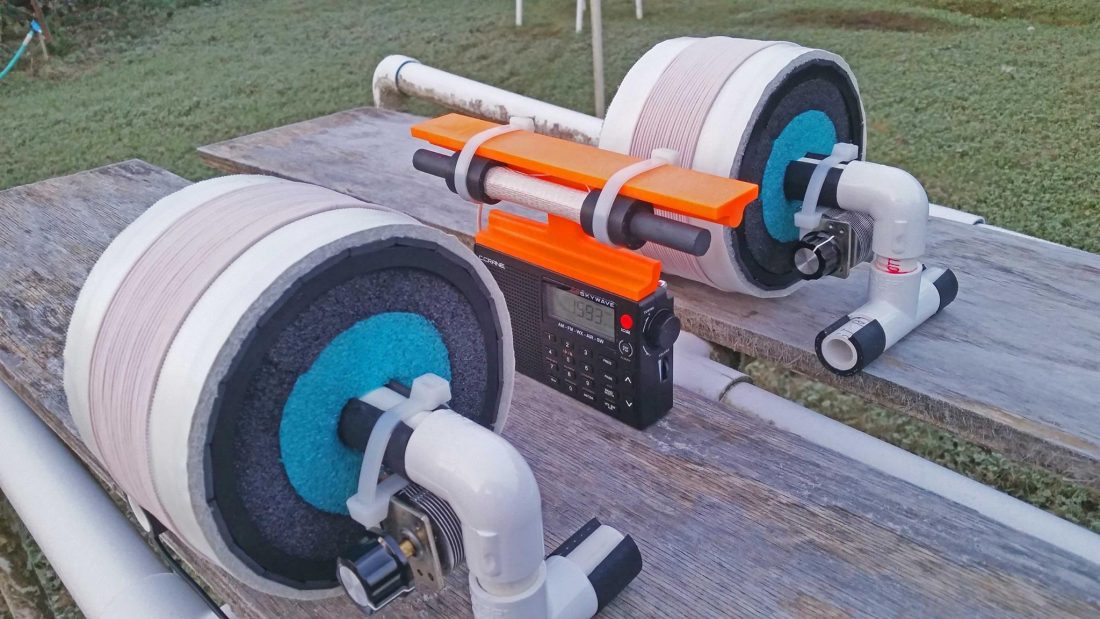
The attached photos show my setup on New Year’s Day to record Stephen Cooper’s DigiDX program over WRMI.

One thing about DXing and SWLing outside in the winter is that the knobs on the Tecsun PL-880 can become stiff to turn if it’s too cold and the battery doesn’t last as long as when it’s warm outside. Best approach is to go out with a fully charged battery, tune to a particular frequency and record the audio for later playback.

[…]I’ve also noted on a couple of occasions that the Tecsun will shut itself off after a few hours in really cold weather (around -20°C). And it’s not that the battery power is exhausted. I can turn it back on manually and it shows plenty of battery capacity remaining.

Thanks for sharing your notes, Richard! It certainly looks like a winter wonderland at your home. I like how you’ve made such a lightweight, portable station that protects the PL-880 from moisture.

Paul Walker also uses the PL-880 extensively in Galena, Alaska–in some very cold temps as well. Perhaps we can compare notes.

Post readers: What radios do you use outdoors in winter conditions? Please feel free to share your experiences!

By the way: I should offer my sincere apologies for sharing beautiful winter wonderland scenes while many of our dear readers in Australia are coping with a sweltering heatwave! 🙂 Perhaps we should also be sharing notes about high temp outdoor DXing!?

Oops…Dutch regulator removes FM broadcaster’s antenna

(Source: Southgate ARC via Mike Terry)

Dutch regulator removes broadcaster’s antenna

It is reported the Dutch Radiocommunications Agency dismantled the antenna of a legally operating broadcast station

It appears they thought Vechtdal NL in Ommen on 105.6 MHz was a pirate but the station, an associate of Vechtdal FM, was correctly licenced. The Agency says that something went wrong with the checking of licences.

The antenna was on the watchtower of the State Forestry Besthmenerberg Ommen near Nieuwleusen. It is unclear if the Radiocommunications Agency will pay compensation for the damage.

Radio.NL article
http://radio.nl/812498/legaal-radiostation-vechtdal-nl-door-at-uit-de-lucht-gehaald

Video: Ivan surveys Cuban TV from a cruise ship

Many thanks to SWLing Post contributor, Ivan Cholakov, who shares the following:

[W]hile on a cruise ship 30 miles off the coast of Cuba (January 2017) I pointed a small active antenna towards the island and scanned for old fashioned analog TV.

The results show analog TV is alive and well in Cuba! Multiple programs on multiple channels.

From what I understand Cuba has selected the Chinese digital TV standard but using their own channel spacing so I am not aware of any receivers that can pick up Cuba’s digital TV transmissions.

I posted the YouTube video of my channel scan here:

Click here to view on YouTube.

Shortwave Relays This Weekend

(Source: Tom Taylor)

Relays this Weekend

Hamurger Lokal Radio via Shortwave Station Göhren, Germany with 1KW to Western Europe:
6190 KHz Every Saturday 07.00 to 11.00 UTC
7265 KHz Every Saturday 11.00 to 16.00 UTC
9485 KHz Every Sunday 10.00 to 13.00 UTC
Contact email: [email protected]

NEXT WEEK Radio City via:
IRRS to Europe on 7290 KHz (every 3rd Friday) between 19.00 to 20.00 UTC
IRRS to Europe on 9510 KHz (every Saturday) between 09.00 to 10.00 UTC
Challenger Radio to Northern Italy on 1368 KHz every Saturdays from 20.00 UTC onwards
Radio Merkurs on 1485 KHz Every Saturday between 20.00 onwards
Contact email: [email protected]
A comment: IRRS has been noted on a Sunday on 9880 kHz instead of 9510 kHz, in order to avaoid co-channel
interference from a domestic Chinese station. This may perhaps also apply to Saturday transmissions.

European Music Radio Transmissions via;
WBCQ to Central & North America on 7490 KHz on 14th January between 22.00 to 23.00 UTC
KBC to Western Europe on 6045 KHz on 15th January between 09.00 to 10.00 UTC
Shortwave Station Göhren on 9485 KHz on 15th January between 09.00 to 10.00 UTC
Channel 292 on 6070 KHz on 15th January between 14.00 to 15.00 UTC
Contact email: [email protected]

EMR Internet Repeats on 15th January 2017:
EMR will repeat this months Transmissions via two streams running at the following Times:16.00, 18.00, 20.00 UTC
http://nednl.net:8000/emr.m3u will be on 96 kbps /44 KHz stereo for normal listening
http://nednl.net:8000/emr24.m3u will be 24 kbps / 22 KHz mono will be especially for low bandwidth like mobile phones.
( at 17.00, 19.00 & 21.00 UTC are recordings from the 15th of January 1978 with AJ’s DX & Roger Tate’s mail box )

KBC via:
Media Broadcast to America on 6145 KHz Every Sunday between 00.00 to 01.00
Contact email: [email protected]

Hobart Radio via:
Channel 292 to Western Europe on 6070 KHz Sundays between 21.00 to 21.30 UTC
WRMI to Americas, Asia/Pacific on 9955 KHz Sunday between 03.30 to 04.00 UTC
WRMI to Americas, Asia/Pacific on 9955 KHz Tuesday between 22.30 to 23.00 UTC
WBCQ to North America on 5130 KHz Mondays 03.30 to 04.00 UTC
Contact email: [email protected]


For outside the listening area please try the Twente/Netherlands Web RX at http://websdr.ewi.utwente.nl:8901/

You can also hear many European free and alternative stations via the Internet at: http://laut.fm/jukebox

Radio Channel 292 Transmission schedules on 6070 KHz (on the air every day):
http://www.channel292.de/schedule-for-bookings/

Radio Mi Amigo Transmission schedules:
www.radiomiamigo.es/shortwave

Good Listening!
73s

Radyo Pilipinas From 1973

One of the things I now regret is that I didn’t make more recordings of radio stations from my listening days in the 1970s and 80s. I have very few audio examples of stations operating at that time. So disappointing!

However….a few weeks ago, I stumbled across a recording I made in December 1973 of Radyo Pilipinas, The Voice of the Philippines (DZRP).  After a bit of audio engineering on the deteriorating old cassette tape, I’ve managed to somewhat improve the tone quality. I also found an image of the QSL card from that exact transmission on December 11, 1973 on 9580 kHz. I’ve posted the recording on YouTube – click the embedded video below.

This is for those of you who can remember and for those who enjoy some radio history!

These days, Radyo Pilipinas still has a small presence on the shortwave bands with the following schedule:

To the Middle East in English and Tagalog from the Tinang relay site (250 kW)
0200-0330 on 15640, 17700 and 17820 kHz
1730-1930 on 9925, 12120 and 15190 kHz

73 and have a great weekend everyone!

Rob Wagner VK3BVW

Rob Wagner, VK3BVW, is the author of this post and a regular contributor to the SWLing Post. He also blogs at the Mount Evelyn DX Report.