Chris’ 2016 Pirate Radio Year in Review

Many thanks to Chris Smolinski who has, once again, crunched the numbers to give us a look at HF pirate radio activity in 2016.

[…]To gauge shortwave pirate radio activity in 2016, I analyzed the Shortwave Pirate loggings forum of the HF Underground (http://www.hfunderground.com). A computer script parsed the message thread titles, as well as the timestamps of the messages. This information was used to produce some statistics about the level of pirate radio activity. Of course, as Mark Twain has written: “There are three kinds of lies: lies, damned lies, and statistics.” Still, let’s see what we can learn.

There were 13,860 messages posted to 2,398 unique threads, compared to 13,944 messages posted to 2,183 unique threads in 2015. Activity levels are essentially flat, but still at historically high levels. Back in the 1990s, it was not uncommon for an entire month to go by with only a handful of pirate stations logged. If you want to know when the “golden age” of shortwave pirate radio was, I would say it is right now.[…]

Chris has posted his full analysis on RadioHobbyist.org.

As you can tell from Chris table at the top of this page, January is a very active month for HF pirates. If you’ve never chased pirate radio stations, check out our pirate radio primer. Pirate radio DXing is incredibly fun!

DSWCI archives now online

Many thanks to SWLing Post contributor, Harald Kuhl, who shares the following message sent by Anker Petersen of the The Danish Shortwave Club International (DSWCI):

Dear DSWCI members.

In a few hours the DSWCI exists no longer.

But our webmaster Rolf Wernli has done a tremendous job between Christmas and New Year by changing our wellknown website to an electronic archive with good reading for all members !

If our former website appears, it is because it has been saved in your computer.

Please type www.dswci.org, press Enter and the new website should appear.

Enjoy and have a Happy New Year!

Best 73,

Anker

What a brilliant resource! Thank you, Harald, for passing this information along and many thanks to the fine folks at the DSWCI for sharing their archives with the radio community!

Click here to browse the archives at the DSWCI website.

The SWLing Post: 3,000 posts and counting!

SWLingPost-DXFiend-Vintage-FrontA couple of weeks ago, I noticed that we had crossed a small milestone here on the SWLing Post: as of this post, there are now 3,067 (!!!) published posts in our archives.

I simply can’t believe we’ve surpassed 3,000 posts–especially knowing we only passed 2,000 posts September of 2015.

People can say what they will about our shortwave hobby’s future, but I’m here to tell you that  interest in is far from dead. Indeed, it is dynamic, alive and well!

This morning, I took a look at our web statistics via Google Analytics for the month of December 2016 (not including today).

It’s hard for me to believe we’re averaging about 6,790 daily pageviews!

And the secret sauce in surpassing 3,000 posts and healthy numbers? Our amazing contributors!

Thank you so very much!

As I’ve mentioned before, I had no aspirations for the SWLing Post to become a popular destination for shortwave and amateur radio enthusiasts; it was mainly a site where I could jot down things I found of interest to me and keep tabs on the radio and international broadcasting industry. I was simply making my bookmarks and thoughts public, perhaps a little in advance of the social media outlets that now exist for shortwave radio and related topics.

As we move into 2017, I’d like to thank you all for reading and contributing to the SWLing Post community!

Happy New Year, radio friends!

Looking at HF OTH RADAR

Many thanks to SWLing Post contributor, Trevor, who shares this link to a blog post from Daniel Estevez describing the characteristics of HF OTH RADAR:

Most amateur operators are familiar with over-the-horizon radars in the HF bands. They sometimes pop up in the Amateur bands, rendering several tens of kilohertzs unusable. Inspired by Balint Seeber’s talk in GRCon16, I’ve decided to learn more about radars. Here I look at a typical OTH radar, presumably of Russian origin. It was recorded at my station around 20:00UTC on 8 December at a frequency around 6860kHz. This radar sometimes appears inside the 40m Amateur band as well.

Above this post you can see a waterfall plot of the radar signal. It’s the wide red signal. It is 15kHz wide and pretty strong, but severely affected by frequency-selective fading. Looking at the IQ recording in Audacity, it is clear that the radar uses pulses with a 50Hz repetition rate. This explains the characteristic sound of this radar when received with a conventional SSB radio. It sounds similar to AC hum (here in Europe, of course).

Continue reading on Daniel’s blog…

From the Isle of Music, Week of January 2-8, 2017

Happy 2017!
We begin the new year with some new and recent recordings we received during 2016, and our special guest is Leonardo Pérez, Director of Cuarteto de Cuerdas Amadeo Roldan, who will be sharing a little of Una Mecánica Diferente, which was nominated for a Cubadisco in Concert and Chamber Music in 2016, during each of the next several weeks. This week will have a tasty blend of concert, Jazz and dance music.
Also, our Saturday transmission moves to 1200-1300 UTC on Channel 292, 6070 KHz to escape from interference from the Voice of Turkey.

Three options for listening on shortwave:
WBCQ, 7490 KHz, Tuesdays 0100-0200 UTC (8pm-9pm EDT Mondays in the Americas)
Channel 292, 6070 KHz, Fridays 1100-1200 UTC (1200-1300 CET) and Saturdays 1200-1300 UTC (1300-1400 CET)
Our Facebook Page has more information.


Video: Gary DeBock’s “Baby FSL” antenna

Many thanks to SWLing Post contributor, Gary DeBock (N7EKX), who shares this video and notes the following on YouTube:

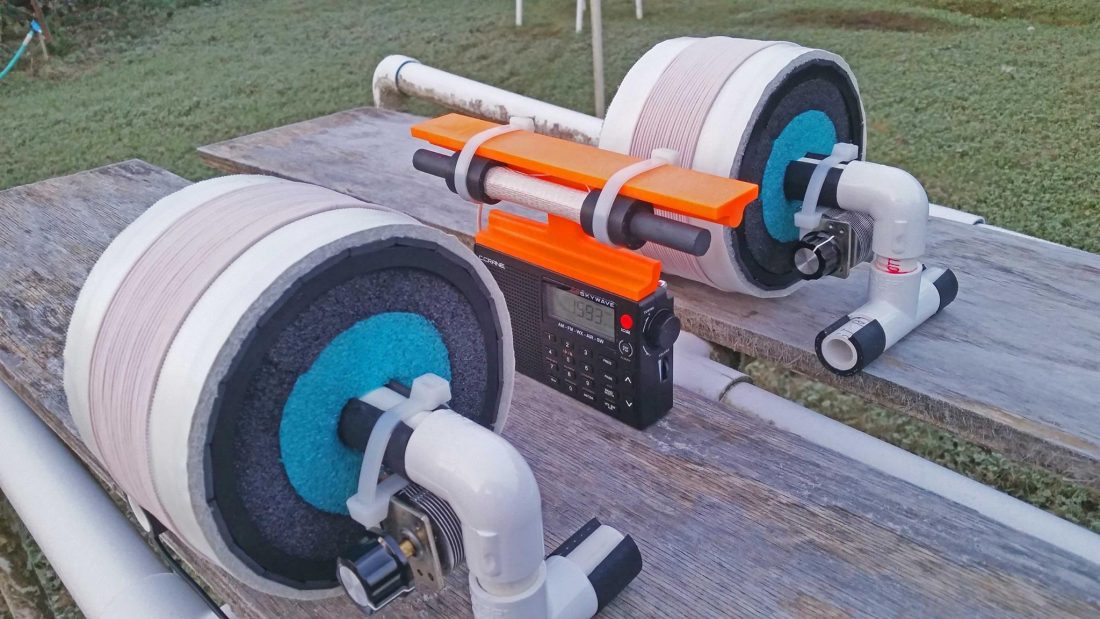
This is the new 3.5 inch (89mm) “Baby FSL” antenna, designed to provide a powerful DXing gain boost for Ultralight radios (or any other portables) despite its very small size. It has 32 Russian surplus 140mm x 8mm ferrite rods and 31 turns of 1162/46 Litz wire. In the demonstration video it provides a daytime DX gain boost for 750-KXTG (Tigard, Oregon, 50 kW at 160 miles) from inaudible up to about S7 on the Eton Traveler III Ultralight radio.

Click here to view on YouTube.

Gary is certainly a first-rate DXer and an ambassador of our radio hobby. Gary shows us here that, with a little ingenuity, we can take a $50 radio and turn it into something exceptional! Homebrewing at its best.  Thank you, Gary!

Also, I had never considered that a high-gain FSL antenna would require very precise placement of the receiver for proper inductive coupling. It makes sense, though. This loop is tuned for razor-sharp precision!

Some day, when I have a little free time, I’m going to build one of Gary’s FSL designs.

Leap second added to 2016

(Source: NPR)

Here’s a timely reminder for all you would-be revelers out there: Be careful with your countdowns this New Year’s Eve. There will be a little extra time to bask in the glow of a retreating 2016 — or curse its name, as the case may be.

Whatever your inclination may be, one thing is certain: Before the year is out, the world’s foremost authority on time will be adding one more second to the clock.

In a bulletin released this summer, the International Earth Rotation and Reference Systems Service, or IERS, said it would be necessary to introduce a “leap second” at the end of December. Timekeepers use this added second much as leap years are used — to bring the world’s atomic clocks in sync with the Earth’s own distinctive rhythm, which in this case is determined by its rotation.

This leap second isn’t the first. Since 1971, the world has added leap seconds with some regularity — typically every two to three years — and the latest leap second was added only last year, in June.

Continue reading at NPR…

Last year, I recorded the 2015 Leap Second via WWV–click here to read that post. Though such a subtle change, it is fun to hear that extra second added. I plan to record the full 31 meter band New Year’s Eve–hopefully, I’ll also catch the 10,000 kHz WWV Leap Second!