Guest Post: Backpack-Shack radio listening

Many thanks to SWLing Post contributor TomL, who shares the following guest post:


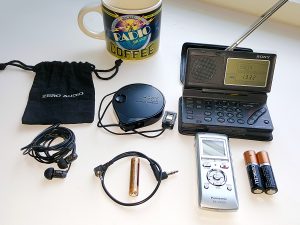
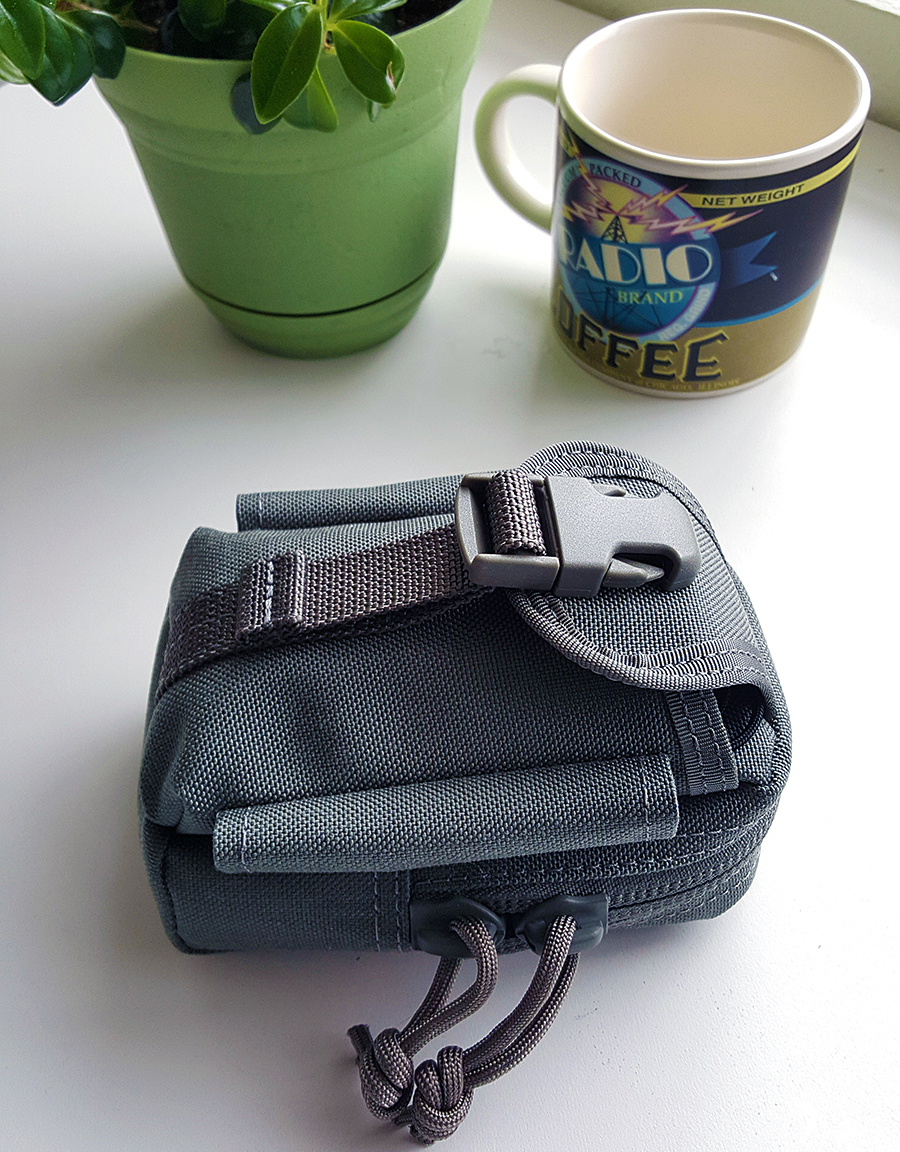
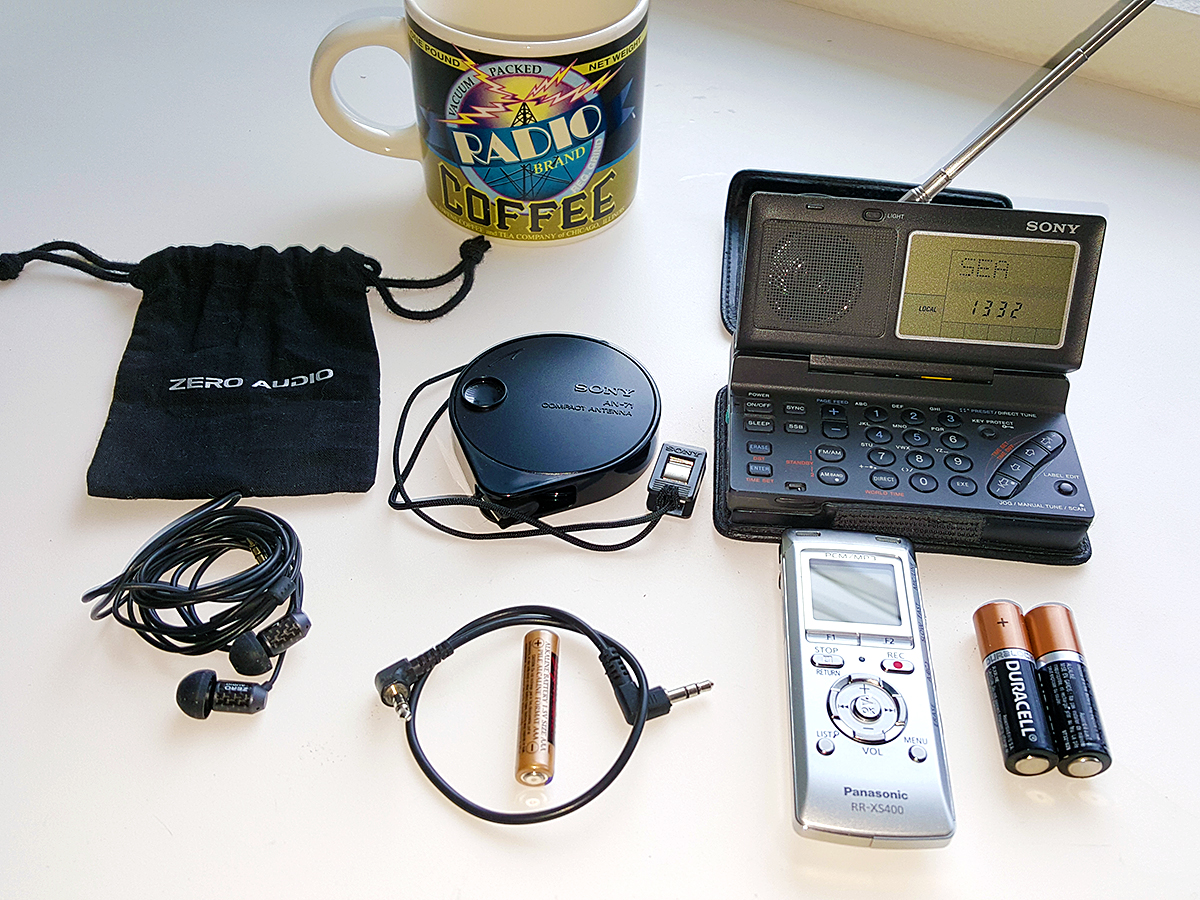
Illustration 1: Main contents

Backpack-Shack radio listening

by TomL

So, the Car Shack idea was good, but I felt constrained by lack of access to better locations to listen to shortwave radio. I took most of the original equipment and stuffed it into a photo backpack I was not using and now I have a portable listening station. Now I can listen in my car or in the field fairly easily.

LowePro350AW – The backpack has three main compartments, integrated carry handles, nice padded waist belt, and a couple of ways to stick a 3/4-inch PVC pipe into external tripod or water bottle pouches. My homemade 14-inch loop antenna with Wellbrook amplifier is light enough to be attached to a 3-foot PVC pipe attached to the backpack. The Palstar preselector (active antenna) and KIWA BCB filter are still part of the portable setup. I added a Daiwa two-position switch to cut out the KIWA BCB filter so I can listen to mediumwave. Power for all these devices are Powerex AA’s for the Sony 2010 and two 12V power packs made from three sets of XTAR 14500 lithium batteries + one dummy AA. I have mounted the electronics and wires using large cable tie-wraps to a 14×10 inch polypropylene kitchen cutting board (sturdy and easy to drill through).

Illustration 2: The electronics board fits neatly into the laptop section of the backpack

Illustration 3: Backpack Shack in operation

Here are some recordings from two test outings around 2100-2200 hours UTC. A local county park (“Forest Preserve”) purposely has few man-made structures (just a trail, picnic shelter made of wood and an outhouse). It is about 15 minutes drive from where I live; the reception is notably clear of local noise. There is an occasional wide-band noise that comes and goes but nothing else I can identify as detrimental noise and it is mostly just a nuisance.

Cuban Numbers station on 11635 kHz:

Click here to download.

VOA from Santa Maria di Galeria, Italy in French on 12075 kHz:

Click here to download.

All India Radio on 11670 kHz:

Click here to download.

BBC Ascension I. on 11810 kHz:

Click here to download.

R. Guinea with music and announcer on 9650 kHz:

Click here to download.

A big downside of the Forest Preserve, like most parks now, is that it is ONLY open from sunrise to sunset and strictly enforced. So, my personal quest for nighttime access to an RF-quiet location continues (I guess I will have to buy/build my own)! It begs for an even more portable setup than this one. That means buying an SDR (with control via a tablet), miniaturizing the antenna, and modifying the lithium power packs to fit in a very small backpack or fanny pack.

If I can miniaturize it enough, I will be able to use common parts of this setup at home, in the car, and at field locations for either mediumwave or shortwave listening. I could then pre-install the unique parts in those situations and just plug-and-play, so-to-speak!

It could be that the continuing tech wave of small, powerful, wide-band equipment is causing a revolution in general. A type of radio revival may be at hand where regional radio starts to take a foothold, catering to a multi-state area and not just to one local metro area – with its one-city mindset and control (Do I really care that the Big City is installing a downtown-only, 12 million dollar bike and jogging connection + hearing endless whining about how bankrupt pensions are putting that County at risk when I never go there and don’t care to?). Portable wide-band radios allow for hours of listening to various types of broadcasts!

An example could be to use digital broadcasts over longwave (somewhere from 150 kHz-500 kHz) which allows ground wave signals to travel hundreds of miles reliably during the day or night without depending on variable skywave propagation. Digital would enhance the listener experience in stereo. It would probably need a narrower type of digital modulation since the current “HD Radio” standard is really too wide and splatters everything at adjacent frequencies. Pure wishful thinking but the technology is available to make something NEW happen!!

Cheers from NoiZey Illinoiz,
TomL


Thank you, Tom! You certainly have the right idea: taking your radio to the field! Keep us informed about your progress and updates. No doubt, over time you will discover a year-round spot to play radio in the field!

Tecsun PL-310ET Memory Reset

Many thanks to SWLing Post contributor, Mike Ladd (KD2KOG), who writes with a Tecsun PL-310ET tip:

Happy Holidays! I found this trying different button combos on the PL-310ET. I don’t think this is documented online.

Tecsun PL-310ET Memory Reset

  1. Power off the radio
  2. Press and hold the Del key.When the radio beeps release the Del key.
  3. Press and hold the Del key again. When the radio beeps a second time hit the power button. All the station memories will be erased.

This should work on most of the Tecsun radios.

Very cool! Thanks for the tip, Mike!

Updates to the Morse Pad app

Many thanks to Chris Smolinski, who shares the following update:

I have a new version of Morse Pad for the iPad/iPhone/iPod Touch.

This update includes an improved decoder which better handles improper dot / dash / space timing by the sender (poor fist), automatic speed (WPM) algorithm, and adds AFC (Automatic Frequency Control), which auto tunes in the strongest signal present.

App Store Link: https://itunes.apple.com/us/app/morse-pad/id385629886?mt=8

Radio Free Europe and Christmas

1951 RFE Christmas card

Many thanks to SWLing Post contributor, Richard Cummings, who shares the 1951 Radio Free Europe Christmas card above.

Richard also notes that he recently published a two-part series on RFE and Christmas on his blog, Cold War Radio Vignettes.

Both excellent reads! Thanks, Richard!

Update: Countdown to the North American Shortwave DX Contest

Many thanks to SWLing Post contributor, John Cooper, who shares the following announcement:

NORTH AMERICAN SHORTWAVE CONTEST

“The Final Countdown” 2017

Just a friendly reminder that the North American SW DX Contest, “The Final Countdown,” will be starting in a few weeks.  The Holidays are upon us and time is flying.

Remember the Contest starts at:

00:00 UTC, 1/7/17 thru 00:00 UTC, 1/29/17.

Get your contest forms if you haven’t yet by contacting me at: [email protected] or mail at: John P. Cooper, 734 Sally Ann Drive, Lebanon, PA 17046.

Additionally, the entrance fee is not due until you submit your final entry forms. $5.00 is the cost of entry, check, money order or cash accepted. Checks and Money Orders should be made out to John P. Cooper.

Universal Radio Inc. is sponsoring the contest and has donated really Great Prizes for 1-3rd place that will be awarded along with Certificates of Completion for all who participate with contest standing annotated on them. The NASWA, and CIDX are also sponsors of this event.

Since most of us DXers will be ready for some action after the Holidays are over this is your chance to participate in a great Contest. Support your Hobby.

Remember, the contest is open to all North American DXers regardless of membership in any club or organization. Any questions, please contact me at: [email protected]

eBay find: Sony ICF-SW100S

Many thanks to SWLing Post contributor, Rick Lewis (WPE5BST), who writes:

Have been watching this radio on eBay. […] Looks like a post 97′ model SW100S and thus the ribbon cable shouldn’t be an issue.

Click here to view on eBay.

It appears the seller may only be willing to ship this within Europe. You would need to ask about international shipping prior to bidding.

I love my Sony SW100–it’s one of my go-to travel portables! I’m still most grateful to my buddy, Vlado, who fixed the ribbon cable in my unit. Click here to read more.

As Rick mentions, this Sony SW100S shouldn’t have a ribbon cable problem like the original SW100 series.

Mechanically Based Antenna: Underwater and underground radio

The Mechanically Based Antenna (AMEBA) (Source: DARPA)

(Source: Space Daily)

The Mechanically Based Antenna (AMEBA) program could enable radio communication through seawater and the ground. and directly between warfighters hundreds and ultimately thousands of kilometers apart.

Here’s something easy to forget when you are chatting on your cell phone or flipping channels on your smart TV: although wireless communication seems nothing short of magic, it is a brilliant, reality-anchored application of physics and engineering in which radio signals travel from a transmitter to a receiver in the form of electric and magnetic fields woven into fast-as-light electromagnetic waves.

That very same physics imposes some strict limits, including ones that frustrate the Department of Defense. Key among these is that radio frequency signals hit veritable and literal walls when they encounter materials like water, soil, and stone, which can block or otherwise ruin those radio signals. This is why scuba buddies rely on sign language and there are radio-dead zones inside tunnels and caves.

With his newly announced A Mechanically Based Antenna (AMEBA) effort, program manager Troy Olsson of DARPA’s Microsystems Technology Office is betting on a little-exploited aspect of electromagnetic physics that could expand wireless communication and data transfer into undersea, underground, and other settings where such capabilities essentially have been absent.

The basis for these potential new abilities are ultra-low-frequency (ULF) electromagnetic waves, ones between hundreds of hertz and 3 kilohertz (KHz), which can penetrate some distance into media like water, soil, rock, metal, and building materials.

A nearby band of very-low-frequency (VLF) signals (3 KHz to 30 KHz) opens additional communications possibilities because for these wavelengths the atmospheric corridor between the Earth’s surface and the ionosphere-the highest and electric-charge-rich portion of the upper atmosphere-behaves like a radio waveguide in which the signals can propagate halfway around the planet.

“If we are successful, scuba divers would be able to use a ULF channel for low bit-rate communications, like text messages, to communicate with each other or with nearby submarines, ships, relay buoys, UAVs, and ground-based assets, Through-ground communication with people in deep bunkers, mines, or caves could also become possible,” Olsson said. And because of that atmospheric waveguide effect, VLF systems might ultimately enable direct soldier-to-soldier text and voice communication across continents and oceans.

Continue reading….