Tag Archives: AM

A review of the Sony SRF-59 — cheap, fun Mediumwave DX thrills

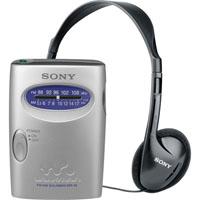
The Sony SRF-59

A few years ago, I heard a lot of buzz in AM/Mediumwave radio circles about a small, inexpensive radio called the Sony SRF-59. Discussions were focused on the incredible performance of this diminutive low-cost radio and how it held it own against some real benchmark receivers. Out of curiosity, I did a search on the radio to see what it looked like–I expected some Tecsun PL-like unit–and found that, much to my surprise, it’s a simple, analog, totally unassuming AM/FM walkman.  Say, what?

The far biggest surprise came with my price search, however. The SRF-59 is easy to find at $14.95 US. Really, you ask? Oh, yes–and it’s readily available at many online and big box stores.

So–carefully counting my pocket change–I took the plunge, and bought one.

The radio came in a basic plastic blister pack, and it also included headphones. I can’t comment on the headphones as I didn’t even bother unpacking them; instead, I plugged my new SRF-59 into my favorite Sony earbuds.

I have to admit, the AM band on this little radio does indeed shine. Not only is the receiver sensitive and relatively selective (meaning, I don’t hear adjacent signals when tuned in), but it also has excellent audio.  Amazingly, it lives up to all of the praise I had heard about it. I’m quite amazed, in fact, at how well this little unit can null out stations by rotating the radio body a few degrees. Most impressive.

Though I’m no major FM radio listener, I can also vouch for its FM performance, which is quite good.

Pros:

  • lightweight–indeed, one can safely say, “ultralight”
  • very inexpensive, by comparision
  • operates almost indefinitely on one AA cell
  • simple design, durable construction
  • AM (Mediumwave) sensitivity and selectivity comparable to $100 shortwave portables
  • because tuning is analog, it works in North America just as well as in Japan (see cons)
Cons:
  • tuning is analog, thus no stations can be saved to memory and there is a noticeable amount of receiver drift if listening over long periods of time
  • no fine-tuning mechanism means that tuning in weak stations takes precision skill on the SRF-59’s very small dial
  • no built-in speaker (this is a Walkman, after all)
In summary, you will regret not purchasing this radio should Sony pull it from the market without warning. While it is a walkman with the above listed limitations, it’s nonetheless a first-rate AM/MW receiver and might be a great avenue into the fun hobby of ultralight DXing.
In short, the Sony SRF-59 is a real gem. But don’t take my word for it, either–go check one out for yourself!
Where to buy:

  • B&H photo
  • Amazon


CNN reports on new Voice of Russia studios in DC

Many long-time shortwave listeners may find it ironic that the likes of Voice of Russia now broadcasts from a studio in downtown Washington DC. I just read this news article posted on CNN about VOR’s new presence:

Jordan Hostetter doesn’t know it, but he’s a target. He’s a young professional living in Washington, curious about international events and listens to the radio while driving to work — just the kind of person Voice of Russia radio is trying to reach.

Changing American hearts and minds about Russia has been Voice of Russia’s mission since it first went on the air in 1929, broadcasting from Moscow via short-wave radio. It still does use short wave but with the Internet, Facebook and Twitter, that seems like a blast from the past.

It goes on to mention how, long-time rival, Voice of America has gone totally digital. Not totally true, in fact, but VOA is putting a major effort into moving off of the shortwave bands. As we mentioned previously, in their shortwave sunset plans, the BBG plans to keep shortwave alive in parts of the world where free speech is suppressed and where shortwave is the only option. They will, most likely, rent broadcasting time from other providers and shut down VOA-run facilities.

What was notable in this CNN article was a tidbit about a VOA attempt to do what their Russian counterpart is doing:

VOA says it tried to get a license to […] broadcast on local Russian radio in Russian to Russians. But Elez Biberaj, VOA’s Eurasia division director, says it was prevented from affiliating with Russian radio and television stations “because of threats and because of the pressure that the government brings on license holders.”

So, I guess, VOA will take on this objective with a web presence?

No doubt, our international broadcasting field is changing. I believe we’ll see more broadcasters following VOR and CRI’s local vector. Perhaps, in fact, this is just what our AM band needs.

China Radio International now on your local AM station

As local AM broadcast (a.k.a. mediumwave) stations around the world struggle to find their local niche, a new global angle may be taking shape. Much like the proliferation of political talk shows in the late 80’s which began to give the AM spectrum  its identity (at least here in the USA) could the AM broadcast band now be a local vector for international communities?

I found this article and story from NPR member station, WBUR in Boston. It features WILD-AM who has traditionally served the African American community in Boston. Their newest offering, however, is coming from thousands of miles away–from China:

1090 WILD-AM was the scrappy little engine that could. A small-budget radio station with big ideas with over 40 years on air, it earned a trusted place in the heart and soul of Boston’s inner city community. But now that’s all gone. The station serves a very different audience.

[…]As of June 1, China Radio International is the new sound of WILD. The station is targeting “new Americans.”

[…]One of the reasons WILD is no longer on the air is that the marketplace has changed — the competition is greater. What’s happened to WILD is not surprising to media observers like WBUR media analyst John Carroll.

“I think it’s a reflection of what’s happening in the radio market overall, a movement toward consolidation, a movement toward nationalization or internationalization, a movement away from local community presence on radio stations and more toward major conglomerates, which are much less expensive to operate,” Carroll said. “One of the issues is can anyone make the FCC care about this?”

Read and listen to this full story at WBUR’s website.

Also, consider reading commentary from Boston Radio Watch.

Radio Caroline seeks a spot on the British AM dial

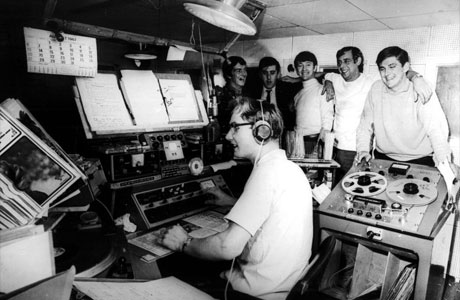
Radio Caroline circa 1960's.

(Source: NY Times)

“Since first taking to the air from a makeshift studio on an offshore ship in 1964, Radio Caroline has endured government raids, shipwrecks and a decade of radio silence before finding a land-based studio in the southeastern county of Kent. From there, a cast of volunteer disc jockeys has transmitted album-oriented rock to a global audience over satellite radio and the Internet since 1999.

But to station management, that global reach isn’t enough. In an age when many prefer to listen to music over the Web or by satellite, Radio Caroline would like to be rewarded for its contribution to British popular culture in the most modest of ways: an AM radio designation in the southeast of England, where it was conceived.”

Read full article at the NY Times.