 RNW announced “A new Radio Netherlands Worldwide” just yesterday on their website; here is their announcement in its entirety (my comments follow).
<><><><><><>
“This coming year is an important one for RNW. A year in which, at the age of 65, we will be reinventing ourselves. Our new Editor-in-Chief William Valkenburg officially begins today; he looks to what lies ahead of us in 2013.
“The era of short-wave radio is behind us; satellite and Internet are the communication channels of the future. The worldwide dissemination of information is no longer the exclusive domain of specialised broadcasters. Via internet, anyone anywhere can reach out to the world with a good story.
“That doesn’t mean journalists and broadcasters are redundant; quite the contrary in fact. Huge amounts of information are available more and more quickly and via all sorts of different channels. The need to filter, analyse and investigate all this information remains the same while the goalposts of journalism have moved completely.
Active link
“Our public is no longer a passive audience that very occasionally might write us a letter, but an active link in the process of newsgathering and distribution. Our public engages actively in discussion and has stories that are worth telling. They help us filter by letting us know what is or isn’t relevant to them. And via social media, our public spreads our best stories further abroad.
“RNW will have to forge a strong and unique identity if we are to win a place as a visible force in the new media landscape. Focus and specialisation are key. Free access to information, freedom of expression, good governance, and civil and sexual rights are the pillars of the new RNW: universal themes we’ll be tackling with an individualistic Dutch approach. We’ll be focusing our work in areas where freedoms are limited and aiming to appeal to a younger generation that is increasingly tuned in to new media.
New stories
“2013 is Year Zero for the new-look RNW. A year in which we’ll be looking more than ever to strengthen cooperation with our partners and audiences in China, Latin America, Africa and the Arab world. A year in which we’ll be actively looking for new ways to find and tell the stories that are important to our audience, and in which our audiences will be encouraged to play an ever more active part. A year in which we’ll be pushing ourselves to cement the ties with our audience and our themes. A year, in short, of dialogue and renewal.”
<><><><><><>
And, unfortunately, of short-sighted misstatements and errors. No doubt, SWLing Post readers know how we feel about this–it’s a recurrent theme in many of our posts.
Shortwave is not behind us, but RNW’s ability to listen may be.
As a shortwave radio broadcaster, RNW arguably had a dedicated listener pool in the millions. Of course, it’s hard to know, because those living in poverty and those living under repressive regimes–millions of listeners–who lack free internet access and whose free speech is regularly quelled, don’t have the ability to cry out, “We’re listening–!”
Millions of ears are still tuned to the static you recently vacated. Outreach in all forms–even via shortwave–is vital, and communication with those still without Internet or freedom (or the voices to tell you so) is a form of diplomacy more valuable than any money spent to achieve it.
 Perhaps host of the previous RNW’s acclaimed program The State We’re In, Jonathan Grubert, had a point when Jonathan Marks interviewed him on the night of RNW’s final shortwave broadcast. Marks asked if RNW had stayed on shortwave too long, to which Grubert responded by saying, “Yeah, I think Radio Netherlands stayed on shortwave too long.” I think Grubert believed that RNW had remained faithful to shortwave at the expense of resources required for other contemporary and future media. And at the expense of their future.
As much as we hate to admit it, he was probably correct…in part. The fact is, the previous incarnation of RNW should have focused on making their shortwave broadcasting arm more lean and efficient, in order to continue to target parts of the world that need it most, while diversifying their media delivery systems to include the Internet, satellite and wireless in all forms. Instead, the organization failed to adapt, and funds were cut completely, leaving RNW gutted. But the lesson is apparently not learned: the new but-not-proved RNW seems to be putting all its eggs in one (Internet) basket, as well.
Indeed, this is the problem with shortwave broadcasting in general. Many broadcasters developed their transmission infrastructure either during WWII or in the Cold War, when countries were willing to invest vast sums of money in order to have their national voice heard. Broadcasting sites were never intended to be efficient: resources were either cheaper when the services were initiated or efficiency simply was not a concern in the days before fiscal cliffs.
Today, it’s true that shortwave radio is on the decline in many parts of the world, particularly first-world countries. In the great pie chart that represents all of the content delivery systems an international broadcaster has at their disposal, the shortwave slice should be thinner, while Internet and wireless-based systems must also be included. Diversification is key. Indeed, I would also argue that a small, separate slice of the budget should be reserved for future HF content delivery systems–such as innovations that are based upon the shortwave radio medium and existing infrastructures. We’d like to think that many are doing this now. After all, shortwave is still the only international communications medium that is resilient to jamming and thus to censorship.
What’s obvious is that shortwave is still highly relevant to those who rely on it, just as the Internet is crucial to the future of international broadcasting. There’s a false dichotomy in the “shortwave vs Internet” argument, and broadcasters and the governments that support them are fooling themselves if they think cutting shortwave will lead to their fiscal salvation and a promised future in new media technologies. One might as well argue the relative merits of wealthy versus poor, or of first world nations versus third because that’s where the divide takes place…Does the former have more “right” to information than the latter? “Free access to information, freedom of expression, good governance, and civil and sexual rights are the pillars of the new RNW.” Already, the first “pillar” of RNW is crumbling under its complete dismissal of shortwave–a tested and effective international content delivery system that requires no subscription and streams at the speed of light.
We found at least this statement from their announcement to be accurate:
“RNW will have to forge a strong and unique identity if we are to win a place as a visible force in the new media landscape…”
In order to achieve this goal–namely, to actively engage a global audience on the “new” world wide web–RNW will need spectacular content created by exceptional talent–much like they had only last year, that is, before they incomprehensibly severed it. As much as we want to believe that Radio Netherlands will continue to have something to contribute to the media landscape after shutting down their shortwave service and gutting their resource pool of talented and dedicated journalists, we’re deeply, profoundly skeptical. To say the least.
Why? They’re nearly two decades late to this game. Obviously, the Internet is no longer a “new” media landscape; it’s absolutely saturated with content and communications innovations. RNW has dispensed with the one thing they might have brought to the Internet–their programming. Once we learned that RNW was going to cut The State We’re In–an award-winning program, arguably RNW’s most popular–we knew RNW wasn’t making logical goal-based decisions to mark their place in future media. RNW’s claim that it will “forge a strong and unique identity” in the face of cutting all that made it respectable, listener-worthy and unique, shows a decided lack of judgement…a lack of direction.
RNW, no one is going to listen if you’ve nothing worth hearing. We hope you can find what you’ve lost–your talent, on the one hand, and millions of listeners, on the other. Connected via radio.

 (Source: SunSentinel)
 For a broadcaster that was rumored to be extinguished last year, REE sure knows how to ring in the new year. I managed to record hours of their live broadcast over the 31 and 49 meter bands.
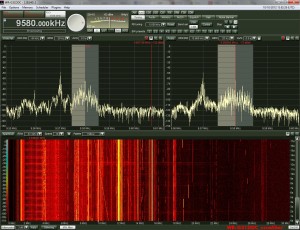 Yesterday, when I attempted to start my WinRadio Excalibur software, I received an error message from Windows 7. No matter if I restarted my PC, re-installed the control software or the USB driver, I simply could not get the Excalibur software to launch.
 Over the holidays, the