Author Archives: Thomas

An AI-Powered Shortwave Radio Resource

A reader, Michael, recently shared a new online resource he created for the shortwave listening community called HQ Shortwave Radio: https://hqshortwaveradio.com

According to Michael, the site lets users enter a frequency and uses AI to help identify what’s currently on the air. It also incorporates current broadcast schedules, propagation information, station listings, maps, and a variety of other tools designed to help listeners explore the bands.

I’m traveling, so I haven’t had an opportunity to put it through its paces and can’t offer an evaluation. That said, while I’m generally not a fan of AI-generated writing, YouTube videos, or artwork, I do think AI can be a genuinely useful tool for organizing, searching, and presenting complex datasets. This seems like an interesting application of that idea, and I’m curious to hear how well it works in practice.

If you give it a try, please share your impressions in the comments. I’m sure Michael would appreciate constructive feedback from fellow SWLing Post readers.

The End of BBC Longwave: News and the Final Off-Air Recording

Droitwich Transmitter Site (Source: Wikimedia Commons)

Many thanks to SWLing Post contributor David Iurescia, who shares this BBC article about the end of an era in British broadcasting: the BBC has permanently switched off its longwave Radio 4 service after nearly a century on the air. The closure marks the end of longwave broadcasting in the UK, with the historic 198 kHz transmitters at Droitwich, Westerglen, and Burghead now falling silent after decades of service.

For many radio enthusiasts, this represents far more than the retirement of an aging transmission system—it is the closing chapter of one of broadcasting’s most iconic services, one that carried everything from the Shipping Forecast to Test Match Special and reached listeners across the British Isles and beyond.

Click here to read the article.

Many thanks as well to SWLing Post contributor Andy Wang, who shares this off-air recording capturing the final hours of the BBC’s longwave service before the transmitters went silent:

Mark’s Charity Shop Find: A Grundig Elite Boy 500

Many thanks to SWling Post contributor, Mark Hirst, who writes:

Thomas,

My local charity shop received a donation recently in the form of a Grundig Elite Boy 500.

It’s in working order, although the volume control needed some Deoxit D5 to solve some bad scratching. Good cosmetic condition and works across all the bands.

Here’s a YouTube video I made of it in action:

Mark

Special Mediumwave Broadcast of “De vliegende Hollander” on August 14, 2026

Many thanks to SWLing Post contributor, Gérard Koopal, who writes:

Dear Thomas,

Just to let you know that Radio “De vliegende Hollander” will transmit on August 14th at 1800 UTC on 1467 kHz. from Roumoules in France with 500 kW.

Radio “De vliegende Hollander” is a LPAM-station from Meppel, the Netherlands.

I realize that this info will be more for Europeans but I hope that Roumoules reaches beyond the targeted area.

Gérard Koopal

Almere,

The Netherlands

Recordings: VOA Chinese and Possible Co-Channel QRM

Many thanks to SWLing Post contributor, Dan Greenall, who writes:

The Voice of America is currently using its Tinang, Philippines site for a broadcast in Chinese beginning at 2100 UTC on 9535 kHz.

Here are 2 recordings of their sign-on with English ID and Yankee Doodle, one using a Kiwi SDR in Athens, Greece, and another using a Kiwi SDR in Taiwan (closer to the target area).

Athens, Greece

Taiwan

The signal starts out OK around 2157 with a test tone prior to Yankee Doodle, but seems to suffer from QRM from a co-channel station signing on after a minute or so. CRI is listed as using 9535 at other times, but perhaps this is a deliberate attempt to make the reception of VOA “uncomfortable”?

July 2026 Schedule Updates: From the Isle of Music & Uncle Bill’s Melting Pot

Many thanks to SWLing Post contributor, Bill Tilford, who shares the following update:

From the Isle of Music, July 2026
This month, some new releases of Cuban jazz
Friday, July 10, 2026, 9670 kHz, 1800 CEST (1600 UTC), repeat on 3955kHz at 2400 CEST (2200 UTC)

Uncle Bill’s Melting Pot, July 2026
Friday, July 17, 2016: 9670 kHz at 1600 UTC, repeats on 3955 kHz at 2200 UTC
To recognize the 250th anniversary of the US Declaration of Independence, we will feature “Stan Freberg Presents the United States of America Part 1”, a comedic version of US history.

All transmissions on international shortwave from Channel 292 in Germany. https://www.channel292.de/

In addition to direct terrestrial reception, we do honor reception reports using remote SDRs, provided that both the physical location of the listener and the location of the remote SDR are given. EQSLs only

My Recording of the 2026 BBC Midwinter Broadcast to Antarctica

by Thomas (K4SWL)

First, a huge thank you to everyone who has submitted recordings of this year’s BBC Midwinter Broadcast to Antarctica on our recording-sharing post. It’s been a real pleasure browsing reception reports and recordings from around the globe.

If you haven’t yet shared your recording, there’s still time! Please add it to the original post here.

(Please post your recording there rather than in the comments of this post so we can keep all of the recordings together in one place.)

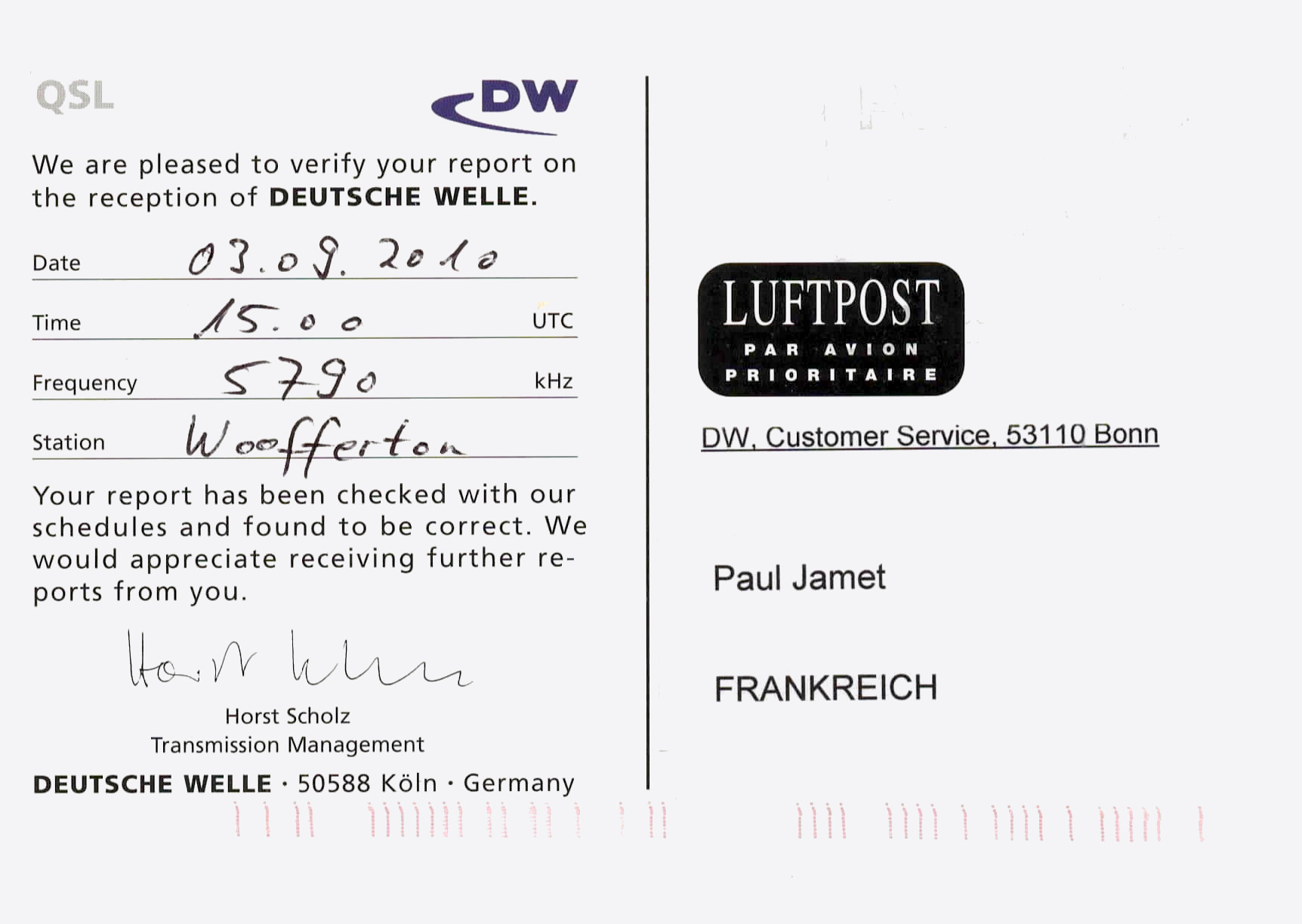
I thought I’d share my own recording of the broadcast because this year’s reception was especially memorable. Unlike previous years when I’ve listened from the United States or Canada, I’m in the UK this year—and the results were brilliant. Both frequencies transmitted from the Woofferton site delivered excellent audio quality.

Recording notes:

This is the BBC Midwinter Broadcast to Antarctica recorded on June 21, 2026 at 09:30 UTC in Foulden, Scotland, UK. The radio was an Elecraft KX2 connected to a 31-foot 9:1 random wire antenna in the back garden. The broadcast starts on 9460 kHz, but I then move to 12070 kHz because it had slightly less local noise.

Click here to download.

Thank you again to everyone who has contributed recordings and reception reports.

The BBC Midwinter Broadcast remains one of my favorite SWLing events of the year. I simply love the idea that the BBC would broadcast from two different sites on three different frequencies via shortwave to a relatively small audience of British Antarctic Survey scientists wintering over in Antarctica.

It’s always a joy to listen live, knowing that they’re celebrating midwinter with parties at their stations and hearing the voices, messages, laughter, and well-wishes of loved ones carried to them over the air by shortwave radio.

In an age of instant communications, there’s still something magical about that.