Author Archives: Thomas

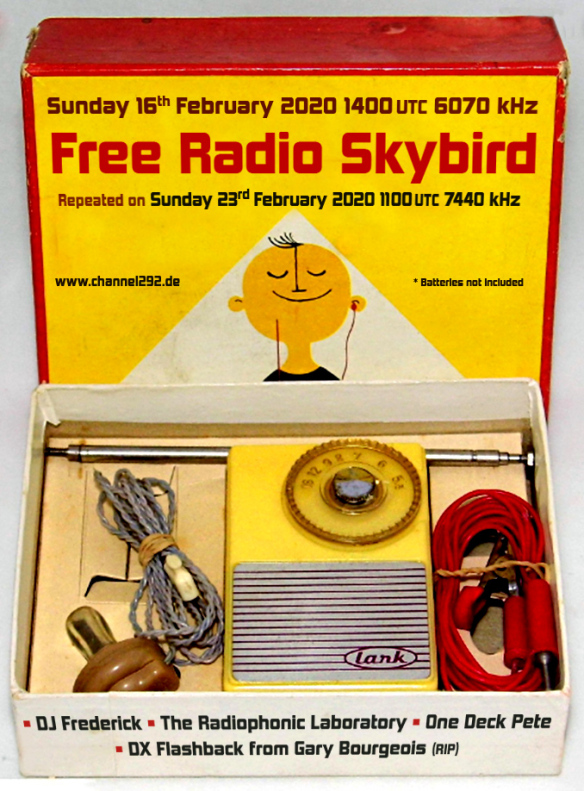
Free Radio Skybird returns February 16th and 23rd

(Source: Pete Madtone)

It seems like it’s been a while since DJ Frederick’s Free Radio Skybird was last on the shortwaves. Don’t worry, it won’t be long until the next one on Sunday 16th February at 1400 UTC/UK on 6070 kHz via Channel 292. The show will be rebroadcast on Sunday 23rd February at 1100 UTC/UK on 7440 kHz. If you haven’t got a shortwave radio it can also be heard on the SDR link on Channel 292’s site here.

The programme will feature Justin Patrick Moore’s Radiophonic Laboratory and One Deck Pete (from Weeds up to me knees) presenting the Skybird Mailbag. There’ll also be an airing of Pete’s “Less is more” that has new tunes from MaiMohammad-Reza  Shajarian & Seventh Soul and Blanco.

Mixes from previous shows are available at our audio podcast page here. The programme will be available on DJ Frederick’s Soundcloud page a day or so before transmission date if you want to hear it in true stereo but we here prefer the show with added noises from the ionosphere. Tune in and turn on! #shortwavesnotdead #madtone #freeradioskybird

The secret role of Beaumanor Hall

(Source: Southgate ARC)

The Leicester Mercury reports on the top secret wartime listening station role of a Leicestershire mansion

As we approach the 75th anniversary of VE Day in May, a Loughborough Library Local Studies Volunteer (LLLSV) tells the fascinating story of Beaumanor Hall’s crucial role in the Second World War.

Many readers may not know, but Beaumanor Hall was the site of a vital wartime intelligence service, namely the War Office “Y” (wireless) Group or W.O.Y.G.

The top secret “Y” Group was part of M18 Wireless Intelligence and Beaumanor was a highly-strategic “Intercept Station”, concerned with monitoring the enemy’s main channels of wireless traffic and communications.

The “Y” Intercept Listening Service operated from 1941 to 1945 and its wartime activities were as top secret as those at the Code and Cypher School at Bletchley Park.

Click here to read the full story at The Leicester Mercury.

World Radio Day 2020

Today is UNESCO World Radio Day and this year the theme highlights diversity on the airwaves. Here’s the announcement from UNESCO:

On World Radio Day 2020 (WRD 2020), UNESCO calls on radio stations to uphold diversity, both in their newsroom and on the airwaves.

Radio is a powerful medium for celebrating humanity in all its diversity and constitutes a platform for democratic discourse. At the global level, radio remains the most widely consumed medium. This unique ability to reach out the widest audience means radio can shape a society’s experience of diversity, stand as an arena for all voices to speak out, be represented and heard. Radio stations should serve diverse communities, offering a wide variety of programs, viewpoints and content, and reflect the diversity of audiences in their organizations and operations.

This edition of WRD is divided into three main sub-themes:

    • ADVOCATING for pluralism in radio, including a mix of public, private and community broadcasters.
    • ENCOURAGING representation in the newsroom, with teams comprised of diverse society groups.
    • PROMOTING a diversity of editorial content and programme types reflecting the variety of the audiences.

Click here to check out the UNESCO website devoted to World Radio Day 2020.

Happy World Radio Day, everyone!

Loss of BBC Hindi shortwave service and listener reactions

(Photo by Elle via Unsplash)

Many thanks to SWLing Post contributor, David Iurescia (LW4DAF), who shares the following story from The Print:

Emotional emails & offers to crowdfund — how fans tried to keep BBC Hindi radio on air

The service fell silent last month with its last transmission on 31 January. The BBC management now plans to boost its digital and TV presence.

New Delhi: It was the BBC’s Hindi radio on shortwave that slowly carved an identity for the British broadcaster in India after its launch 80 years ago. With an estimated audience of 40 lakh across India, the radio service was the first choice for consumers of serious news and entertainment alike, particularly in the remote and far-flung parts of the country.

But the service fell silent last month, on 31 January, with the BBC management citing a dwindling audience and plans to boost digital and TV presence as reasons to call time on this chapter of history.

It came as a rude shock for its loyal audience and the dismay was evident, according to BBC insiders.

“It was heartbreaking to see the kind of emotional emails and letters we received on the days preceding the shutdown and after that,” an insider told ThePrint. “They (the audience) pleaded to keep the service afloat. Some even said they were willing to crowdfund it. But it seems the management was interested in the numbers and the BBC Hindi radio service on shortwave was not giving them adequate numbers.”

Another insider in the BBC said audience numbers for the radio service had come down from 1 crore a few years ago to about 40 lakh now, even as its presence on platforms such as YouTube thrived. The service has also established its presence on television with a tie-up with news channel NDTV.

“But in our experience the quality of news consumers is poor in digital as compared to the loyal audience that BBC Hindi radio service in shortwave enjoyed,” the second insider said, basing the assessment on feedback received from both sets of audiences.

“I would say the management was insensitive to the millions of listeners in the remote corners of India who banked on the service as their daily source of news,” the insider added.

The decision to switch off BBC Hindi radio is part of the British broadcaster’s global cost-cutting efforts. It had planned to end the BBC Hindi radio service in 2011, but changed plans owing to massive outrage and a high-profile campaign supported by eminent journalist and author Sir Mark Tully, a former bureau chief of the BBC.

It’s not just the BBC Hindi radio service that has suffered on account of this twin push to cut costs and go digital. Even BBC Urdu announced in December last year that it will end the radio broadcast of its popular news and current affairs programme, Sairbeen.

In India, BBC also has internet broadcasts in other Indian regional languages, but no associated radio services. […]

Continue reading the full article at The Print.

Radio Waves: Russian State Radio in KC, FRBs, New-Cycle Sunspot, and ABC Friends Bushfire Update

Radio Waves:  Stories Making Waves in the World of Radio

Because I keep my ear to the waves, as well as receive many tips from others who do the same, I find myself privy to radio-related stories that might interest SWLing Post readers.  To that end: Welcome to the SWLing Post’sRadio Waves, a collection of links to interesting stories making waves in the world of radio. Enjoy!

Many thanks to SWLing Post contributors Michael Bird and Ted Miller for the following tips:


Meet The Man Who Brought Russian State Radio To Kansas City (KCUR)

The man responsible for broadcasting Russian state programming in the Kansas City area says he always dreamed of owning a radio station.

Today he owns two, plus a small fleet of radio transmitters across the Kansas City metro.

But money remains tight, he laid off his staff years ago and the stations sell airtime to local residents and religious organizations at cut-rate prices. He hasn’t given himself a paycheck in months.

So Pete Schartel’s ears perked up a while back when he heard that Radio Sputnik pays $30,000 a month to broadcast its programming in Washington, D.C.

“I’m going, ‘Oh my Lord, that’s twice what my whole budget is,’” he told KCUR in a two-hour interview at his flagship station, KCXL, last week. “They must have some money. Let’s investigate this.”

Schartel found Arnold Ferolito, the broker who negotiated the 2017 deal to broadcast Russian programming 24 hours a day in Washington, and made his pitch: “We’re right in the middle of the country. This would be a good test market.”[]

Something in Deep Space Is Sending Signals to Earth in Steady 16-Day Cycles (Vice)

Scientists have discovered the first fast radio burst that beats at a steady rhythm, and the mysterious repeating signal is coming from the outskirts of another galaxy.

A mysterious radio source located in a galaxy 500 million light years from Earth is pulsing on a 16-day cycle, like clockwork, according to a new study. This marks the first time that scientists have ever detected periodicity in these signals, which are known as fast radio bursts (FRBs), and is a major step toward unmasking their sources.

FRBs are one of the most tantalizing puzzles that the universe has thrown at scientists in recent years. First spotted in 2007, these powerful radio bursts are produced by energetic sources, though nobody is sure what those might be. FRBs are also mystifying because they can be either one-offs or “repeaters,” meaning some bursts appear only once in a certain part of the sky, while others emit multiple flashes to Earth.

Pulses from these repeat bursts have, so far, seemed somewhat random and discordant in their timing. But that changed last year, when the Canadian Hydrogen Intensity Mapping Experiment Fast Radio Burst Project (CHIME/FRB), a group dedicated to observing and studying FRBs, discovered that a repeater called FRB 180916.J0158+65 had a regular cadence.[]

A New-Cycle Sunspot is Forming (SpaceWeather.com)

Today, [February 7, 2020] a new sunspot is emerging in the sun’s southern hemisphere, right here. Its magnetic polarity identifies it as a member of Solar Cycle 25, the long-awaited next solar cycle. Although solar activity remains low, this new-cycle spot continues the recent trend of intensifying Solar Cycle 25 sunspot formation. Apparently, Solar Minimum won’t last forever….www.spaceweather.com

ABC Friends’ Special Bushfire Edition of Update (ABC Friends)

British natural historian David Attenborough has described this summer’s fires as ‘a major international catastrophe.’ Read gripping personal accounts of bushfire experiences, analysis from our National President Margaret Reynolds and Vice-President Professor Ed Davis, selected articles from journalists, reports from the ABC, and the observations of many ordinary Australians on the role of the ABC as our Emergency Broadcaster.

The ABC’s Emergency Broadcasts saved lives and kept families safe. Hundreds of ABC staff, many returning early from leave and working in extreme conditions, brought stories, pictures, sound and  essential emergency information to every corner of Australia.  It is appalling that many ABC staff are facing redundancy as a result of the recent $83.7 million budget cuts inflicted on the ABC by the Morrison government, on top of the $250m in cuts since 2014.

ABC Friends will be in Canberra when parliament resumes to demand the restoration of funds so that our ABC remains strong and independent.

Read Update here

Update is the national membership magazine of ABC Friends. Not a member? Sign up here.

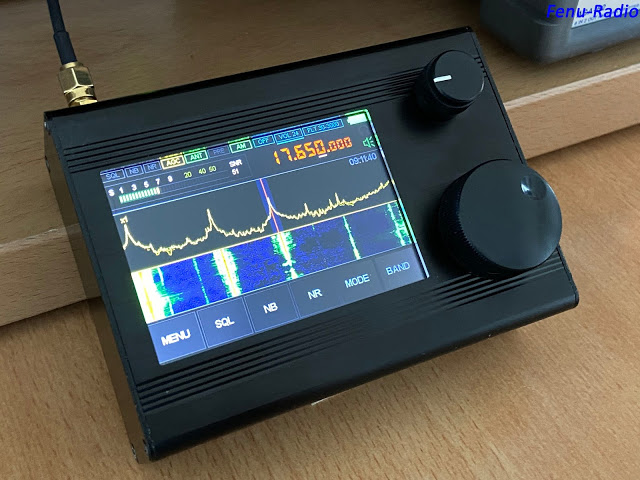
The Malahit-DSP: A potential Holy Grail portable SDR?

(Image via Fenu Duarte)

Many thanks to SWLing Post contributor, Dan Robinson, who provides this update to his article on the Belka DSP receiver. Dan writes:

One of the other DSP radios shown being demonstrated on YouTube is this one by Georgy Yatsuk, presumably from somewhere in Russia. In his comments posted on January 14th, Fernando Duarte who runs the FENU site says:

“This little gem makes a name for itself. Everyone wants it. But it is still difficult to get. Georgy Yatsuk (RX9CIM) developed this small portable SDR with two of his colleagues. What this little guy offers is simply phenomenal! -Frequency range: 50KHz-2GHz -All important types of operation -160KHz wide waterfall & spectrum display zoomable -Noise reduction adjustable -Noiseblanker adjustable -Equalizer for adjusting the timbre – Controllable via PC -Control via CAT -etc, etc … Because the firmware is still in full development, certain functions will definitely be added. A test and a detailed presentation will be available on my website in the near future. Stay tuned !!”

https://fenuradio.blogspot.com/2020/01/malachit-dsp-der-edelstein-aus-russland.html

As of this moment there is no additional information as to whether this seemingly excellent receiver will ever become available and in what numbers.

Many thanks for this update, Dan! We published a post about the Malahit-DSP in November on a tip from H. Garcia (PU3HAG). I have put in an inquiry to purchase one to evaluate here on the SWLing Post as well.  This does look like a fascinating portable SDR!


Do you enjoy the SWLing Post?

Please consider supporting us via Patreon or our Coffee Fund!

Your support makes articles like this one possible. Thank you!

RTI and Space Line test broadcasts (Feb 22 – Mar 1)

Many thanks to SWLing Post contributor, Kanwar Sandhu, who writes:

Following email was received by Radio Taiwan International, French Service:

French service will collaborate with Space Line from Bulgaria for a daily broadcast of thirty minutes from 19:00 to 19:30 UTC from Sunday March 29, 2020. Broadcasting will be provided from the city of Kostinbord on the frequency 6005 kHz.

Before the official resumption of our broadcast, we will conduct five days of trial scheduled for February 22-23, 28-29 and March 1.

We would like to invite you to help us to find out the listening conditions by sending us your listening reports on these five days of testing. (Meg Wang, French Service RTI)

Many thanks, Kanwar, for sharing this tip!