Category Archives: Digital Modes

More shortwave digital text (and the reason behind it)

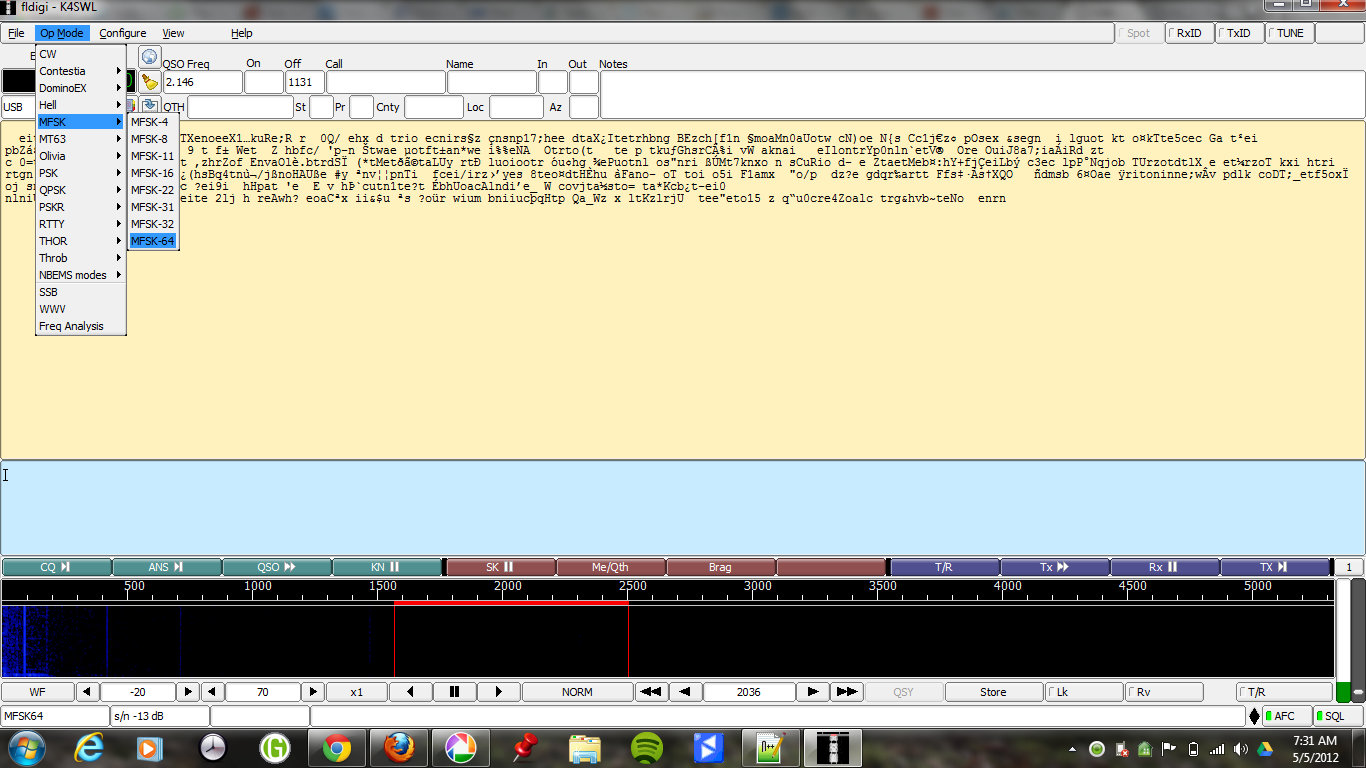
Screenshot of digital mode being selected in FLDIGI. Click image to enlarge.

SWLing Post readers have seen previous posts regarding text being broadcast via shortwave digital modes on WBCQ, WRMI and The Mighty KBC (which broadcasts again this weekend).

Recently, Kim Elliott explained his mission behind these digital tests. Not only do I agree, but I support him completely. Why? It’s proof that the shortwave spectrum is an excellent medium to transmit digital information across the globe. Decoding requires a very basic shortwave radio, some free software and a computer. I believe, in the near future, there will be a smart phone app that can handle this with ease–it simply needs a developer (hint, hint).

Here is Kim Elliott’s post on the topic–I have emphasized points in bold:

Radio amateurs use several modes to transmit text via shortwave. It occurred to me that text via shortwave might be a workaround whe[r]e the internet is not available because of disasters, dictators, or other causes.

I have not yet convinced any major international broadcasters to let me test this hypothesis on their (remaining) shortwave transmitters. However, the Netherlands-based Mighty KBC has kindly been allowing me two one-minute segments during their broadcast to North America at 0000 to 0200 UTC on 9450 kHz. This is via leased time on a transmitter in Bulgaria.

Reception of text via shortwave is possible on an inexpensive shortwave radio, even one without single sideband (SSB) capability. The audio is patched into a PC that does not have to be especially powerful. This involves a patch cord from the earphone jack of the radio to the microphone input of the PC. If there is no patch cord, placing the radio’s speaker near the built-in microphone of a laptop might work.

Software for decoding the text should be installed in the PC. There are several available to radio amateurs, including DM780, MixW, and MultiPSK. Especially popular these days is Fldigi. This is available from www.w1hkj.com. While you are there, please also download Flmsg, because it will be needed for this weekend’s test on KBC. [Note: This software is free and open source.]

This weekend’s test on KBC will feature the MT63 modes with long interleave. After Fldigi is installed, go to Configure > Modems > MT-63 > check 64-bit (long) interleave, 8-bit extended characters, and Allow manual tuning. Also, go to Configure > Misc > NBEMS > check Open with flmsg and Open in browser and, below that, indicate where your flmsg.exe file is located.

The first KBC text transmission will be around 0130 UTC Sunday (Saturday evening 8:30 pm EST). The MT63-1000 mode with long interleave will be centered at 1000 Hz on the waterfall visible on the software display. PSKR125 will be cenetered at 2200 Hz. Decode one while listening, and decode the other from your recording of the transmission.

The second text transmission will be just before 0200 UTC Sunday (9 pm Saturday EST). This will be MT63-2000 centered at 1500 Hz. This message will be formatted for Flmsg. If all goes well, the shortwave transmitter in Bulgaria will open a new window of Flmsg and then open a new window of your web browser with formatted content, in color no less.

One week after my first text transmissions (11 November) on KBC, Arnie Coro at Radio Havana Cuba began transmitting digital text modes on his Dxers Unlimited program (in English). He might do so again this weekend. The schedule for DXers Unlimited can be found at the World of Radio website (where all times and days are UTC, so those UT Monday transmissions are actually Sunday evening in North America).

More discussion of the concept of digital text via analog shortwave broadcast is in Kim’s December 2012 column (pdf) for the North American Shortwave Asociation.
The Mighty KBC to broadcast in DRM (Digital Radio Mondiale)

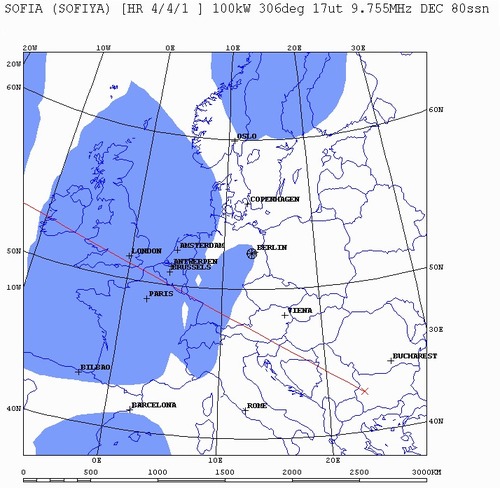
DRM propagation map for Europe (image courtesy: The Mighty KBC)

The Mighty KBC has announced that they’re going to broadcast in DRM again on the 22, 23, 25 & 26 of December from 16:00 – 18:00 UTC. This is in addition to their previous announced December specials. The DRM broadcasts will come from a 100 kW transmitter and curtain antenna in Kostinbrod (Sofia) Bulgaria on 9,755 kHz DRM.

Tune in and let us know if you heard The Mighty KBC in DRM.

Saturday, from Bulgaria, Dr. Elliott will control your web browser

As DRMNA.info says:

“Let Dr. Elliott take control of your PC!”

I agree.

On several occasions now, Dr. Kim Elliott has transmitted digital messages via shortwave radio in an assortment of digital modes. We’ve mentioned this in the past (and we even posted a tutorial on decoding his WBCQ message).

Early Sunday morning (UTC–Saturday night for many) The Mighty KBC will once again broadcast some of Elliott’s digital messages from 00:00-02:00 UTC on 9,450 kHz. This time, they’ll even broadcast two different messages in two different modes simultaneously (details below). No Johnny, this isn’t your granfather’s shortwave:

(Source: Kim Elliott)

The Mighty KBC, 21 Nov 2012: “This UTC Sunday, 25 November, more digital text during the broadcast of The Mighty KBC at 0000 to 0200 on 9450 kHz. At about 0130 UTC, PSK125 will be centered at 1300 Hz on the waterfall, MFSK32 at 2200 Hz. Decode one from the radio, and the other from your recording. Just before 0200, only one mode, MFSK32, will be transmitted, centered at 1500 Hz. For this message, please have Fldigi and Flmsg (both available from www.w1hkj.com), as well as your web browser, all running on your PC. If all goes well, at the end of this transmission, the message should pop up in new windows of Flmsg and your browser. (In Flmsg, click Configure, then Misc, then NBEMS, then check Open with flmsg and check Open in browser.)

[Elliott’s comments] “UTC Sunday 25 November at 0000 to 0200 UTC is the same as Saturday evening, 24 November, 7 to 9 pm Eastern Time in North America. This transmission on 9450 kHz is via a leased transmitter in Bulgaria.

To decode the two text transmissions, download Fldigi and Flmsg from w1hkj.com. Configure Fldigi to work with your PC’s sound card.

Also, in Fldigi, click Configure, Misc, NBEMS. Under NBEMS data file interface, click Enable. Under reception of flmsg file, click Open with flmsg and Open in browser.

During reception, patch audio from the earphone or line out jack of your radio to the microphone input of your PC. You may have to experiment a bit with audio settings. You should see a “waterfall” on your Fldigi display.

If all goes according to plan, when the text message just before 0200 UTC (9 pm Eastern) is completely received, it should pop up in a new window of your default web browser.

By the way, if you haven’t noticed, I’m a big fan of The Mighty KBC. Not only do they broadcast an excellent mix of music on shortwave radio, but they’ll also blast these digital messages to their listeners. Thanks, KBC!

Again, please comment if you decode these messages!

The Mighty KBC tests 9,450 kHz and will send a digital message this weekend

KBC Propagation Map (Source: The Mighty KBC)

This Sunday, from 00:00-02:00 UTC, The Mighty KBC will again broadcast 2 hours of music on the 31 meter band.  This time, they will be testing on 9,450 kHz to avoid adjacent signal interference heard on 9,500 kHz last week.

They will also broadcast a special digital message at 01:30 and then again prior to the end of their broadcast. They have sent full details about the broadcast in a press release (below). Note that though the mode is different, the procedure of decoding the digital message is similar to the one WBCQ broadcast this year. We published a short primer on decoding the WBCQ message in May.

Here are the details on Sunday’s broadcast and how to decode the QPSK125 message:

(Source: The Might KBC)

The Mighty KBC will test to the USA on Sunday 11 November 2012 00.00 – 02.00 UTC on 9450 kHz!

Please join the Mighty KBC for a test of a digital text sent via a shortwave broadcast transmitter. This will take place during the next transmission to North America, Sunday 0000-0200 UTC, at approximately 0130 and just before the end of the broadcast at 0200.

All you need is a basic shortwave receiver (no SSB mode is necessary), and a basic personal computer. Using a patch cord, you will feed the audio out of the earphone jack (or line out) of your radio into the microphone jack of your PC. If you don’t have a patch cord, you can try placing the speaker of your radio close to the built-in microphone of a laptop PC.

You will also need software. There are several freeware or shareware programs used by the amateur radio community that decode digital text modes. One is FLDIGI, available from http://www.w1hkj.com .

After installing FLDIGI, pull down the Configure menu, then click Sound Card, and select the soundcard your PC is using.

You might also have to adjust your audio settings. In Windows 7, left click twice on the speaker icon in the lower right of PC display, then click Options, then click Properties, then click Recording, then click the input that works. Other operating systems will have different procedures. A good way to test your audio settings is to try to decode the radio amateurs using the PSK31 mode on 14070 kHz.

For the test digital text transmissions on Sunday, The Mighty KBC will be using the QPSK125 mode. On your software, your cursor should be centered on 1500 Hertz, where you will see the “waterfall” of the QPSK125 signal. You can decode the transmission while you receive it, or record the transmission and decode from the recording. The latter will give you more opportunities to perfect the technique.

The test to be transmitted will be a formatted html file. Copy it from <html> to (and including) </html>, and paste it to a text editor (such as Notepad in Windows). Save the file, using any file name, with the suffix .htm or .html. Then open the file in any web browser. If all goes well, this might be the first time you receive a shortwave radio broadcast in color!

In the future, an app will be developed to make this process simpler!

Radio World looks at DRM

(Source: Radio World)

By: Ernie Franke

Once touted as the “Savior of Shortwave,” Digital Radio Mondiale has not lived up to its hype. Proposed in 1988, with early field-testing in 2000, inaugural broadcasting in 2001 and its official rollout in 2003, DRM has had a lackluster career over the last decade.

With the allure of FM-quality audio and fade-free operation, it had appeared that DRM might revive the shortwave community. Unfortunately, it has been overcome by other events, some technical and some social. The main weakness has been alternate sources of information and entertainment, fueled by the very technology that gave DRM hope.

Additionally, in areas of the world without ubiquitous social media, DRM has yet to realize receivers at a moderate cost with adequate battery life. The very processing technology that allows improved operation using the more complex DRM waveform costs more and consumes more power than the standard AM receiver. A quick look at standalone DRM receivers over the past decade shows almost a dozen companies entering the market, only to retreat when the promise didn’t materialize.

[…]The rise of the Internet has influenced many broadcasters to cease their shortwave transmissions in favor of broadcasting over the World Wide Web. When BBC World Service discontinued service to Europe, North America, Australasia and the Caribbean, it generated many protests. The shifting of resources from shortwave to Internet and television by the Broadcasting Board of Governors, which oversees U.S. international broadcasting, further reduced broadcasting hours in the English language. […]Although most of the prominent broadcasters continue to scale back their analog shortwave transmissions or completely terminate them, shortwave is still common and active in developing regions, such as parts of Africa and South America.[…]

The article then goes into an in-depth look at both the reasons for and technology behind Digital Radio Mondiale–both on the broadcasting and receiving ends.

Read the full article at Radio World’s website.

German Armed Forces Radio testing in DRM

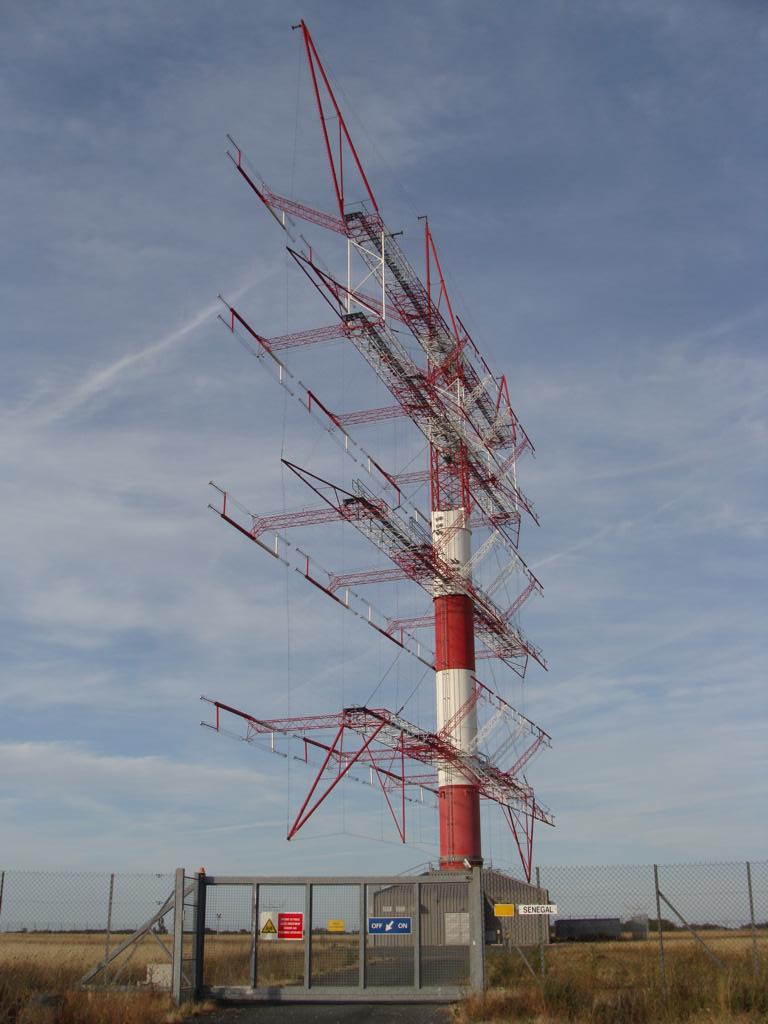
Issoundun HF antenna (Photo: dxaktuell.de)

Radio Andernach, Germany’s armed forces radio station, is now testing in Digital Radio Mondiale (DRM) on 6,015 kHz from TDF Issoudun in central France. They claim that the potential move to DRM would mean that they would equip all of their Naval vessels with DRM receivers.

Source:
http://www.dxaktuell.de/?p=2616

Thanks to Alokesh and Marc for the tip!

DRM Consortium publishes the DRM Introduction & Implementation Guide

The DRM Consortium has made their DRM Introduction & Implementation Guide available for download on their site. The  guide is intended for management of broadcasting organizations, “in areas of policy making as well as in program making and technical planning.” I imagine a few SWLing Post readers will enjoy it too.

Thanks to DRMNA.info for the tip!

Download the DRM Introduction & Implementation Guide via the DRM Consortium (PDF).