Category Archives: Ham Radio

BBC Radio 4 – Lights Out: Call Signs


My dear friend and SWLing Post community member, Volodymyr Gurtovy (US7IGN), has been featured in another brilliant documentary on BBC Radio 4 called Call Signs.

This documentary was produced by the talented Cicely Fell with Falling Tree productions for BBC Radio 4. Note that Cicely also produced a BBC Radio 4 Short Cuts earlier this year featuring Vlad as well. Enjoy:

BBC Radio 4 Lights Out: Call Signs

A man, a Mouse and a morse key: the story of a radio amateur in Kyiv as the Russian invasion unfolds.

When his wife and two children flee Kyiv to escape the war, Volodymyr Gurtovy (call sign US7IGN) stays behind in their apartment with only his radios and the family hamster, Mouse, for company.

Before the war, he used to go deep into the pine forests, spinning intricate webs of treetop antennas using a fishing rod, catching signals from radio amateurs in distant countries.

Prohibited by martial law from sending messages, he becomes a listener, intercepting conversations of Russian pilots and warning his neighbours to hide in shelters well before the sirens sound. After three months of silence, he begins transmitting again. Switching his lawyer’s suit for a soldering iron, he runs a radio surgery for his friends and neighbours, dusting off old shortwave receivers and bringing them back to life.

During air raids, he hides behind the thickest wall in his apartment, close to his radios, their flickering amber lights opening a window to another world. A story of sending and receiving signals from within the darkness of the Kyiv blackout.

Music: Ollie Chubb (8ctavius)
Producer: Cicely Fell
A Falling Tree production for BBC Radio 4

Listen to Call Signs on BBC Sounds by clicking here, or via the embedded player below:

Today: HAARP to bounce signal off asteroid; SWLs/Hams asked to listen and record results

Many thanks to a number of SWLing Post readers who share the following announcement–also previously noted by Robert–from the University of Alaska Fairbanks (followed by an announcement from the ARRL):

HAARP to bounce signal off asteroid in NASA experiment (UAF News)

An experiment to bounce a radio signal off an asteroid on Dec. 27 will serve as a test for probing a larger asteroid that in 2029 will pass closer to Earth than the many geostationary satellites that orbit our planet.

The High-frequency Active Auroral Research Program research site in Gakona will transmit radio signals to asteroid 2010 XC15, which could be about 500 feet across. The University of New Mexico Long Wavelength Array near Socorro, New Mexico, and the Owens Valley Radio Observatory Long Wavelength Array near Bishop, California, will receive the signal.

This will be the first use of HAARP to probe an asteroid.

“What’s new and what we are trying to do is probe asteroid interiors with long wavelength radars and radio telescopes from the ground,” said Mark Haynes, lead investigator on the project and a radar systems engineer at NASA’s Jet Propulsion Laboratory in Southern California. “Longer wavelengths can penetrate the interior of an object much better than the radio wavelengths used for communication.”

Knowing more about an asteroid’s interior, especially of an asteroid large enough to cause major damage on Earth, is important for determining how to defend against it.

“If you know the distribution of mass, you can make an impactor more effective, because you’ll know where to hit the asteroid a little better,” Haynes said.

Many programs exist to quickly detect asteroids, determine their orbit and shape and image their surface, either with optical telescopes or the planetary radar of the Deep Space Network, NASA’s network of large and highly sensitive radio antennas in California, Spain and Australia.

Those radar-imaging programs use signals of short wavelengths, which bounce off the surface and provide high-quality external images but don’t penetrate an object.

HAARP will transmit a continually chirping signal to asteroid 2010 XC15 at slightly above and below 9.6 megahertz (9.6 million times per second). The chirp will repeat at two-second intervals. Distance will be a challenge, Haynes said, because the asteroid will be twice as far from Earth as the moon is. [Continue reading…]

The ARRL provides the following specific information about how SWLs and Hams can participate:

Amateur Radio Operators Invited to participate in Asteroid Bounce Experiment (ARRL News)

The High-frequency Active Auroral Research Program (HAARP) will be conducting a research campaign/experiment on December 27, 2022, with transmissions between 1100 – 2300 UTC (0200 – 1400 AKST).

[…]Actual transmit times are highly variable based on real-time ionospheric conditions and all information is subject to change. Currently, the Asteroid Bounce (2010 XC15) experiment will take place Dec. 27, 2022, from 1100 UTC to 2300 UTC; 9.6 MHz, LFM (linear FM), 0.5 Hz WRF (waveform repetition frequency), 30 kHz bandwidth. Reports recording echo are encouraged; demodulated recordings in .wav or .mp3 are recommended.

For real-time ionospheric conditions in Gakona, please consult ionograms from the HAARP Diagnostic Suite at https://haarp.gi.alaska.edu/diagnostic-suite.

Amateur radio and radio astronomy enthusiasts are invited to listen to the transmissions/echoes and submit reception reports to the HAARP facility at [email protected] and request a QSL card by mailing a report to:

HAARP
P.O. Box 271
Gakona AK 99586
USA

Click here to read this announcement on the ARRL News website.

Alexander’s POV: Community disaster preparedness favors ham radio in Germany

Many thanks to SWLing Post contributor, Alexander (DL4NO), who writes:

A Message from Germany: Growing Disaster Preparedness favours Ham Radio

For a long time most radio amateurs in Germany found themselves in the defensive: Building regulations, combined with EMC standards, heavily restrict antenna possibilities. Neighbors fear “dangerous” radiation, often going to court without any legal reasons. Emergency services got a much improved digital communication systems (TETRA), removing many of the artificial borders where they sometimes used ham radio to build bridges.

This could be quite different, as you can see in Austria. If radio amateurs organize a congress about emergency traffic, even the federal government and the Austrian army send competent representatives.

But the political turmoil and the connected energy crisis change attitudes in quite some branches of administrations:

The county of Soest urges citizens to buy license-free PMR handheld radios so they can reach the “light houses” that the county of Soest is creating all over its area.

The county of Ebersberg, east of Munich, is well known for its initiatives. Recently they invited the regional chapter of DARC, our German ham radio society, to discuss the build-up of a resilient data net for the county. In normal times, this data net could be used as part of HAMNET, our part of 44net. The county and towns would help to get access to suitable positions, including power supply. Some of the stations, for example on town halls, might be dormant most of the time. But as soon as power goes out, local radio amateurs are to activate the emergency net. The first application is to be VoIP, i.e. a independent phone service.

The county of Freising, a few km to the north, is also interested in working together with radio amateurs. We are just building a task force for this.

These activities are quite different from traditional emergency traffic. The most important difference: We work as enablers, not as radio officers. Our task will be to maintain the system, make it operational in case of an emergency, and introduce the officials to its use.

This is critical as we do not have enough radio amateurs to get the messages, send them over our system, and hand them down to the respective officer: Multply 2 radio amateurs by 3 shifts per day by a new crew every second day by the number of sites.

And in normal times, we can enjoy a much improved HAMNET coverage. Until now, most radio amateurs only had to access 44net through VPNs over the Internet.

Please comment!

Guest Post: 10 Meter Beacon DXing

Many thanks to SWLing Post contributor, Walter Salmaniw, who shares the following guest post:


10 Meter Beacon DXing

by Walter Salmaniw, Masset, BC

My hobby of radio listening has evolved over the years.  Beginning with crystal radios as a child in the 60s, I’ve migrated through SWLing with numerous rigs including the kings of valve technology, like the Collins R390A and Racal RA17, and then on to high end mil-spec solid state rigs:  Racals, Harris, Ten-Tec, and my all-time favourite, the Rockwell-Collins HF-2050 receiver.   Unfortunately, broadcast band stations, especially transmitting to North America, have dwindled over the years, and my favourite Pacific stations also disappeared:  120 and 90 meter Indonesians, the 60 meter AIR network, and the numerous PNG stations.  Well, what’s one to do?

About 10 years ago, I switched over to MW DXing, and especially trans-Pacific and trans-Atlantic DX.  My cottage near Masset, BC is the ideal location for such DXing, as I have an ocean beach location, the room for some great antennas, and very low noise in the area.  This has produced some incredible DX, and I’ve been honoured with visits by some pretty eminent DXers, including Victor Goonetilleke from Sri Lanka, Mauno Ritola from Norway, Vlad Titarev from Ukraine, as well as our own experts in DXing from Victoria and the Pacific North-West of the US.

MW DXing is great, but that involves DXing primarily during the night time and early morning hours.  What to do with the rest of the day?  Well, with the rising sunspot counts and heading toward the peak of the next solar cycle, why not look at 10 meters?  About 2 years ago, with a lot of help from the local DX geniuses, I was able to remote my set-up in Masset, and DX even when at home in Victoria, BC.  10 meters has consistently remained open almost every afternoon.  Now, I’m not a ham, and at this point, have no interest in obtaining my ham license.  However, I noted a lot of beacon activity on 10 meters.

I’ve dabbled in LW NDB DX, which can be a lot of fun.  Why not do something similar on the higher frequencies?   Not being a ham, I needed some help with decoding the beacons.  Thankfully, one can often see the CW and it’s slow enough to read in many cases.  Being a bit too lazy for that exercise, though, I’ve tried several software solutions to use with my KiwiSDR and Perseus SDR in Masset.  Fldigi is probably best known, and works fairly well.  Another program I use is MixW, which I’ve always liked for SSTV reception.  Another is CW Decoder.   None, however, get anywhere close to how well CW Skimmer works.  It’s an awesome program, albeit a pricey one.  I’m still in the test phase, but will likely go ahead and fork over the $75 to purchase this.  It will even take control of my Perseus receiver and decode 192 kHz worth of spectrum.  Wow!

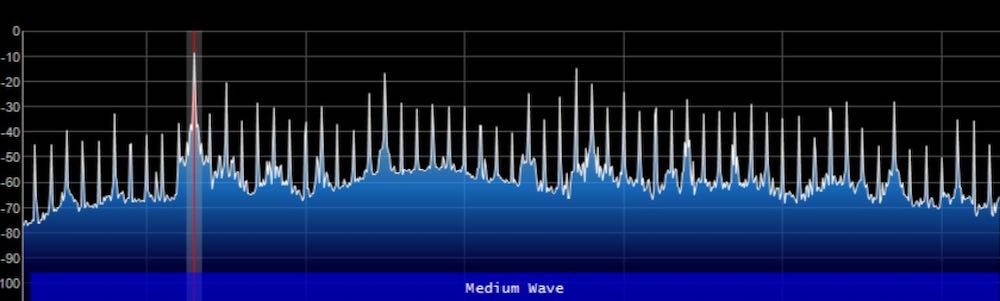
     Here’s an example of what the band looked like last weekend:

There happened to have been a world-wide CW DX competition, but nonetheless, there were literally hundreds of CW signals to be decoded!  Now, for me, however, I was more interested in the Beacon region of 10 M which is roughly between 28150 and 28300 kHz.  I’ve found CW Skimmer to be a perfect tool to decode the beacons.  Not only is it very accurate, but one can also easily see the CW signal with the dahs and dits on the screen and a continual readout of the messages.  Most of these beacons run 5 or 10 W, and all are run by amateurs.  Where to find information about who they belong to?  That’s easy as well.  WI5V.net has a great 10 M beacon list at https://wi5v.net/beacon-list-table-version/ .  That’s my go to, but I also have DL8WX.de’s beacon list on my laptop, giving even more information, like contact e-mails, etc.  He’s found at:  http://www.dl8wx.de/BAKE_KW.HTM

What type of antenna do I use?  Well, none of mine are 10 M antennas at all.  Most are, in fact, for DXing trans-oceanic MW DX!  Still, they seem to work quite well.  My go-to has been a DKAZ antenna aimed 290 degrees.  Now, that’s 180 deg to where most of my Beacon activity comes from.  How come?  Well, Nick Hall-Patch, MW DXer extraordinaire, used his ENZEC antenna prediction program to see how the DKAZ works on 28 MHz, and sure enough, it’s opposite to MW DX.  On the lower band, it’s best aimed 290 deg, but 180 deg opposite on 28 MHz!   Who would have guessed that one?  In any case, the next time I’m in Masset, I plan on putting up a simple vertical for 10 meters, seeing that solar max is still a year or two away, so there’s plenty of time for some fun DX!

Here’s what I’ve heard with a few afternoons of listening.  My best catch has been Darwin, Australia!

28207   N4XRO  1924  CW  5 watt beacon heard with a bit of a buzzy signal best deciphered on my 110 deg DKAZ….  17/Oct/2022 (Salmaniw, Masset, BC)

28236.5   W0KIZ  1933  CW  Another well heard beacon this morning giving ID in CW along with location.  Also very strong at 23:11 recheck.  Almost a barn burner!  Not bad for 5 watts! 17/Oct/2022  (Salmaniw, Masset, BC)

28244   WA6APQ  1934  CW  Much stronger, and it shows with their 30 watts output, with slow CW giving callsign, then location. Very strong when rechecking at 23:05 UTC.  Frequency is actually a little lower than listed.  Actually measuring 28243.942 kHz.  17/Oct/2022  (Salmaniw, Masset, BC)

28287   WI6J  1949  CW  Poor reception, but with same format giving ID and location.    17/Oct/2022  (Salmaniw, Masset, BC)

28250   K0HTF  2248  CW  Fairly good copy of this beacon away from the coast now in Iowa.  Only giving callsign/B.  Tom ‘Doc’ Gruis

replyed to my email confirming he’s feeding 20 Watts from an Old President radio and feeding an AR-10 antenna.  Thanks, Doc!  17/Oct/2022  (Salmaniw, Masset, BC)

28248.3   NJ5T  2258  CW  A relatively difficult catch, but I decoded the J5 part of his call, as well as ‘dipole’.   17/Oct/2022 (Salmaniw, Masset, BC)

28215   KA9SZX  1954  CW  Beacon quite well heard from Masset.  Most of my 10 meter beacon loggings have been a more N/S axis, but this one is coming in nicely in our early afternoon.  Callsign and power listed as 3 W, along with his email address. 5/Nov/2022  (Salmaniw, Masset, BC)

28218   AC0KC  2035  CW  Despite being listed as on 28218.5, he’s actually on the even channel at fair level into Masset.  Solar powered and only 3W, into a Bazooka antenna (what’s that?). Call sign repeated.  5/Nov/2022  (Salmaniw, Masset, BC)

28220   AA8HS  2123  CW  Despite listed as 30 Hz higher, I’m hearing them on the even channel with repeated IDs.  Fair level. Antenna listed is a vertical J-Pole.  5/Nov/2022  (Salmaniw, Masset, BC)

28230.3   W2MQO  2125  CW  Strong reception with call sign as W2MQ0/B repeated twice, then tones, and cycle repeats.  Into a Bazooka Antenna.  5/Nov/2022  (Salmaniw, Masset, BC)

28203   KG8C0  2132  CW  Another strong beacon with call sign, and prolonged tone, and repeat.  5/Nov/2022  (Salmaniw, Masset, BC)

28203.5   K6LL  2134  CW  Strong signal also from California, ID’ing as K6LLL/BCN, and giving location and QSL info.    5/Nov/2022 (Salmaniw, Masset, BC)

28193   VE4ARM  1827  CW  Excellent reception of my first 10 meter Canadian Beacon.  Run by the Austin, MD Amateur Radio Museum, as outlined in their beacon text.  6/Nov/2022  (Salmaniw, Masset, BC)

28284.8   N9TNY  2226  CW  Another new one for me from Illinois.  Not a particularly great afternoon, but nonetheless, a number of CW Beacons on 10 meters are visible/audible.  Callsign is given, then PSE RST.  Not sure what that means?  Wiki tells me that this is like SIO or SINPO code.  Stands for Readability-Signal Strength-Tone.  Hmm.  28/Nov/2022  (Salmaniw, Masset, BC)

28297   NS9RC  2237  CW  Another Illinois Beacon audible.  This one is weak, but fiddling with the KiwiSDR AGC settings, makes for a much better decode (mostly raising the CW Threshold (marked Thresh CW in the AGC section).  Near 100% correct decode now. Chicago is sent along with call sign.    28/Nov/2022 (Salmaniw, Masset, BC)

28287   WI6J  2240  CW  Strong signal from this Californian, and heard before.  VVV VI6J/B Bakersfield CA DM 5     28/Nov/2022 (Salmaniw, Masset, BC)

28254.5   K4JEE  2243  CW  Good copy with VVV DE K4JEE/B K4JEE/B K4JEE/B LOUISVILLE, KY  28/Nov/2022  (Salmaniw, Masset, BC)

28236.5   W0KIZ  2300  CW  Always one of the strongest beacons on 10 meters, and not disappointing this afternoon.  VVV W0KIZ/B DENVER, COLORADO . 5 WATTS, So does he mean 5 or 0.5 Watts? Presumably 5 Watts.  28/Nov/2022  (Salmaniw, Masset, BC)

28206.5   KA7TXS/B  2303  CW  Nice reception with VVV DE KA7TXS/B DM22 Listed in dl8wx.de website, but not the primary one I use (wi5v.net Beacon Website).  28/Nov/2022  (Salmaniw, Masset, BC)

28209   N5TIT/B  2315  CW  Fair reception with VVV DE N5TIT/B EM1UPX, or something similar.  28/Nov/2022  (Salmaniw, Masset, BC)

28211.8   AC7GZ  2321  CW  Good reception for only 3 W with VVV DE AC7GZ AC7GZ AC7GZ DM3BI.    The latter is the ham grid square, near Mesa, AZ.  28/Nov/2022  (Salmaniw, Masset, BC)

28232.3   W7SWL  2323  CW  I like the callsign!  Fair reception with VV DE W7SWL TUCSON AZ DM42  The band is fading fast.  Fascinating that the best antenna for 10 m Beacon reception today is my 290 deg DKAZ (and not the 110 deg DKAZ).  Not sure why! 28/Nov/2022  (Salmaniw, Masset, BC)

28206.5   N4SO  2231  CW  Very weak, but really picked up just now.  DE N4SO/B repeated. A fine catch!    30/Nov/2022  (Salmaniw, Masset, BC)

28212.8   AC7GZ  2253  CW  Very strong reception with VVV DE AC7GZ AC7GZ AC7GZ DM43BI  30/Nov/2022  (Salmaniw, Masset, BC)

28209.5   N2UHC  2300  CW  Tough copy, but bits of STPAUL decoded. as well as N2UHC/B.    30/Nov/2022  (Salmaniw, Masset, BC)

28254.5   K4JEE  2308  CW  Strong reception with ID and location.  Deep fades, as well, though.  30/Nov/2022  (Salmaniw, Masset, BC)

28255.8   WI5V  2310  CW  Fair reception with occasional good fade-ups with WI5V/B repeated.  30/Nov/2022  (Salmaniw, Masset, BC)

28175.5   VE3BKM  2034  CW  Hearing an unlisted beacon.  VE3BKM/BCN repeated, often at strong level.  A new one for me! 5/Dec/2022  (Salmaniw, Masset, BC)

28168   VA3KAH  2040  CW  I have no idea where this island is located, so had to look it up.  Fair reception with VV DE VA3DAH/B It’s located to the north of Lake Simcoe in southern Ontario. 5/Dec/2022  (Salmaniw, Masset, BC)

28145   DL2WB  2048  CW  A highly tentative logging.  All I hear is the occasional tone for several seconds, then off.  Nothing else listed on this frequency, so no idea!  5/Dec/2022  (Salmaniw, Masset, BC)

28203   KG8CO  2055  CW  Very strong signal with repeated KG8CO/BT 5/Dec/2022  (Salmaniw, Masset, BC)

28203.5   K6LLL  2058  CW  Weak reception with VVV K6LLL/BC Grid Square coordinates, and PSE QSL TNX DE K6LL/BCN.  5/Dec/2022 (Salmaniw, Masset, BC)

28206.3   KA7TXS  2100  CW  Strong reception, although a bit of a congested part of the band making decodes a tad difficult. Not listed on my main source (WI5V Beacon website), but it is on the dl8wx.de website.  5/Dec/2022  (Salmaniw, Masset, BC)

28208   WD5GLO  2126  CW  Fair copy with WD5GLO/B repeated 3 times and OK OK  5/Dec/2022  (Salmaniw, Masset, BC)

28209.1   N5TIT  2130  CW  Poor reception this afternoon, but making out the call-sign.  VVV DE N5TIT/B.  100 Hz higher than listed.    5/Dec/2022  (Salmaniw, Masset, BC)

28209.5   N2UHC  2133  CW  Poor reception, but seeing his callsign. Fades up to quite good at times.  N2UHC/B EM27JM N2UHC/B ST PAUL KS.  5/Dec/2022  (Salmaniw, Masset, BC)

28212.1   AC7GZ  2140  CW  A regular visitor to Masset.  Fair to good this afternoon with VVV DE AC7GZ DM43BI  5/Dec/2022 (Salmaniw, Masset, BC)

28215   KA9SZX  2142  CW  A slower rate beacon at good reception:  VVVV KA9SZX KA9SZX KA9SZX BCN MACOMB IL PWR 3W GRID EN40PK EMAIL KA9SZXWAYAHOO.COM  Now that’s a full information beacon! 5/Dec/2022  (Salmaniw, Masset, BC)

28217.7   K4PAR  2152  CW  Very weak, but fully decodable with VV DE K4PAR/B.  Listed as from the Piedmont ARC and 25 W.  Just barely audible.  5/Dec/2022  (Salmaniw, Masset, BC)

28220.15   AA8HS  2155  CW  Measuring below their listed 28.2203 frequency.  Weak but in the clear.  5/Dec/2022  (Salmaniw, Masset, BC)

28232.3   W7SWL  2206  CW  Now that’s a call-sign!  He wasn’t there a few minutes ago, but noticed a very powerful beacon.  VVV DE W7SWL W7SWL TUCSON AZ DM42 and repeated.    5/Dec/2022 (Salmaniw, Masset, BC)

28254.5   K4JEE  2220  CW  Another beacon I recognize from previous sessions.  Fair to good reception this afternoon with VVV DE K4JEE/B K4JEE/B K4JEE/B LOUISVILLE, KU EM78.  5/Dec/2022 (Salmaniw, Masset, BC)

28255.8   WI5V  2226  CW  Weak reception, with some AM QRM.  VVV DE WI5V/B   5/Dec/2022  (Salmaniw, Masset, BC)

28278.5   WA4OTD  2228  CW  Weak, but in the clear with callsign and location.    5/Dec/2022  (Salmaniw, Masset, BC)

28280   K5AB  2231  CW  Strong reception with DE K5AB EM01BEACON, repeated, then CENTRAL TEXAS  5/Dec/2022  (Salmaniw, Masset, BC)

28281.1   W8EH  2234  CW  100 Hz above their listed frequency at fair level with callsign and grid square reference.    5/Dec/2022 (Salmaniw, Masset, BC)

28284.8   N9TNY  2237  CW  Strong reception with callsign and grid square reference.  5/Dec/2022  (Salmaniw, Masset, BC)

28236.5   W0KIZ  2243  CW  Again, a beacon not there a few minutes ago, but really burning up the receiver with repeated VVV DE W0KIZ/B DENVER COLORADO 5 WATTS.  5/Dec/2022  (Salmaniw, Masset, BC)

28240   W8EDU/B  2223  CW  Weak, but readable.  For only a watt, I’m impressed!  Giving callsign and grid square location.  Found them on the dl8wx.de beacon website.  Location and operator is the Case Western Reserve University amateur radio club. 8/Dec/2022  (Salmaniw, Masset, BC)

28252.5   WD8INF  2227  CW  Good reception with callsign and grid square locatioon (EM79).  8/Dec/2022  (Salmaniw, Masset, BC)

28258.5   AC5JM  2229  CW  Good copy with callsign and OK repeated. 8/Dec/2022  (Salmaniw, Masset, BC)

28277.56   WA4OTD  2232  CW  Fair copy.  Listed in the WI5V beacon website on 28.2788, so a bit lower in reality.  Giving callsign, grid square, and CARMEL  8/Dec/2022  (Salmaniw, Masset, BC)

28281.1   W8EH  2235  CW  Good reception with callsign and grid square (EM79).  Clearly, Ohio is coming in well this afternoon. Normally I’m hearing AC7AV on or near this channel (Green Acres, WA).    8/Dec/2022  (Salmaniw, Masset, BC)

28284.8   N9TNY  2237  CW  Strong signal with VVV DE N9TNY/B EN51 PSE RST.  8/Dec/2022  (Salmaniw, Masset, BC)

28271   W4ZZK  2245  CW  A very weak signal heard while monitoring another very adjacent signal.  , giving the callsign/B.  CW Skimmer comes through again!  8/Dec/2022  (Salmaniw, Masset, BC)

28290.8   K5TLJ  2302  CW  Weak reception, but able to copy AR AR AR DE K5TLJ/B K5TLJ/B K5TLJ/B AR   Band is quickly fading, so looks like this is the top frequency beacon I can hear now. 8/Dec/2022  (Salmaniw, Masset, BC)

28250   K5AB  2341  CW  A this late hour, very little propagating in the 10M Beacon band.  Nonetheless, good reception from this high power beacon with DE D5AB EM01BEACON DE D5AB CENTRAL TEXAS.    14/Dec/2022  (Salmaniw, Masset, BC)

28268.334   VK8VF  2344  CW  My first Australian beacon!   Very weak, but the call sign is being decoded by CW Skimmer.  Not even visible on the waterfall.  334 Hz high compared to the listed 28.268 on the WI5V Beacon website.    14/Dec/2022  (Salmaniw, Masset, BC)

28189   VE4TEN  2100  CW  Great reception this afternoon.  The band had many 10 M beacons, but unfortunately, I had other family matters today.  Still, nabbed this one, with an interesting call, and flea powered as well.    18/Dec/2022  (Salmaniw, Masset, BC)

28193    LU2DT  2355  CW  My surprise for the afternoon, and my first Argentinian beacon.  Fair reception.  Long, somewhat garbled tone, followed by VV DE LU2DT LU2DT GF12FA.  Distance approximately 12,432 kM with bearing 125 degrees!  19/Dec/2022 (Salmaniw, Masset, BC)

I hope that I’ve wetted your appetite into trying something, “completely different” in our radio monitoring hobby.  Who knows next what I’ll want to try!

Walter Salmaniw, Masset and Victoria, BC

SSTV Fiesta 2022

Many thanks to SWLing Post contributor, Mario Filippi (N2HUN), who writes:

For those who’d like to try receiving SSTV images and also get into the holiday spirit, there is an annual SSTV Fiesta from December 12, 2022 to January 6, 2023. The Fiesta is sponsored by the Azteca DX’ers. The frequencies are 14.230 MHz in the 20m amateur band and 27.700 MHz, just above the US Citizen’s Band.

An excellent decoder is MMSSTV available free on line.

I’ve monitored 27.700 MHz the past week and have decoded the images below using an Airspy HF + Discovery, 31 foot ground mounted vertical, MMSSTV software and VB cable for piping the audio from the Airspy to MMSSTV.

Note that you have to set your receiver to USB. With MMSSTV you can set your receiver on the frequency of choice and just walk away like I did and the software will store any images received. Image clarity depends on propagation, just like other modes.

Good luck, thanks go out to the Azteca DX’ers for this enjoyable event and 73’s.

In search of the unique, the weird, the unusual . . . a reader participation post

By Jock Elliott, KB2GOM

There is a richness in human experience, and I want to sample it.

When I worked the world on the HF ham bands, I considered myself a “conversation hunter.” I wasn’t content to simply make a contact, exchange signal reports, and move on; I wanted to talk to people in foreign lands, to chat with folks who did unusual things, to hear things you would not normally hear otherwise.

Here’s a quick sampling:

  • I spoke with a ham in England, a falconer, who flew the birds for the movie “Lady Hawke,” and who had a side business of manufacturing tiny transmitters that falconers could use to track their birds.
  • The chief groundskeeper for a major university in Ohio once explained, on ten meters, the difference between commercial and consumer lawn mower engines (the commercial units are designed to be rebuilt quickly and easily).
  • Recently, on 2 meters I heard a ham explain how he used VHF/UHF crossband repeat to provide coverage for a special event.

Similarly, I enjoy hearing the unusual on the AM, FM, or shortwave broadcast bands. For example, one evening years ago, on shortwave I heard “Radio Peace and Love” from somewhere in the Caribbean, followed (on another frequency) by “Mark from Michigan” extolling the militia movement. On another occasion, I heard a story on Radio New Zealand about a Maori weaver’s collective.

So, bottom line, I am interested in the unique, the unusual, the weird (could be all three!) . . . and I prefer stuff that is NOT syndicated across a bunch of stations. Marion’s Attic comes to mind as I write this.

So, now it’s your turn: what’s your favorite programming that is off the beaten path? Please respond, and be sure to mention the time and frequency when it might be heard.

Tom’s Recommendations: Earbuds and EQ Settings for Shortwave Listening

Many thanks to SWLing Post contributor, TomL, who shares the following guest post:


Earbuds for Shortwave Listening

by TomL

A few years ago I had bought the discontinued Sennheiser MM 50 earbuds for a cheap price on Amazon to use in my various radios.  The portable radios in particular can use more fidelity because of their small, raspy speakers.  I also like to listen without bothering others around me who might not want to listen.  And earbuds are a LOT more comfortable for my ear lobes than any over-the-ear headphones I have ever used.  Furthermore, the old Apple iPhone 4 earbuds were very harsh to listen to.  However, a trade-off is that, generally, earbuds are somewhat fragile; one of the two pairs of MM50’s died through mishandling.

I was generally happy with them while listening to Shortwave broadcasters with a mix of news/talk and music.  I especially liked them on Mediumwave listening; stations can sound surprisingly good when playing music.  Then I tried using these earbuds on my Amateur Radio transceiver, a Kenwood TS-590S.  I was impressed how clear they sounded with a lack of distortion, although there was too much bass.  Fortunately, Kenwood supplies USB connected software with an TX & RX 18 band EQ (300 Hz spacing, not octaves).

Here is a frequency response chart I found from Reviewed.com for this model:

One of the notable things about these earbuds is the total lack of distortion.  Most likely one of the reasons they sound so clear on Shortwave, which has many LOUD audio spikes.

I had not wanted to get Bluetooth earbuds.  However, I had recently upgraded my cell phone and NO headphone jacks anymore!  So, while I do not use Bluetooth yet for radios, I can see a time in the future to get a Bluetooth transmitter to plug into a radio with a headphone jack.  I am reluctant since I do not like having to recharge my earbuds and I put in a lot of radio listening time.  Am I supposed to buy two Bluetooth earbuds and swap while charging?  Maybe in the future.  And also, am I supposed to buy a Bluetooth transmitter for every non-Bluetooth radio I own?  Not likely gonna happen.

In the meantime, I ordered cheap wired earbuds from Amazon.  I had a $5 credit for trying Prime, so when I saw these Panasonic ErgoFit wired earbuds (RP-HJE120-K) for slightly over $10, I said to myself, “why not?”.   Supposedly wildly popular, they are one of the most rated products on all of Amazon with 133,821 ratings/opinions (perhaps Russian bots?!?!?).

Here is a frequency response chart from ThePhonograph.com for these Panasonic earbuds:

You can see comparatively that the bass response in the very good Sennheiser MM50’s is much stronger, being good music earbuds.  But for voice articulation, not as much, even though they have no distortion.  The Panasonic ErgoFit’s have more modest bass, less of a dip in the lower midrange audio frequencies, and more importantly, has a peak near 2500 Hz and its harmonic 5000 Hz.  The highest highs are also modest compared to the Sennheiser model.  This general frequency response to “recess” the bass and treble frequencies and peak the 2500 Hz is very useful for voice intelligibility.

As described by the famous speaker-microphone-sound-system maker, Bob Heil relates what he learned from the scientists at Bell Labs many years ago.  Speech intelligibility is enhanced when audio is compensated for our natural human hearing.  Equalizing below 160 Hz, reducing the 600-900 Hz region, and peaking the 2000-3000 region centered at 2500 Hz will increase intelligibility dramatically.  The story goes that Bell Labs was tasked by parent AT&T with finding out why the earliest phones in the 1920’s sounded so muffled and hard to understand.  After many experiments, the scientists found the most important frequencies for our ears + brain to comprehend speech.  In other words, our ears are not “EQ-flat” like a scientific instrument is. Continue reading