Category Archives: Ham Radio

“No Strong Opposition to 144 – 146 MHz Reallocation Proposal at CEPT Meeting”

Many thanks to SWLing Post contributor, Paul, who shares the following links and notes:

No Strong Opposition to 144 – 146 MHz Reallocation Proposal at CEPT Meeting
http://www.arrl.org/news/no-strong-opposition-to-144-146-mhz-reallocation-proposal-at-cept-meeting

This appears to be pushed through by France at the behest of Thales, a large and diverse manufacturer of civilian and military tech that, among other things, builds UAVs and aeronautical communication equipment. This portion of the band is allocated globally to amateur radio, and is not assigned to any commercial or (formal) public safety use. This likely makes it a valuable and easy target for reallocation for an entity wishing to operate on it globally.
https://www.f4fxl.org/update-on-the-threats-on-2m-amateur-band/

In the UK, the Radio Society of Great Britain (RSGB) is leading the charge to stop this in Europe:
https://www.change.org/p/rsgb-stop-the-2-meter-band-144-146mhz-being-taken-away-from-radio-amateurs

The loss of this band would really hurt ham radio. The cheap Baofeng VHF radios that use this band are probably second only to the RTL-SDR for enticing people into the radio hobby.
Use of this band is not limited to amateur radio novices who are new to the hobby; during emergency/disaster relief, the 2m VHF amateur bands are the among the most used bands due to how inexpensive the radios are. By creating an ad-hoc network used as a failsafe when cell towers and internet services could be offline for an indefinite period of time, civilians are able to save lives when police and and EMS are allocated at their capacity.

Thanks for sharing this, Paul. It seems this issue has gotten the attention of all of the major amateur radio associations.

FCC: RM-11843 seeks creation of a new 8-meter Amateur Radio allocation

Many thanks to a number of SWLing Post readers who have shared links to this petition for rulemaking–created by Michelle KU3N–to create a new 8-meter Amateur Radio allocation.

I’ve included the author’s notice about this proposal and also a news item from the ARRL below. First, however, just a quick tip on filing comments via the FCC system:

Making a comment

If you’re interested in commenting on this petition, you can do so via the FCC Electronic Comment Filing System until July 26, 2019.

Using the system the first time is a little confusing–here’s a tip:

Open the comment form on the FCC Express Filing site.

Next, type in the filing number in the first field:
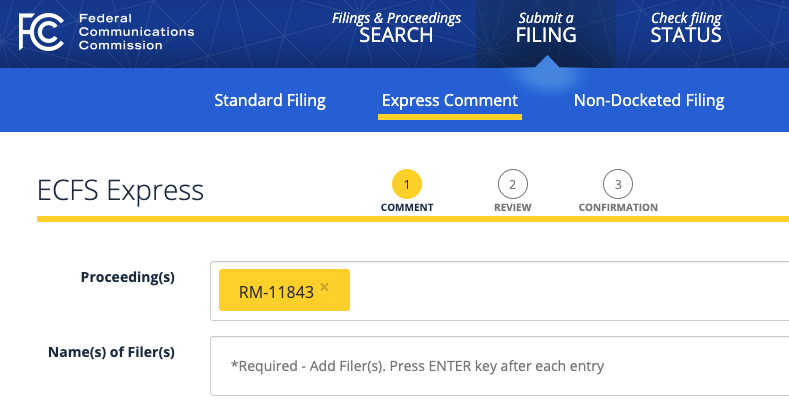
The filing number should auto-complete as you type. Once it has been selected (as in the screenshot above) continue filling out the rest of the form with comments and then submitting it. It’s pretty simple, but if you’re not used to the comment system, selecting the proper petition can be a little confusing.

Of course, the FCC also has the following help page: “How to Comment on FCC Proceedings

For more information about this proposal check out the articles below from the petition author at REC Networks and also a notice from the ARRL:

(Source: REC Networks)

Today, the FCC has assigned a rulemaking (RM) number to a Petition for Rulemaking filed by REC Networks, through its founder, Michelle Bradley, KU3N as RM-11843.

This petition calls on the Commission to work with the National Telecommunications and Information Aministration (NTIA) to allow for amateur radio operations in the 8-meter band. This petition was in response to activities taking place in ITU Region 1 where more administrations are starting to authorize very limited operation on 8 meters.  Ireland, Slovenia and South Africa have already granted amateurs regular access to all or portions of the band being asked for in the petition.   In fact, ComReg, the Irish regulator has even gone far enough to allocate virtually the entire VHF low band (30~49 MHz) for amateur radio use.

In the petition, REC/KU3N notes that this spectrum could be used for weak signal experimentation and general amateur use primarily along transatlantic paths using CW, SSB and digital modes such as FT8 and digital voice.  As no radios are currently manufactured for this band, it could encourage “makers” to design new equipment and antenna design.  REC/KU3N predicts low usage of this band except during scheduled activities such as Field Day and contests as well as periods of sporadic-E, high sunspot numbers and other periods with a higher maximum usable frequency.

In the petition, REC/KU3N is asking to use 40.51 to 40.70 MHz, allowing beacons, prohibiting repeaters and discouraging FM operation.

This spectrum is currently used by the Federal Government as part of an older channelized land mobile radio system, mainly by the Department of Agriculture for national forests and parks.  It is also used for federal and non-federal telemetry and wildlife tracking. The spectrum is also sporadically used by the military for short-range communication.  Industrial, scientific and medical (ISM) devices also operate in the 40.66 to 40.70 MHz area.  REC/KU3N notes that this spectrum would be of most interest to those who wish to conduct transatlantic experimentation and thus will have more amateur activity in the eastern USA where it is likely that federal use of this spectrum is more likely in the western USA.

Comments on this petition will be accepted by the FCC through their Electronic Comment Filing System until July 26, 2019.  Select proceeding RM-11843.

A copy of the petition can be found at the following URL:
https://recnet.net/fcc/8_meter_PRM.pdf

Questions and media inquiries should be directed to REC Networks at our Contact REC form.

(Source: ARRL News)

The FCC has put on public notice for comment a Petition for Rulemaking (RM-11843) that seeks the creation of a new 8-meter Amateur Radio allocation on a secondary basis. The Petition suggests the new band could be centered on an industrial-scientific-medical (ISM) segment somewhere between 40.51 and 40.70 MHz. The spectrum between 40 and 41 MHz is currently allocated to the Federal Government and, as such, within the purview of the National Telecommunications and Information Administration (NTIA). ARRL member Michelle Bradley, KU3N, of Maryland, filed the petition in May on behalf of REC Networks, which she founded and described in the Petition as “a leading advocate for a citizen’s access to spectrum,” including Amateur Radio spectrum.

“REC feels that the time is right for the Commission to open a Notice of Inquiry and eventually a Notice of Proposed Rulemaking, and in cooperation with the NTIA, this new band opportunity can be realized to spark the next generation of ‘makers’ in the fields of science, technology, education, and math (STEM), especially women and girls,” Bradley told the FCC in the Petition. “The more opportunities we give to make things, the more opportunities we have to build a pool of experts in STEM, right here at home.”

The Petition said the objective of a new band would be “an effort to foster experimentation into the propagation characteristics of this band midway between the 10- and 6-meter bands.” An allocation in the 8-meter band is available to radio amateurs in Ireland, where the Irish Radio Transmitters Society has developed a band plan for 40 – 41 MHz.

“REC perceives this spectrum can be used for weak signal experimentation and eventually general amateur use, especially along transatlantic paths using CW, SSB, digital modes such as FT8 and digital voice,” the Petition said. “As no radios are mass-produced for this band at this time, this opens up new opportunities for ‘makers’ to construct transmitters, receivers, and antenna systems that can be used in this spectrum.”

REC anticipates “very low” usage of the new band, “with peak usage around sporadic-E episodes, operating events such as ARRL Field Day, and VHF contests, as well as during the peak of sunspot cycles,” Bradley told the Commission. “[W]e feel that the sharing of 40 MHz can be accomplished in a manner that serves the needs of the Amateur Radio Service while meeting the organizational missions of Federal Government agencies that utilize this spectrum.”

Interested parties may file short comments on RM-11843 via the FCC’s Electronic Comment Filing Service (Express). Visit the FCC “How to Comment on FCC Proceedings” page for information on filing extended comments.

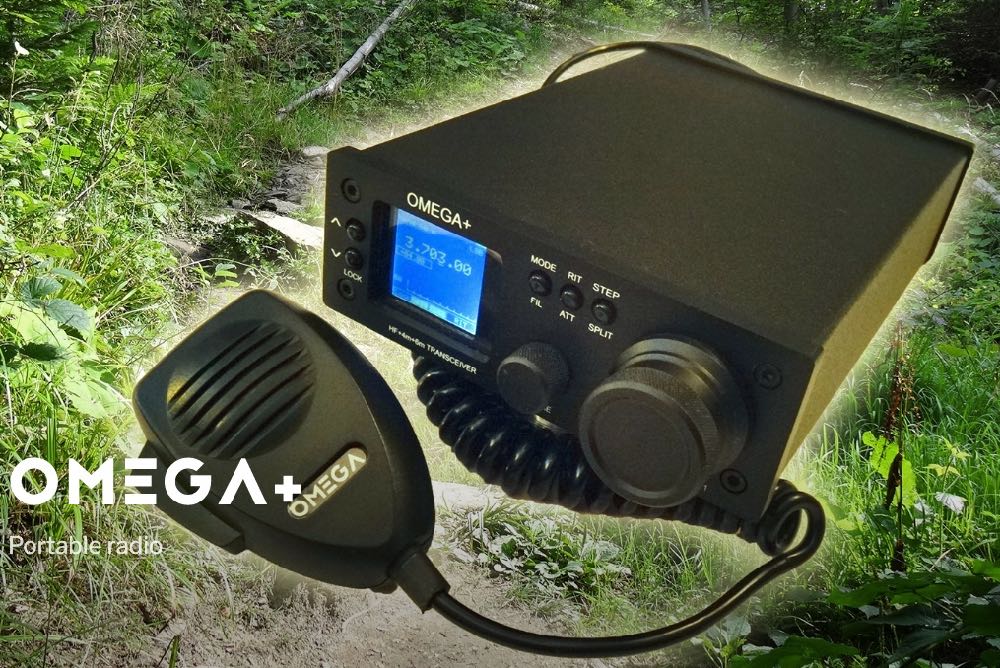
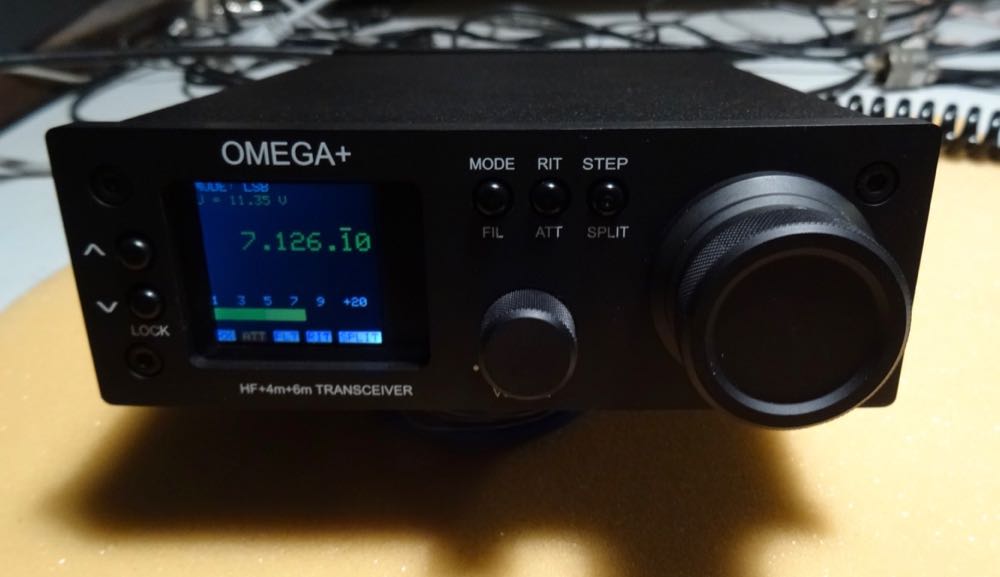
The Omega + HF QRP Transceiver

Many thanks to SWLing Post contributor, Paul Evans (W4/VP9KF), who notes another affordable QRP transceiver on the market: the Omega +.

According to the Omega + website, it appears there are three configurations/versions:

  • 1 band – basic (up to 30 MHz)
  • 2 bands (50 / 70 MHz)
  • 10 bands (160/80/60/40/30/20/17/15/12/10m)

Notes, Specifications and Features

The following details were lifted from this product page and reference the 10 band version of the Omega + (translated from Polish via Google Translate).

Omega + – 10 band QRP transceiver with installed S-meter, power meter, CW monitor and standard quartz filter.

Transceiver fully launched by producers Lukasza SQ7BFS and Pawla SP7NJ.

The front and rear TRX wall in military color, the remaining part of the housing black (in the picture is presented the whole black version).

Rx [MHz]: 0.100 – 72.000
Tx [MHz]:

  • 1.800-2.000
  • 3.500-3.800
  • 5.100-5.500
  • 7.000-7.200
  • 10.100-10.150
  • 14.000-14.350
  • 18.068-18.168
  • 21.000-21.450
  • 24.890-24.990
  • 28.000-30.000

Modes:

  • USB
  • LSB
  • CWU
  • CWL

Antenna connector: SO-239
Working temperature range: -10 ° C to + 50 ° C;
Power supply: 11 – 14V DC
Power consumption

  • Tx Max. Power: 1.6A
  • Rx: 0.26A

Dimensions: (W × H × D) 120x40x180 mm
Weight (approx.): 800g
Output power: (at 13.8V DC)> 6W
Sensitivity: 0.16?V

Package includes:

  • Omega + 10 band transceiver in a black-green (military) enclosure
  • microphone
  • power cord
  • adapter for an external speaker

The listed price is 1,200 Poland zloty (roughly $321 US).

Videos

The Omega + in the WARD Contest 2017:

Click here to view on YouTube.

Here’s a video showing how (impressively) strong the Omega + chassis is:

Click here to view on YouTube.

For more product details, check out the Omega + website.

Our Polish-speaking readers may be able to add more details or clarify/correct anything above that may not have been correctly translated. Please feel free to comment!

Again, Paul, many thanks for the tip!


Do you enjoy the SWLing Post?

Please consider supporting us via Patreon or our Coffee Fund!

Your support makes articles like this one possible. Thank you!

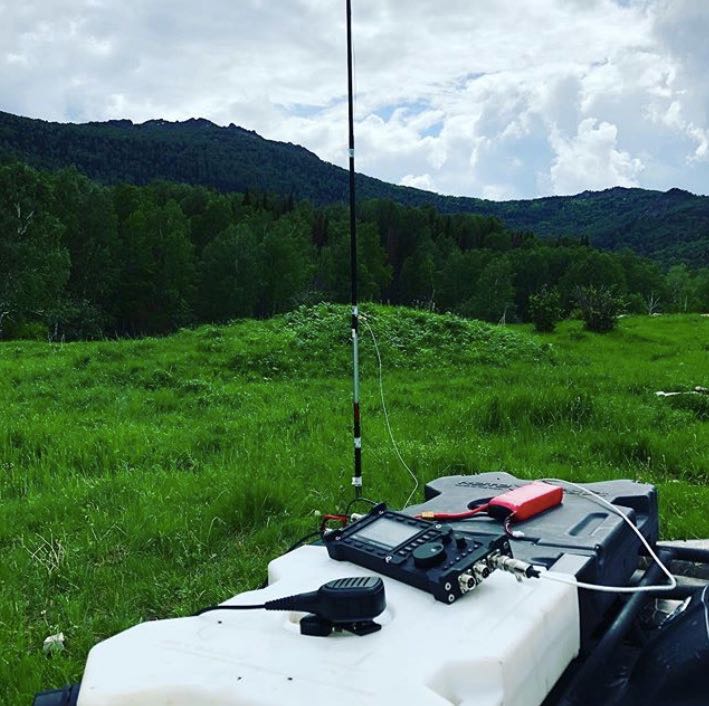
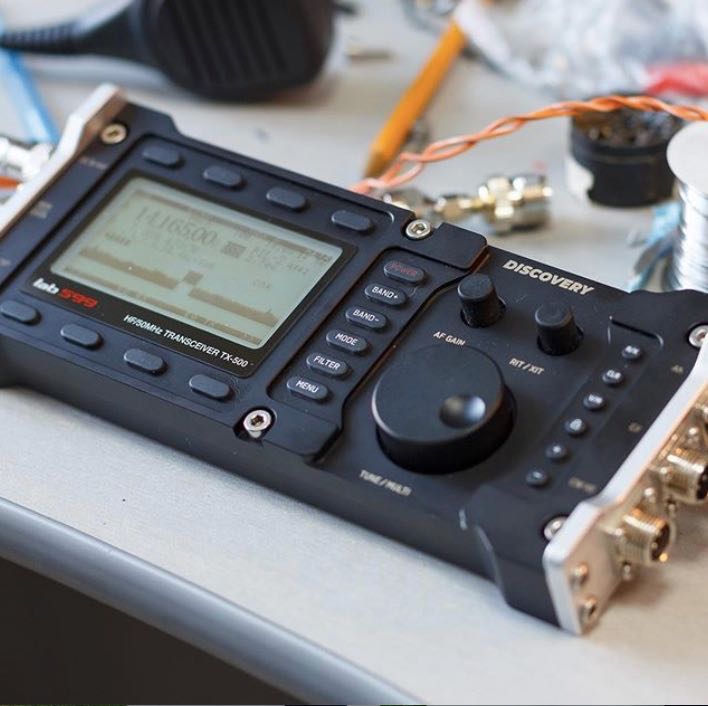
The lab599 Discovery TX-500 ruggedized portable QRP transceiver

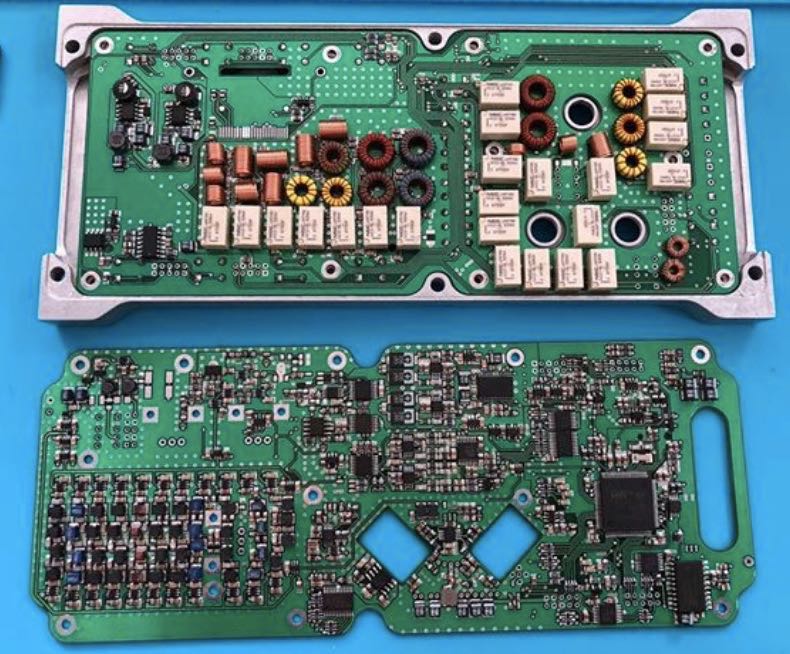
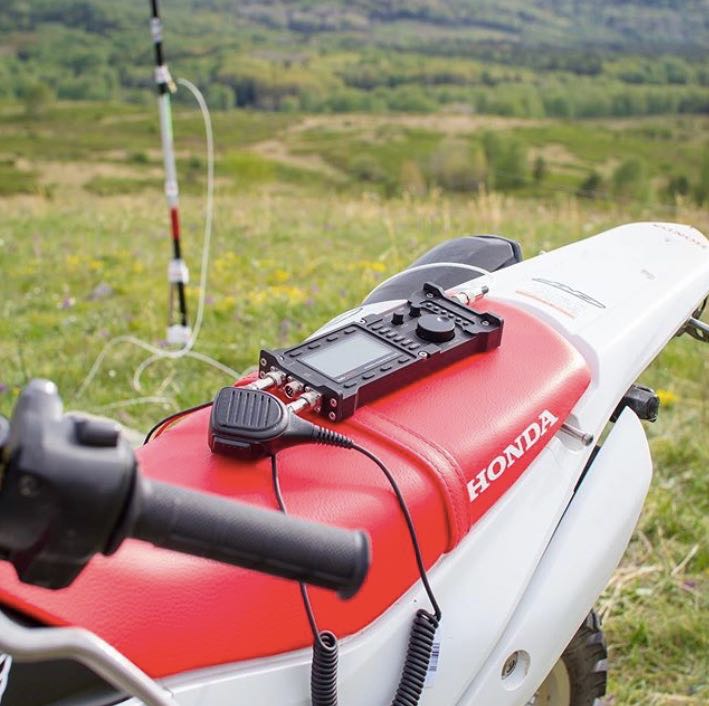
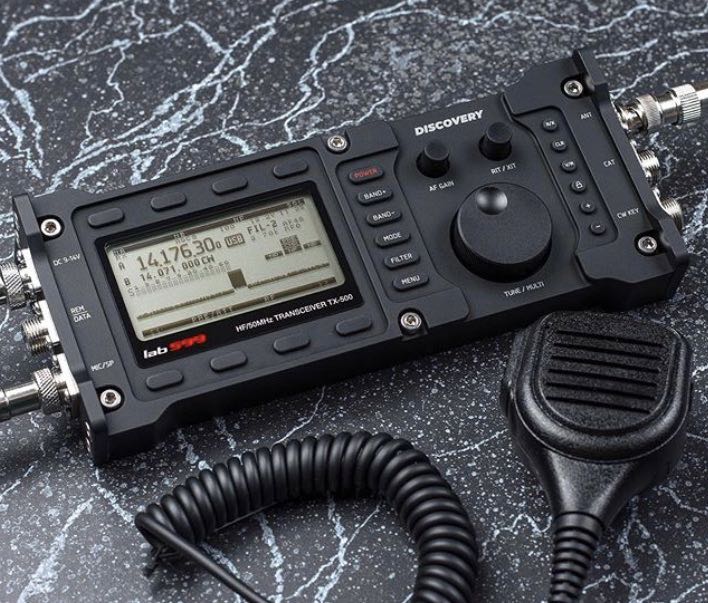
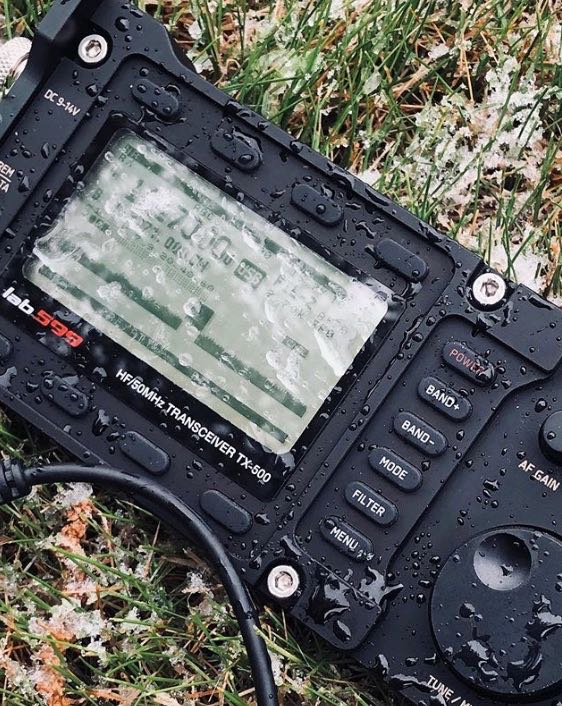
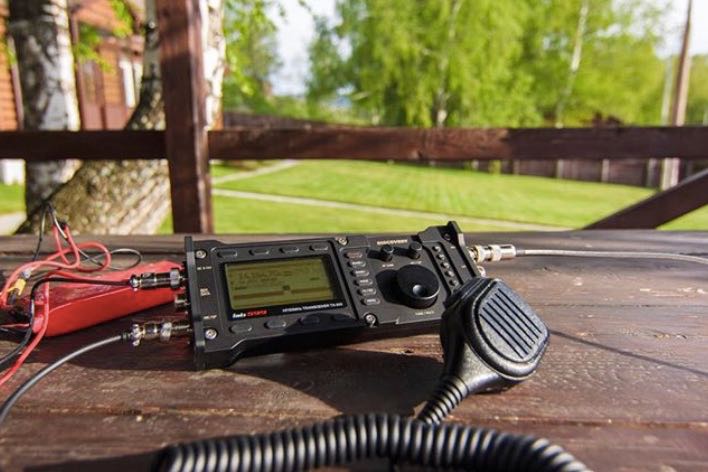
Many thanks to SWLing Post contributor, Vlad, who shares some images and a video of a new QRP transceiver in development: the Discovery TX-500 by a company called lab599.

Specifications have not been published yet, but we have confirmed a few details from the manufacturer:

  • 10 watts PEP
  • HF plus 6 meters
  • Weight 570 grams (1.25 pounds)
  • Voltage 9 – 14 VDC
  • 105 milliamps at 13.8 VDC and with backlit display on
  • CAT control via USB and using Kenwood codes
  • I/Q outputs
  • Weatherized
  • Expected availability autumn 2019
  • Target retail price is $700 US
  • Product website is forthcoming

All of the following images came from the Discovery TX-500 gallery on Instagram:

Here are a few videos:

Click here to view on Instagram.

Click here to view on Instagram.

Click here to view on Instagram.

For someone, like me, who loves playing radio in the field (Parks On The Air and Summits On The Air) this looks like an ideal rig. It’s one of the only ham radio transceivers I’ve seen that is weatherized to some degree (how much, we don’t know yet).

I don’t see a speaker on the TX-500, so I’m guessing it might require a mic/speaker combo or an external speaker of some sort? I also don’t see a built-in ATU, but at $700, I certainly wouldn’t expect one.

With a power consumption of 110 milliamps at 13.8 VDC, this little transceiver should run for ages on a modest battery pack.

This is certainly a fascinating prototype QRP transceiver. If the Discovery TX-500 transceiver can be produced and marketed at $700 with all of the features mentioned so far, it should certainly fly off the shelves. They can certainly take my money!

Of course, I will plan to grab one of these for review. I’m also eager to see how this little SDR transceiver might perform on the broadcast bands.

We will post post TX-500 updates and details as they become available. Bookmark the tag Discovery TX-500 and stay tuned!


Do you enjoy the SWLing Post?

Please consider supporting us via Patreon or our Coffee Fund!

Your support makes articles like this one possible. Thank you!

It’s Field Day weekend 2019: find a local event, have fun!

If you live in North America and have an interest in becoming a ham radio operator, this is the weekend to check out what amateur radio is all about, and meet local radio enthusiasts.  

It’s Field Day!

What is Field Day?  I’ll quote from the ARRL, who sponsors the event:

“ARRL Field Day is the single most popular on-the-air event held annually in the US and Canada. On the fourth weekend of June of each year, more than 35,000 radio amateurs gather with their clubs, groups or simply with friends to operate from remote locations.

Field Day is a picnic, a camp out, practice for emergencies, an informal contest and, most of all, FUN!

It is a time where many aspects of Amateur Radio come together to highlight our many roles. While some will treat it as a contest, other groups use the opportunity to practice their emergency response capabilities. It is an excellent opportunity to demonstrate Amateur Radio to the organizations that Amateur Radio might serve in an emergency, as well as the general public. For many clubs, ARRL Field Day is one of the highlights of their annual calendar.

The contest part is simply to contact as many other stations as possible and to learn to operate our radio gear in abnormal situations and less than optimal conditions.”

GOTAField Day is always the fourth full weekend of June, beginning at 1800 UTC Saturday and running through 2059 UTC Sunday.

Many Field Day sites have a GOTA (Get On The Air) station where non-licensed individuals are welcome to play radio. It’s a fantastic way to try your hand at transmitting with a little guidance and encouragement from the more experienced. Indeed, even if there is no GOTA station, you will often be invited to try out the mic.

You’ll find that ham radio operators are very welcoming on Field Day–after all, spreading the word about the fun of amateur radio is what it’s all about. Indeed, I’ve shown up unannounced to a number of Field Days over the years; once I got some serious radio time with the Charlotteville Amateur Radio Club while on vacation in Prince Edward Island, Canada and I’ve spent the two recent Field Days with the Québec Amateur Radio Club (Club Radio Amateur de Québec). It’s all been amazingly fun.

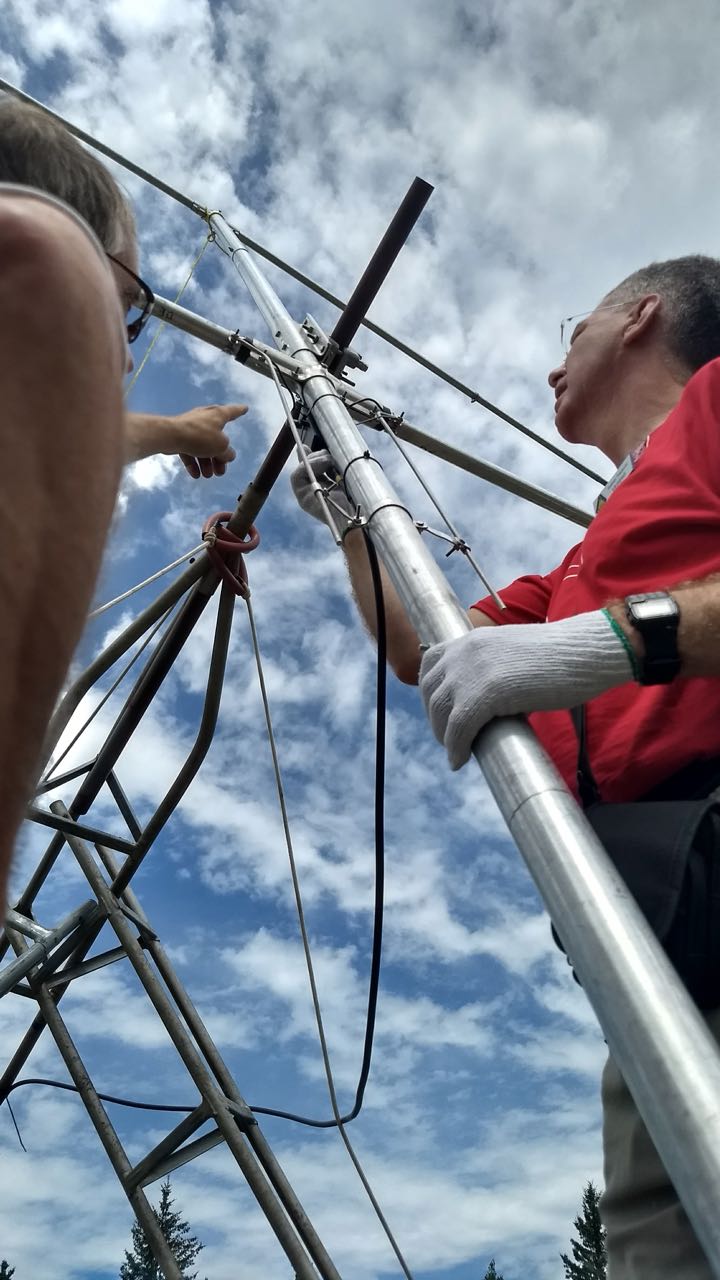
Gaétan Trépanier (VE2GHO) making final adjustments to the club’s HF Yagi during Field Day 2017

This year, like last, I’ll be home and plan to spend Field Day with my buddy Vlado (N3CZ) in the Field! We plan to operate from Mount Mitchell State Park for a few hours. Later, we’ll likely stop by some local clubs on the air.

Keep in mind that there are many shortwave listeners among the amateur radio community; indeed, many hams became interested in the hobby through SWLing.

The ARRL has made it quite easy to find registered Field Day locations in your region. Click here to find a local Field Day event near you–and have a great Field Day!

ELAD introduces the new DUO-X SDR Transceiver

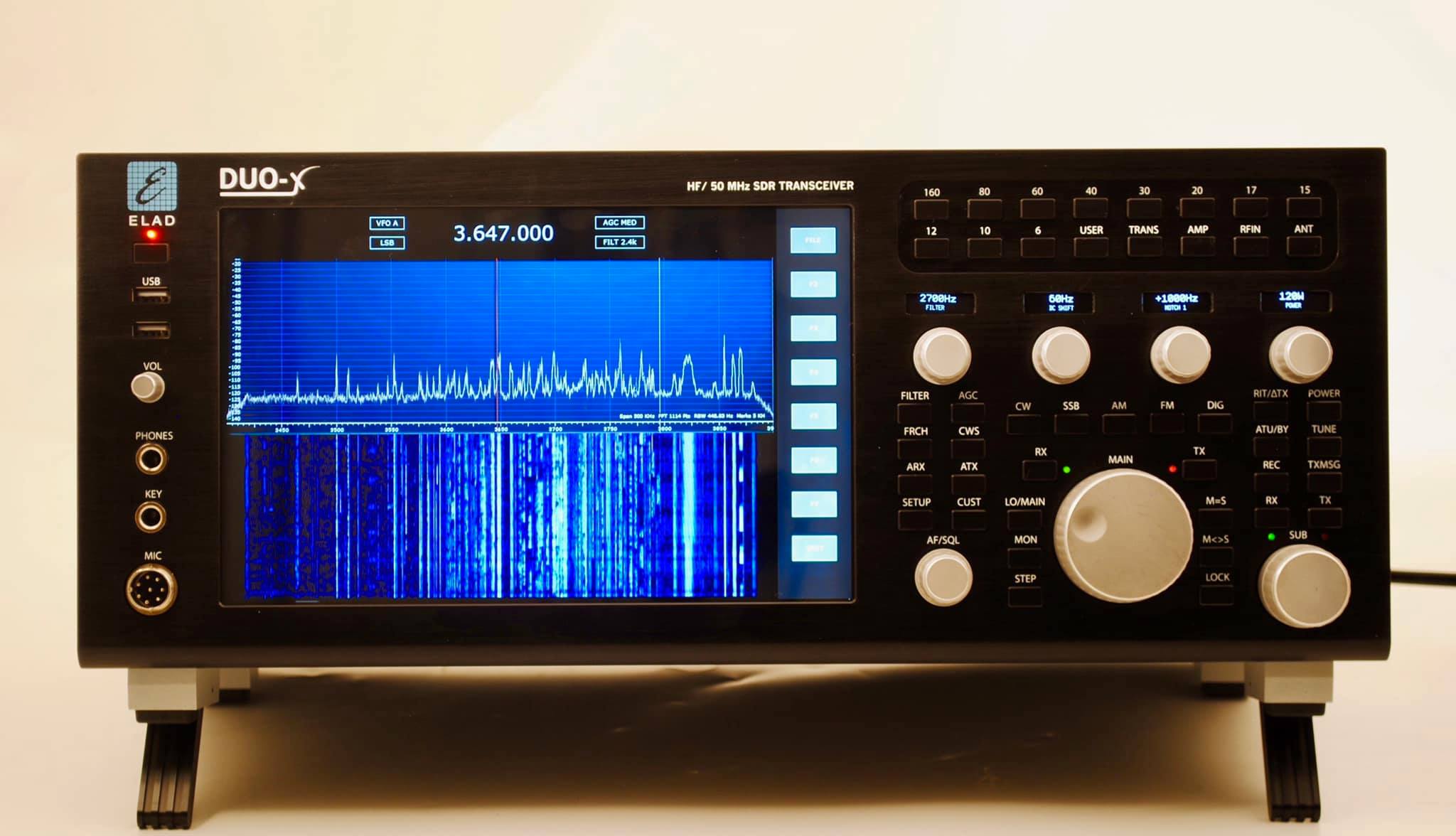
Many thanks to SWLing Post contributor, Paul Jones, who shares an image of the new ELAD DUO-X transceiver:

A prototype of the DUO-X will be on display this weekend at Ham Radio Friedrichshafen this weekend.

I don’t have a lot of details about the DUO-X yet, but here is what I can confirm:

  • There will be two 2 versions 120 watt and a 220 watt
  • 4 independent receivers
  • 10.2 inch touchscreen
  • 4x 1″ OLED screens above four programmable multifunction knobs
  • Built-in ATU
  • Stand-alone or connect to your PC

More details to follow! Bookmark the tag ELAD DUO-X for updates.

Hamvention Highlights: The Polar Explorer 500 watt transmitter

Each year at the Dayton Hamvention I enjoy checking out the latest radio products and services. This year (2019) I found an exceptional number of innovations and will share these in Hamvention Highlights posts. If you would like to check out 2019 Hamvention Highlights as I publish them, bookmark this tag: 2019 Hamvention Highlights


The Polar Explorer

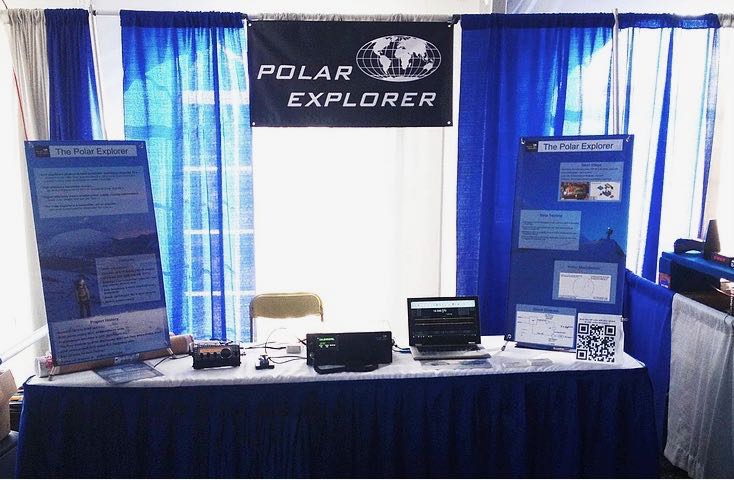
Compared to others, the Polar Explorer booth at the 2019 Hamvention was quite modest. As you can see in Polex Technology photo [at the top of this page], they only had an Elecraft KX3, a laptop, and their Polar Explorer on the table.

So what is the Polar Explorer exactly?

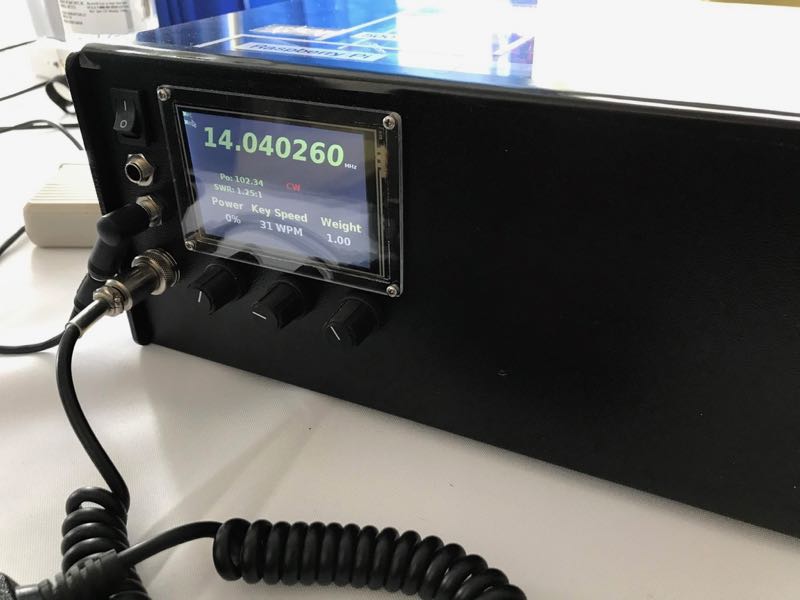
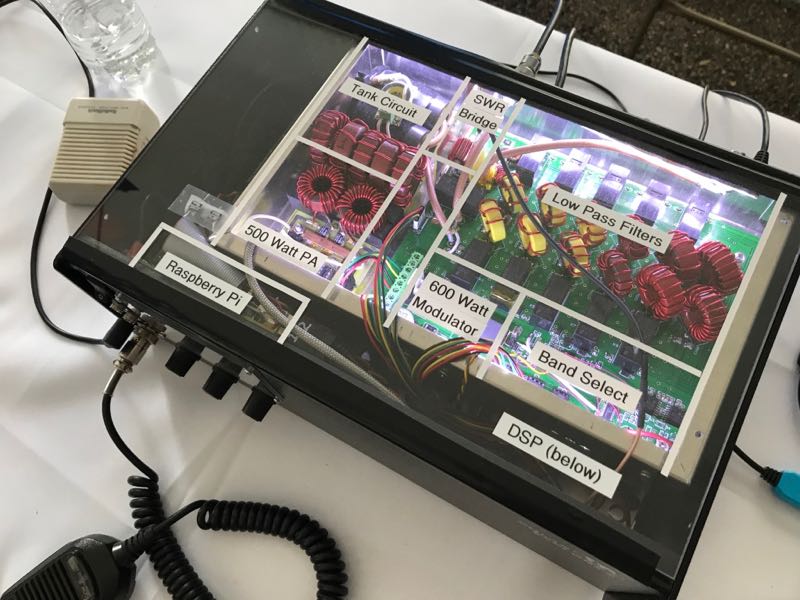
At first blush, the Polar Explorer looks like a 500 watt amplifier, but then you notice that it has both a microphone and key connected directly to it. The Polar Explorer also has a color backlit screen/display–and the one at the 2019 Hamention was attached to an Elecraft KX3 QRP Transceiver.

Turns out the Polar Explorer isn’t an amplifier at all–it’s an external 500 watt transmitter. As noted on the Polar Explorer website:

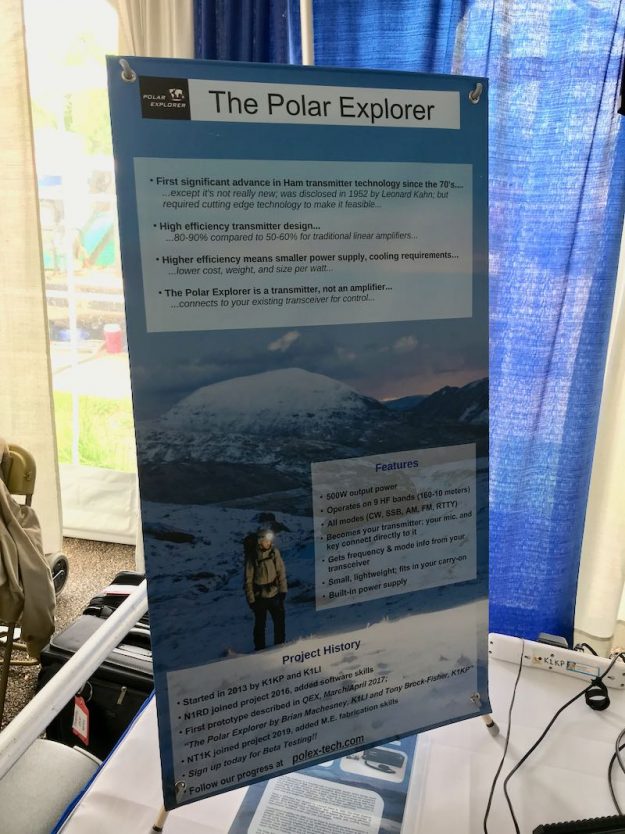
The Polar Explorer is a breakthrough in transmitter design which brings much higher efficiency to SSB and CW transmitters. Most ‘linear’ amplifiers run at around 55 to 60% efficiency, which means a lot of extra power supply capacity is required, along with extra cooling and dissipation capacity. By increasing efficiency, The Polar Explorer significantly reduces power supply requirements as well as cooling. From this, significant reductions in cost, size, and weight can be realized for a given power output level.

[…]The Polar Explorer interfaces to your transceiver using the CAT interface to obtain frequency and mode information. It automatically follows the transceiver as you QSY or change modes. Your transceiver never transmits; The Polar Explorer handles those functions, and includes a T/R relay to protect your transceiver.

By connecting your transceiver to the Polar Explorer, you’re essentially bypassing and delegating the transmitter portion of your transceiver to it. Your transceiver still provides the receiver section and full interface/user experience–the Polar Explorer provides the muscle.

Note that the Polar Explorer is a project in development. I know that at least initially it has been designed to interface with the Elecraft KX3, but I imagine additional compatible transceivers will be added in due time.

At the 2019 Hamvention, the company was seeking beta testers that would be willing to pay for the Polar Explorer–essentially in kit form–at cost. If all goes well, they hope to finish all beta testing by the end of the year and potentially start production in early 2020.

As for the price, I don’t think they have a firm number yet, so I would either contact them directly or watch their website for updates.

If you’re interested in becoming a beta tester or learning more about the Polar Explorer, I encourage you to check out the Polex Technologies website!


Do you enjoy the SWLing Post?

Please consider supporting us via Patreon or our Coffee Fund!

Your support makes articles like this one possible. Thank you!