Category Archives: News

BBG: Hurricane Sandy Fails To Stop VOA Broadcasts

Though this press release rightfully focuses on the staff at VOA headquarters in DC, we should take our hats off to the good folks that kept the Edward R. Murrow Transmission site running in North Carolina as well.

(Source: BBG)

Pounding rain and 80 mile an hour winds from Hurricane Sandy shut down U.S. government offices and the Washington, D.C. public transportation Monday and Tuesday, but it didn’t stop VOA journalists, technicians and support personnel from delivering news around the world in 43 languages.

“We had people sleep on couches around the building, and one used a cot, but the cots are not very comfortable,” English Branch Chief Terry Wing says.  “Some folks came in early on Monday, some stayed late, a couple are still here, I think some are going on 30 hours or more.”

VOA Director David Ensor says every show aired on schedule.  “It was extraordinary, hundreds of programs went out, we never missed a beat.”  Ensor says many language services provided constant updates to network affiliate stations around the world.

Executive Editor Steve Redisch says, “The Spanish Branch did more than 50 live shots to affiliates in Latin America and had a reporter on the New Jersey beach. The Russian Service was on with their affiliate, and the Indonesian Service filed for 20 radio and TV affiliates.”  Redisch says those are just some examples of what went on during the storm.

Newsroom Deputy Managing Editor David Jones, who spent the night at a nearby hotel, says it was all hands on deck.  “People were great.  We had TV and radio packages on the weather, and our political reporter did a story on how the hurricane affected the campaign, but most of our coverage was international — the fighting in Syria, Secretary of State [Hillary] Clinton’s trip to the Balkans, the Ukrainian Election, and   there was something on South African politics,” Jones says.

Executive Editor Redisch says there was a lot of resourcefulness.  The French-to-Africa Service found a French speaking meteorologist at the National Weather Service, and the Mandarin Service TV show was anchored by an alternate who borrowed clothes so she could host the program.

While VOA journalists were hunkered down in Washington, videographer Daniela Schrier managed to capture something that nobody else had, footage of flood waters rushing through streets of Lower Manhattan Monday night.  Schrier, who was trapped in her apartment in New York’s East Village, managed to upload the video to Washington just before she lost power.

VOA broadcasts more than 1,700 hours of radio and television programming around the world each week from its headquarters in Washington.  The programs are delivered on satellite, cable, shortwave, AM, FM, the Internet and on a worldwide network of affiliate stations.

CRTC revokes Sackville’s CBC North license

A few of RCI Sackville’s curtain antennas

Occasionally, I have the opportunity to report good news on the SWLing Post. Unfortunately, this news is of a very disappointing turn:  According to the CBC’s plan, Sackville’s shortwave broadcasting license for the CBC North Quebec service has been revoked by the CRTC. This was announced today on the CRTC website; it is an eventuality in the wake of the 80% cut Radio Canada International received in April of this year.

What’s most sad about this revocation is that communities in North Quebec and Northern Canada who rely on this service, many representing First Nations (American Indians), probably do not even realize that they’re about to lose that service–the only service capable of bringing news to their vast Northern region.  The “replacement” for the service will be low-powered FM, which will just not have the same reach as shortwave.

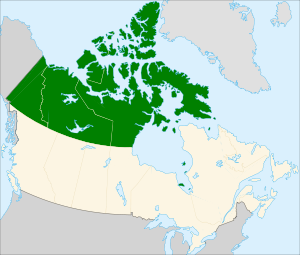
If the three provinces that make up north Canada were a country, it would be the 7th largest country in the world by land mass. Five low power FM transmitters cannot cover this region. (Map: WikiMedia Commons)

A closer look

How vast is this territory? After all, we’re talking about an area where most of us have never traveled. Well, the North Quebec administrative region, alone, is 747,161 sq km (288,480 sq miles)–that’s about the size of Afghanistan, or 200,000 sq km larger than France.

The three provinces which make up northern Canada have a combined area of 3,921,739 km2 (1,514,192 sq mi)–an area larger than India. If northern Canada were a country, it would be the 7th largest in the world.

The Sackville shortwave service covers the entire North Quebec region with ease, and probably most of Northern Canada.

FM can’t replace this service

The CRTC decision states:

The CBC also requested the revocation of its broadcasting license for the shortwave radio undertaking CKCX-SW Sackville, New Brunswick. It indicated that the new transmitters will ensure that the population of the aforementioned locations [Puvirnituq, Kuujjuarapik, Inukjuak, Salluit, and Kuujjuaq] continues to be served by the news and regional information programming of its Radio One service when CKCX-SW Sackville ceases operation.

Five low-power FM stations, one for each of these communities will, at best, cover a total land area of 500 square miles combined.  That equates to a land area about the size of New York City. Note that this is a very generous figure and assumes ideal FM transmission conditions.  Clearly, vast areas of the enormous region–where people live, travel, or hunt–will not be covered; in these areas, radios which once received programming from Sackville will receive only static.

Our petition lives on

Last week, I spearheaded a petition to Canada’s Heritage and Public Safety Ministers and the CBC management asking them to stop dismantling the RCI Sackville site –at least, we asked, please keep this site in a state that could support Canada’s domestic security and the North Quebec Service. While I’m fully aware that this petition is unlikely to alter the course of this previously-made decision (made before anyone could voice disagreement), the petition could still make a positive difference.

There is still time to save Sackville from being dismantled. This petition makes it clear that there is a large community of people who are aware of this arbitrary cut. Only last week, Senator Hugh Segal made a motion on the senate floor that the CBC be made accountable for their unfair 80% cut to RCI (while the whole of the CBC was only cut 10%).

This petition also validates the efforts of those who work at the Sackville site, with whom I’ve been in contact.  They are humbled and appreciative of the extraordinary outpouring of support, in the form of nearly 500 signatures from individuals all over the world. Among the countries represented:  the United States, Mexico, India, Taiwan, and various countries in both Europe and Africa.

If you haven’t already, I encourage you to sign the petition and share it with your friends.

Another Mighty KBC transmission into North/South America–Nov 4th

KBC Propagation Map (Source: The Mighty KBC)

The Mighty KBC is once again broadcasting into North and South America on 9,500 kHz, Sunday, November 4th (00:00-02:00 UTC).

This is their third 2 hour broadcast in the 31 meter band this year.

Try to catch them! If the past is any indicator, their signal is strong (easily heard on a portable in eastern NA) and their music mixes are fantastic.

Please comment if you hear this KBC broadcast outside of North and South America.

Senator Hugh Segal demands that CBC senior management explain rationale for sharp cuts to RCI

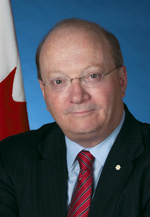
Senator Hugh Segal

Yesterday, Senator Hugh Segal made a motion in the 1st Session of the 41st Parliment that the senior management of the Canadian Broadcasting Corporation (CBC) explain the decision to cut funding of Radio Canada International by 80%, in light of RCI being Canada’s voice to the world and that shortwave serves those, ” in oppressed regions worldwide that are denied access to the Internet.”

His motion is beautifully articulated. It echoes many of the points we make here on the SWLing Post about why shortwave radio is still a vital national and international resource in the Internet age.

Regarding the unfair portion of cuts that RCI received, Senator Segal stated:

My concern is not that CBC senior management decided to reduce RCI’s budget. I would have preferred that CBC had not received a 10 per cent cut. Facing a 10 per cent cut, however, it is understandable that CBC management sought economies in the corporation. My concern is that, when a 10 per cent cut in the core grant produces an 80 per cent cut in one service, a vital and important international service, someone has made a focused and direct choice to target one aspect of the network for effective shutdown. While the management and the board of the CBC are and should be at arm’s length and while they make their own choices, that does not mean that they are not accountable for the choices they make. One area of accountability should be facing questions from this chamber, as well as the other chamber of Parliament, when necessary.

Again, his full motion (below) makes a well-rounded argument that RCI should not have been cut and the decision lacked accountability.

The timing of Senator Segal’s motion coincides with a very successful petition that asks the Misters of Heritage and Public Safety to stop the dismantling of the RCI Sackville transmission site. Please, if you haven’t already, sign this petition and share it with your friends and radio networks

Below, please find the text of Senator Segal’s motion in its entirety:

Hon. Hugh Segal, pursuant to notice of June 29, 2012, moved:

That, at the end of Question Period and Delayed Answers on the sitting following the adoption of this motion, the Senate resolve itself into a Committee of the Whole in order to receive senior management and officials of the Canadian Broadcasting Corporation to explain their decision to cut funding to Radio Canada International services by 80%, particularly in view of the importance of

(a) Radio Canada International as the voice of Canada around the world; and

(b) short wave radio in oppressed regions worldwide that are denied access to the Internet.

He said: Honourable senators, I move this motion as a friend and supporter of Radio-Canada International but also as a friend and supporter of public broadcasting in Canada. It was in 1985, after the election of the Mulroney Progressive Conservative administration, that a group of Canadians from different walks of life, including Adrienne Clarkson; Peter C. Newman; Lois Wilson, the former moderator of the United Church of Canada; Keith Morrison; the Rev. David MacDonald; David Suzuki and others gathered to form the FRIENDS of Canadian Broadcasting to organize, advance and protect the role of public broadcasting in Canada, including Radio-Canada, CBC, TVO and others. It was a privilege to be a part of that group.

The fact that the Mulroney Progressive Conservative administration increased the amount of CBC TV networks, built a new state of the art broadcast headquarters in Toronto, made other investments in the CBC and Radio-Canada and began the important commitment to TV5 speaks to the broad and non-partisan place of public broadcasting in the mixed market economy and pluralist society that Canada has become.

[Translation]

I would like to congratulate Senator Andrée Champagne, who is part of this government, and Senator Marjorie LeBreton, who was the Deputy Chief of Staff to the Prime Minister at the time. Both have made a great contribution to this important area.

[English]

My concern is not that CBC senior management decided to reduce RCI’s budget. I would have preferred that CBC had not received a 10 per cent cut. Facing a 10 per cent cut, however, it is understandable that CBC management sought economies in the corporation. My concern is that, when a 10 per cent cut in the core grant produces an 80 per cent cut in one service, a vital and important international service, someone has made a focused and direct choice to target one aspect of the network for effective shutdown. While the management and the board of the CBC are and should be at arm’s length and while they make their own choices, that does not mean that they are not accountable for the choices they make. One area of accountability should be facing questions from this chamber, as well as the other chamber of Parliament, when necessary.

When a shortwave service, which has been serving the Canadian ideal, Canada and the world, is closed after 67 years, this is not a trivial administrative decision. When a service that could reach around the world is cut to an Internet-based service that will be accessed by only a fraction of the world and only the wealthier fraction at that, this is not a trivial decision. When the separate programming base that produced a global Canadian program mix for RCI, which was shaped for an international audience, becomes a derivative, Internet-based, repeater station, that is also not a trivial decision.

Did anyone afford listeners or Canadians generally a policy paper or plan of action before the announcement was made? No. Were different options for RCI discussed internally? No. Was there a plan to see if different Canadian broadcasters might wish to collaborate on a reconfigured international service? No.

Acting as ruthlessly and capriciously as a private broadcaster that only matches mission with income and avoids more challenging missions might be the CBC’s idea of the rational way ahead. However, if they are going to cut and slash as a private broadcaster might, why do we need a public broadcaster? If it is all about news, hockey and the bottom line, there are private broadcasters who can fill this role at an even greater savings to the Canadian taxpayer. That would not be what I would ever hope for. However, every time the CBC pretends to have no greater duty to its audience than a private broadcaster might, it is the CBC that validates the private option. I believe that a committee of this chamber or a Committee of the Whole, as is in the motion, might well call the CBC management before it to address a few questions that fly in the face of this CBC management decision. I will conclude with these brief questions.

Why has RCI been on the CBC’s own cut agenda since 1991?

What are the foreign and trade policy impacts of denying China Radio International use of our transmitters, which will happen when Sackville is closed? What are the implications of that? When was the decision made to let them use our facilities and at what cost?

Will CBC management consult with the broader community, including the residents of Sackville, New Brunswick, with respect to the disposition of those transmitters?

Why did we have fewer program hours on our international shortwave service, long before the cuts, than the BBC, Voice of Russia, Deutsche Welle, Radio Cairo, All India Radio, NHK World Radio Japan, Radio France Internationale, Voice of Turkey, Radio Pyongyang, Radio Bulgaria, Radio Australia, Radio Tirana, Radio Romania International, Radio Exterior de España, RDP Internacional, Radio Havana and Radio Italia.

Shortwave service and listeners are increasing massively, according to the BBC. In China, production of shortwave radios cannot keep up with demand worldwide, Grundig’s production cannot keep up either. Yet we are exiting this medium of transmission. Why?

There is no limit to who can listen to shortwave, yet world Internet usage, while growing, has no such potential or present reach. In Africa, less than 20 per cent have access to the Internet. In Asia, it is less than 30 per cent. In the Middle East, it is less than half. In developing countries, the percentage is even higher. When dictatorships do not like a message on the Internet, they simply block it, as RCI’s message is now blocked in the People’s Republic of China and was blocked by the former Egyptian regime before a form of democracy ensued in that country. Does the end of creative programming for the international community represent a CBC decision that the international world no longer matters to the CBC or to Canada?

Was there no middle ground, no more modest cutting scenario possible, aligned with the actual 10 per cent cut as opposed to the shutdown? Was an 80 per cent cut the only rational option?

Honourable senators, I commend the motion before you for your consideration and assessment and hopefully your engagement and debate.

I know that there are cultural and artistic aspects that I have not discussed but that others are planning to, with more expertise than I could bring to bear on that issue. I look forward to others participating either in the debate on this motion or before hearings that may occur based on its provision. It may well be that CBC management has decided to move on, to make RCI and its message of freedom, dissent, diversity, democratic debate and robust cultural creativity a thing of the past.

(1600)

I would hope that when arrogance reflects no will to consult, no will to array options, no openness to look for less draconian solutions when it crests on an issue like this, even within a proud, compelling and high-quality public broadcaster, which the CBC is, at least in this chamber there will be some will to ask some very tough questions.

Some Hon. Senators: Bravo!

BBC: Shortwave hit by World Service cuts

As we mentioned last week in our post with the internal memo from the BBC World Service, the BBC has now formally announced that World Service shortwave broadcasts in Arabic are to close by next April and the Cyprus shortwave relay station will close as well.

(Source: BBC)

Short wave broadcasts of World Service Arabic will end by next April, while the Cyprus short wave relay station will close.

World Service English short wave transmissions will be reduced to six hours a day, with 1.5m listeners likely to be lost as a result. Currently, there are between seven and 19 hours of short wave depending on region.

The distribution changes – which include cuts to medium wave transmissions – are designed to save £4.8m in 2013/14. It’s a large chunk of the £12m savings the World Service is targetting in its third phase of cuts as a result of a 16% reduction to its grant-in-aid.

An estimated 3% of the Arabic audience is likely to be lost when the eight hours a day of Arabic short wave in the Middle East is halted. A short wave service will continue in troubled Sudan where there’s a ‘strong need’ for humanitarian information and access to other platforms is limited…

Read the full article on the BBC website

Petition to save RCI Sackville from being dismantled

Dear SWLing Post readers,

I don’t often ask you for favors, but over the past few days, I’ve been working hard in the background to stop the Radio Canada International Sackville, New Brunswick transmission site from being dismantled.

Now, I need a favor.

Could you please take a few moments out of your day to sign this Change.org petition I started? Your voice will be added to the petition and it will automatically email the appropriate Canadian politicians who could, at the very least, put a halt to the destruction of the RCI Sackville site.  Canada–indeed, the world–needs this vital shortwave resource.

You don’t have to be Canadian to sign (after all, I’m not), but just someone who cares about radio and believes in its role in domestic security and international relations.

Click here to  sign the petition at Change.org, or use the embedded form below. Also, please consider sharing this with your radio enthusiast networks and email groups. The more voices, the better!

Sincerely,

Thomas

BBC internal memo outlines year three cuts and changes to the BBC World Service

This BBC internal memo, sent to employees by World Service Director, Peter Horrocks, outlines the unfortunate pending cuts and changes in much greater detail than those presented by the press.

Here is the memo in its entirety–it concludes with further comments from internal sources:

Dear colleagues 

Today we are announcing Year 3 Savings from the 2010 Comprehensive Spending Review settlement for the World Service.

We took quick action last year to deliver the bulk of the required savings immediately after funding cuts were announced in 2010. As a result, we have already achieved nearly £30m of our £42m three-year savings target. However, this still leaves £12m of savings for 2013/14, the final year of Grant-in-Aid funding.

We will be making changes to programming, staffing, scheduling and distribution. We have tried to avoid job losses wherever possible. Of the £12m savings, a significant £4.8m will be achieved via reductions in shortwave and medium wave distribution, details of which will be announced next week. However, it is impossible to make cuts of this scale without impacting on jobs and the plans announced today will result in 73 post closures. Affected teams and individuals have, of course, already been informed and we will work with them to help them through this.

The main changes today are as follows:

WS ENGLISH

  • We are simplifying the World Service English global schedule to have fewer regional variations, creating a more coherent offer which we can also promote and cross-trail more effectively. Being able to link together all the programmes in an hour will also make it easier to fit our content into partner stations’ schedules.
  • A new programme, The Newsroom, will replace World Briefing. This new programme will be live and reactive and it will showcase the best of our Newsgathering presence across English and WS Languages. There will be six editions of The Newsroom across the schedule, with World Have Your Say and The Newsroom coming together each day at 11:00 and 11:30 BST, a prime spot in the schedule.
  • Schedule changes mean fewer full hours of news output – down from about eighteen hours each weekday to about fourteen hours. As a result, there will be post closures in WS News. Further savings will be found in WS News through efficiencies and by integrating some functions across BBC News. In addition, there will be some reductions in Newsgathering, resulting in some post closures.
  • World Service English is also creating a smaller single management team working across distribution, channel management and scheduling. There will be a reduction in the number of specialist announcers on WS English.
  • From April, we will close our daily arts programme, The Strand, and at the same time extend Outlook to an hour long format, offering a new approach to covering Arts, Music and Humanities. A daily 10 minute section will look at the people behind the world of music, entertainment, film and the performance arts.

Every Friday, The 5th Floor will run in the Outlook time slot. The move of this programme to a more prominent slot in the schedule is an indication of its success after less than a year on air and it is a great way of bringing the work of our Language Services to an English audience. The 5th Floor will include a 10 minute arts segment drawn from the Language services’ coverage across the week.

We are also making space in the schedule for The Slot: an hour long programme dedicated to arts and culture coverage across the BBC and the Language Services.

These scheduling changes will enable a significant saving, but will ensure that arts coverage maintains prominence and relevance on the World Service, while making best use of our connections across Languages and the broader BBC.

  • There will be a reduction in the number of documentaries: instead of having four weekly documentary strands, we will now have three with Your World ending. There will be no post closures as a result of this change.
  • Bottom Line will no longer be reversioned for the World Service. Again, this will not result in post closures.

These changes in WS English will result in the closure of 25 posts.

WS LANGUAGES

Year 3 savings affect those Services which were not required to make changes in Years 1 and 2 of the Spending Review settlement.

  • There will be a change in the editorial purpose and remit for the English Language Teaching team. For the last four years, the team has been asked to earn revenue from commercial sources. In the future, the team will focus on public service provision. This change in remit will result in post closures.
  • There will be post closures in BBC Afghan, BBC Burmese, BBC Bengali, and French for Africa. In some services, this will be mitigated by the creation of new posts in bureaux overseas driven by new editorial and operational considerations.
  • A number of currently vacant posts in the Near East hub, African English, BBC Swahili and BBC Brasil will not be filled and will therefore close.
  • In 2013, BBC Swahili morning radio production will move to Dar es Salaam, and the dawn transmission for BBC Somali will move to Nairobi. This will deliver savings for these two services. One vacant Swahili post will close. There will be no impact on Somali posts.
  • BBC Hausa and Great Lakes will be making changes to their schedules to deliver savings. There will be no impact on posts.

The changes to WS Languages, including a few extra post closures outside the UK to be announced at a later stage, will result in 44 post closures.

In addition to the above, now that we have moved out of Bush House, we will be closing four posts in WS Property.

Despite financial pressures, we have continued to adapt our services in response to changes in our audiences and this strategy will continue. We have already seen the successful launch of new TV programmes, Focus on Africa in English for partners and on BBC World News, and Dira Ya Dunia in Swahili, carried by partner broadcasters across sub Saharan Africa. We plan to develop similar programmes in Hindi and Urdu and hope to be able soon to announce a successful conclusion of negotiations with our partners on this new programming.

As we prepare to move to Licence Fee funding, we will be able to demonstrate that the World Service remains strong despite the funding cuts of recent years, is more efficient than ever, and remains a vital force in today’s complex media world. As the new Director General stated in his opening address to staff, he is very supportive of the World Service, as is the BBC Chairman. No doubt, following two major reductions in two years to the size of the World Service, many of you will have questions about its future.

Before 2014, the BBC Trust will prepare a licence describing the purpose, remit, strategy and budget of the World Service in the Licence Fee. The Trust will consult and publish on this licence ahead of transfer to the Licence Fee. This licence will be the key document that will, from April 2014, govern the size, shape and character of the future World Service. All World Service staff will have the opportunity to share their views with the Trust and this will include opportunities to hear from and question individual Trustees.

As I said above, the changes we are announcing today do impact on individuals and teams. We have notified the NUJ and BECTU of these proposals and will consult both them and staff affected so that we can look for ways to reduce the number of compulsory redundancies where possible. I know you will all be supportive of your colleagues through what will be a difficult time and I and the World Service management team will do all that we can to help them through this.

Peter

Internal sources also suggest:

  • nearly all Arabic on shortwave is to end (apart from broadcasts targeting Sudan)
  • the BBC Cyprus relay on SW is to close and English MW from Cyprus is also closing
  • BBC English World Service to Africa, the Middle East, and Asia is to be cut from 18 hrs a day on SW to 7 hours a day

It seems much of the monies are being diverted from shortwave to fund TV ventures, instead.