Category Archives: News

Syria loses the Internet (again)

SyriaMapThis week one of my favorite public radio programs, Marketplace, aired an interview with Matthew Prince, CEO of website security firm CloudFlare. Marketplace’s host, Kai Ryssdal, asked Price why Syria’s Internet is so vulnerable to shut-down. You see, on Tuesday Syria’s Internet had completely shut down by 2:48 PM EST and remained down for a total of 19 hours. Price’s explanation:

“Certain countries have limited access to the internet. In the case of Syria, there are only four connection points, and they’re all run by the national Syrian telecommunications company.”

Interesting.  Other countries that are similarly vulnerable include Greenland, Cuba, North Korea, Libya, and Tunisia.

photo (1)A few months ago, I wrote a post on this very topic, entitled: Syria stifles the Internet while Canada stifles shortwave. I’m pleased and gratified that Popular Communications Magazine picked up my article; it’s published in their April 2013 issue.

Shortwave radio is not the solution to all communications needs, of course, but it is certainly the only international broadcast medium I know of that is impossible for a country like Syria to completely shut down. As I’ve said before, shortwave radio has no regard for national borders, requires no subscription, no apps, no computers, and is nearly impossible to trace to the individual(s) using it.  It is free speech, for free.

For more insight into Syria’s insecure Internet, listen to this full segment from Marketplace via the embedded player below:

Tagged under our growing category: Why Shortwave Radio?

The Age National Times: Radio Australia may cut broadcasts to China/Indonesia

ABC-Radio-AustraliaThanks to Richard Cuff for bringing this item to my attention:

(Source: The Age – National Times)

The ABC could soon abandon international shortwave radio broadcasts to China and Indonesia, ending more than 70 years of beaming news and current affairs on high frequency into Asia.

But the public broadcaster’s management insist it will not flick the switch on shortwave services of Radio Australia to Papua New Guinea and tiny Pacific nations for now.

ABC international chief Lynley Marshall said the older shortwave technology was still relevant in the Pacific, despite a drive to make mobile and internet devices the ”primary” way of delivering news.

Staff had grown increasingly alarmed in recent months that the shortwave service to the Pacific would be canned – including a popular Tok Pisin [a service we recently mentioned] to PNG – raising fears expats and locals would be vulnerable to dangerous news blackouts during natural disasters or regional strife.

Radio is the cheapest and most widespread source of news in poorer Pacific provinces. Most nations run only a 2G mobile network with little coverage outside capitals. When Prime Minister Julia Gillard visits Port Moresby on Thursday almost twice as many locals will hear news of the trip on radio than see it on television or read it in newspapers.[…]

Read more: http://www.theage.com.au/opinion/political-news/abc-may-pull-plug-on-china-broadcast-20130508-2j7yu.html#ixzz2Sjy5NUTu

Richard also posted this relevant comment in the SW Programs discussion list:

[…]I believe this would be the service more audible in Western Europe.

However the Pacific service – which is the service we’re more likely to hear in North America – appears to be safe for now, as mobile/Internet technologies aren’t adequate enough in that region.

Radio Australia has become my staple, reliable shortwave radio news and entertainment source. I certainly hope RA does not cut services in the same manner as RNW or RCI.

Radio Free Sarawak takes a break

RadioFreeSarawakThe clandestine station Radio Free Sarawakwho we most recently mentioned in connection with the Malaysian elections–has announced that they are going off the air.  There is a note of finality in their announcement (below), yet they do leave some ambiguity by declaring, “We will be taking a break until further notice.”

[UPDATE: Radio Free Sarawak back on the air 12 August 2013]

Listen to their final broadcast (studio copy) embedded below:

(Source: Radio Free Sarawak)

While most PR supporters are still reeling from the results of the GE13 amidst widespread rigging that are essentially acts of treason, activists and ordinary people alike are not giving up on booting out the BN government The have set their sights on the 11th state election that will have to be conducted latest by early 2016.

Meanwhile, take a listen to the analysis of Dr Mohd Faisal Syam Abdol Hazis from the Universiti Malaysia Sarawak of the results in the state.

Last but not least, we hear the sadness, anger, frustration and nevertheless, determination of RFS and PR supporters to realise the dream of changing the government in the near future.

p/s Today’s show will be our last. We will be taking a break until further notice. Thank you for your support. It will be a memorable 18 months! We hope you had enjoyed the experience as much as we did.

All Africa: Digital Did Not Kill the Radio Star

ChildSWRadioUgandaThis is a brilliant article on the importance and relevance of radio by David Smith with All Africa.  Below you’ll find some quotes, but it must be read in its entirety:

(Source: All Africa)

By David Smith

Radio threatens many of Africa’s big men.

Thugs working for Zimbabwe’s President Robert Mugabe have recently been confiscating and destroying receivers. Eritrea’s President Isaias Afewerki stopped issuing import licenses. Other iron-fisted rulers such as Swaziland’s King Mswati III and Sudan’s President Omar al-Bashir rarely hand out frequencies, thus reducing the range of independent radio.

The actions taken by these big men merely confirm radio’s supremacy in Africa. It may be old technology, but it is still relevant and appropriate. While not everybody owns a radio, most people have access to one.

[…]A number of radio stations based outside of Zimbabwe’s borders rely on reports from in-country correspondents who use mobile phones and the internet, particularly social media, to send their reports to distant studios.

[S]hort-wave has the advantage of sending signals over vast distances, irrespective of borders and local broadcasting restrictions.

[…]Zimbabwe is not the only country where short-wave is used to bypass restrictive broadcast legislation. Pirate, or clandestine short-wave stations, often staffed by members of the target country’s diaspora, use high-frequency transmitters to send uncensored programming to dozens of countries, including Libya, Madagascar, Sudan, Western Sahara and all the states in the Horn of Africa.

[…]Radios no longer simply transmit. They also receive. The convergence between these two communications devices has created a new community and international platform for lone, isolated voices.

The list of radio stations that do not have an SMS or social network relationship with their listeners, despite their location, is getting increasingly shorter. Any station that fails to interact with its public risks going the way of the dodo.

[…]Video and digital did not kill the radio star. Radio is stronger than ever in Africa, thanks largely to its ability to absorb and adapt to changing technology.[…]

Thanks to author David Smith and All Africa.

Just one more article filed under: Why Shortwave Radio?

Thoughts after the Canadian RCI/CBC Senate hearing

CBC-RCI-HearingLast night, I listened to a live stream of the Canadian senate hearings regarding last year’s Radio Canada International cuts to shortwave radio. CBC president Hubert LaCroix and RCI director Michelle Parent met remarkably little criticism or resistance in the hearing, and it appears the report to the senate will be nothing short of cheerleading for the CBC. Indeed, the hearing’s tone overall was one of self-congratulation.

The decision to cut RCI in this manner is a prime example of a few officials with all-too-limited knowledge making decisions in the absence of experts’ input.  The business decision seemed to them essentially sound, and yet the impact of the decision has far-reaching negative consequences–for Canadians and as well as the rest of the world–that these officials may never fully comprehend.

Notes from the hearing:

  • All but one senator patted CBC and RCI management on the back for becoming more innovative in the wake of devastating budget cuts; only one suggested that such innovation could have been achieved prior to them
  • No one asked if the CBC explored the possibility of scaling back shortwave services without closing the Sackville, NB transmitter site and eliminating shortwave broadcasts altogether, which would have been a much better use of funds as well as maintaining foreign relations and domestic security
  • Hubert LaCroix basically suggested that people living in oppressed regions could gain access to RCI via mobile platforms (sadly, this is not the case)
  • When asked how cuts to shortwave have effected their listenership and demographic, LaCroix basically shrugged his shoulders and pointed out how difficult it is to judge how many people listen on shortwave.  (My response: What areas of our world lack a power grid infrastructure? Fully 1/4 of our planet.  These are the underserved who rely heavily on shortwave)
  • No one inquired about the impact upon their Chinese audience, as RCI’s website is blocked in China; meanwhile, shortwave continues to be comparatively impermeable to firewalls and is untraceable in restrictive countries

Monsieur LaCroix made it clear that the primary CBC mandate is to be a creative, innovative media force within Canada. For him, and most of CBC management, Radio Canada International must have felt like a leech to their dwindling budget. Were I in his position, with limited information and a mandate to protect his main “client” set (Canadians living in Canada)–I might have made the same decision.   And yet…it was the wrong one.

What would have solved the problem in the first place?  Radio Canada International should have been its own entity, with its own budget to manage, however modest–and if anything, funded through the foreign office rather than the domestic public news/entertainment body. After all, what RCI accomplished on shortwave was far more humanitarian and diplomatic in nature.

I’ve written at length about the RCI cuts and will not go into them further on this post. But I do believe RCI Sackville could have been a more efficient and productive operation if it employed some sensible changes. Sackville had just finished installing a (paid-for) technology infrastructure to remotely operate the entire transmitter site. Moreover, Sackville management told me they had planned to cut their staff to a skeleton crew (of three people, if memory serves), only to be there if something mechanical on site needed service. These new adjustments were not even tried.

Additionally, using a market model, RCI/Sackville could have offered their relay services to more broadcasters at competitive (even market) rates. Their hourly rate to broadcast on shortwave was simply too high, thus potential customers sought more efficient cost-effective transmission sites. Sackville was never given the tools to become a self-funding operation like so many private broadcasters have become.

Sackville’s infrastructure was an incomparably valuable resource in which many millions in taxpayer money was already invested and paid in full; sadly, these cuts have destroyed this investment.  The Sackville site, moreover, had the potential of a sleeping army, both in foreign affairs…and in Canadian security.  But it’s gone.  Simply because a few politicians doing their near-best didn’t have all the relevant information.

RCIFor what it’s worth

RCI still has some great talent on board. Canadian expats living abroad, and those  who are connected to the web, can still enjoy RCI via the website or on mobile platforms. That is an audience that may actually expand through a social media presence–something they could have done more effectively prior to the budget cuts last year.

I was also encouraged to hear that there is a serious effort to distribute RCI’s online audio content–free of charge–to broadcasters in local radio stations around the world. This is very positive: FM, though not as accessible as shortwave in Africa, has a strong community following and stations are appearing everywhere. I hope RCI has a dedicated employee whose sole focus is to identify and build connections with these local outlets for their content.

Barring a takeover or drastic re-organization, it sounds like Radio Canada International over shortwave is now destined for the history books. To honor this history, I sincerely hope the new RCI innovates and penetrates new markets. And I hope RCI employees, many of whom have long memories, find challenge and renewed confidence going forward. We certainly appreciate all of the years during which they graced the shortwaves, and wish them all the best.

New large portable shortwave radio in the works?

(Source: bbs.tecsun.com.cn)

(Source: bbs.tecsun.com.cn)

Gary writes:

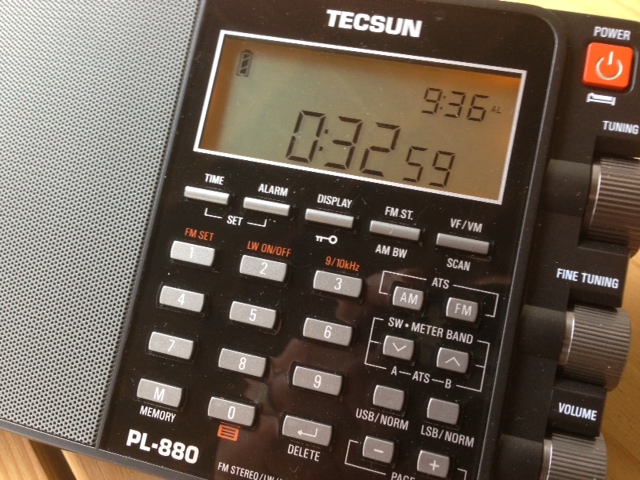
It looks like a new, large portable radio — along the lines of the Redsun RP2100 — is on the way. At least this one includes a direct-entry keypad and SSB, like the RP3100 is supposed to.

http://herculodge.typepad.com/herculodge/2013/04/another-large-portable-all-band-radio-to-be-released.html

I hope they can do good QC, and keep the sample to sample variation low.

Thanks, Gary. It does look like a variation of the of the RP3100. Sounds like it’s not a Redsun product, but may have been ported from one of their engineers for JiDian. It certainly has the trademark look. If this is true, there’s a possibility that C.Crane could bring this to North America. Perhaps it’s the next radio in line to succeed the CCRadio SW?  Though a great radio, the CCRadio-SW is getting a little long in the tooth.

Epoch Times: Radio Taiwan International dismantling two transmission sites?

RadioTaiwanInternationalLogoUpdate: This article, from the Epoch Times, is somewhat misleading: it appears that RTI is not actually being silenced; rather, they’re merely removing sites that are retired and redundant. See post comments for more info.

(Source: Epoch Times)

Media freedom in Taiwan is again under attack by political forces from mainland China, resulting in a sudden decision by Radio Taiwan International (RTI) to dismantle two of its substations. Among RTI’s customers who will lose their contracts are Sound of Hope Radio and Radio Free Asia, which have played an important role in broadcasting uncensored news to the mainland.

Earlier this month, RTI’s largest customer, Sound of Hope Radio (SOH), received a notice that the Huwei substation in Yunlin County will be dismantled beginning June 1. The eight radio antennas pointing towards China will be removed ahead of schedule, and the broadcasting business will also stop at the end of May.

Tainan, another RTI substation in Tianma, will also be dismantled in a few months’ time, according to an insider.

[…]According to insider information, RTI high-level executives visited mainland China at the end of February. Soon after, RTI announced its intention to take down the two substations.

Following the removal of the substations, RTI will terminate all its rebroadcasting customers and also stop its own shortwave broadcasting, and develop a mobile platform and Internet broadcasting instead, the insider said.

Zeng (Allen) Yong, President of SOH, told The Epoch Times he had rushed to Taiwan as he was very concerned about RTI’s move to terminate its main customers in the name of consolidating substations and eventually ending shortwave broadcasting into China–a matter of great concern to the Communist Party, which censors media in the mainland.[…]

Read the full article at The Epoch Times.