Category Archives: News

“When the world got its news from shortwave radio”

Many thanks to SWLing Post contributor, Dennis Dura, who shares the following article from SwissInfo.ch. Make sure you visit SwissInfo.ch to listen to their embedded recordings:

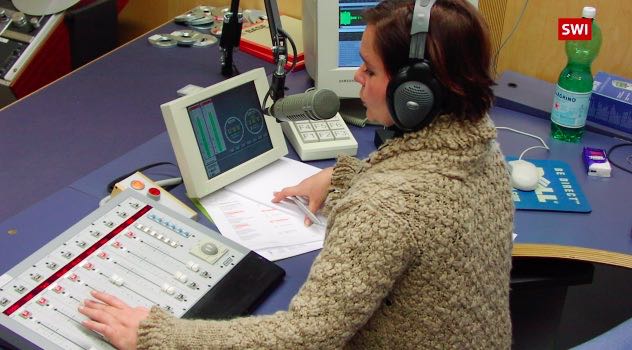
What did SWI swissinfo.ch sound like for the first seven decades of its existence? The short answer: a radio station. 

From the mid-1930s to 2004, Switzerland’s international service was Swiss Radio International (SRI). The first few decades of SRI’s existence were the heyday of shortwave – it was often the only way of getting news directly from other countries.

A brief history of SRI, the predecessor of swissinfo.ch, helps explain why you hear what you do in the video above.

What began as the Swiss Short Wave Service in 1935, would grow from broadcasting programmes in German, French, Italian and English to include other European languages and Arabic, and eventually change its name to Swiss Radio International.

The international service was considered a voice of neutrality during times of war, first during World War II, followed by the decades of the Cold War and up to and including the first war in the Gulf in the early 1990s.

This decade would mark the beginning of the end for Switzerland’s shortwave broadcasts. Shortwave transmitters gave way to relaying programmes via satellite, and this, in turn, would give way to the internet when the service went online in 1999 as SRI’s website.

In 2004, the plug was pulled for good on SRI as part of budget cuts, but not swissinfo.ch. Now producing exclusively online, the international service extended its linguistic reach by adding Russian, Japanese and Chinese, and publishing more video and audio reports.

Journalists working in swissinfo.ch’s current ten languages collaborate closely to set the editorial agenda, providing the necessary context in their stories so they are understood wherever they are read, seen, or heard in the world.

Project ‘The Sounds of…’

This article is part of the project “The Sounds of…” produced with our partner media organisations Polskie RadioRadio Canada InternationalRadio Romania International and Radio Prague International. Further videos have been produced by journalists at these outlets, to give an insight into their work in these countries.

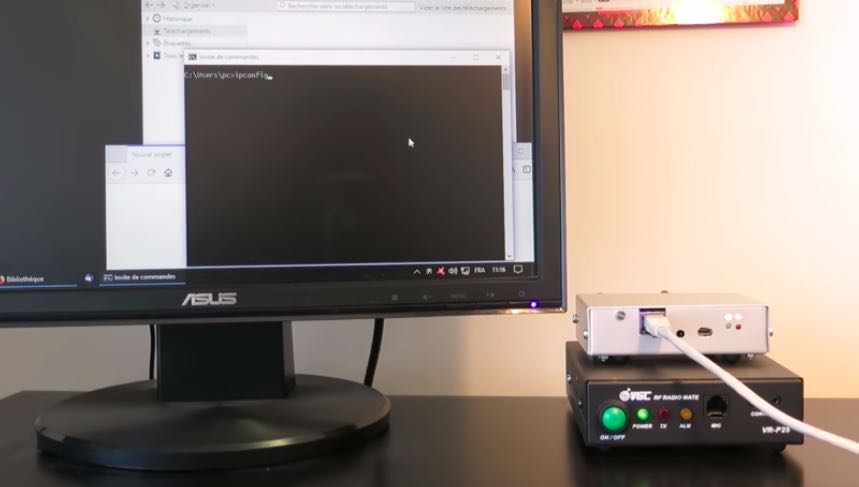
IEEE Spectrum: Build a Long-Distance Data Network Using Ham Radio

(Source: F4HKD via YouTube)

(Source: IEEE Spectrum)

Send data via IPv4 up to 300 kilometers with easy-to-assemble hardware

By F4HDK

I have been a hobbyist and maker for almost 15 years now. I like inventing things and diving into low-level things. In 2013, I was looking at a protocol called NBP, used to create a data network over amateur radio links. NBP was developed in the 2000s as a potential replacement for the venerable AX.25 protocol [PDF] that’s been in use for digital links since the mid-1980s. I believed it was possible to create an even better protocol with a modern design that would be easier to use and inexpensive to physically implement.

It took six years, but the result is New Packet Radio (NPR), which I chose to publish under my call sign, F4HDK, as a nom de plume. It supports today’s de facto universal standard of communication—the Internet’s IPv4—and allows data to be transmitted at up to 500 kilobits per second on the popular 70-centimeter UHF ham radio band. Admittedly, 500 kb/s is not as fast as the megabits per second that flow through amateur networks such as the European Hamnet or U.S. AREDN, which use gigahertz frequencies like those of Wi-Fi. But it is still faster than the 1.2 kb/s normally used by AX.25 links, and the 70-cm band permits long-distance links even when obstructions prevent line-of-sight transmissions.

Initially, I considered using different frequency bands for the uplink and downlink connections: Downlinks would have used the DVB-S standard, originally developed for digital satellite television. Uplinks would have used a variation of FSK (frequency-shift keying) to encode data. But the complexity involved in synchronizing the uplink and downlink was too high. Then I tried using a software-defined radio equipped with a field-programmable gate array (FPGA). I had some experience with FPGAs thanks to a previous project in which I had implemented a complete custom CPU using an Altera Cyclone 4 FPGA. The goal was to do all the modulation and demodulation using the FPGA, but again the method was too complex. I lost almost two years chasing these ideas to their dead ends.

Then, in one of those why-didn’t-I-think-of-this-earlier moments, I turned to ISM (industrial, scientific, and medical) chips.[…]

Click here to read the full article.

Many thanks to SWLing Post contributor, Marty, for the tip!

Update: Availability of the Tecsun PL-990 and H-501

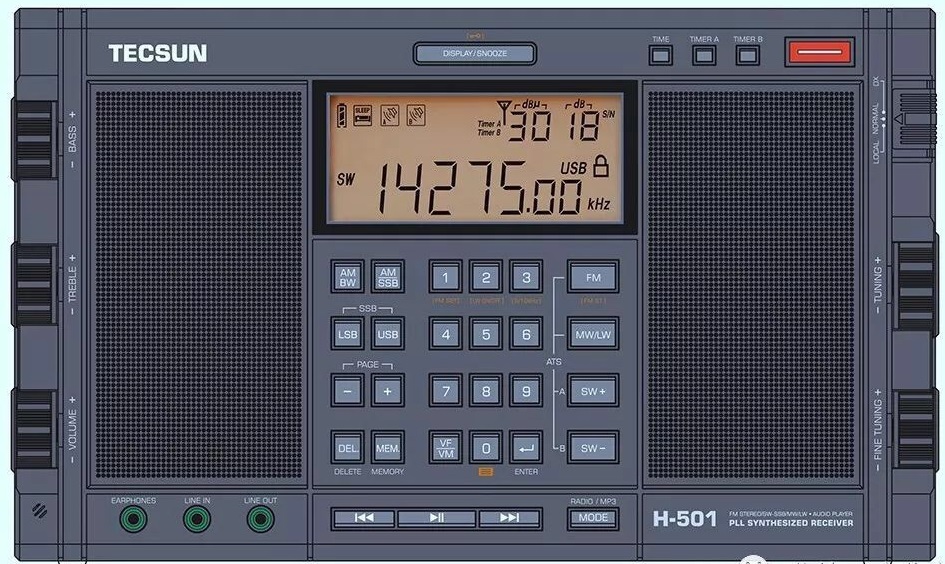
Many thanks to SWLing Post contributor, Gareth Buxton, who recently received the latest availability dates of the new Tecsun PL-990 and H-501.

According to Anna at Anon-Co, both radios should start shipping in January or February of 2020. Gareth included the following screenshot which also notes the new AN-48x active loop antenna:

Still no firm pricing information. I will be reviewing both of these radios as soon as they’re available, so stay tuned!


Do you enjoy the SWLing Post?

Please consider supporting us via Patreon or our Coffee Fund!

Your support makes articles like this one possible. Thank you!

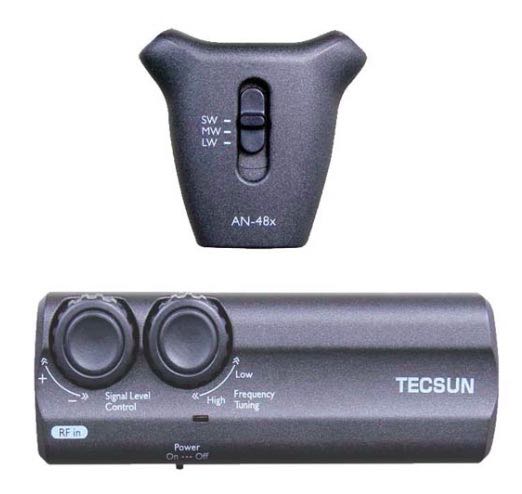
The new Tecsun AN-48x Active Loop Antenna

Many thanks to SWLing Post contributor, Troy Riedel, who shares a link to the new Tecsun AN-48x Active Loop Antenna at Anon-Co. Here’s the description from Anon-Co:

TECSUN AN-48x is an active loop antenna for enhancing shortwave (SW), medium wave (MW/AM) and longwave (LW) reception.

Unlike previous models (DE31MS, A38-LMS) available on anon-co.com, the AN-48x is supplied with adapters to connect the antenna to BNC and RCA sockets. This greatly simplifies hooking up the antenna to TECSUN receivers like S-2000 and S-8800, while it is just as easy to use with H-501, PL-990, PL-880 and the rest of the “PL”-family.

AN-48x also works with portable radios that do not have an external antenna jack!

Effective Frequency Range

Longwave: 120 ~ 400 kHz

Medium Wave (AM): 520 ~ 1700 kHz

Shortwave: 3500 ~ 20,000 kHz

[…]

Click here to view at Anon-Co.

Anon-Co notes that they expect to launch this product in December 2019. If you happen to grab one, consider sharing your review here on the SWLing Post!

One sunspot into Solar Cycle 25

(Source: NASA Solar Dynamics Observatory via Spaceweather Archive)

(Source: Spaceweather Archive via Michael Bird)

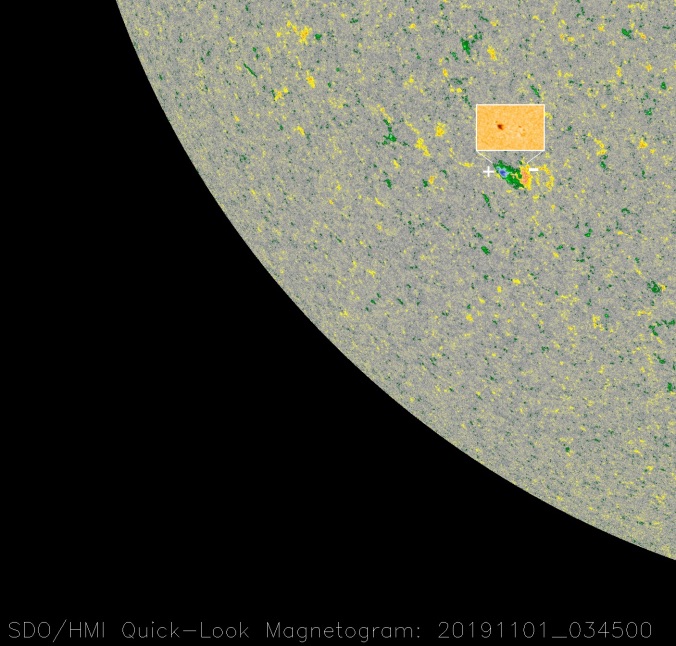
Nov. 1, 2019: Breaking a string of 28 spotless days, a new sunspot (AR2750) is emerging in the sun’s southern hemisphere–and it’s a member of the next solar cycle. A picture of the sunspot is inset in this magnetic map of the sun’s surface from NASA’s Solar Dynamics Observatory:

How do we know AR2750 belongs to the next solar cycle? Its magnetic polarity tells us so. Southern sunspots from old Solar Cycle 24 have a -/+ polarity. This sunspot is the opposite: +/-. According to Hale’s Law, sunspots switch polarities from one solar cycle to the next. AR2750 is therefore a member of Solar Cycle 25.[…]

Click here to read the full article.

TX Factor Episode 24

Many thanks to SWLing Post contributors, Eric and Tom, who note that the latest episode of TX Factor has been released.  Here’s the show summary:

Episode 24 of TX Factor is a Hamfest 2019 special, reporting on some of the eye-catching products and services on display at this year’s event in Newark.

We investigate the current state of HF propagation, celebrate 50 years of Nevada Radio, Mike tries out a few solder stations, and Bob goes all soft over the VMARS vintage AM radios. And to cap it all, we take a look at the latest rig from Yaesu.

As always, there’s a chance to win a great bundle of prizes from our sponsors, ML&S and the RSGB.

We hope you enjoy the show!

Click here to view on YouTube.

Crew 15.61 announces its first DXcamp in the Amazon rainforest

Crew 15.61 announces its first DXcamp in the Amazon rainforest of Brazil and launches its exclusive event site.
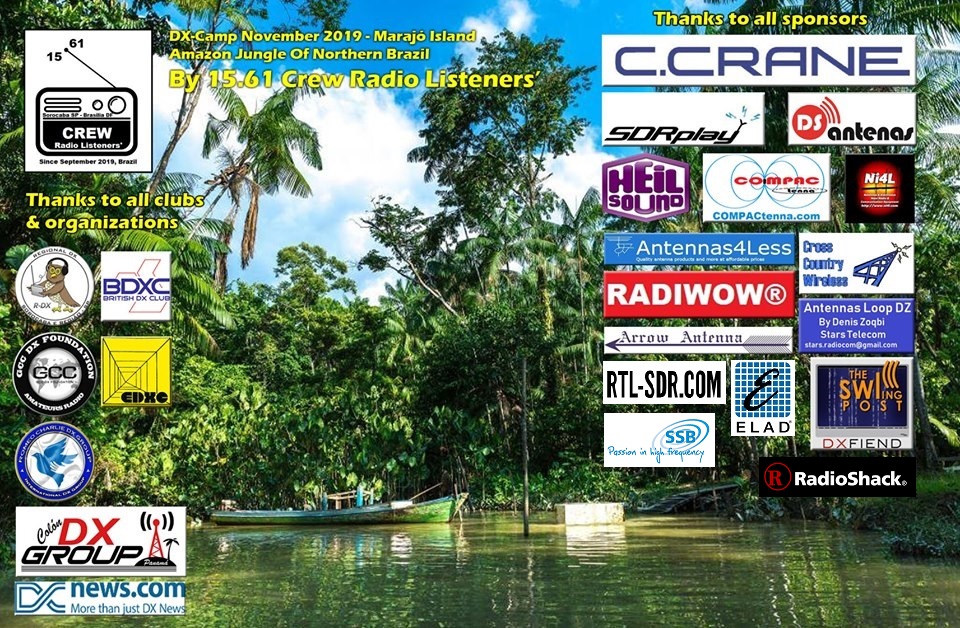

From today you can visit https://dxcamp-marajo2019.blogspot.com/ and find all the information about the first DXcamps of the 15.61 Crew.

The DXcamp, will be held between November 15-18 on Marajó island. It’s the first time that an event with these dimensions and characteristics is held in Brazil and maybe in South America.

This DXcamp got the attention of several sponsors who helped the 15.61 Crew, including: C.Crane, SDRplay, DS Antennas (Brazil), Heil Sound, COMPACtenna, Cross Country Wireless, Antennas4Less, NI4L Antennas, Radiwow, RTL-SDR, ELAD, SSB, RadioShack, Antennas Loop DZ by Denis Zoqbi (Brazil), Arrow Antennas and the SWLing Post blog.

“When the Last Tree Is Cut Down, the Last Fish Eaten, and the Last Stream Poisoned, You Will Realize That You Cannot Eat Money ” (Native American saying).

Vital to the planet weather, the Amazon region has suffered fires for several weeks and several organizations have denounced the silence of Brazilian President Jair Bolsonaro about what they consider a devastating environmental crime against Earth. Such disaster has caused worldwide shock and must be remembered, because as something that happened during September, unfortunately the media coverage is focusing probably another disaster.

Marajó is the largest island in Brazil and the largest river island in the world, where the Amazon and Tocantins rivers and the Atlantic Ocean meet. It’s located about three hours by boat from Belém, capital of Pará state.

The 15.61 Crew founders are Martín Butera, correspondent journalist in South America for the British DX Club and Ivan Dias da Silva Júnior, founder of the Regional DX group of Sorocaba/São Paulo.

The objective of 15.61 Crew is not just DX. We will take a direct and committed action to help the planet and raise awareness about the climate change that we are sadly living.

We will plant a tree on behalf of the European DX Council (EDXC). Planting a tree amid the flames that are killing the Amazon rainforest today will certainly not be your salvation, but it will leave a legacy and our contribution for a better world.

We will raise awareness that together we can change this situation with actions such like waste sorting, buying products that can be reused, lowering electricity consumption, eating more organic fruits and vegetables, moving on public transport and so on.

Martin Butera lives in Brasilia, the capital of Brazil, about 27 hours from Belém or 1982 km. Ivan, lives in Sorocaba,São Paulo state, 38 hours from Belém or 2893 km. Both will meet in Belém and then go by boat to the island.

A trip like this requires a lot of preparation. It’s not something cheap or easy to be done. It takes a lot of time, effort and personal expenses to go to these remote places in South America and then share our catches with you. Those who would like to collaborate with us can do by Paypal account, from our website.

Why do we ask your financial support? Airline weight limits and luggage size are a problem in South America and are increasing the costs for us. We also have a long boat trip of more than 3 hours and will rent a house in the island.

Everything is already paid, but your help can made everything easier on the next DXcamps of 15.61 Crew. All donations will be reported on our site, but whoever makes an anonymous donation will be kept anonymous, and we will report only the value. Please consider support our DXcamp camp in Marajó island!

Your contribution will help us take the best listening station we can gather and have more and better chances of getting good results.

The 15.61 Crew founders, have extensive experience in the hobby, both Martin, 29 years as a ham radio operator (LU9EFO-PT2ZDX), with many DXpeditions in several South American islands, as Ivan, started DXing 26 years ago, including contributions to several clubs and as utility stations professional monitor.

Everything we do during this DXcamp will be shared by texts, photos and videos of our correspondent Martín Butera and will be published as son as possible on the BDXC bulletin and SWLing Post blog.

This will be the first of many DXcamps in exotic places that we plan to carry out, always with a message and a proposal for direct action. We are living in a world in danger and our roles as a society can’t be limited only to be only radio listeners.

Thank you!

Martin Butera & Ivan Dias
15.61 Crew Radio Listeners founders

To know more about CREW 15.61 Radio Listeners’ please click here.

Martín Butera is a correspondent journalist in South America for the British DX Club.