Tag Archives: Solar Cycle 25

Radio Waves: DLARC, Solar Cycle 25 Explained, and VOA Delano property to be sold

Radio Waves:  Stories Making Waves in the World of Radio

Welcome to the SWLing Post’s Radio Waves, a collection of links to interesting stories making waves in the world of radio. Enjoy!

Many thanks to SWLing Post contributor Dennis Dura for the following tips:


DLARC: The Radio Geek’s Doomscrolling Antidote (Radio World)

The internet has aged to the point where it is easy to fall into a rabbit hole, reminiscing about websites from decades past.

The site that fuels those scrolling endeavors is the Internet Archive — a nonprofit that hosts a digital library of internet sites and other artifacts in digital form. The project began in 1996 to archive the web.

Today, it contains one trillion web pages through its “Wayback Machine,” as well as 56 million books and texts. It also works with approximately 1,400 libraries through its Archive-It program to identify and preserve important digital history.

Kay Savetz (K6KJN) freely admits to having been an Internet Archive power user. Savetz used not just the archive.org website, but also its command line interface to upload many documents. [Continue reading…][Continue reading…]

Solar Cycle 25 Gives Amateurs and Shortwave a Boost (Radio World)

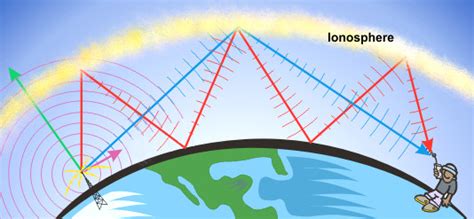
Beyond their love of radio, amateur radio operators and shortwave radio broadcasters have one thing in common: They rely on the ionosphere to refract or bend their signals back to Earth, so that they can travel beyond line-of-sight distances.

In turn, the ionosphere’s ability to refract radio signals depends on its level of ionization or charge. The more ionized the ionosphere is, the more likely it is to bend signals back to the ground rather than let them pass through.

Here’s where the sun comes in. The number of sunspots on the solar surface rises and falls over an 11-year period, during what is known as a solar cycle. The more sunspots, the more solar radiation comes to Earth. [Continue reading…]

City of Delano plans to sell Voice of America property, keep portion for ‘future park purposes’ (KGET)

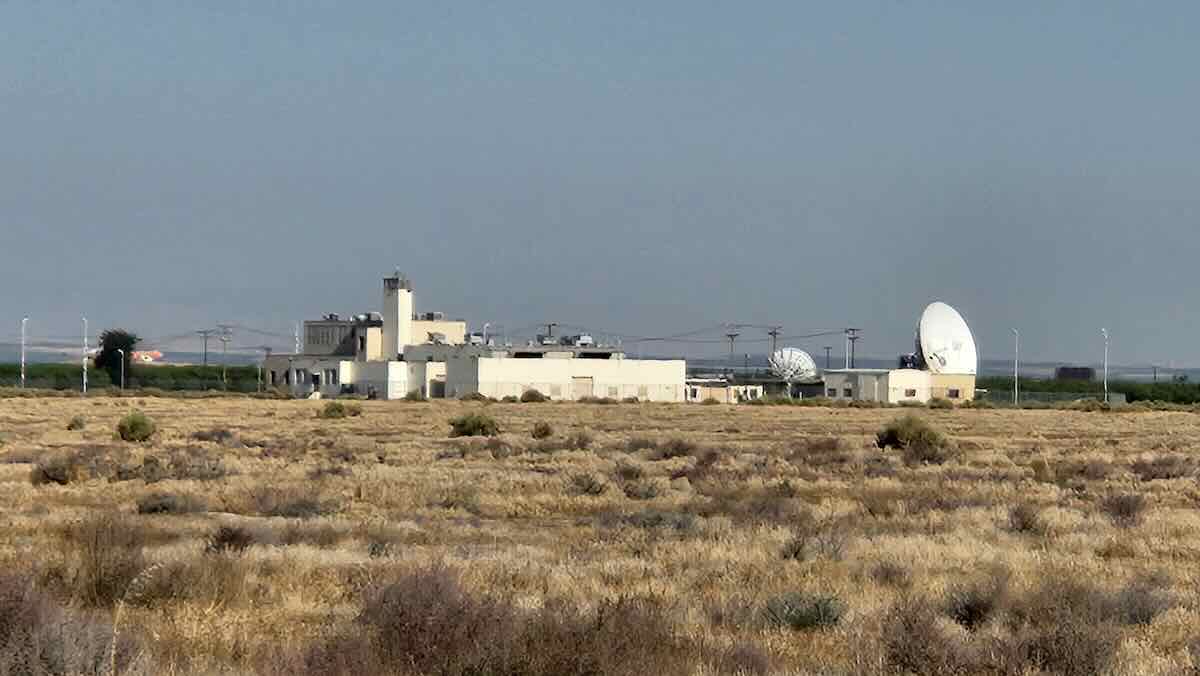
BAKERSFIELD, Calif. (KGET) — The city of Delano is looking to keep a portion of the former Voice of America property for “future park purposes” and sell the rest, according to the Delano City Council agenda for Monday.

The property is on about 800 acres bordered by West Garces Highway, Woollomes Avenue, Melcher Road and Casey Avenue.

It was home to the Delano Transmitting Station, built in 1944 to broadcast Voice of America programming worldwide. It stopped operating in 2007 and was demolished shortly after.

The City Council is set to consider whether it should retain about 20 acres of that property for park-related reasons and designate the remainder as “surplus land” and approve selling it. [Continue reading…]


Do you enjoy the SWLing Post?

Please consider supporting us via Patreon or our Coffee Fund!

Your support makes articles like this one possible. Thank you!

Sunspots

A Second Solar Max Peak?


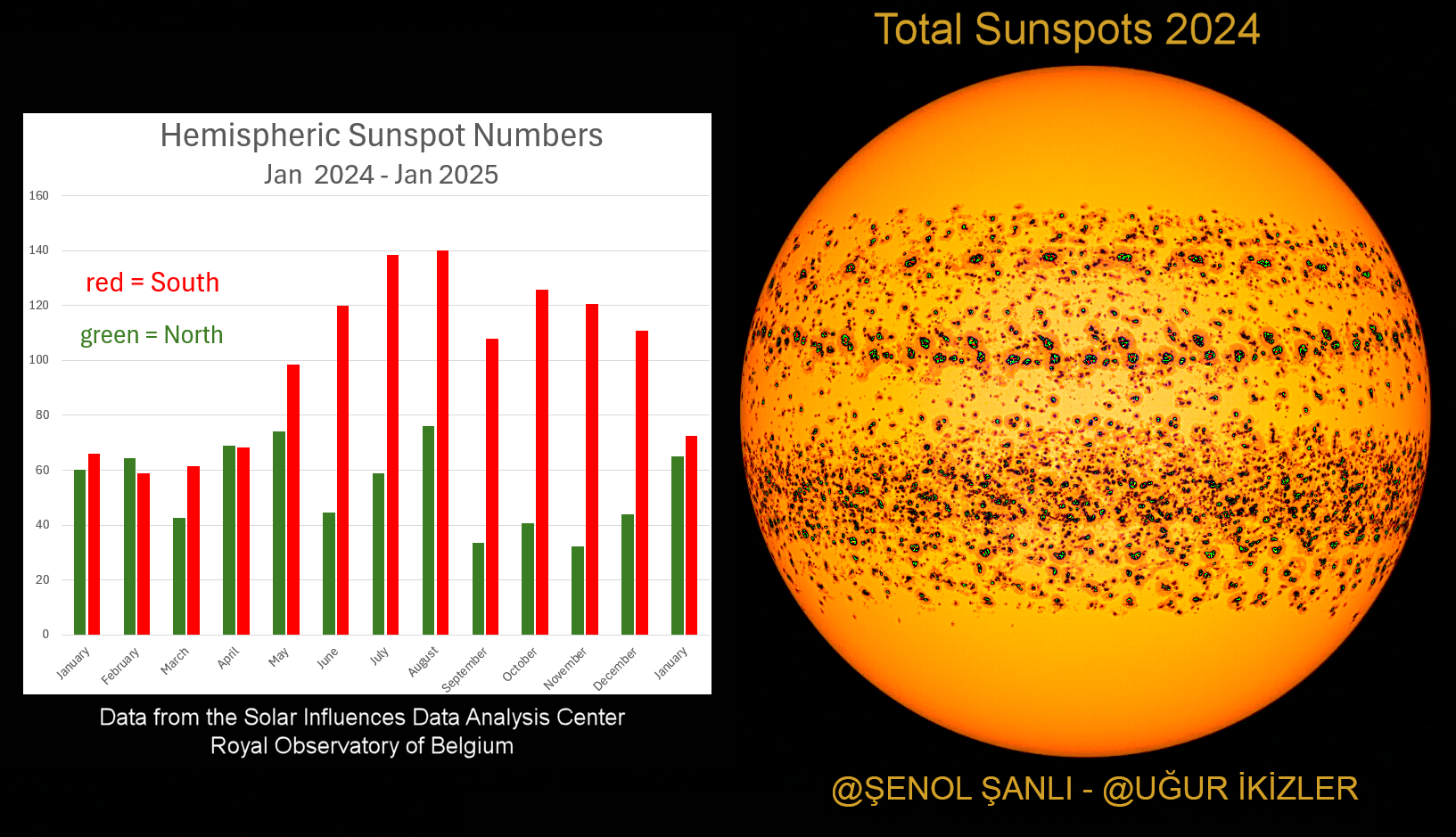
SOLAR MAX — IS A SECOND PEAK COMING? Last October, NOAA and NASA announced that Solar Max has arrived. Only half the sun got the memo. The majority of solar activity has been happening in just one of the sun’s hemispheres–the south. The solar superstorm of May 10, 2024, for instance, was caused by a monster southern sunspot.

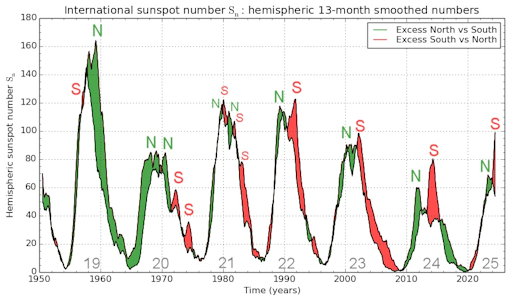
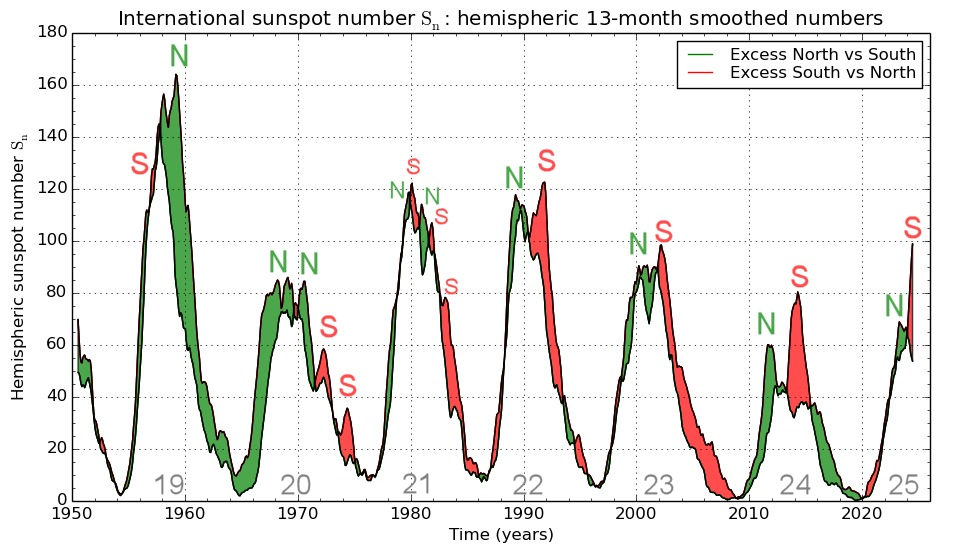
It makes you wonder, is the other half of Solar Max still coming? This plot of hemispheric sunspot numbers from SILSO provides some context:

Here we see all seven solar cycles of the Space Age, punctuated by current Solar Cycle 25 on the far right. The most recent cycles are double peaked, with northern sunspots (green) and southern sunspots (red) reaching their own Solar Max ~two years apart. This isn’t big news. Researchers have long known that the two hemispheres of the sun are slightly out of sync. The north vs. south delay is called the “Gnevyshev gap.”

This composite image of last year’s sunspots shows how dominant the southern hemisphere has been:

For forecasters of the solar cycle, this raises an interesting possibility: Maybe the northern peak is still coming. Indeed, there are signs in February 2025 that the pendulum is swinging. This month’s sunspots have been more evenly distributed between the two hemispheres, a sign that activity may be shifting north.

On the other hand, the northern peak might have already occured [sic]. Take another look at the first plot. There is a puny northern peak near the beginning of Solar Cycle 25. Perhaps that was it. (Indeed, that would jibe with the north-first, south-second order of recent double peaks.)

This discussion focuses attention on the north-south balance of sunspots. A northern shift in the months ahead could herald a second peak and another year or two of excellent auroras before Solar Cycle 25 finally peters out. Stay tuned!

Published by Spaceweather.com

Posted by Robert Gulley, K4PKM

Cycle 25 may peak sooner than expected

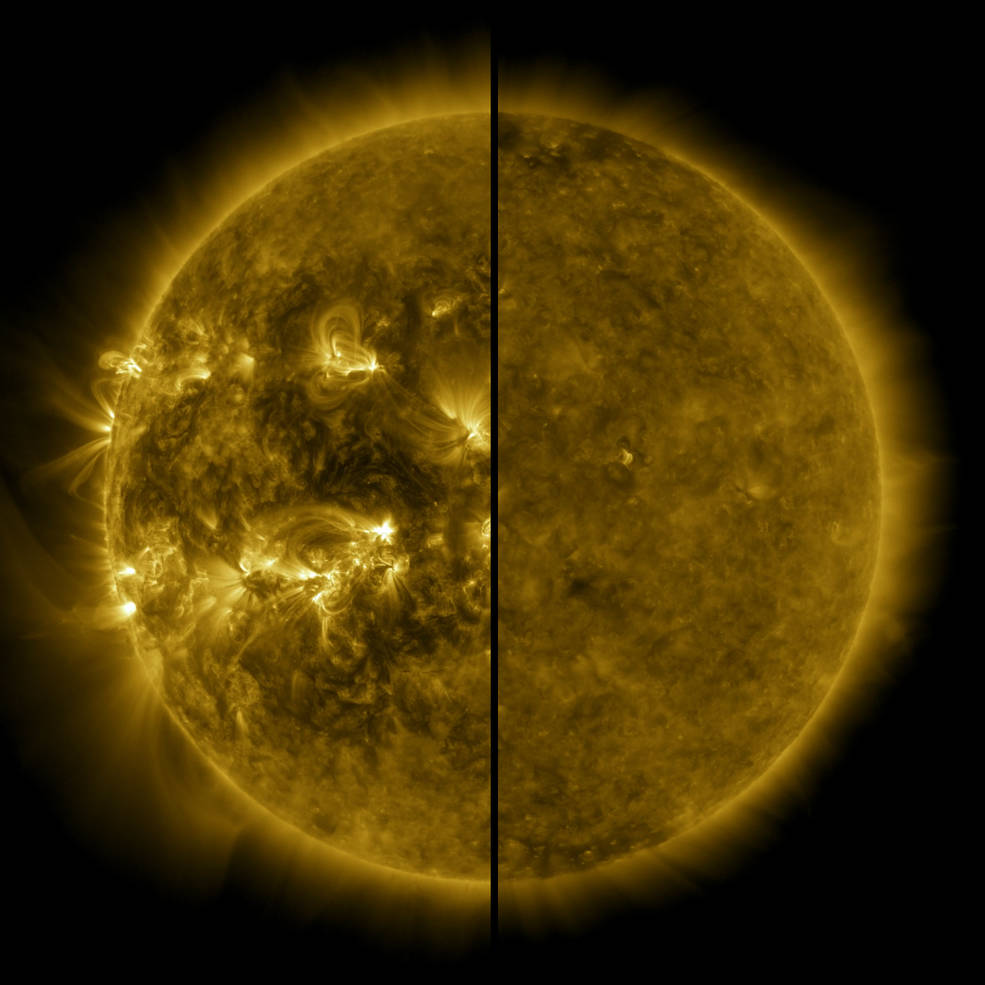
This split image shows the difference between an active Sun during [a previous] solar maximum (on the left, captured in April 2014) and a quiet Sun during solar minimum (on the right, captured in December 2019). Credits: NASA/SDO

Many thanks to SWLing Post contributor, TomL, who shares the following news item:

Solar Cycle 25 May Peak Much Sooner Than Expected

“In April 2019, the Solar Cycle 25 Prediction Panel, which is made up of dozens of scientists from NASA and the National Oceanic and Atmospheric Administration (NOAA), released its forecast for Solar Cycle 25, suggesting that the solar maximum would likely begin sometime in 2025 and would be comparable in size to the maximum of Solar Cycle 24, which peaked unusually late between mid-2014 and early 2016 and was quite weak compared with past solar maximums.

But from the beginning, the forecast seemed off. For instance, the number of observed sunspots has been much higher than predicted.”

TomL notes:

To read the rest of the article go to web site link here:
https://www.livescience.com/space/the-sun/solar-maximum-could-hit-us-harder-and-sooner-than-we-thought-how-dangerous-will-the-suns-chaotic-peak-be

Not mentioned in the article are implications for a sooner-than-expected Peak may mean that the Peak will be about the same strength as Cycle 24 but with a shorter duration. It may also mean that the future Cycle 26 may be weaker than both 24 or 25, but that remains to be seen.

You and the ionosphere: Share your propagation stories!

Many thanks to SWLing Post contributor, Jock Elliott, who shares the following guest post:


You and the ionosphere . . . a reader participation post

By Jock Elliott, KB2GOM

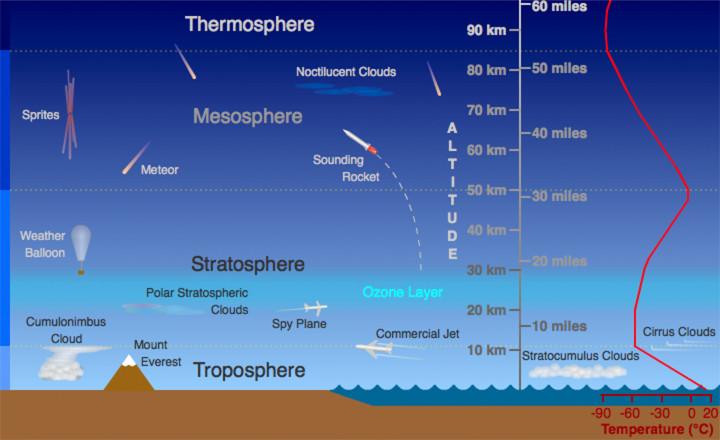
Here’s a shocker for you: we live at the bottom of the sky. Above us there are multiple layers of the atmosphere, pressing down on us at 14.7 pounds per square inch.

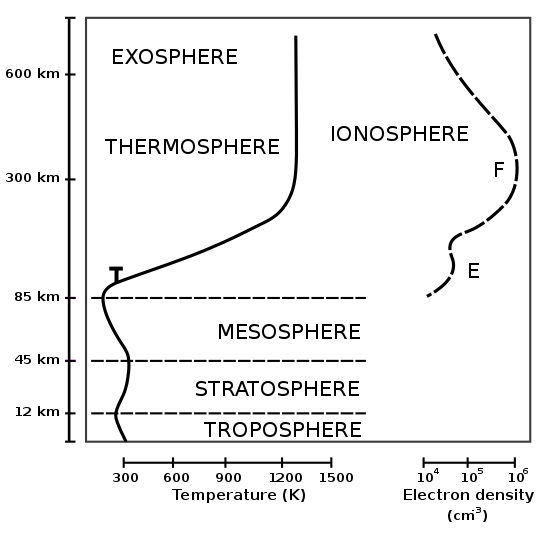
Of particular relevance to us as shortwave listeners and hams, there is a special layer of the atmosphere, not shown on the chart above called the ionosphere. The ionosphere starts around 30 miles above us and extends up to about 600 miles and includes parts of the layers above.

The Sun’s upper atmosphere, the corona, is very hot and produces a constant stream of Ultra-Violet and X-rays, some of which reach our atmosphere.  When the high energy UV and X-rays strike the atmosphere, electrons are knocked loose from their parent atoms and molecules, creating a layer of electrons.

Now, here’s the cool part: this layer – the ionosphere – is important because radio waves bounce off of it.

The sun, however, is not constant in its action on the ionosphere. The amount of UV and x-ray energy (photon flux) produced by the sun varies at by nearly a factor of ten as the sun goes through an 11 year cycle. The density of the ionosphere changes accordingly, and so does the ability of the ionosphere to bounce radio waves. When the sun is at peak activity, and the ionosphere is “hot,” SWLs and hams are likely to experience excellent long-range propagation. When the sun is quieter, long-range propagation diminishes.

Every 11-year solar cycle is unique, but early indications are that we may on the verge a cycle that favors long-range propagation: https://swling.com/blog/2022/03/termination-event-may-indicate-solar-cycle-strength/

The results can be spectacular. Decades ago, during a particularly hot solar cycle, I once spoke from my station near Albany, NY, to a station in the state of Georgia on a mere 4 watts. On another occasion, I conversed with a ham in Christchurch, New Zealand – a distance of over 9,000 miles – with 100 watts single sideband transmit power. During that same period, I would routinely listen to shortwave stations halfway around the world.

And now, it’s your turn – what’s your favorite long-range propagation story, either as an SWL or ham? Please comment!

Radio Waves: Termination Event, Russian Propaganda in DC, Renewed Relevance, Circumventing Censorship, and Old-School Radio Sense

Radio Waves:  Stories Making Waves in the World of Radio

Because I keep my ear to the waves, as well as receive many tips from others who do the same, I find myself privy to radio-related stories that might interest SWLing Post readers.  To that end: Welcome to the SWLing Post’s Radio Waves, a collection of links to interesting stories making waves in the world of radio. Enjoy!


The Termination Event has Arrived (Space Weather Archive)

Feb. 26, 2022: Something big just happened on the sun. Solar physicists Scott McIntosh (NCAR) and Bob Leamon (U. Maryland-Baltimore County) call it “The Termination Event.”

“Old Solar Cycle 24 has finally died–it was terminated!” says McIntosh. “Now the new solar cycle, Solar Cycle 25, can really take off.”

The “Termination Event” is a new idea in solar physics, outlined by McIntosh and Leamon in a December 2020 paper in the journal Solar Physics. Not everyone accepts it–yet. If Solar Cycle 25 unfolds as McIntosh and Leamon predict, the Termination Event will have to be taken seriously.

The basic idea is this: Solar Cycle 25 (SC25) started in Dec. 2019. However, old Solar Cycle 24 (SC24) refused to go away. It hung on for two more years, producing occasional old-cycle sunspots and clogging the sun’s upper layers with its decaying magnetic field.  During this time, the two cycles coexisted, SC25 struggling to break free while old SC24 held it back.

“Solar Cycle 24 was cramping Solar Cycle 25’s style,” says Leamon. [Continue reading…]

The tiny radio station broadcasting Russian propaganda in D.C. (Washington Post)

For a few seconds every hour, WZHF-AM interrupts its round-the-clock schedule of talk to air a curious disclaimer: “This radio programming is distributed by RM Broadcasting on behalf of the Federal State Unitary Enterprise Rossiya Segodnya International Information Agency, Moscow, Russia. Additional information is available at the Department of Justice, Washington, D.C.” Continue reading

Termination Event May Indicate Solar Cycle Strength

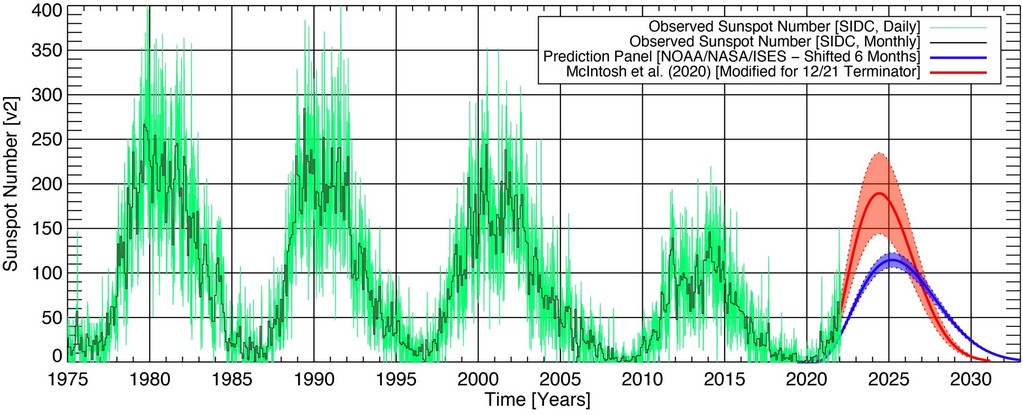
Predictions for Solar Cycle 25. Blue is the “official” prediction of a weak cycle. Red is a new prediction based on the Termination Event.

Feb. 26, 2022: Something big just happened on the sun. Solar physicists Scott McIntosh (NCAR) and Bob Leamon (U. Maryland-Baltimore County) call it “The Termination Event.”

“Old Solar Cycle 24 has finally died–it was terminated!” says McIntosh. “Now the new solar cycle, Solar Cycle 25, can really take off.”

The “Termination Event” is a new idea in solar physics, outlined by McIntosh and Leamon in a December 2020 paper in the journal Solar Physics. Not everyone accepts it–yet. If Solar Cycle 25 unfolds as McIntosh and Leamon predict, the Termination Event will have to be taken seriously.

(Read the full story here at Spaceweather.com)

Robert Gulley, K4PKM (formerly AK3Q), is the author of this post and a regular contributor to the SWLing Post. 

Radio Waves: DAB on UK Smart Speakers, MORE Project, Sun Getting Busy, and RTI’s German special “garners thousands of responses”

Radio Waves:  Stories Making Waves in the World of Radio

Because I keep my ear to the waves, as well as receive many tips from others who do the same, I find myself privy to radio-related stories that might interest SWLing Post readers.  To that end: Welcome to the SWLing Post’s Radio Waves, a collection of links to interesting stories making waves in the world of radio. Enjoy!

Many thanks to SWLing Post contributors Skip Arey, Mike Hansgen, and David Iurescia for the following tips:


Nobody cares about DAB radio – so let’s force it onto smart speakers, suggests UK govt review (The Register)

Britain’s anti Amazon and Google war gets a second front

The UK may require smart speakers such as Amazon Echo and Google Home devices to broadcast UK DAB radio stations, over government fears that Brits aren’t consuming enough of the unloved radio tech.

Under the guise of “protecting UK radio stations’ accessibility” the Department for Culture, Media and Sport (DCMS) has published a report calling for smart speakers to rebroadcast domestic radio stations’ output. The recommendation is as follows:

The government to consider regulatory changes to ensure radio stations and radio and audio content can be easily found and is discoverable by users of voice assistant platforms, including smart speakers and in-car infotainment systems.

The call, made in the Ministry of Fun’s Digital Radio and Audio Review, was backed by national broadcaster the BBC and commercial radio groups.

The same report found that 64 per cent of audio on smart speakers is live radio, though smart speaker users make up around 6 per cent of radio listeners at present. Nonetheless, DCMS called for governmental action to enforce the provision of something that’s already provided.

Media minister Julia Lopez said in a canned statement: “We must make sure this treasured medium continues to reach audiences as listening shifts to new technologies and that we have a gradual transition away from FM to protect elderly listeners and those in remote areas.” [Continue reading…]

Interested in getting a U.S. Amateur Radio license? (David Sarnoff Radio Club)

Earlier this year, the IEEE Princeton / Central Jersey Section’s Broadcast Technology Chapter (IEEE PCJS BT) received a generous grant to provide mentoring and equipment that encourages understanding of digital and analog aspects of radio communication, through hands-on activities and explorations. Over the next 2 years, our Make Operating Radio Easier (MORE) Project will be training 500 new U.S. Amateur Radio (“Ham”) operators in small (10 to 15 person) groups. We are especially seeking youth (ages 12-18) and non-males to help increase the demographics for these underrepresented groups on the air, but are currently accepting applicants of all ages (12+) and all genders.

Class sessions are primarily virtual (via Zoom) but may be arranged to be on-site if there is sufficient interest by a school, club or organization (as allowed, given the ongoing health situation). Virtual or in-person FCC amateur license testing sessions will also be arranged (throughout the USA) by our ARRL-certified MORE Project Volunteer Examiner (VE) team. There is no charge for the classes, and ALL testing and licensing fees for participants in the MORE Project are covered by our grant. Trainees in our program will also receive (paid by the MORE Project) a Software Defined Radio USB dongle, a pre-assembled 25-foot longwire receiving antenna, and (after successfully licensing) a hand-held Yaesu 2 Meter (HT) radio. The MORE Project course will provide instruction in the use of this equipment and assistance in Getting On The Air (GOTA) to make radio contacts.

Additional information about the MORE Project, including how to register for a training course, is at n2re.org/m-o-r-e-project and in our IEEE PCJS Call for Participation flyer. Questions should be directed to Dr. Rebecca Mercuri K3RPM at [email protected].

Our Sun is About to Get Busy | Solar Storm Forecast 10.25.2021 (Tamitha Skove)

RTI’s German-language special program garners thousands of responses (RTI)

During the third quarter of every year, Radio Taiwan International (RTI) broadcasts a special one-hour radio program via shortwave directly to German-speaking countries. The programs were transmitted over four weekends between July and August. Usually, RTI’s German programs are relayed through Bulgaria.

This year, thanks to conducive weather conditions and precise engineering, RTI’s signal was stronger than in prior years. In response to the program, listeners from 33 countries sent over a thousand reception reports confirming they received the broadcast. According to RTI, it received a record number of reports.

Radio Taiwan International President Chang Cheng says that even though most of the station’s programs are available online, there is still a significant community of people that prefers listening to shortwave radio.

This year, listeners who sent in a reception report for the special one-hour broadcast will receive a limited edition RTI QSL card featuring Taiwan’s iconic Formosan Blue Magpie. RTI says that it is still in the process of responding to all of the listening reports it received.


Do you enjoy the SWLing Post?

Please consider supporting us via Patreon or our Coffee Fund!

Your support makes articles like this one possible. Thank you!