Category Archives: Schedules and Frequencies

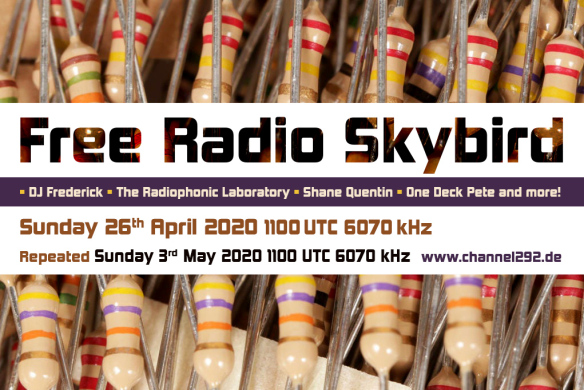
Free Radio Skybird: “One alternative to lockdown lunacy”

(Source: Pete Madtone)

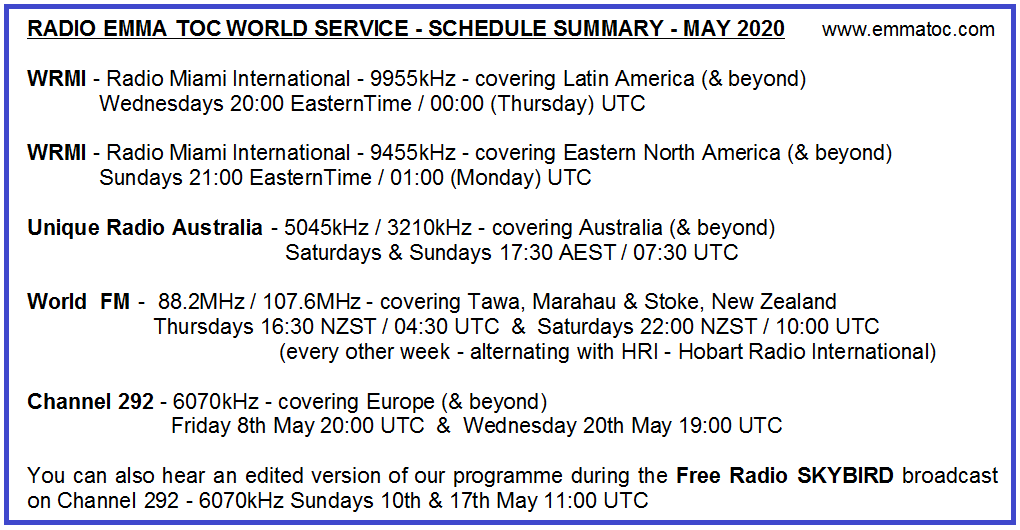
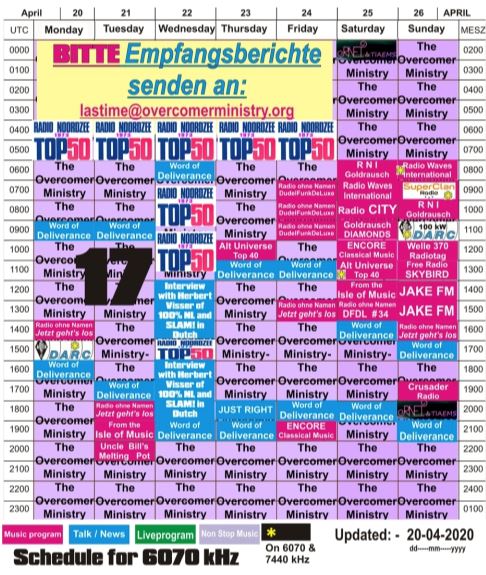
This Sunday coming 26th April 2020DJ Frederick’s Free Radio Skybird will be broadcasting another show in its weekly spring run at 1100 UTC (1200 UK) on 6070 kHz via Channel 292. 

This week’s episode features Justin Patrick Moore’s Radiophonic Laboratory and One Deck Pete’s “Radio connects us all” mix featuring Patrick McGoohanSasskia, Mokka and Camille Murray. We’ve also the debut of Shane Quentin from the excellent Garden of Earthly Delights radio show who’s bringing us a bit of “Radio Re-flex-ology”.

Tune in using your shortwave radio in the 49 Metre band on 6070 kHz or by using the link here. It’s going to be one interesting hour!

New KB6IBB SWL Logger version for MacOS

Many thanks to SWLing Post contributor, Valery Titievsky, who writes:

Good news from Jeff, KB6IBB.

I’ve waited a long time for this news and it has finally happened!

Jeff has published a new release of his “KB6IBB SWL Logger” now for Mac OS.

It is available as a free download here: https://sourceforge.net/projects/kb6ibbswllogger/

Excellent news!  Thank you for sharing this tip, Val!

Free Download: Domestic Broadcasting Survey 22nd Edition

Many thanks to the European DX Council who note:

Anker Petersen just published the annual Domestic Broadcasting Survey-22 (DBS-22). As usual, it is FREE OF CHARGE for any DX-er to download for his or her personal use.

Click here to check it out on the Danish Shortwave Club International website.

Click here for a direct download (PDF).

Radio Northern Europe International and This is a Music Show broadcasts

Many thanks to SWLing Post contributor, Roseanna, who shares the following announcement posted on her blog [with apologies for the late plug!]:

Radio Northern Europe International has worked with This is a Music Show to make a broadcast consisting of 30 minutes of RNEI and 30 minutes of TIAMS, that’s 1 hour of great music!

We really love what TIAMS has made for us and we can’t wait to share it with you!!

Radio Northern Europe International show #2 will have music from Iceland, Norway, Ireland, Sweden, Denmark and Finland this month, I really love the music we are playing and we hope to introduce you to some new music this month!
Songs 4,5 and 6 are my favourites this show!

Broadcast Times:
We have good news to those of you not in Europe and those of you nearer the transmitter, multiple times throughout the month! RNEI #2 will broadcast 5 times on 6070 kHz at the following times:

Saturday the 7th of March 2020, 10-11UTC
Saturday the 7th of March 2020, 19-20UTC
Friday the 13th of March 2020, 11-12UTC
Saturday the 21st of March 2020, 19-20UTC
Sunday the 29th of March 2020, 01-02UTC (this time is very experimental!)

Digital modes:
In RNEI Show #2 the final song will have the MFSK32 embedded into it. This time: text, Emoji and some Icelandic art! (Note, an app like TIVAR shows the emoji!)
TIAMS’ contribution will contain some MFSK64 text and an MFSK64 image!
Many thanks to one of our listeners for suggesting our final MFSK song!

Audio Processing:
This show Daz has been working hard making an audio processor to try and expand the audio range of RNEI! We have decided on trying to broadcast a flat signal to combat the noise floor. This means that the highs might come across a bit too bright and the bass might feel bit lacking.
Don’t worry, a little bit of EQ on the receiver should reverse it ending up with a better frequency range than before! Most standalone radios should already apply a high frequency reduction however SDRs can omit this!

You can send your reception reports, feedback and suggestions for RNEI to [email protected]!
Wishing you good reception conditions and all the best,
-Roseanna

For more info, check out Roseanna’s blog.

Radio Northern Europe International on shortwave

Many thanks to SWLing Post contributor, Roseanna, who shares the following announcement posted on her blog:

(Source: The Girl With The Radio)

I would like to share something very exciting that I’ve been working on since May 2019:
Radio Northern Europe International

RNEI will be the station for pop and dance music from Northern Europe on shortwave playing music from Norway, Sweden, Denmark, Iceland, Finland, the UK and Ireland!

I aim to play music you haven’t heard before and the first show features a very exciting experiment: Embedded MFSK64! This means, hidden in the final song, there will be the song list sent in MFSK64 in such a way it won’t be off-putting for those of you not decoding!
My shows will mainly consist of lesser known music with a small amount of speaking and jingles. Without spoiling too much of the show I can hint that you’ll hear some Swedish, Norwegian, Finnish, English and Icelandic language music if you tune in!

The first pilot show will go out on 6070 kHz Channel292 from Germany (decent reception all over Europe) at the following times:
February Saturdays 19:00-19:30 UTC (Starting Saturday 15th)

I’m also in talks with shortwaveradio.de so there is a possibility of using 3975KHz & 6160KHz as well (increased reception in the Benelux/UK/Ireland regions!)
After the broadcast, shows will be published on Mixcloud and my reception on YouTube in case you’ve missed the show!

I will respond to all reception reports sent in and, if I get enough, I’ll try and get postcards made to send out (I’ve designed one I want to get printed!)

I would like to take this space to thank RPC Audio (Jono) for the cheap jingles and Daz from HFZone for helping me with making my mic sound good!

I really hope you all get a chance to listen in and that you get decent reception!
until next time,
tgwtr

Arcángel San Gabriel (LRA36) special broadcasts and LU1ZV activation

Source: Base Esperanza – Antártida

Many thanks to SWLing Post contributor, Tracy Wood, who writes:

I listened to LRA36 streaming this past Friday with their special show, including callouts to other Argentine scientific stations via satphone and lots of greetings by ham radio enthusiasts, both recorded and via live call-in.

Source: Base Esperanza – Antártida

…At the conclusion the announcer said they would be back this Monday at 1800 Buenos Aires time or 2100 UTC.

Details about last Friday’s broadcast:

http://www.radionacional.com.ar/continuan-las-emisiones-especiales-en-lra-36-arcangel-san-gabriel/

Source: Base Esperanza – Antártida

The audio stream is only up when LRA36 is on the air apparently but is at the Radio Nacional website under the audio streams listing:”

http://vmf.edge-apps.net/embed/live.php?streamname=sc_rad32-100131&autoplay=true

Thank you so much for sharing this, Tracy! It’s incredibly difficult for me to snag LRA36 broadcasts off the air, so it’ll be nice to have this stream link as well.

I also recently received a note about LU1ZV: the amateur radio station at the Esperanza Antarctic Base.  What follows is a rough English translation of the press release. Click here to download the original press release in Spanish (MS Word Doc).

Source: Base Esperanza – Antártida

THE HAM RADIO ACTIVATION OF ESPERANZA ANTARCTIC BASE

Started on December 8, the activation of the LU1ZV amateur radio station of the Antarctic Base Esperanza, after years of being inactive.

The radio activity of LU1ZV has as primary objective to remember the 40th anniversary of the beginning of the transmission of the radio station LRA 36 “Arcángel San Gabriel” of the Esperanza Base, the first shortwave station in AM across Antarctica, which began broadcasting on October 20,1979. In addition, this activity seeks to maintain the continuity of emission of stations of radio amateurs from Antarctica.

The LU1ZV activation has registered more than 900 contacts with amateur radio stations
nationally and abroad, and in addition to covering all regions of the country, they have already

Source: Base Esperanza – Antártida

contacted twenty-two Argentine provinces.

Among the most relevant data that LU1ZV activity exhibits so far are the distant radio contacts  (despite the low emission power) as in the case of Japan, Canada, Latvia, Ukraine and Finland among others. They have contacted most South American countries, several of Central American countries and all from North America.

Another outstanding contact was made with VP8HAL, the Halley VI scientific station of the British Antarctic Survey (BAS), located in the Brunt Ice Barrier, about 1,700 km SE of Hope.

The operation of LU1ZV is carried out from the study of LRA 36 and the rhombic antenna of the station, while the station isn’t operating. The amateur radio station activity adapts to the general schedule of the base and of LRA36, so activation times are reduced to a few hours during the evening – night.

The Head of Hope Base, Lieutenant Colonel Norman Walter Nahueltripay was present during some contacts and received greetings from radio correspondents.

This special activation also includes the project “Uniendo Voces” of the National University of Quilmes (UNQ) of the province of Buenos Aires, an initiative that included areas of interest to amateur radio and Antarctic activations, and which was presented to the
Antarctic Joint Command (COCOANTAR).

“Uniendo Voces” has participated in these radio activations since 2013 (in Marambio Base and Matienzo) to which the historical emission from Base Esperanza is now added, within the framework of a special initiative called “DX Radial Expedition Uniting Voices”.

The amateur Radio Claudio García (LU1VC) member of the LRA 57 Radio Nacional de El
Bolsón (province of Chubut) and Juan C. Benavente (LU8DBS) of COCOANTAR and UNQ, perform the activation for which they had to move equipment to that Antarctic base.
The radio activation of Esperanza has the support and collaboration of Adrián Korol,
director of the Argentine Broadcasting Abroad (RAE) who expressed his emotion and
satisfaction for “this joint achievement with the Antarctic Command and the National University of Quilmes. “

Antarctic bases are licensed by amateur radio stations, and like all the activity, is regulated by the National Communications Agency (ENACOM). These radio activations have a “high symbolic and real value”, as Korol says, and they contribute, in addition to remembering ephemeris, to the promotion of sovereignty in the Antarctic region from the radio spectrum.

Likewise, the amateur radio activity contributes to the study of communications – such as
radio wave propagation conditions- and keeps an alternative communication service active and effective.

Many Argentine radio amateurs from different parts of the country are attentive to the
calls from LU1ZV and collaborate with the initiative.”

Along with the photos and LU1ZV press release above, I also received press releases from two special broadcasts that happened earlier. Click here and here to download the MS Word documents in Spanish.