Category Archives: Schedules and Frequencies

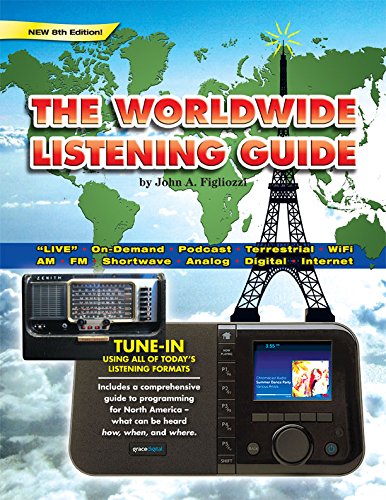
The 8th Edition of the Worldwide Listening Guide

I’m very pleased to have received the 8th edition of John Figliozzi’s Worldwide Listening Guide (WWLG), the latest, most updated version of the excellent guide I’ve often reviewed.

SWLing Post readers know that I’m a huge fan of the Word Radio TV Handbook (WRTH); it’s my go-to guide for radio frequencies and schedules.

Figliozzi’s Worldwide Listening Guide is my go-to for programming and content, not only helpful on the shortwaves, but especially handy when tracking online content.

Indeed, the WWLG is a unique guide–there’s nothing quite like it on the market. As I’ve said, you may want a copy of the WWLG in your shack, especially alongside your computer or Wi-Fi radio.

WWLG: The Content DXers Guide

Like many SWLs, I’m something of a “Content DXer:” I love chasing obscure programming––news, documentaries, music, and variety shows, anything the broadcasting world has to offer.  For this, I often turn to Wi-Fi radio.  Wi-Fi radio offers the discerning listener the ability to track down fascinating regional content from every corner of the globe––content never actually intended for an international audience.

Digging into local content via a WiFi radio isn’t nearly as challenging or fun (for me, at least) as scanning the shortwave bands in search of elusive weak signal DX or pop-up pirate radio station. Though my WiFi radio offers an easy and reliable way to “tune” to online content, the actual content discovery part is quite difficult.

Truth is, there’s so much content out there–tens of thousands of stations and shows–it’s hard to know where to start!

This is where the WWLG comes in: Figliozzi exhaustively curates more than 4,000 programs (!), indexing their airing times, stations, days of broadcast, program types, frequencies, and web addresses. Additionally, he sorts the programs by genre:  arts, culture, history, music, sports, and more. And Figliozzi also includes a well-thought-out directory of at least forty genres.   In short, this directory has helped me not just locate, but identify, programming I would never have known about otherwise.

Frankly, I’m not sure how Figliozzi manages to curate such a vast assortment of programming.  But I’m happy that he does, and especially, that he offers it for the SWL’s benefit––!

As I’ve said many time before, the WWLG  has become a permanent reference book in my shack, alongside my trusty WRTH. There’s a surprising amount of information packed into this slim, spiral-bound book…enough to keep even a seasoned content DXer happy for years.

The 8th edition of Worldwide Listening Guide can be purchased here:
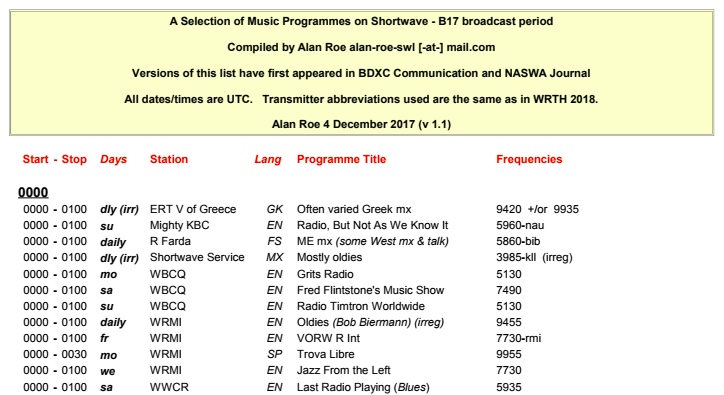
Alan Roe’s B17 season guide to music on shortwave

Many thanks to SWLing Post contributor, Alan Roe, who notes:

I have now compiled my Music on Shortwave listing for B17. Extracts listing music programmes in English language transmissions have been listed in BDXC-UK Communication and in NASWA Journal. I now attach a consolidated version listing a selection of music programmes in a variety of language transmissions. If of interest, please go ahead and post it on your excellent SWLing site.

Alan, thanks so much for keeping this excellent guide updated each broadcast season and for sharing it here with the community! When people claim that there’s nothing to listen to on shortwave, I often send them a link to your excellent guide!

Click here to download Alan Roe’s B17 Shortwave Music Guide (PDF).

Marconi Radio International upcoming broadcasts

(Source: Mike Terry)

The next broadcasts of Marconi Radio International are scheduled as follows: today, Sunday, 3 December 2017, from 1100 to 1400 UTC on 11390 kHz and from 1415 to 1630 UTC on 7720 kHz (USB mode) and on Saturday, 9 December 2017, from 1415 to 1630 UTC on 7720 kHz (USB Mode).

All reception reports are verified with eQSL. However, a limited number of listeners will also receive a printed QSL card. E-mail address: [email protected]

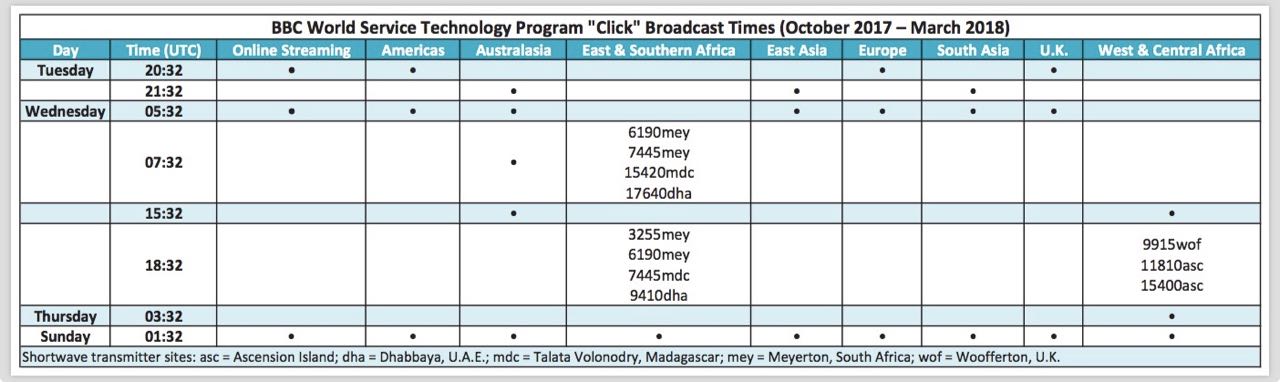
BBC World Service: “Click” Broadcast Times (October 2017 – March 2018)

Many thanks to SWLing Post contributor, Richard Langley, who shares his latest shortwave radio schedule for the BBC World Service technology program, Click.

Click on the image below to view the schedule, or simply click here to view the schedule as a PDF.

Richard notes:

As with previous versions of the chart, a “bullet” indicates a broadcast on line or by one or more different radio platforms to or in the indicated geographical region, including local AM and FM radio, DAB radio, satellite radio, and, for some regions, shortwave radio. There are currently two times “Click” is broadcast on shortwave.

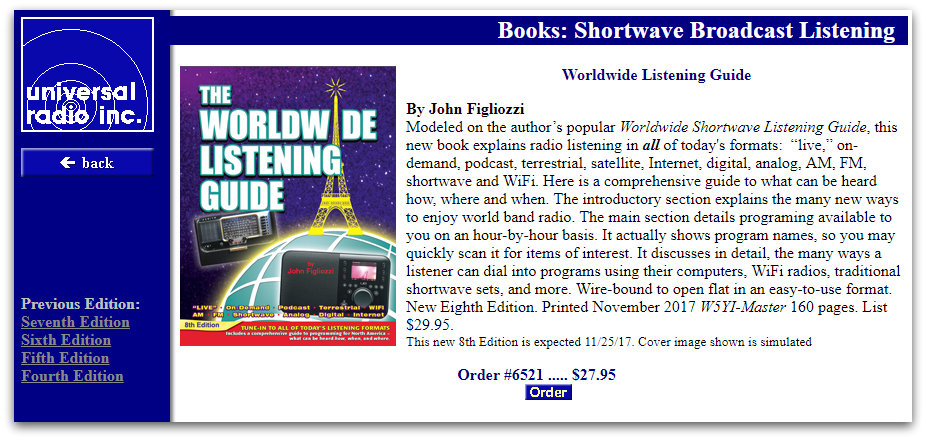
Universal Radio taking pre-orders for the 8th Edition of the WWLG


Many thanks to SWLing Post contributor, Troy Riedel, who notes that Universal Radio is now taking pre-orders for the 8th edition of the Worldwide Listening Guide by John Figliozzi.

Click here to check it out on the Universal Radio website.

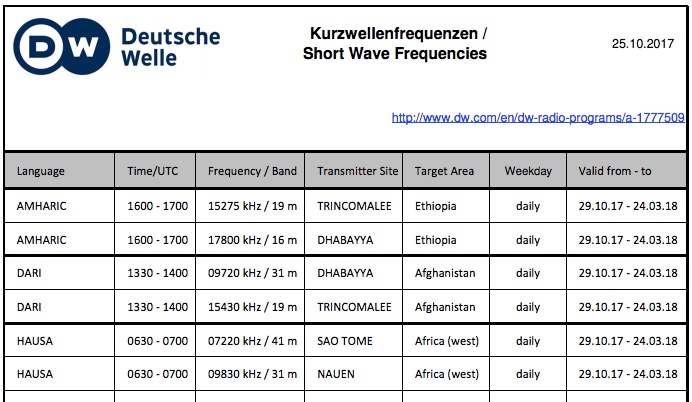
Deutsche Welle may have dropped English language shortwave service

Many thanks to SWLing Post contributor Paul Walker who notes that, according to their latest schedule, Deutsche Welle has dropped English language shortwave services. Paul shared the following links:

Current shortwave schedule:
http://www.dw.com/downloads/41133929/b17webkw.pdf

Linked from this page:
http://www.dw.com/en/dw-radio-programs/a-1777509

English only gets one hour a day on satellite
http://www.dw.com/downloads/41133930/b17websat.pdf

Changes to Radio Exterior de España shortwave frequencies

Many thanks to SWLing Post contributor, David Iurescia (LW4DAF), who notes that Radio Exterior de España’s has announced winter frequency changes on their website.

David passed along an English (Google) translation of the REE notice:


Due to the winter time change, from October 29, Radio Exterior of Spain changes its emission frequencies in Short Wave.

From Monday to Friday, between 19 and 23 hours, universal time coordinated, Radio Exterior of Spain will offer its emissions in 11,685 kilohertz for West Africa and the South Atlantic. At 15,390 kilohertz for South America and the Pacific Ocean. At 9,690 kilohertz for North America and Greenland. And at 15,500 kilohertz for the Indian Ocean, Middle East and Great Sun.

On weekends, for West Africa and the South Atlantic, between 15 and 19 hours, universal time coordinated, at 17,755 kilohertz; and between 19 and 23 hours at 11,685 kilohertz.

On Saturdays and Sundays, between 15 and 23 hours, at 15,390 kilohertz for South America and the Pacific Oceans; at 9,690 kilohertz for North America and Greenland; and 15,500 kilohertz for the Indian Ocean, Middle East and Great Sun.

These are the frequency changes of the Spanish Foreign Radio Broadcast Wave emissions that will come into effect on October 30 due to the time shift to the winter.

Radio Exterior of Spain can be followed through satellite radio in all parts of the planet 24 hours a day uninterruptedly:

SES Astra 1M: frequency 11,626.5 MHz. Vertical polarization.
Hispasat 30W-5: frequency 12,015 Mhz. Vertical polarization.
Asiasat 5: frequency 3,960 Mhz. Horizontal polarization.
Eutelsat 5 West A: frequency 3,727 Mhz. Circular polarization.
Intelsat Galaxy 23: Frequency 4,191.35 Mhz. Vertical polarization.
Radio Exterior of Spain is heard on the Internet, in streaming or in the podcast of all its programming.

There are also mobile applications (link for Apple app or Android) for mobile applications, such as phones and tablets. And from any municipality and province of Spain you can enjoy, through television, Radio Exterior of Spain by DTT.

Click here to read the original notice in Spanish.

Thanks for the tip, David!