Shortwave listening and everything radio including reviews, broadcasting, ham radio, field operation, DXing, maker kits, travel, emergency gear, events, and more
Many thanks to SWLing Post contributor, Jim Meirose, who recently shared a few photos and writes:
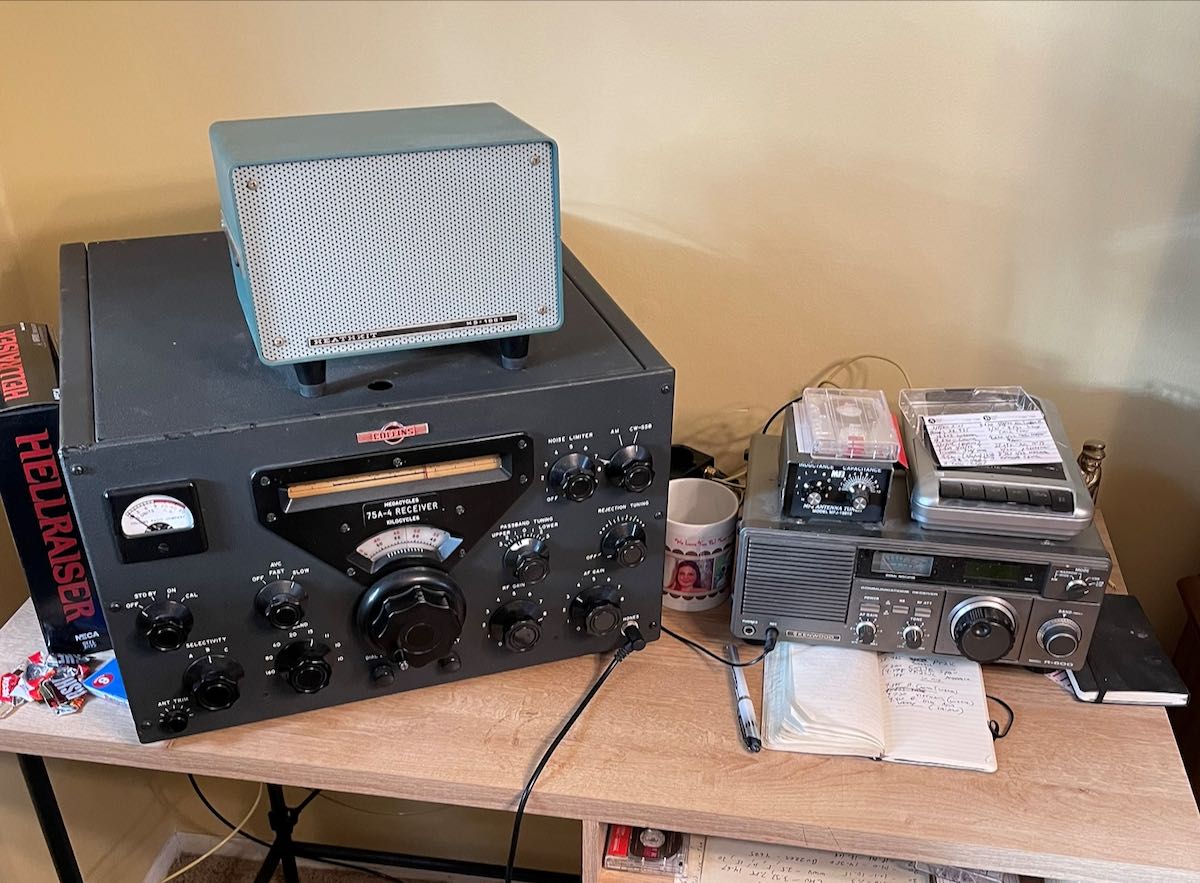
This is the equipment currently in use here in Somerville, NJ. The Collins 75A-4 is a recent acquisition. This radio is used to cover all amateur bands. The other is the Kenwood R-600, for general coverage up to 30 MHz. The Collins has proven to be a wise purchase, as I can hear both ends of almost any SSB QSO picked up on any band. The Collins is sensitive enough to be able to even pull in signals from bands which real-time band condition maps say are nearly or totally dead at the time.
Comparison of the Kenwood to the Collins on ham bands has shown nearly an even match; but, the Collins can sometimes detect weak amateur signals that the Kenwood can’t (using the same antenna) and totally beats the Kenwood for clarity of SSB audio. The Kenwood has much better audio quality on AM, however.
Both radios are very easy to use. Before using a 75A-4, however, study the manual to set up the controls, because there are some odd (non-intuitive) quirks to know to get the set to work properly.
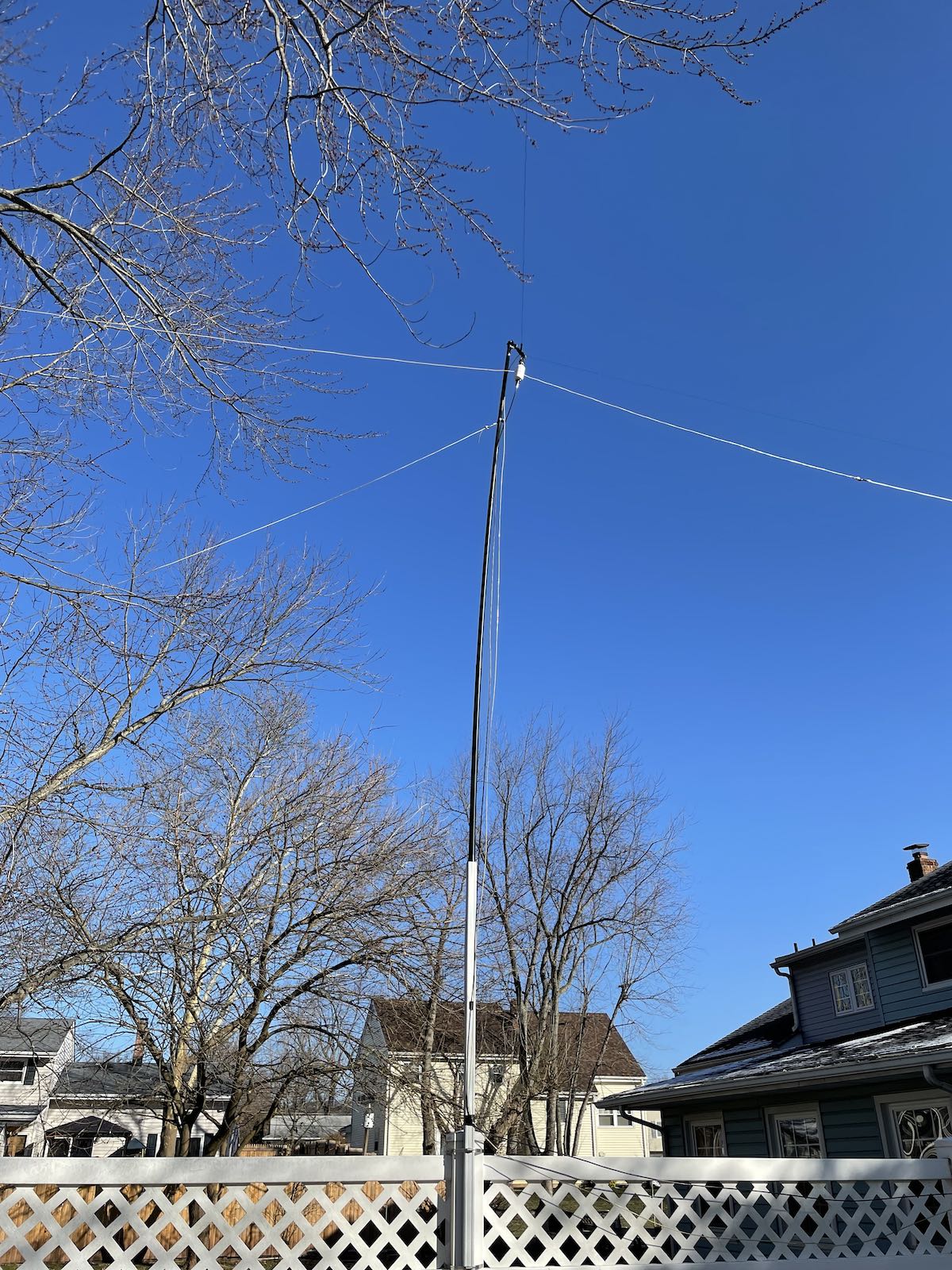
The antennas here are a 150′ long wire, which works well on all frequencies. A 15 meter half-wave dipole was put up to get the most from the Collins on that band. A 10 meter dipole will soon be put up also. For ham bands 20 meters and lower the long wire does the job. For convenience’s sake, I have the 15 meter antenna and the long wire connected to the Collins all the time. But, an odd quirk; 10 meters comes in stronger with just the 15 meter dipole connected. Looking forward to see how it sounds with the 10 meter antenna.
I bought the Kenwood at the beginning of the pandemic. I knew for general coverage it would beat anything I’d used before (Heathkit and Hammarlund radios). I got the 75A-4 purely based on reviews I had read. I wanted a peak performer in the amateur bands. It has proven to be great on every ham band and under nearly any atmospheric conditions.
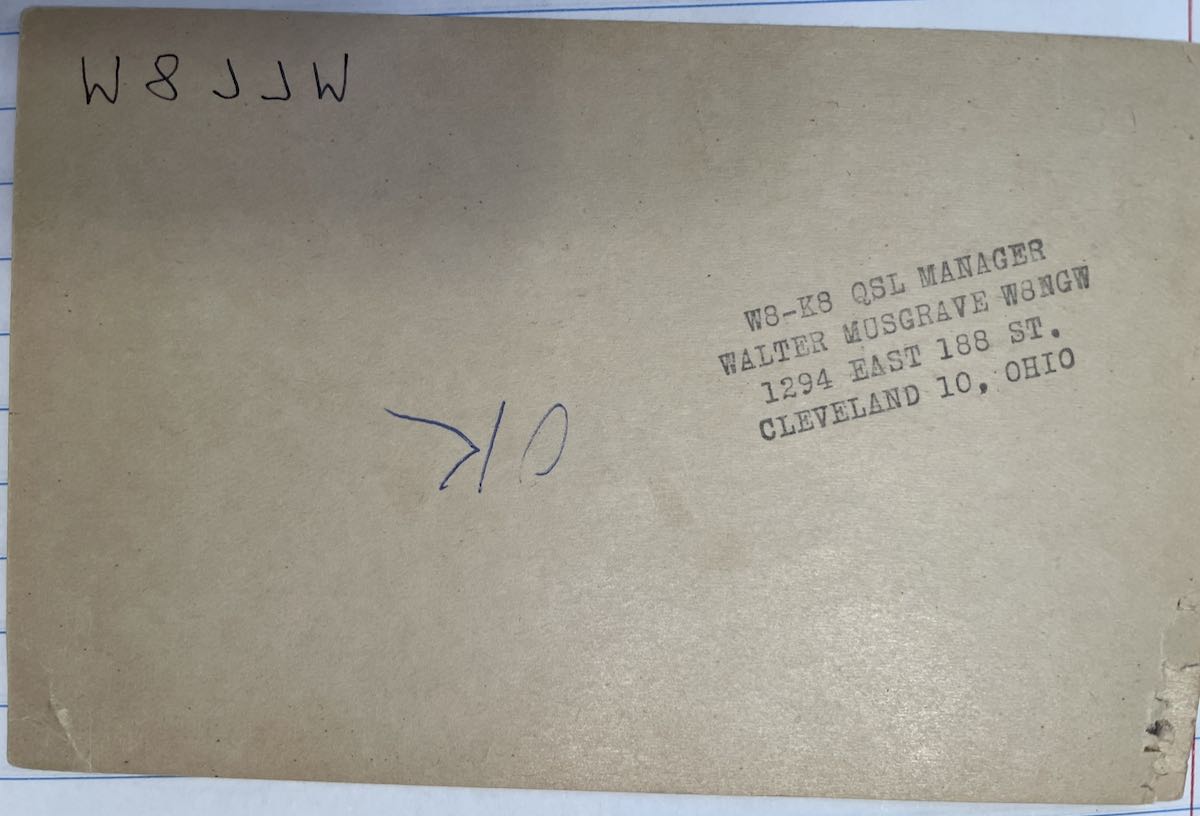
Regarding the Tristan Da Cunha QSL card; I find the mystique of this world’s remotest community to be fascinating. When I saw this QSL card up for sale in eBay, I grabbed it. Especially since the QSO ocurred on August 1948, when I was slightly over one month old.
Thanks for sharing this, Jim! That Collins is a thing of beauty! I would love to have one if I had the space for it! It’ll certainly keep the shack warm on cold winter nights.
Many thanks to SWLing Post contributor, Tim Brockett, who writes:
Thomas,
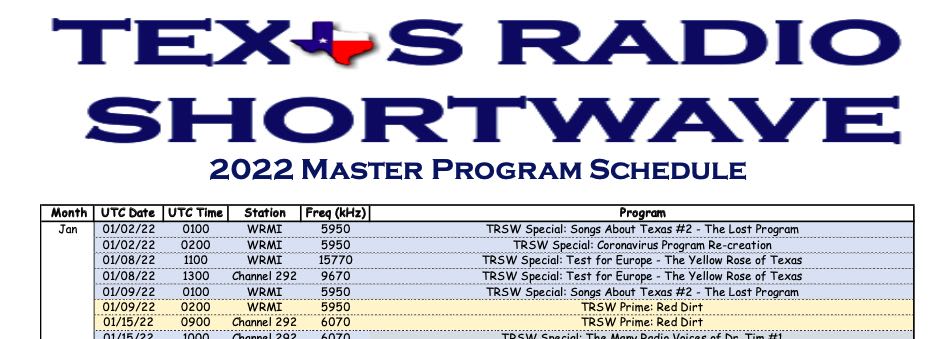
Attached is the latest 2022 schedule for Texas Radio Shortwave.
These folks have GREAT QSL cards too! The designs change frequently and each is personalized.
Thanks,
Tim Brockett
Many thanks to SWLing Post contributor, Dan Robinson, for the following guest post:
Dan Robinson
How VOA’s Communications World Started
by Dan Robinson
NOTE: This exclusive is being published simultaneously with the North American Shortwave Association (NASWA) journal in its March 2022 edition.
Voice of America recently observed its 80th birthday. Readers may recall that in the mid-1980’s into the 2000s, VOA broadcast a program about communications, but which was in fact designed specifically for shortwave listeners.
Communications World as it was known owed its existence to my efforts in the late 1970’s and into the early 1980’s to persuade VOA managers to put such a program on the air, The story is told in detail here for the first time.
In a SWL career that began in the late 1960’s, I was an enthusiastic consumer of DX programs broadcast by stations at the time, from Radio Netherlands to HCJB and others. I always wondered why VOA wasn’t among them, and I was determined to make some progress on this.
First steps came in 1975 as I was attending The American University and began making contacts at VOA in downtown Washington, DC. This would become a multi-year effort to induce VOA to re-start a DX’ing program. I say “re-start” because I would later learn that VOA once had such a program, but aimed at radio amateurs.
These early efforts included at one point a meeting with the head of a major think tank on K Street in Washington. I can only imagine their reaction when two college age kids (I was accompanied by ace DX’er Taylor “Pitt” McNeil) arrived seeking help in selling a federal agency on a hobbyist show.
I never learned whether anything came from that meeting. In my final two college years, I interned with ABC News, where I observed network operations, including the evening news with Frank Reynolds, and also interned with local station WASH-FM.
By 1979, my contacts at VOA had led me to part-time work in its English to Africa, Worldwide English, and central news divisions. In 1980, I was formally sworn in as a full-time VOA news writer. My objective was to become a VOA foreign correspondent, which I would achieve in 1983. But putting VOA back on the board, so to speak, with a SWL program remained high on my priority list.
A pilot for the show needed to be produced. It needed a name. What came to mind was something containing the word communications, to have wider appeal. So, there it was: the VOA Communications Magazine.
My time in VOA’s central news operation included work on all three shifts over 24 hours. On the side, I set about putting together a script for VOA Communications Magazine – conceptualizing what elements would go into it. By 1983 – just before I departed for Nairobi as VOA’s new East Africa correspondent – we were ready to record the pilot.
The show began by recognizing World Communications Year, and a message noting that we would cover SW hobby news, international broadcasting developments, satellites and computers, news about receivers and antennas, along with letters from listeners.
WRNO New Orleans had gone on the air on shortwave. I thought that would make an interesting segment. Shortwave broadcasting had not yet started its downward slide. Stations remained on the air in Africa, Latin America, and Asia. Transmitter manufacturers still had customers. New stations were coming on air.
I served as host of the Communications Magazine pilot. Bob Arnold, who was doing science reporting for VOA at the time, voiced a roundup of broadcasting news. Included were some of my personal recordings, including Voice of Kenya and Radio Mozambique.
In the news, Kenya was reported planning international broadcasting (we now know this never happened). Ghana was expanding domestic radio. The U.S. was helping Liberia expand rural radio. We noted ELBC and ELWA, and played a recording of ELWA.
Iran was installing what were expected to be the world’s most powerful transmitters. There was news from Singapore, and a recording of Radio Singapore. Malaysia planned two 500 kw transmitters. I noted existing domestic Malaysian stations, and included a recording of Radio Malaysia Sarawak.
Arnold reported on the explosion of the production, distribution and storage of information, including an interview with Wilson Dizard, then with Georgetown University.
Dipping into the mailbag I read letters and reception reports from VOA listeners in Denmark, Sweden (one of whom used a Grundig 3400 receiver), Australia (who used a Panasonic RF-2800), and Japan (who used a Kenwood R-1000).
My interview with Joseph Costello of WRNO concluded the pilot, and began with a recording I had made of a WRNO test transmission. Costello pointed to “a couple of thousand pieces of mail per month,” and surprising response from New Zealand and Australia, though WRNO’s signal was beamed northward.
Private shortwave stations were granted to reflect the culture and lifestyle of the United States, Costello said. By partially simulcasting WRNO-FM, listeners heard about life in New Orleans, with coverage of the Jazz and Heritage Festival, and progress reports on Mardi Gras. WRNO was considering a morning Spanish service beamed to central and south America
Doug Flodin of Drake-Chenault discussed the purpose of KYOI. And we reported on other shortwave broadcasters preparing to go to air, including Radio Miami International, and KNLS from Alaska.
Based on my pilot for VOA Communications Magazine, VOA green lighted what would become Communications World, hosted first by Gene Reich, who later would join Worldspace, the satellite radio pioneer that filed for bankruptcy in 2008, and later by Kim Elliott.
This is the first time I have told the in depth story of how Communications World came into being, which likely never would have existed had it not been for my efforts to bring this kind of program to Voice of America. The full 1983 pilot for Communications World is available on the Internet Archive and below:
Many thanks to SWLing Post contributor, Frank, who writes:
Thomas,
I have asked for and received help from your members a couple of times during the last year. I am sending this to you in an effort to “give something back” to your members.
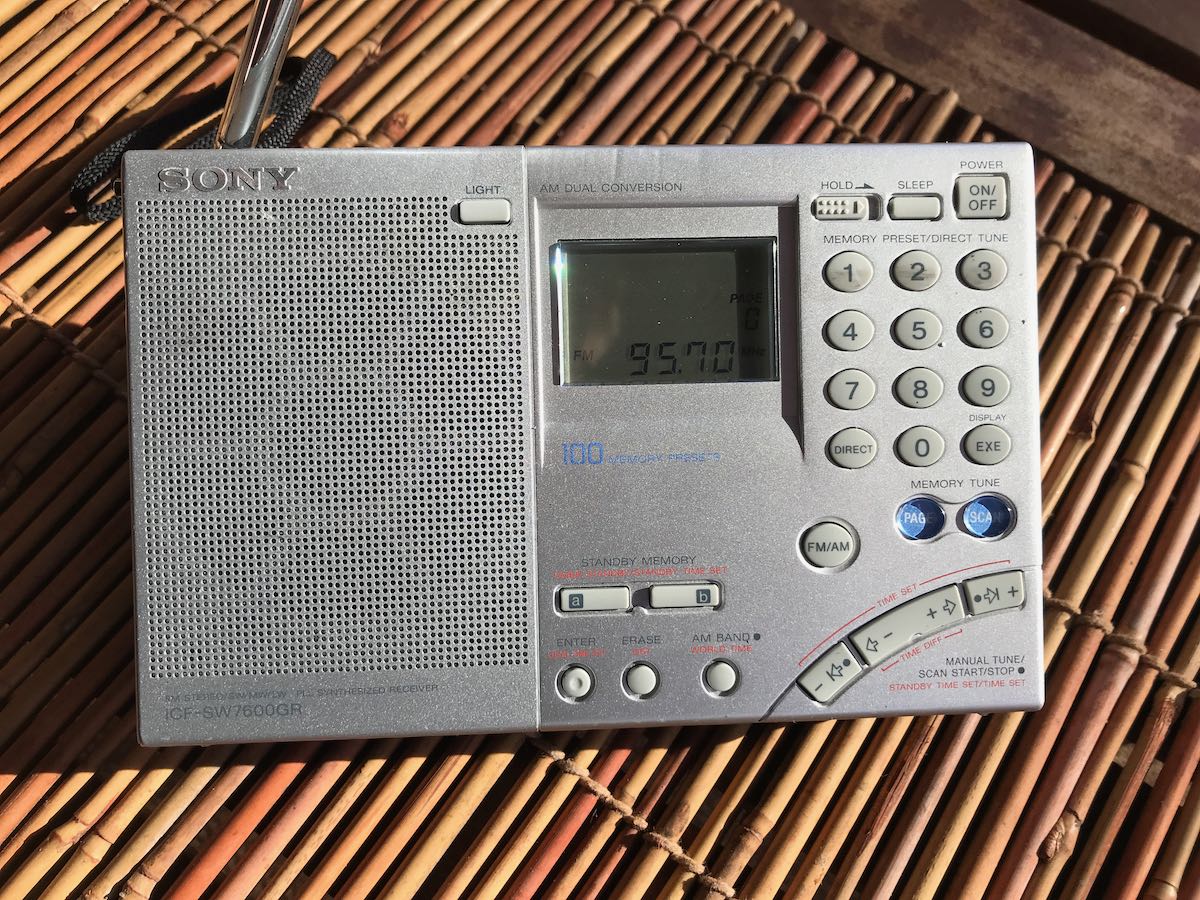
I managed to stupidly break the built-in whip antenna on my Sony 7600GR and looked for a replacement. Several are on eBay for 5- 60 dollars which is a bit steep.
I eventually tried one (for $20) in the link below from eBay:
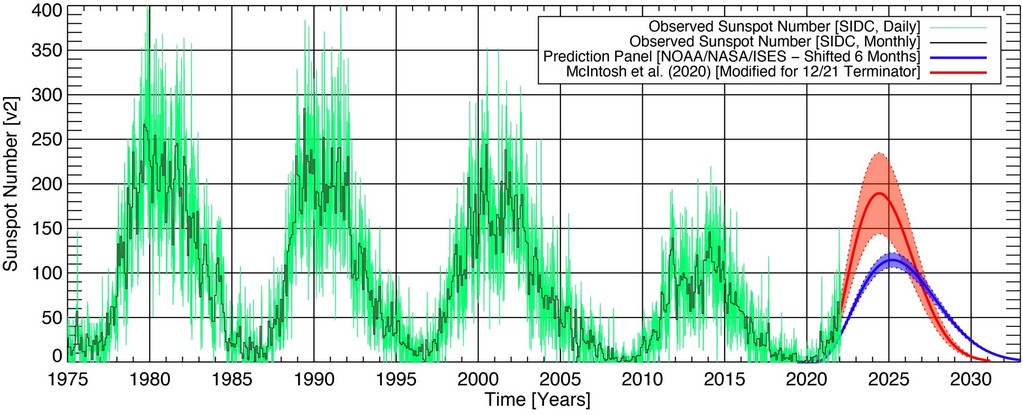
Predictions for Solar Cycle 25. Blue is the “official” prediction of a weak cycle. Red is a new prediction based on the Termination Event.
Feb. 26, 2022: Something big just happened on the sun. Solar physicists Scott McIntosh (NCAR) and Bob Leamon (U. Maryland-Baltimore County) call it “The Termination Event.”
“Old Solar Cycle 24 has finally died–it was terminated!” says McIntosh. “Now the new solar cycle, Solar Cycle 25, can really take off.”
The “Termination Event” is a new idea in solar physics, outlined by McIntosh and Leamon in a December 2020 paper in the journal Solar Physics. Not everyone accepts it–yet. If Solar Cycle 25 unfolds as McIntosh and Leamon predict, the Termination Event will have to be taken seriously.
Many thanks to SWLing Post contributor, Fastradioburst23, who shares the Scented Garden flyer above announcing broadcasts on Sunday, March 9th and 16th, 2022 at 1700 UTC on 3955 kHz (Channel 292). I’m under the impression this station may be a tribute to John Peel’s Perfumed Garden show on the pirate Radio London. Brilliant!
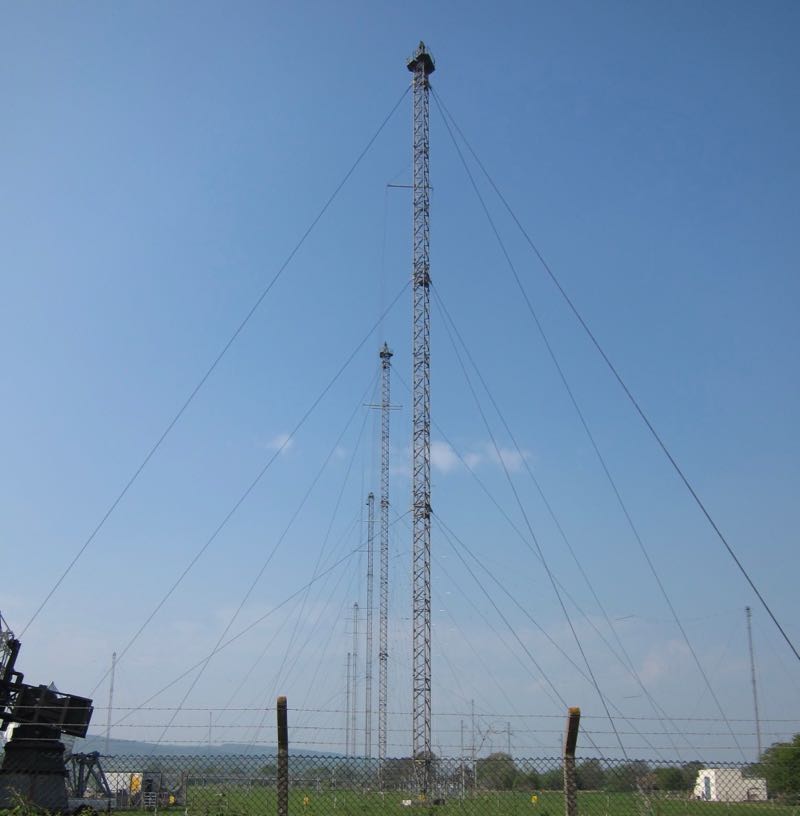
Woofferton Transmitting Station (Photo by Shirokazan via Wikimedia Commons.)
Many thanks to a number of SWLing Post contributors who share the following news item from the New York Times. I’ve included an excerpt below, but the full article article can be found on the NY Times website. You may need a NY Times account to read this article if you’re not a paid subscriber; the account is free and allows you a limited number of free articles each month:
As Russia is trying to cut off the flow of information in Ukraine by attacking its communications infrastructure, the British news outlet BBC is revisiting a broadcasting tactic popularized during World War II: shortwave radio.
The BBC said this week that it would use radio frequencies that can travel for long distances and be accessible on portable radios to broadcast its World Service news in English for four hours a day in Kyiv, the Ukrainian capital, and in parts of Russia.
“It’s often said truth is the first casualty of war,” Tim Davie, director-general of the BBC, said in a statement. “In a conflict where disinformation and propaganda is rife, there is a clear need for factual and independent news people can trust.”
On Tuesday, Russian projectiles struck the main radio and television tower in Kyiv. Oleksii Reznikov, Ukraine’s defense minister, wrote on Twitter that Russia’s goal was “to break the resistance of the Ukrainian people and army,” starting with “a breakdown of connection” and “the spread of massive FAKE messages that the Ukrainian country leadership has agreed to give up.”
Shortwave radio has been a go-to vehicle to reach listeners in conflict zones for decades, used to deliver crackling dispatches to soldiers in the Persian Gulf war, send codes to spies in North Korea and pontificate through the Iron Curtain during the Cold War. But more modern forms of radio along with the internet eventually pushed shortwave out of favor; the BBC retired its shortwave transmissions in Europe 14 years ago. [Continue reading the full article…]
Please support this website by adding us to your whitelist in your ad blocker. Ads are what helps us bring you premium content! Thank you!