Shortwave listening and everything radio including reviews, broadcasting, ham radio, field operation, DXing, maker kits, travel, emergency gear, events, and more
Bust A Nut Radio‘s AM signal came in fairly strong last night sometime around 5:45 UTC (February 2nd) on 6,940 kHz.
You’ll hear a great variety of music–from classic rock to electronica–complete with originally produced ID’s and bumpers in this pirate radio recording.
Note:This is a recording of a real pirate radio broadcast. If you are easily offended by strong lyrics and offensive music, you should slowly back away.
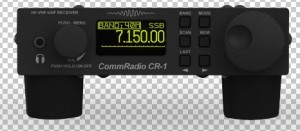
Don Moore (N0HDX), founder of CommRadio, placed the following statement on the CR-1 order page:
As the lead designer of the CR-1, I am pleased to offer this new radio to you. It draws on my experience as a kid building Knight Kits, from my paper route earnings through currently owning a classic Drake 2B and a Zenith Transoceanic; my benchmarks for enjoyable, high quality short wave listening. I added a smooth machined aluminum tuning knob and minimized the number of buttons to provide you (and me), an intuitively obvious and enjoyable radio to operate. This radio is solid as a brick, looks cool and sounds great. The tall feet have a purpose besides good-looks: rest your hand on the tabletop to spin the knob and for the bottom- speaker to bounce the sound to you instead of going straight up into up in space. The military ‘black box’ people who visit us see it sitting on the shelf with the bright OLED display and they all say: “I want one!” Well, here it is. Let the CR-1 draw you into the wonderful hobby I’ve enjoyed throughout my life.
I do love the look of this little radio–its simplicity reminds me of the Palstar line of shortwave radios.
In my recent post, The truth about portable amplified shortwave antennas, I argue that small, portable amplified antennas are, by and large, ineffective. The post comments are interesting, however; many readers agree, and some tout the Sony ANT-LP1 as worthy, but Mike made the following comment about his amplified antenna:
The one active antenna that I have been pleased with is one I built myself. The design was by ON2NLT and uses a ferrite rod, so it is somewhat directional. Rotating the unit (it is very compact) often allows nulling out noise or interference. You have to be careful not to crank up the gain too much though, or you will amplify the noise floor. The link is here
If you live in the Americas and you regularly listen to a shortwave radio, you have no doubt heard Radio Havana Cuba across the shortwave spectrum. When I travel in North or Central America, I can easily hear RHC, often without even extending the telescopic antenna on my portable.
A long-running program on RHC’s English hour is Arnie Coro’s DXers Unlimited.
Tuesday night, I recorded the DXers Unlimited segment from RHC’s The English Hour on 6 MHz, and offer it here for your listening pleasure. If the recording doesn’t sound typical of shortwave radio, it’s because: a) RHC’s signal is exceptionally strong into North America, and b) I recorded this with an AM filter 24 kHz wide. In other words, I widened my DSP filter to match RHC’s bandwidth on my spectrum display–and to put this in perspective, I regularly record between 7-9 kHz wide. (This results in the crisp, high-fidelity audio you hear in this recording, though unfortunately at the compromise of any adjacent stations abiding by HF broadcasting etiquette.)
US-based CommRadio is introducing a new tabletop, SDR-based, shortwave receiver this year: the CR-1. Their website has a few specifications and the video I’ve embedded below.
The CR-1 receives the full medium wave and shortwave spectrum (.5-30 MHz), plus some portions of VHF and UHF (FM broadcast band, Aircraft, Marine, NOAA weather radio, GMRS and FRS services).
The receiver architecture is a dual conversion super-heterodyne design with low-IF , I-Q digital sampling, 16 bit DSP with digital audio CODEC. Their website also mentions DSP algorithms for all demodulation: DSB-AM, SSB, CW, WBFM, NBFM and channel filtering.
Other impressive features:
Can be powered from USB or a 6-18 VDC power source (from a separate 2.1mm jack). The CR-1 possibly has the most flexible power source I’ve ever seen in a shortwave receiver!
The knobs are black anodized machined aluminium and front panel is powder coated machined aluminium; case is 20 gauge powder coated steel
Three antenna inputs
BNC for HF/MW
3.5 mm audio jack (rated at 1000 Ohm, for roll-up antennas or telescoping whip),
BNC for VHF and UHF
Very portable size!
Full specs are available on their website: commradio.com
We will also keep you posted with any future updates.

 Last Saturday night, I caught the shortwave radio pirate, Red Mercury Labs, on 6.9251 MHz in the upper side band.
 If you live in the Americas and you regularly listen to a shortwave radio, you have no doubt heard Radio Havana Cuba across the shortwave spectrum. When I travel in North or Central America, I can easily hear RHC, often without even extending the telescopic antenna on my portable.