Category Archives: Shortwave Radio

English Section of Polish Radio External Service is changing broadcast times and leaving shortwave

Sad news for those who listen to Polish Radio External’s English service on shortwave, but good to know that they will still have an online presence.

(Source: Polish Radio External Service)

From Sunday 25 March, the English Section of Polish Radio External Service is changing its broadcast times and the nature of its transmissions.

As of Sunday, the English Section will NOT be available on Short Wave, ending almost 80 years of broadcasts on this spectrum. Many thanks to all our listeners who tuned in via these means over the years.

However, the English Section is continuing ALL its transmissions via satellite and online, with podcasts also available via our RSS feed and through the iTunes platform. Additionally, the English Section of Polish Radio External Service is available in London on DAB Spectrum 1 daily at 1900 local time.

Major changes are our LIVE transmission at the time of 1400 CEST (1200 UTC), with our main broadcast moving to 2000 CEST (1800 UTC).

Our flagship production, News from Poland, will move to the time of 1400 CEST, with a second edition at 2000 CEST. All magazine premieres will also air at 2000 CEST.
Our new transmission schedule is detailed [by scrolling to the bottom of this page]. A detailed schedule of our 1400 and 2000 transmissions will be made available over the weekend.
For more information about how to tune in to the English Section, please see our How to Listen page.

Update: ELAD FDM-S1 shipping March 26

The ELAD FDM-S1 Software Defined Receiver

I just received an update from WoodBoxRadio stating that the new ELAD FDM-S1 software defined radio will begin shipping Monday, March 26, 2012 to those who have pre-ordered the unit.

WoodBoxRadio also noted that the FDM-S1 is still available at a “special” price of 399 Euro.  This pricing is only valid until March 31, 2012, at which time, I assume, the price will increase.

If you have purchased the ELAD FDM-S1, we would love your thoughts on this receiver. Please comment!

Update: Bonito RadioJet IF-Receiver 1102S

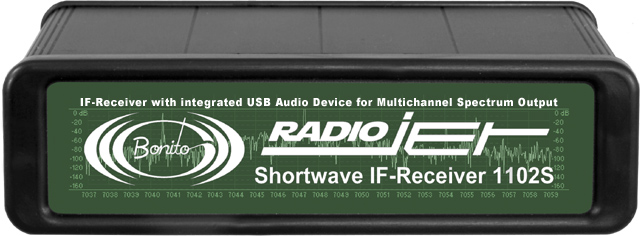
The Bonito RadioJet - Click to Enlarge

An inside scoop just for SWLing Post readers:  We’ve just received some interesting updates about the new Bonito RadioJet IF-Receiver 1102S from German company Bonito. Our contact Dennis, a representative of Bonito, informs us that FCC should be approving the RadioJet within a week, and units will be shipping to retailers about the same time. Naturally, I’m quite eager to review this receiver, as it promises a low noise floor (-137 dBm-!?!) and a sleek, sizable user interface. Pricing seems to be in line with the Perseus and Excalibur for North American buyers.

RadioJet Back

Dennis at Bonito tells us:

[S]ince December we’ve been delivering RadioJets to end customers…

Preordering was amazing in our opinion (370 RadioJets!) and the customers who contacted us are extremely happy with it.

We also have some tests from German magazines and the SDR gurus are delighted with the signal quality.

The real concern with any SDR–especially with a new one–is whether or not the manufacturer will support and upgrade the user interface over time.  After all, an SDR is only as good as your ability to control and use it.  In consideration of this, Dennis volunteers the following:

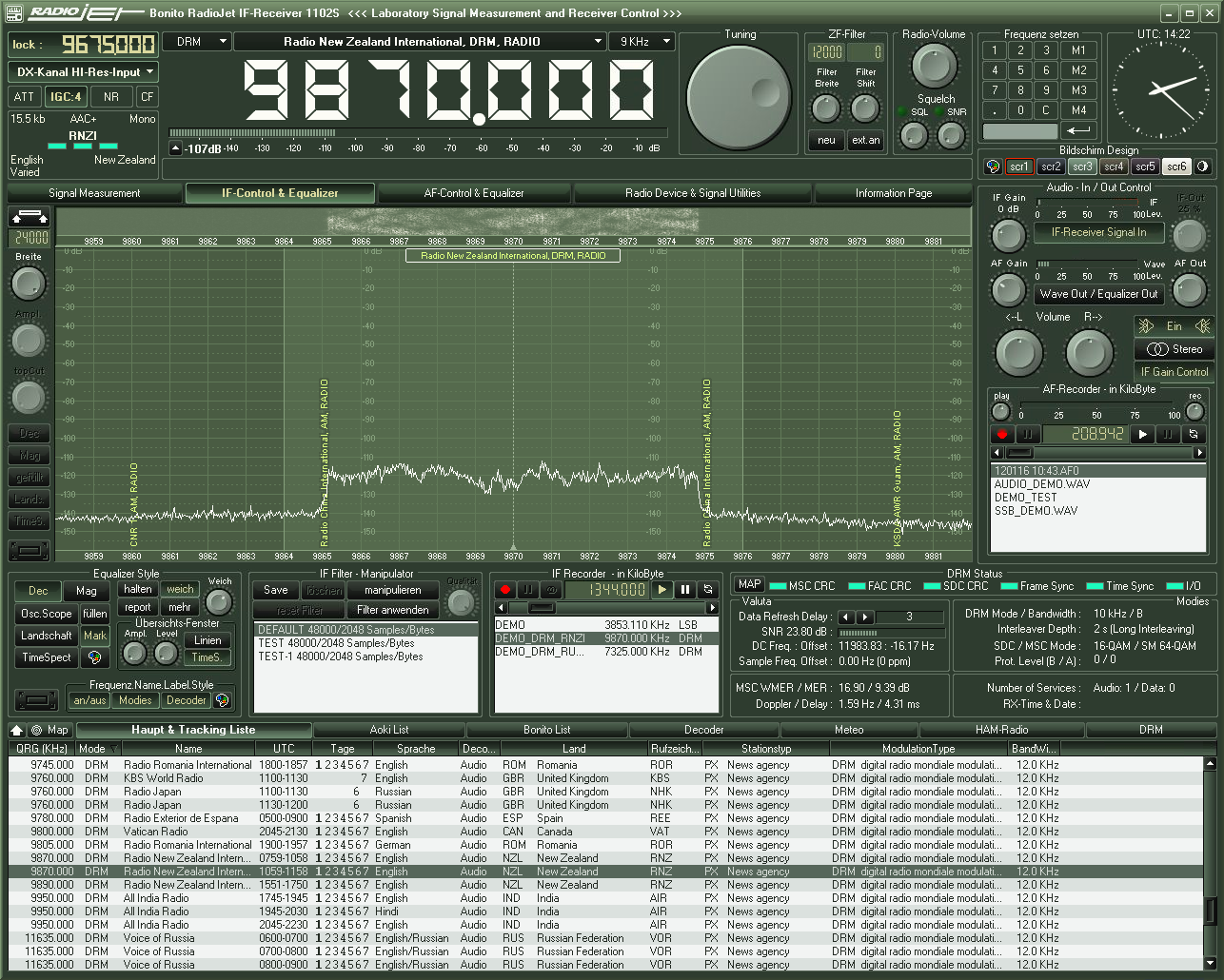
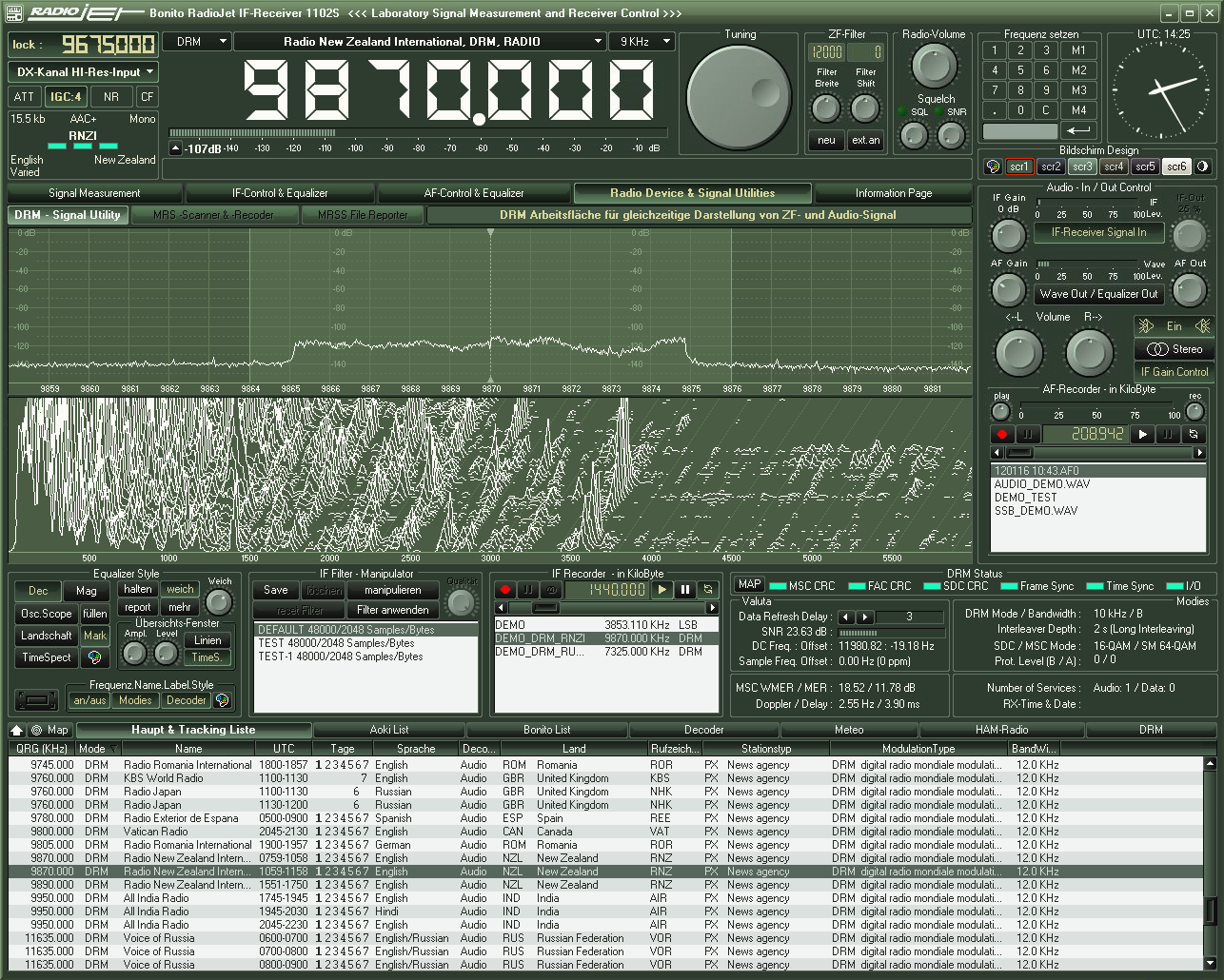
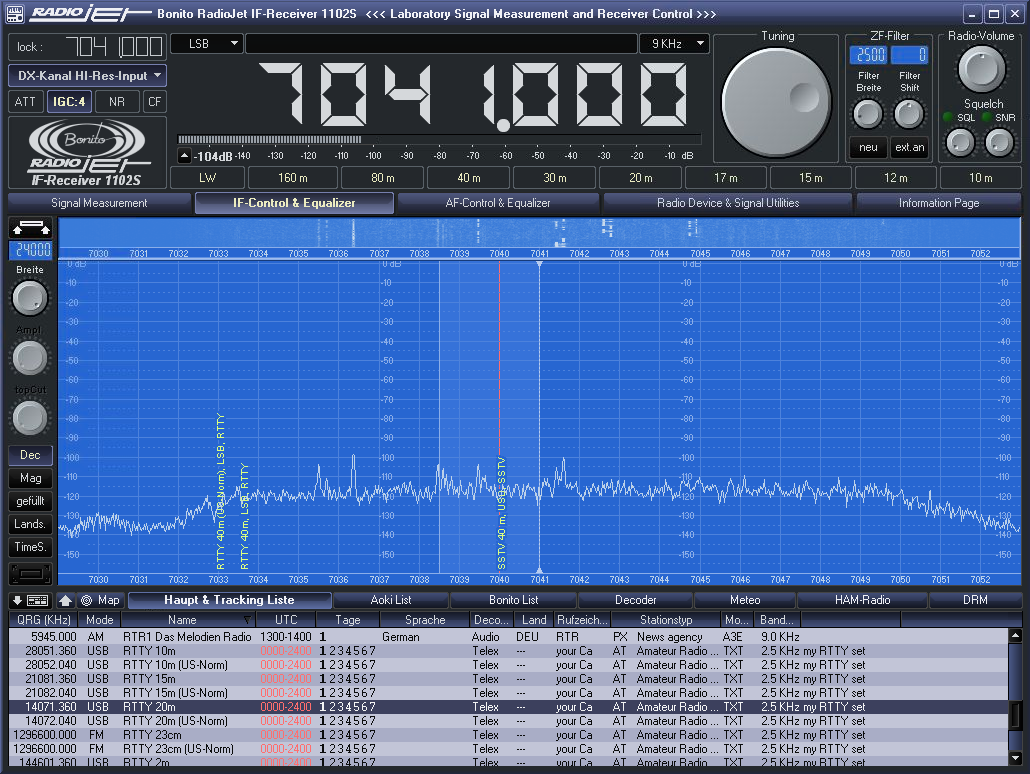
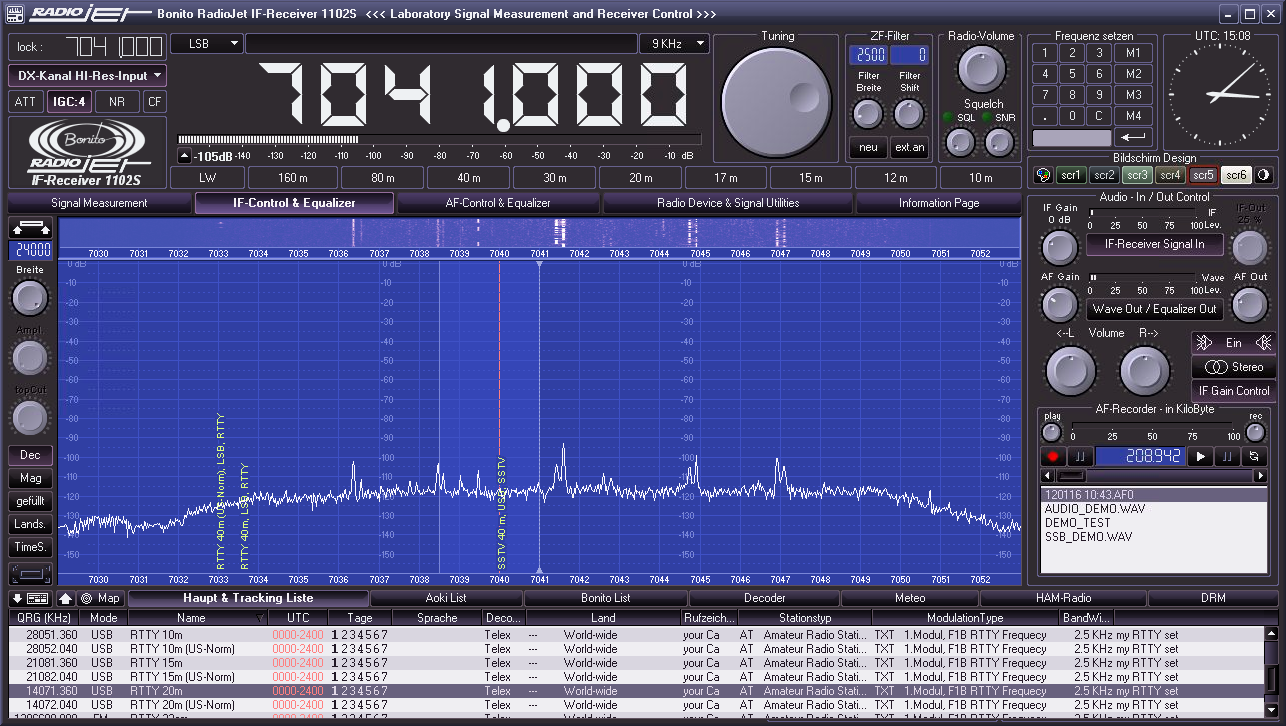
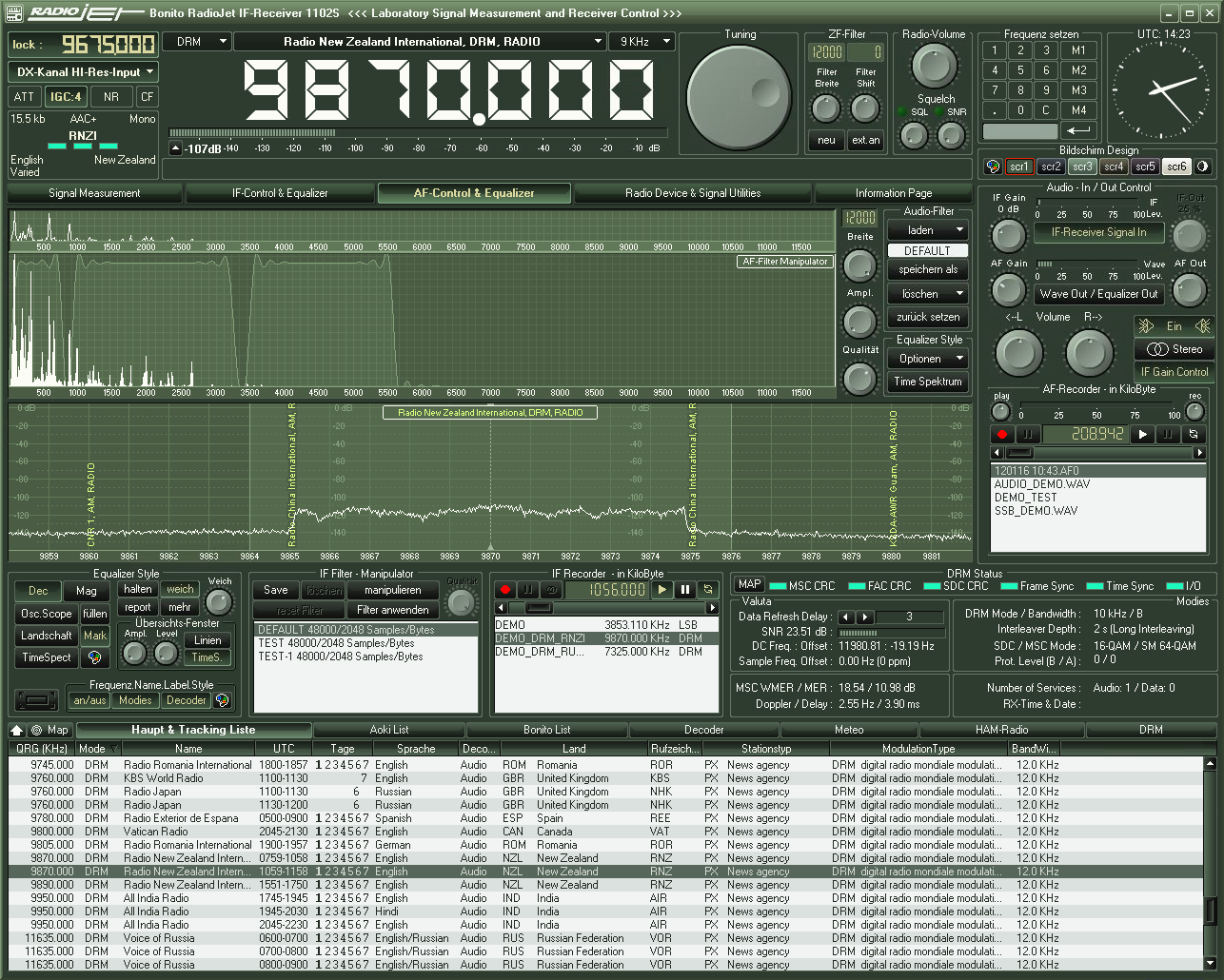
We have, meanwhile, improved and extended the whole software [package] and put a lot of new features in it. One is a huge frequency list, including transmitting times, and shown [in the display is] a world map [indicating] day and night and moon phases. (See screenshots)

Screenshot 1 - Click To Enlarge

Screenshot 2 - Click to Enlarge

I must say, I love the superimposed broadcaster ID as seen in Screenshot 1 (above). This is a very cool addition, which makes for convenient at-a-glance broadcasting identification. Coincidentally, this should also help users find unscheduled broadcasts such as pirate radio stations, numbers stations, utilities, etc. The map target icons also make it quite easy to identify broadcast sites on the world map (see Screenshot 2).  Again, Dennis:

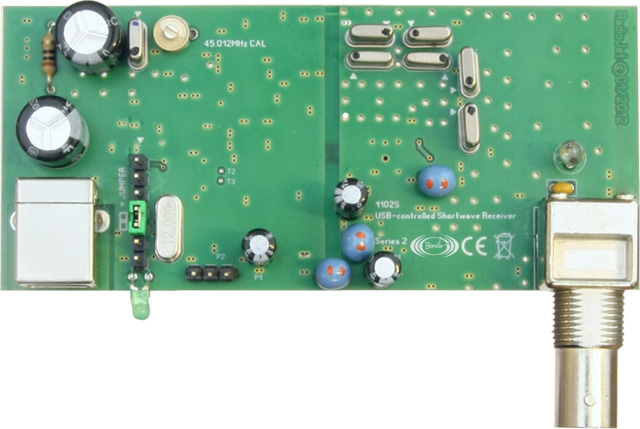
Top view of RadioJet board (Click to enlarge)

I’ve included an image of the [receiver] board. You see no active parts between the antenna and ADC [analog to digital converter].

Dennis claims that it is this absence of any active components between the antenna and ADC that keep the RadioJet noise floor so remarkably low.

Bonito rep Dennis also voluntarily asked me to post the following to SWLing Post readers:

It would be great if you would send me a small list of things that MUST be in the software. Every comment is welcome.

So if you have a comment or a particular request regarding this software, please leave it in this post or simply contact us–we’ll make sure Bonito receives this informative feedback from you.

Of course, these are early days, but it looks like Bonito has the right focus to create a very competitive and innovative SDR product. This will require more than good engineering, however; it requires excellent support and a user-friendly experience.  Time will tell–and so will our forthcoming review!  We will be reviewing the Bonito RadioJet IF-Receiver 1102S in the near future, comparing it with the Microtelecom Perseus, so check back and follow this tag.

In the meantime, you can check out further screenshots below:

Screenshot 3 - Click to enlarge

Screenshot 4 - Click To Enlarge

Screenshot 5 - Click To Enlarge

Screenshot 6 - Click To Enlarge

Screenshot 7 - Click To Enlarge

Screenshot 8 - Click To Enlarge

Screenshot 9 - Click To Enlarge

Screenshot 10 - Click To Enlarge

Check Universal Radio’s website for Bonito Radiojet IF-Receiver 1102S availability and pricing in the USA.

Voice of Nigeria broadcasts DRM from their new facility

(Source: VON via Kim Elliott)

VON’s ultra modern transmission station launched 
Lawan Hamidu, Abuja

President Goodluck Jonathan has commissioned Voice of Nigeria’s (VON) ultramodern super transmitting station and its revolving antenna, located at Lugbe, Airport Road, Abuja.

President Goodluck Jonathan, represented by the Vice President, Namadi Sambo at the event, stated that the project was in line with Federal Government’s commitment to meet the 2015 global deadline for the digitization of the broadcast industry and international best practices.

Sambo said “We are today empowering the Voice of Nigeria to robustly project our international profile and make Nigeria heard positively and more widely around the world,” adding that “the transmitting station we are commissioning today is therefore aimed at making VON better able to meet its vital obligation of telling our story from our own perspective.”

The President noted that VON established in 1961, as an external arm of the then Nigeria Broadcasting Corporation, was in recognition of the critical role the country was playing in freeing other African countries from the shackles of colonialism.

“Nigeria understood in her early history that it needed an external voice to reach the world as the leader of Africa and to provide a platform for rallying African voices,” he stated.

President Jonathan, charged the management and staff of VON to as a matter of priority develop programmes that would make the Radio station the choice of listeners in and outside the shores of Nigeria.

He added that “You have the duty of helping to inculcate in all Nigerians abiding peace and pride in Nigeria and the knowledge that we all have a stake in ensuring that our strive towards sustained economic growth and development is not compromised by breaches of peace and security in any part of the country.”

Similarly, Dr. Jonathan assured that Government was committed to meeting its obligations to VON and other broadcast organisations.

“In keeping with my avid policy of expanding the political space and driving the ideals of democratic process, this administration is not interested in turning VON, or any government broadcast organisation into an uncritical mouthpiece for our policies,” he emphasised.

In his remarks, the Minister of Information, Mr Labaran Maku, called on President Jonathan to ensure the immediate completion of the second phase of the VON project.

He also appealed for additional funds for the nation’s information sector for the smooth execution of government transformation agenda.

The Minister said “Mr President what we now need is the second phase of this project, that second phase would mean the construction of two more transmitters and we don’t have those two transmitters we are going to have a heavy burden on the existing transmitters and this will not be good for this technology. So, we plead with Mr President that after this commissioning we will want Mr President to approve the immediate execution of the second phase of this project. The Information sector is need of infusion of funds to make us give Nigerians and Africans all over the world the best programmes.”

In his welcome address, the Director-General of VON, Abubakar Jijiwa, expressed optimism that the second phase of the project, when completed, would enable VON to embark on 24-hour broadcasting.

Alhaji Jijiwa solicited for Presidential intervention for the VON expansion projects which included the construction of two additional transmitters and antenna systems in line with global best practices and standards, construction of VON Abuja Broadcasting House as well as rehabilitation and upgrading of the ageing Ikorodu Transmitting Station.

Mal. Jijjiwa stated that “The second phase of this project needs be commenced urgently. It will comprise of two additional super power transmitters and one fixed and one rotatable antenna. When this is done and completed, VON would have the capacity for 24-hour broadcast and we can move this from our existing 18-hour broadcast and this would be the hall marks of simultaneous broadcasting which every external broadcaster hopes to achieve.”

The event included, the commissioning of three Super-Power Transmitters, three fixed and one rotatable antenna, the first in Africa and sixth in the World.

Voice of Nigeria, Nigeria’s external broadcast station is mandated to project Nigeria and Africa’s views to the world.

Located in Lugbe, a suburb of Abuja in the Federal Capital Territory, the transmitter has a rotating antenna, with the capacity of a hundred and fifty kilowatts and is powered by one thousand two hundred high tension generators.

New Digital Studio

On Monday, the Voice of Nigeria commissioned an ultra-modern digital studio in Abuja, as part of efforts to enhance its broadcast.

The new studio, commissioned by the Minister of Information, Mr Labaran Maku, is named after Mrs Stella Bassey, a seasoned broadcaster and former Deputy Director, Programmes of the Voice of Nigeria.

Commending Voice of Nigeria for its quality broadcasting, Mr Maku urged the radio station not to relent in its efforts to maintain world class broadcast standards.

The Director General of Voice of Nigeria, Mallam Abubakar Jijiwa said the station had a culture of rewarding hard work.

Mallam Jijiwa said the studio was named after Stella Bassey because of her immense contributions to the corporation and the country in the area of broadcasting.


 

A traveler’s review of the Grundig G6 shortwave radio

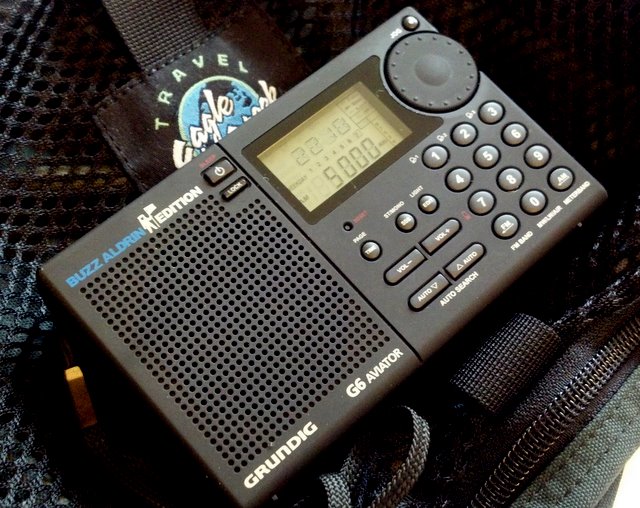
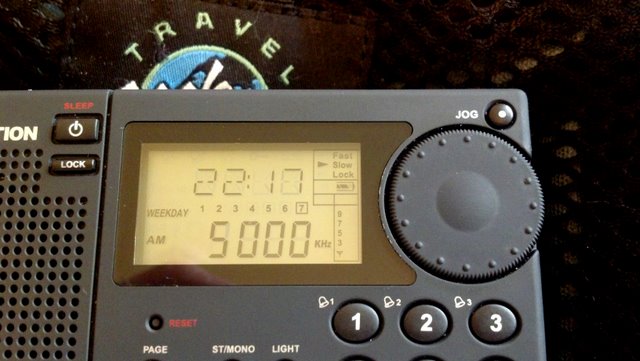
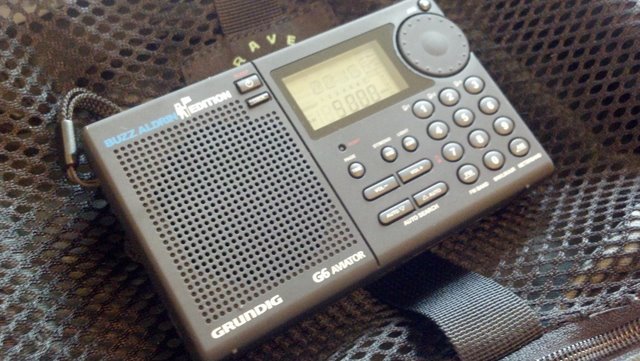
The Grundig G6 makes for an excellent travel companion

Last week, I traveled to New York City by air and used trains, taxis and buses en route to Philadelphia. All the while, I carted along my luggage–and it’s a good thing I like to travel light.

Indeed, I almost never check in luggage, no doubt a remnant of my days as an expatriate, when I was required to travel throughout Europe at a moment’s notice. But I love traveling with only one bag. It’s incredibly liberating. I revel in the challenge of fitting everything I need into one Eagle Creek convertible backpack/suitcase.

This latest trip was no exception, and I planned to do a little shortwave and medium wave DX along the way. So which radio did I reach for? Oddly enough, none of those I listed from my travel radio suggestions, my usual stand-bys. This time, I chose my Grundig G6.

Keypad for direct entry and as with most Grundig radios, the G6has a logical, simple key combination for entering frequencies.

I have had a mini Grundig G6 review out for a couple years now in which I praise it highly. I am surprised to find that many other reviewers only give it a lukewarm rating. I believe a lot of this stems from the fact that the radio’s aircraft band (117-137 MHz) is not terribly sensitive or selective. Since purchasing the G6, I’ve only used the aircraft band once–during review. I leave aircraft and VHF/UHF listening to a proper scanner, preferably one with triple-conversion circuitry.

Yet I find that the Grundig G6 performs quite well on the shortwave and medium wave bands. Last week, while in NYC and Philadelphia, I was surrounded by big signals and didn’t hear many instances of overloading or imaging. Sure, larger portables (like the Grundig G3, Tecsun PL-660, Sony ICF-SW7600GR, Sangean ATS-909X) will outperform the G6 on SW and MW, but none of those radios can comfortably fit in my pocket. In fact, the G6 is so small that it can get lost in my suitcase–oh, there it is, tucked among my socks. The portables mentioned above, though reasonably sized, will need some dedicated space.

The placement and orientation of the tuning knob on the G6 is genius. My favorite ultra-portable radio for band-scanning

There’s another plus about the G6. It feels good in your hand. I have big, clumsy fingers, yet I still manage to punch in the frequency correctly every time. Having the (smooth) tuning knob in the upper left corner of the radio where it’s accessible both on the side, and (more importantly) on the face, was a stroke of ergonomic genius by this little radio’s designer. I wish more manufacturers would do this. It’s so easy and comfortable to band scan using your thumb on the face of the tuning wheel, which is great when you’re sitting around a campfire or listening to FM on a bumpy bus ride.

Don’t get me wrong: if I were going on a DX vacation where I needed top-notch filtering, sync-detection and SSB, I would not pick the G6. For the odd business trip, though, it’s the perfect little radio.

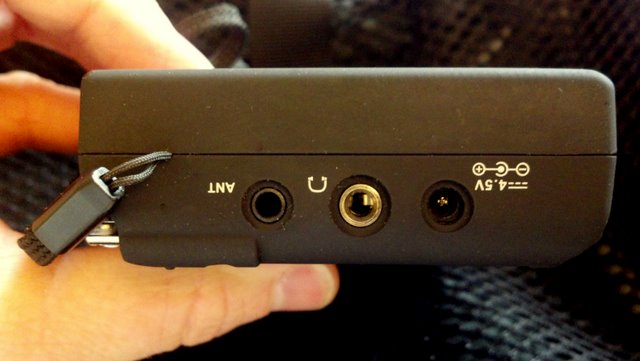
The G6 even has an external antenna connection.

Pros:

  • Small, affordable and full-featured
  • Shortwave and medium wave reception are comparable to others in price class
  • Two bandwidth choices
  • Direct keypad entry of frequencies
  • Fluid and well-placed tuning knob
  • No chuffing/muting during band scans
  • Includes SSB (see con)
  • Great audio for a tiny speaker
  • Excellent ergonomics (especially for such a small package)
  • Aircraft Band (see con)

Cons:

  • SSB reception is mediocre–fine tuning is difficult
  • Volume button increments a little too steep (between 8-12) with headphones
  • Keypad not backlit
  • Some image problems on aircraft band

The Grundig G6 has been on the market a long time, in a consumer electronics life span. I would not wait to purchase one. Occasionally, RadioShack (in the US and Canada) will close out their stock of shortwave radios and the G6 can be found at bargain prices. Universal Radio currently has a promotion where if you buy a Grundig Satellit 750 for $299.95, you will receive a free Grundig G6. You get both a large portable/tabletop radio and a pocket-sized one in the same deal. That’s great value!

Want specifications and other reviews of the Grundig G6? Check out our G6 entry in the Shortwave Radio Index.

WoodBoxRadio will start shipping the new ELAD FDM-S1 SDR this month

According to WoodBoxRadio, the ELAD FDM-S1 software-defined radio will be shipping this month (March 2012). This is an intriguing SDR and boasts some pretty impressive features–download their spec sheet here. Can’t wait to see how it compares to other popular SDRs.

The FDM-S1 is available at a “special” price of 399 Euro–it can be ordered on their website.

WWVB conducting tests on air now through March 10

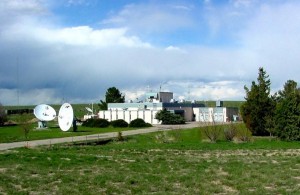
WWV building in Fort Collins, Colorado (photo courtesy: NIST)

(Source: NIST)

IMPORTANT NOTICE FOR WWVB RADIO STATION USERS
Radio Station WWVB will be conducting a test of a new broadcast format from Monday, March 5th, 2012 at 5 p.m. MST through Saturday, March 10th at noon MST.

During the test, Station WWVB will be broadcasting amplitude modulation and phase modulation simultaneously.

This test may affect WWVB timing equipment, but consumer radio-controlled clocks should work fine during this test.

You are encouraged to direct your questions to the Broadcast Manager John Lowe: 303-497-5453 or [email protected]

NIST radio station, WWVB, is located on the same site as WWV near Fort Collins, Colorado. WWVB broadcasts are used by consumer electronic products like wall clocks, clock radios, and wristwatches which sync to its unique time code broadcast stream. WWVB is also used for high level applications such as network time synchronization and frequency calibrations.

Though the tests are being conducted over 5 days, timing may be less than desirable considering the pending solar flare.