Thanks to Marc for passing along this video which takes you inside Radio Havana Cuba:
Video: A look inside Radio Havana Cuba
1 Reply

Thanks to Marc for passing along this video which takes you inside Radio Havana Cuba:
 Sad news, indeed: I had hoped that The State We’re In (also known as TSWI) would weather the RNW cuts, perhaps by gaining independent funding. Unfortunately, this doesn’t seem to have been the case, and we’re pained by the loss of yet another stellar international radio program.
[UPDATE – 23 Oct 2013: TSWI will be produced as a podcast via WBEZ, starting November 2013]
In my opinion, The State We’re In represents some of the best radio documentary out there: TSWI has won international honors, including three New York World Medals in 2010, as well as a Gabriel. Ira Glass, the talented host of Chicago Public Media’s This American Life, has praised TSWI for its “amazing editorial judgment,” and Glass rightly called TSWI host Jonathan Groubert “one of the best news interviewers on public radio today.”
Don’t believe me? Listen to some of their archived shows, like Two Enemies, One Heart. Powerful stuff.
I hold out hope that, somehow, TSWI will find the funding to revive. We simply cannot (and should not!) allow a show if this caliber to dissolve for twelve million listeners across our planet…
(Source: TSWI on Facebook)
We have some bad news:
The State We’re In is being terminated. As many of you may know, Radio Netherlands Worldwide was hit with a drastic 70% cutback last year by the Dutch government. We were assured at that time by Radio Netherlands’ outgoing management that the show was still going to be an integral part of Radio Netherlands, but those assurances didn’t hold.
Subsequent changes in the organization’s mandate towards a tighter focus on nations in the developing world, and a much slower-than-expected transition to new management have made it impossible for us to continue. The State We’re In exits with its head held high: it was the most broadcasted, downloaded and decorated program in the long history of Radio Netherlands, and won praise from radio industry leaders from around the world.
It was heard in top public radio markets the United States, Canada, Australia, Ireland, and in select markets in India and Africa. Our overall audience reach was 12 million people. We will miss you and all the engaged, thoughtful responses you had to what we put on the air. It was a privilege bringing these stories — which sometimes included stories you told us — to light.
FYI: Our last original program will be produced at the end of October. There will be some repeat shows after that.
Greg Kelly, Editor, TSWI
I just received the following QSL card from the shortwave pirate radio station, X-FM:

Click to enlarge
To hear the full X-FM broadcast associated with this QSL, check out our previous post with recorded audio.
Credit: Photo by Hitomi Kai Yoda / Rex Features (1876064b)
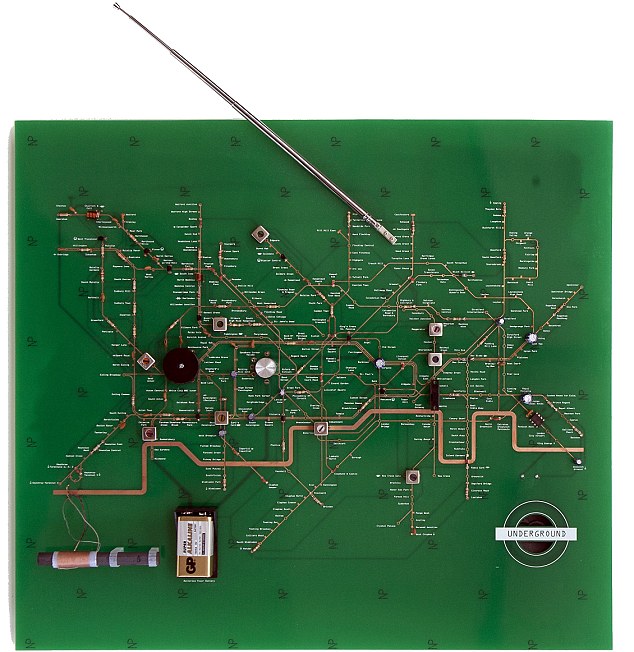
London Underground circuit board radio
(Source: DailyMail.co.uk)
Underground radio stations have a rich history in the UK – but this device gives the term a whole new meaning.
A designer has created a fully functioning radio, which has the entire London tube map built in as its circuit.
The impressive 45cm by 45cm contraption is accurately labeled with each of the 270 stations and took three months to make.
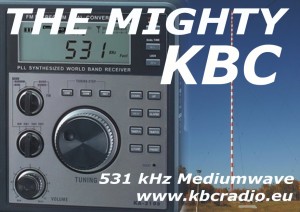 See if you can catch this test transmission on Sunday, October 7 (oo:00-02:00UTC) from The Mighty KBC in the Netherlands:
(Source: The Mighty KBC)
The Mighty KBC is testing on 9400 kHz on Sunday, October 7th, 2012 between 00.00 – 02.00 UTC with 100kW beamed to the USA, South America and Canada.

Propagation Map (Source: The Mighty KBC)
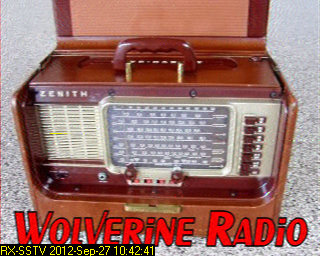
Wolverine Radio sent this SSTV image at the end of the broadcast. This one was decoded with the PC freeware, RX-SSTV.
Wolverine Radio was yet another pirate station I recorded last Saturday night (along with Radio Ronin and Radio Appalachia).
Wolverine Radio was broadcasting on 6.95 MHz in the upper side band. Their signal was very good and fidelity excellent for SSB. Lots of variety and a common “radio” theme throughout WR’s music mix.
Wolverine Radio–at least each time I’ve heard them–sends an SSTV image at the end of the broadcast. I decoded the one in their Satuday night broadcast (see image on right) using RX-SSTV, a very intuitive and simple freeware PC application. Make sure you use the “Scottie 1” mode.
Click here to download an MP3 of the broadcast, or stream from the embedded player below:
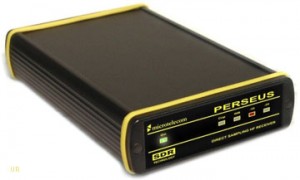
The Microtelecom Perseus SDR
I just received the notification below from Microtelecom. I find it very encouraging that they are still tweaking and working on the Perseus software (which is quite mature at this point). No major upgrades here, but they’re worthy updates.
Note that this is a BETA release for the client and server versions:
(Source: Microtelecom)
A new Perseus release is now in the BETA phase.
Here is the download link:http://microtelecom.it/perseus/Perseusv40c_beta.zip
There are quite a few changes in both client and server.
Client
-The servers map is no longer integrated in the Perseus software (when clicking on the “Show Map” button, a default browser window will open).
The link between the map and the Perseus software is done by a tool (included in the package) called mttps.exe. During the first run, administrative privileges are required to properly register the MTTP protocol.
-Buttons font rendering was modified to address some users that reported “blocky” or hardly readable labels on some buttons.
-Audio Delay: this new feature inserts a configurable delay in the DSP chain, please refer to the release notes (included in the package) for more information about it.
Server
-Support for the delay feature
-Restarting the server is no longer needed after a DNS change
-Blacklist support: using a text file (as explained in the release notes) it is possible to reject connections from an IP address or family of IP addresses (server software settings has a new section).
Enjoy this new release!
The Microtelecom Development Team