Radio St. Helena Day – November 14th, 2009

sthelenalogoRadio St. Helena has announced that their annual Radio St. Helena Day will be held on November 14th, 2009. If you would like to try your shortwave listening skills, this is a fun event indeed. DXers around the world try to tune into the annual broadcast and snag St. Helena’s unique QSL card.

Below is the full press release from Radio St. Helena:

Radio St. Helena Day 2009 will be on Saturday, 14. November 2009.

The “Party On-The-Air” will have the following schedule.
Time in UTC Target Area(s)
20:00 – 21:00 India / Southeast Asia
21:00 – 22:00 Japan / Asia
22:00 – 23:30 Europe
23:30 – 01:00 North America / Central America / Caribbean
The transmission will be on 11092.5 KHz in Upper Side Band, as usual.

Radio St. Helena is very pleased to announce that the newly designed RSD 2009 QSL cards will be sponsored by the highly respected Japan Short Wave Club. This good news has been reported by Mr. T. Ohtake of the JSWC. It can truly be said, that without the very generous help of the JSWC, there would not have been a RSD Revival in 2006.

To get a QSL from Radio St. Helena, you must send a written and verifiable reception report
by AIRMAIL and include sufficient return postage. Email-reports will be not be verified. Recordings will not be returned. In EURO-countries, please send a 5-Euro banknote. Otherwise, please send 3 or more US dollar banknotes to cover the required return postage.
Radio St. Helena
P.O. Box 93
Jamestown , St. Helena
STHL 1ZZ
South Atlantic Ocean
—————————–
via AIRMAIL
via United Kingdom & Ascension
————————————————
The last two lines of the above address are very important and should be written as shown. Be sure to use sufficient postage on your letter to RSH. Ask at your local post office for the correct AIRMAIL postage for your letter to go all the way to St. Helena.
Emails and telephone calls from DXers everywhere are very welcome during the broadcasts.
A special email address for RSD 2009 will, probably, be announced in October.
Gary Walters and his Team at RSH wish everyone excellent listening conditions, hope that you enjoy the programming, and hope that the sunspots will be kinder to us this year.

With best 73’s,

Robert Kipp

(source: Radio St. Helena)

02 Nov 09: Note that the special email address for this event is:

radio.announcements4669 (at) msn.com

Click here to see St. Helena's remote location in the South Atlantic Ocean. (Map coutesy of Wikipedia)

Click here to see St. Helena's remote location in the South Atlantic Ocean. (Map coutesy of Wikipedia)

Zimbabwe needs shortwave radio and text messages

250px-sw_radio_africa_logoFrom Journalism.co.uk:

“We just need old media. We just need radio. We just need people to be allowed to listen to radio,” explains Gerry Jackson, the founder of Zimbabwean radio station SW Radio Africa (SWRA).

“Shortwave and text messages are only real way to get into Zimbabwe…[b]ecause our focus is on serving people in the country,” explains Jackson.

Read the full article here.

The Happy Station Show’s New Year Contest

Radio Miami International

Radio Miami International broadcasts the Happy Station show on 9955 kHz.

Keith Perron of the new Happy Station Show is running a listener contest with some pretty cool prizes up for grabs. I find it encouraging that a new shortwave radio program is offering listener prizes–reminds me of the good old days!

The contest starts September 10, 2009 and winners will be announced on New Year’s day, 2010.  Read the full press release below or directly on the HSS blog.

The Happy Station Show broadcast schedule via WRMI to North and South America:
0100-0155 UTC Thursdays on 9955 kHz
Repeated 1500-1555 UTC Thursdays on 9955 kHz

From Keith Perron:

Hi Everyone,

Starting September 10th, 2009 we are launching a New Years contest with the winners to be announced at 1230am (local HK TIME) that’s 1730UTC on January 1st, 2010.

Times reflect the November time shift. Meaning 0100UTC now will be 0200UTC after that.

Let me fill you in the loop as they say. On December 31, 2009 both editions of Happy Station will be 2 hours each.

The transmission at 0200UTC will be a special program for South America and the Caribbean and will run for 2 hours. Details are still being worked on at this moment. I will fill you in when they become available. This program will be recorded.

The transmission at 1600UTC will be LIVE from Hong Kong. My friends at RTHK (Radio Television Hong Kong) are giving us a studio over looking Victoria Harbor where at 1659UTC we will do the countdown to 2010. They are also letting us patch into the audio feeds for RTHK, so you will be able to hear the countdown live as it happens in Hong Kong. After the countdown, plus a small concert of the Hong Kong Symphony Orchestra I will announce the winner of the contest. Prizes listed below!

This contest is open to both email and post entries. But to enter you will need to send in the time and date you hear a short message that will start to air September 11, 2009 for the broadcast at 0100UTC. This message will also be used during the 1500UTC program, and for the shows for Indonesia and New Zealand. Now the message is in code, but if you can’t understand it. That’s not important! What’s important is you report the time you heard it and the date. I will announce the the shows next week more details about how it will work. But please remember to include your postal address! And that even goes to those who send in emails.

Keith Perron, host of the New Happy Station Show

Keith Perron, host of the New Happy Station Show

Prizes
1st Prize: Sangean ATS909
2nd Prize: Sangean ATS606
3rd Prize: The 3 books from Jerry Berg about SW
4th Prize: 1 Year membership to Communication from the BDXC
5th Prize: 10 winners of a CD by Tom Meijer called Easy Come, Easy Go!

So good luck to everyone!

Warmest regards,
Keith Perron
Happy Station Show

The Grundig G3 – First Impressions

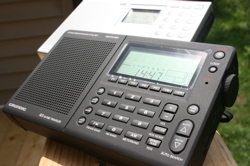
The Grundig G3 with Sony ICF-SW7600GR in background.

The Grundig G3 with Sony ICF-SW7600GR in background.

The Grundig G3 arrived this week and I’ve had a few moments to gather some first impressions.

I’ve received a lot of inquiries regarding the G3, so I thought I’d post a preliminary review.

There are a handful of G3 reviews on the net (not many, as of the date of this post) and I find that my experience with the G3 is quite different than that of other reviewers.

A quick disclaimer: This review is limited, as I have not had enough time to complete my tests of the G3. All tests thus far were performed with built-in whip antennas and a fresh set of internal batteries. I used the Sony ICF-SW7600GR and the Grundig G5 for benchmarking.

Looks a Lot Like the G5…

The well-known predecessor to the G3 is Grundig’s G5 (Eton E5). The G5 has been out for several years and is an excellent portable. Along with Sony’s ICF-SW7600GR, it has been one of the radios I have recommended most to newcomers and SWLers who seek a powerful yet portable radio.  I happen to have one handy for review, so naturally I tested the G3 against its older sibling.

The G5 and G3 are very similar in appearance. Right out of the box, I could see that the G3 shares the same body and keyboard configuration. To my surprise, there are no additional keys on the G3, but the key functions have been shuffled a bit. For example, the former SSB button now switches between upper side-band (USB) and lower side-band (LSB) and toggles RDS. The EDIT button now turns on the sync detector and toggles USB and LSB sync modes. The functions of the four vertically aligned buttons on the left side of the keyboard have all been shuffled as well.
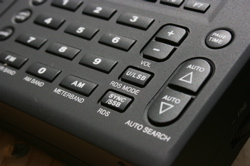
g3keypadThough I had been familiar with the keyboard functions of the G5, I easily found my way around the G3. Grundig (and Eton) products tend to be ergonomic and easy to use. The G3 is no exception: for example, to change frequency to 10,000 kHz, you simply type 10000 on the keypad and then press the AM button. To go to 89.7 MHZ, simply type 897 and press the FM button. This is a formula that Grundig has used since at least the days of the YB400, and I wished more portable radios would adopt this as a standard for direct frequency entry.

Perhaps the most noticeable change, though, is the G3’s display. The clock on the G5 has been moved to the lower part of the display screen and the panel which contains the signal strength meter, battery indicator, etc. has been shrunk to make room for the new RDS alpha numeric display at the top of the screen.

Performance

I have done some initial testing of the G3 against the Sony ICF-SW7600GR and the Grundig G5 on all bands and modes (except FM aircraft, which the Sony and both G5 lack). I feel that people who are looking for a portable in this price range will naturally have to decide between the G3 and the Sony 7600GR as they both have many of the same features. Here are my notes:

  • Audio – The G3 shares the same audio characteristics with the G5 (no surprise here), thus I prefer the audio from its built-in speaker as compared with that of the Sony. The Grundig audio has a surprising amount of dynamic range for such a small radio, the Sony’s audio has more mid-range and lacks the bass heard in the G3.
  • AM Broadcast (MW) band – I found that the G3 performed as well as the Sony and G5. I expected this as the G5 was on par with the Sony in this respect. I can’t comment on LW performance, as I live in North America.
  • FM – I live in a rural, mountainous area where it is a challenge for FM stations to reach listeners.  In my limited testing, I found that FM sensitivity was excellent–again, at least as good as the G5 and the Sony. I can pull in two NPR transponders that are very difficult to receive on a typical radio without an external antenna.
  • Shortwave – Again, the G3 and G5 are almost identical with respect to shortwave sensitivity–I could not tell the difference between the two. When paired against the Sony, though, I find that the G3 is slightly more sensitive and selective. Historically, this has always been a factor that kept the G5 in competition with the Sony 7600GR.

What about Synchronous Detection?

One of the biggest features that separates the G3 from the G5 is synchronous detection. For those of you unfamiliar with this feature, it basically addresses the issue of selective fading and co-channel interference on shortwave. Too technical?  Well, in a sense, it locks onto and “evens out” a signal. Essentially, it helps to separate a signal you want to hear from those you don’t.  For a good primer on sync detection and how it works, read this ARRL document (PDF).

It’s still early days, but it doesn’t seem that the G3’s sync detection function is as good as Sony’s. The G3 has difficulty locking onto a weak signal with sync detection enabled. This is a bit disappointing since sync detection should help with weak signals. The Sony, on the other hand, locks onto signals whether they are strong or weak.  Mind you, I think Sony has the best sync detection available under $300-400. The Eton E1’s sync detector surpasses the Sony’s, but is a much bigger, more expensive radio.

With that said–and here is where I depart from other reviewers who have been upset with the G3’s sync detection–I find that the G3 still performs better than the Sony on the shortwave bands. Especially while listening to broadcasts in AM mode, that is–I have not yet thoroughly compared them side-by-side in SSB.

I have tested both radios with weak and strong signals and have found that if I had to chose a radio for any of those broadcasts, the G3 would have won each time. For example, the morning of this post, I compared both radios side-by-side while listening to the relatively strong signal out of WRMI, Miami, Florida. The G3’s audio was clear–punchy, even–without sync detection turned on. The Sony, on the other hand, also received the signal clearly, but the noise floor was higher (background static was higher–some of which could have been local). When I turned on the Sony’s sync detection, it didn’t help bring the audio and signal to the level the G3 had achieved without sync detection. It would have been nice if the G3’s sync detection worked on the WRMI signal, though–but it did not.

A Souped-Up G5

I look at the Grundig G3 as a G5 with more bells and whistles. It performs as well as the G5 in every respect (possibly better; time will tell) and comes with RDS, FM Aircraft band, and synchronous detection.  RDS alone makes this a great portable for travel as you can quickly identify FM stations on the G3’s alpha numeric display. Also, the Grundigs have tuning knobs that work very well for cruising the bands–the Sony lacks this feature, herein lies my main gripe about the Sony.

I Confess: I’m a Fan of Both

I’ve always loved the Sony ICF-SW7600GR–it’s a great radio, performs very well and is built like a tank. I also loved the Grundig G5–it has a similar price point and similar features, lacking only sync detection. Both, in my mind, have been competitive with each other for these very reasons. I suspect the Grundig G3 will be even more competitive than its predecessor. I do sincerely wish the sync detection was better–I may actually replace this radio just to make sure it’s not a flaw with this particular unit.

Overall, I’m impressed with the G3 and it looks like it’ll be a keeper. I assumed when I bought the G3 that I would either sell my Sony, or sell the G3–now  I’m not so sure I can part with either.

Keep in mind that my tests so far have not been in depth; I will come to more concrete conclusions in due time. Eventually, I will post a full update review–but in the meantime, I will add comments to this post as I discover more about the G3.  Please subscribe for updates.

Ted Landphair takes us to the VOA Bethany transmitting station

bethanyvoa

VOA Bethany transmitting station, now a museum and park.

Veteran Voice of America “Americana” reporter and essayist, Ted Landphair recently posted an essay on his blog outlining the past and present of VOA’s Bethany, Ohio transmitter site. This article is a fascinating read and takes us back to the the site’s roots in WLW and wartime propaganda.

Thanks Ted–and to Kim Elliot for bringing this article to my attention.

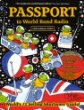
Passport to Word Band Radio® reports they are “in limbo”

Larry Magne, the publisher of Passort To World Band Radio, has reported that the 26th edition of their popular shortwave radio guide may not go to print. From their website:

As with any good recipe, a range of ingredients has to come together if a reference book is to succeed. Solid content is, of course, essential. But in recent months other considerations have had an increased bearing on the future of Passport to World Band Radio®.

So it is that the 26th Edition of Passport to World Band Radio® is being held in limbo. Despite this, for now we are continuing to maintain the WorldScan® database and uphold all proprietary material. Among other things, this should help allow for an orderly return to production, under IBS’ aegis or otherwise, should conditions allow.

For Passport® readers and our small team, alike, this is a seminal moment. After all, Passport to World Band Radio® goes back a quarter century and has had something like a million readers worldwide. But the future has its own rhythm that confounds prognostication. There may yet be more chapters to this story. Stay tuned.

This is sad news for the shortwave listening community. I have been a fan of this fine publication since the 1980’s and always have a copy handy on my radio shelf. There are other notable radio guides out there, but none so easy to use and so perfectly tailored for the newcomer to the hobby.

Read their original post and many listener comments here.

Update 28 Nov 2009: Please see new post–PTWBR No Longer in Print.

Looking for Summer Shortwave Specials?

Since I review shortwave radios for SWLing.com, I’m always looking for great deals on popular portables.  This summer, I’ve noticed several exceptional values and thought I’d share them with you. Note that many of these deals are for the North American market, but if these models are available in your part of the world, you’ll probably find bargains where you live, too.

Grundig G4000A Special

Universal Radio has a limited time offer on the Grundig G4000A.  They’re selling this capable little radio for $99.99 and including a free Eton FR350 self-powered shortwave radio (a $59.95 value) and a Grundig AN200 indoor antenna ($29.95).

Wow.  What a deal–possibly the best I’ve ever seen on a new shortwave portable.  For those of you who don’t yet know, the Grundig G4000A is a classic little portable. It has very decent audio fidelity, good shortwave sensitivity, excellent SW coverage (1711 to 30000 kHz) and is a capable performer on FM and AM bands. It can also tune in SSB (Single Side Band) signals.

I am also quite familiar with the FR350, as it is one of the few self-powered radios (along with the FR200) that passed all of our rigorous tests for use with the classroom SW radio distribution project, Ears To Our World. (Kudos to Universal, by the way, as they are a big supporter of ETOW).

I have not used the Grundig AN200 AM broadcast antenna yet, but I have used similar antennas and must admit that they do improve AM reception. Great thing is, you don’t even need to hook this antenna up to your radio; just place it next to the radio and you’re ready for MW (AM broadcast band) DX.

Universal lists that this unique deal is available until the (updated) 30th of June 2010, or while supplies last.

Click here to download PDF mailer of Grundig/Universal promotion.

Prices have been falling recently on the G5 as Grundig makes way for their new G3 Voyager.

Prices have been falling recently on the G5 as Grundig makes way for their new G3 Voyager.

The Grundig G5/Eton E5

The G5 has been a choice radio amongst SWLers who want portable performance, and, along with many other reviewers, I have given this radio high marks.

There are some good deals out there on the G5 as Eton makes way for the much anticipated G3 Voyager (see previous post). Keep in mind that the G5 used to sell for $160. Below, I have listed some authorized retailers that carry the G5, and their prices as of the date of this posting:

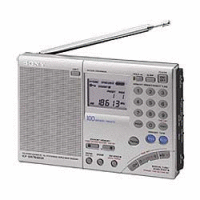
The Sony ICF-SW7600GR is a great choice for the beginner and experienced shortwave listener. Its portable, yet has the features and selectivity of a larger radio.

The Sony ICF-SW7600GR is a great choice for the beginner and experienced shortwave listener. It's portable, yet has the features and selectivity of a larger radio.

The Sony ICF SW7600GR

Many believe that Sony is slowly pulling out of the shortwave radio market. That may be, but they have made some highly sought after radios over the years. The ICF-SW7600GR is no exception (see my mini review here). What sets this radio apart from the competition (at least until the G3 hits the market) is synchronous selectable sideband, a feature which is effective at reducing fading distortion and adjacent-channel interference.

I’ve noticed that prices on the ICF-SW7600GR are starting to fall and supplies are dwindling at retailers. Here are a few that still carry this fine portable:

C. Crane “Orphans”

C. Crane offers two radios that I’m quite fond of–the CCRadio-SW tabletop/portable and the ultra-portable CCRadio-SWP. I reviewed both of these on SWLing.com.

Like many manufacturers, C. Crane sells products that they refurbish and clean, and then guarantee them. They refer to these units as Orphans. Having purchased from C. Crane in the past, I can say that I wouldn’t hesitate to buy an orphan radio from them. It can save you anywhere from $5 to $20 on one of their radios.

Pricing and availability vary, so check out their Orphan page before purchasing new.

Two more Grundig Specials from Universal Radio

Get a free Grundig FR350 with the new Sattelit 750 at Universal Radio.

UPDATED 20 July 2009:

Universal is now offering a free Grundig AN200 antenna with the purchase of the much awaited Grundig G3 Globe Traveler ($149.99) and a free Grundig FR350 self-powered shortwave radio with the purchase of the new Satellit 750 ($299.99).   I believe these offers are exclusive to Universal Radio.

Click here to download PDF mailer of Grundig/Universal promotion.

Did I Miss Anything?

Please let me know if you discover another exceptional value on shortwave portables by leaving a comment. Also, subscibe to our RSS feed and I will post updates as they become available.