The Grundig Globe Traveler G3–now shipping

Grundig G3 Voyager

Grundig G3 - Now shipping

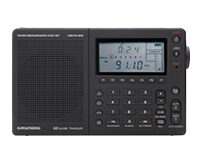
Universal Radio has announced, on their product page, that the Grundig G3 is now shipping. I’ve already ordered one to review.

Pricing is $149.95–a price point similar to the Grundig G5 (which no longer appears in Grundig’s product line). Through Universal, you actually get a Grundig AN200 indoor antenna as a bonus–currently the best deal I could find amongst retailers. See our previous post regarding the Grundig G3 for additional information, and check out Universal’s product page. We will post new info on the G3 as it becomes available.

UPDATE: Universal is now offering a free Grundig AN200 antenna with the G3 purchase ($149.99).

UPDATE: Click here to see our initial G3 review.

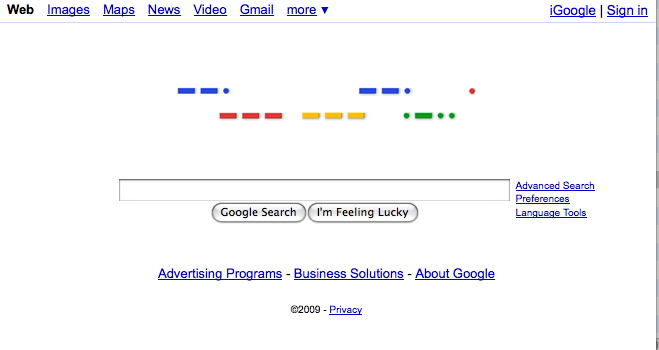
Google commemorates 218th anniversary of Samuel Morse’s birthday

We woke up this morning to find the homepage of search engine, Google, in morse code. What a great way to commemorate Samuel Morse’s birthday. In case you missed this special Google Doodle, check out the screen capture below.

_ _. _.._ Google!

googleincw

Why not learn morse code and add that extra dimension to your SWLing skills? If you’re interested, check out these informative websites:

  • Go to the LCWO (Learn CW Online) website, create an account, and start learning morse code online today!
  • If you’re an amateur radio operator or are considering becoming a ham, check out this article. Code practice is easy if you have a code buddy!

Click here to read Wikipedia’s biography of Samuel Morse.

When shortwave radio is better than the Internet

From Reuters:

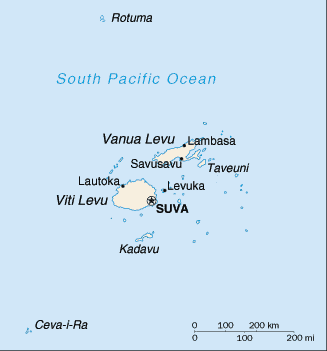
Fiji has been plunged into a political crisis after the president reappointed military chief Frank Bainimarama as interim prime minister on Saturday, less than two days after a court ruled his 2006 coup and subsequent government illegal.
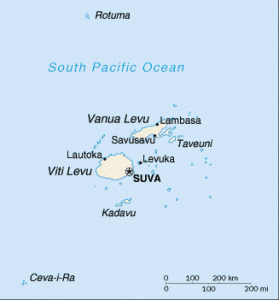
Fiji MapBainimarama tightened media censorship on Wednesday and continued to refuse to hold elections before 2014.

The Australian Broadcasting Corp. said local technicians had been ordered by the military government to shut down two FM relay stations in the capital Suva and the western sugar town of Nadi.

But ABC said its Radio Australia news programme was still broadcasting on shortwave transmitters.

The military government has asked that Fiji reporters only publish “positive” news, or in their terms, “journalism of hope.” This censorship has also pushed Radio New Zealand International out of Fiji.

Other reports have indicated that the government is now trying to restrict internet news sources and blogs. Internet cafe owners are under threat of being shut down, as well.

UPDATE (21 Nov 2009): The military-installed Fiji government has removed all broadcasting licences and given Attorney-General Aiyaz Sayed-Khaiyum the absolute power to renew or redistribute them without any compensation to those whose licences are stripped. (Source: The Australian via RNW Media Network)

Radio without borders
ABC RadioWhen people ask whether we need shortwave radio in this internet information age, events like this provide a clear affirmative answer. Once ABC and RNZI were ousted from Fiji, these broadcasters immediately reiterated to Fiji listeners that their programming can be heard all day on shortwave (see schedule below).

And that’s the remarkable thing about shortwave–it penetrates borders without regard to who is in power or to restrictions placed upon local media. Even when the internet is crippled. Can shortwave broadcasts be jammed?  Sure–but it’s not all that easy to do; it’s much more difficult than, say, seizing control of a country’s internet service provider, or (as in the case of Fiji) of their local broadcasters and stations. Plus, jamming usually targets a specific frequency, so if radio listeners find their broadcasts jammed on one frequency, there are often literally dozens of ways around the jam–other frequencies often carry the same or similiar programming from the same or other international broadcasters.

Much of the decline of shortwave radio is attributed to the end of the Cold War. During the Cold War era,  national superpowers were obsessed with piercing borders with their respective messages; since the Cold War ended, that technology is no longer as driven. But as the Fiji story demonstrates, the need is very much ongoing, perhaps even more so, as small countries try out a variety of political options, often exercising this power along the long and twisting road to democratic governance.  Now, shortwave should have a new and broader focus: sending news, music, education and human interest programming to the developing world.

For an example of an organization making a difference through shortwave radio technology, check out Ears To Our World.

ABC Shortwave Broadcast Schedule to Fiji

Local Time 04:00 – 09:00
Frequencies: 5995 7240 7240 9580 9710 11650 11660 11880 12080

Local Time: 09:00 – 12:00
Frequencies: 11650 11660 12080 12080 12080 13630 15230 15515 17785 17795

Local Time: 12:00 – 16:00
Frequencies: 12080 12080 15240 15515 17795

Local Time: 16:00 – 19:00
Frequencies: 12080 12080 15160 15240 15515

Local Time: 19:00 – 04:00
Frequencies: 5995 6020 7240 9580 9590 12080 12080 12080 13630 15160 15240

New DRM Receiver – Di-Wave 100 / UniWave Di-Wave

Note: Updated 13 December 2009

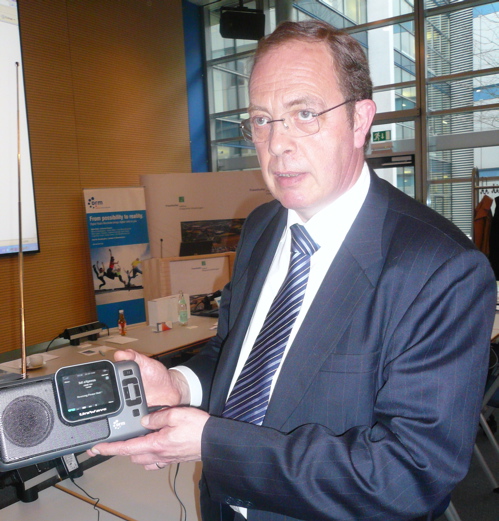
Uniwave SA, CEO, Patrick Leclerc, with the receiver holding the Di-Wave 100. Photo courtesy of DRM consortium.

Uniwave SA, CEO, Patrick Leclerc, with the receiver holding the Di-Wave 100. Photo courtesy of DRM consortium.

The Di-Wave 100, a new DRM digital radio receiver was unveiled at the annual general assembly of the DRM Consortium in Erlangen, Germany. This is big news indeed for DRM enthusiasts as there are so few versatile stand-alone DRM receivers in production.

This announcement also coincides with other exciting news in the DRM world, namely that India and Russia are backing the digital mode for future broadcasts.  See press release here.

The Di-Wave 100 has a USB/SD card  reader and mp3/mp4 play-back. It sports a 3.5 inch TFT color display that reveals station identification, program information, Journaline, MOT Slideshow and listening time shift in several languages. The Di-Wave 100 can receive DRM broadcasts in SW, MW and LW as well as analogue FM and can store 768 stations in its memory.

Click here to view in Universal Radio catalog.

It should be noted that the Di-Wave 100 will be the first consumer DRM receiver authorized by the FCC for sale in the United States. When FCC approval is granted, the Di-Wave 100 (a.k.a. UniWave Di-Wave) can be purchased from Universal Radio.

UPDATE: Universal Radio is now selling the Di-Wave in North America for $299.95 US. The Di-Wave is also available for sale in Thiecom’s online catalog in Germany (249€) and in AV-COMM’s online catalog in Australia ($499AU). Two other distributors in Germany are Charly Hardt and Alan Electronics.

More info on the Di-Wave 100:

The New Happy Station Show via WRMI

SWLers will be happy to know that one of the longest running shortwave radio shows of all time will be back on the air after a 15 year absence. The return of The Happy Station Show? Well, sort of.

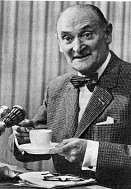
The original Happy Station Show host, Edward "Eddie" Startz. Photo courtesy of RNW.

The original Happy Station Show host, Edward "Eddie" Startz. Photo courtesy of RNW.

A little history…The original Happy Station Show was broadcast by Dutch station PCJJ from 1928 until 1946 when Radio Netherlands took the show.  The format was eclectic and very much tailored to an international crowd–it included popular music (mostly European), vintage recordings and multilingual banter; shows were in English or Spanish (sometimes both). As the name implies, the show was light-hearted and fun.

The Happy Station Show was first hosted by the popular Edward “Eddie” Startz who served until his retirement in the early 1970s.  Many hosts took the reigns after Eddie, including Tom Meijer, Pete Myers, Jonathan Groubert and Jaime Báguena. Unfortunately, the show was canceled by Radio Netherlands in 1995.

I was delighted to hear (via Kim Andrew Elliot) that The Happy Station Show will once again be on the air. At least, a show called “The Happy Station Show” will be on the air.  You see, this show will be based in Taipei, Taiwan and will not be sponsored by Radio Netherlands. The new host is experienced Canadian broadcaster Keith Perron.

Radio Miami International

Radio Miami International

I can’t wait to hear the first broadcast in March from WRMI to North America (9955 kHz)–sounds like those of you who’d rather listen on an iPod will probably have that option available, too.

I will post info here as it becomes available–please subscribe to our feed and comments.

Addendum

Just heard from host Keith Perron, who writes:

The first show will be March 11th at 0100. March 11th, incidentally, is the same date Philips Radio signed on with broadcasts to the Dutch East Indies.

He adds, regarding the new format:

…I don’t want to give too many details, but the first new Happy Station in almost 15 years will have some surprises.

Tom [Meijer] will appear in the new series in guest spots every now and again.

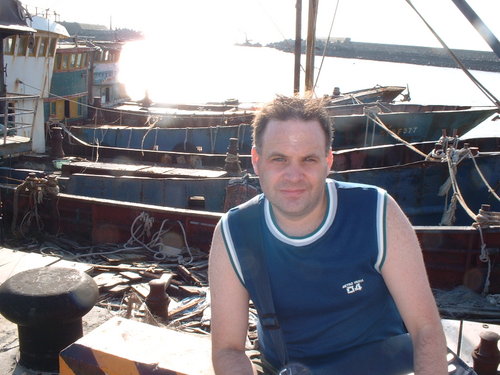
Keith Perron, host of the New Happy Station Show

Keith Perron, host of the New Happy Station Show

I’m looking forward to it!  Thanks to Keith for the scoop.

More info on the new Happy Station Show:

Podcasts/MP3s of past shows:

Also, check out this great article on Edward Startz by Radio Netherlands Worldwide.

A Voice of WWV Goes Silent, Off The Air

I was very saddened to learn recently that Don Elliot Heald–the voice of the National Institute for Standards and Technology (NIST) radio station, WWV–passed away Feb 19th, 2009. My earliest memories of listening to shortwave radio included hearing his voice read the time on WWV’s frequencies (2.5, 5, 10, 15 and 20 MHz) in the 1970s.

Heald was also heavily involved in broadcasting and charitable organizations. You can read his full obituary here.