 Amazon.com is showing the price of the Grundig G3 at $150 with a delivery date in 2-4 weeks–click here for their product page.
Amazon lists price of Grundig G3
1 Reply

Amazon.com is showing the price of the Grundig G3 at $150 with a delivery date in 2-4 weeks–click here for their product page.
This article posted by Reuters is cracking at explaining why so many people still turn to SWLing:
It’s easy and cheap — and fun. You can hear and learn things that you would never find even if you work your search engine like a mule. From Swaziland to Paris to Havana, shortwave broadcasters can surprise an adventurous listener more than any MP3 playlist.
I couldn’t have said it better myself.
 Author Robert MacMillan (with Reuters) began by comparing shortwave radios to many sleek portable digital media devices on display at the Consumer Electronics Show (CES) this year:
iPods and satellite radios are slim and pocket-sized, while shortwaves are throwbacks, typically as square as a textbook and just as serious looking.
While it’s true that most portable shortwave radios are slightly bigger than a Sony Walkman, few portables approach the size of a textbook. Sony, for example, produced the ultra small SW100S years ago–before the internet was much more than an easy way for university researchers to exchange off-color jokes. The SW100S, by the way, was about the size of a pack of cards. Innovative radio designer, Etón Corporation, announced the new, sleek, Grundig Mini 400 at the CES. [Krunker.com has photos of the Mini 400 and other Etón products from the CES–order your Mini 400 at Universal Radio.] I should also note that Chinese manufacturer, Degen, recently released a new, sleek, pocket radio MP3 recorder/player–see Passport’s take here.
I was quite happy to see a few good shortwave news items come out of the CES this year. Yes, more and more focus is being given to web-based devices, and it should be. I am a huge fan of the world wide web and all that it has to offer. But what keeps me glued to my shortwave radio? MacMillian puts it best:
[W]hen you hear voices over the noise and squeal, and realize you are hearing Mongolia, live, there is a warmth and a human connection that are hard to find on the Web.
Amen. Thanks, Robert.

All India Radio (AIR) Headquarters in Dehli, India. Photo courtesy of Wikipedia.
Source — All India Radio News:
“The first digital shortwave transmitter of All India Radio will start functioning from Friday. The Chief Executive Officer of Prasar Bharati, Mr. B. S. Lalli will inaugurate this transmitter to mark the Golden Jubilee of High Power Transmitter Centre of AIR at Khampur in New Delhi. It will provide quality output to the listeners on the shortwave. The External Services programmes of AIR and Vividh Bharati services will be available with a boosted backup.”
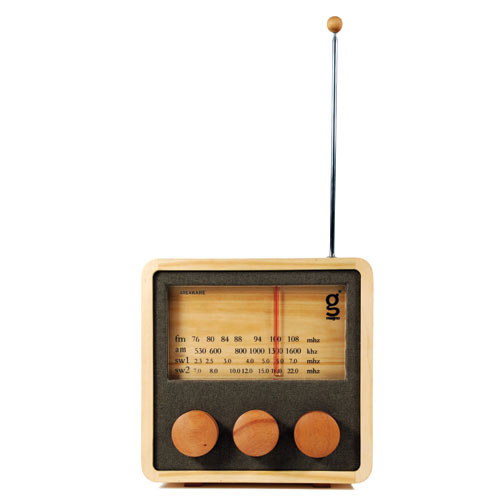
The Magno Medium Radio by designer Singgih Kartono
Areaware, a New York City based eco-retailer, showed off their Magno radio product line by designer Singgih Kartono at the Consumer Electronics Show this year.
An eco radio? Yes, these radios are made of new growth, sustainably harvested wood from Java. Areaware claims that for every tree that is used in production, a new one is planted. Of course, the inside of the radio is electronic–you can only take sustainable wood so far.
I’m not sure what the AM/FM nor 2.3-22 MHz SW reception would be like on the beautifully designed Magno Medium Radio. I do know that Areaware products tend to perform well–perhaps striking that eloquent balance between form and function.
Areaware sells two other radios: the Magno Small Radio (AM/FM), and the three vacuum tube 2B Radio.
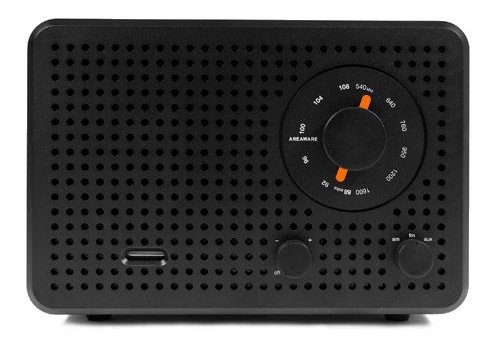
I don’t know about you, but I’d like all three.
Do you have a Magno? Leave a comment!
Grundig G3 Voyager
Universal Radio has just posted a product page for a new Grundig portable–the Grundig G3 Voyager. Feature wise, it looks like a marriage of the G6 and G5 in that it has full LW/MW/AM/FM coverage, plus the G6’s aircraft band. Physically, the G3 resembles the G5.
What could make the G3 Voyager a highly competitive portable, though, is the fact that it will offer Synchronous Detection. This feature reduces fading and adjacent station interference on shortwave frequencies. The other notable portable with this feature is the trusty Sony ICF-7600GR.
Note that the G3 has not not hit retailer shelves yet, nor does it have FCC approval. Subscribe to our RSS feed, or check back here often as we will announce when the G3 becomes available.
UPDATE 01/10/09 – Etón has now released a product spec sheet (below) and has the G3 listed on their website (link below).
UPDATE: The Grundig G5 no longer appears on the etón website. Perhaps the G3 is replacing it?
 Links:
Please comment on this post or contact me if you have more information about the G3. I will add info as it becomes available.
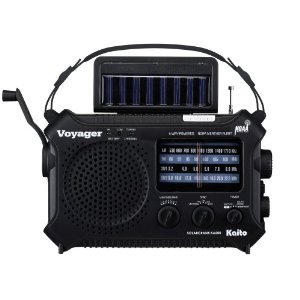
I tested the KA500 along with several other self-powered radios for a project I’m working on in Africa. I found that the KA500 is a very capable shortwave receiver it’s just not nearly as rugged as its current competitors. Here are my thoughts:
What I like about the KA500:
What I didn’t like:
I sent my KA500 back and did not get it replaced. It’s a shame, really. I loved the radio’s features and overall performance, but was very disappointed with quality.
I could only recommend this radio to someone who plans on tucking it away and using it on rare occasions or someone who wants a basic full-featured radio but never plans on using the hand-crank. I’d also keep the receipt handy for the return (and buy from an authorized dealer like Universal Radio).
For my purposes, I will be using the Grundig/Etón FR350 and the FR200. The difference in quality between these and the KA500 is night and day. The Grundigs/Etóns are very rugged, water resistant and time tested. The crank arms are made better and even after long-term use, continue to function properly. They’re simply designed and tested better (before hitting the retail shelf).
Sure wish Kaito would work on the quality of the KA500, they’d have a very competitive product.
[Update 8/11/10: Since the time I first published this review, Etón now makes self-powered radios with built-in solar panels along with hand cranks–the FR600 is a fine example. I have not noticed that the quality of the KA500 has been improved upon.]
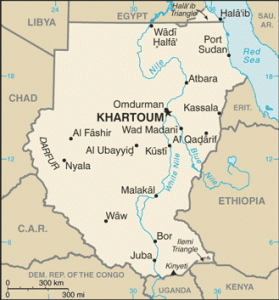 This week’s Living on Earth Broadcast featured an interview with Internews program director Deborah Ensor about bringing solar and wind energy to the region to power a new radio station in Southern Sudan.
This story is a wonderful example of how radio empowers and promotes community relations in parts of the world that lack a communication infrastructure.
Links: