Shortwave listening and everything radio including reviews, broadcasting, ham radio, field operation, DXing, maker kits, travel, emergency gear, events, and more
According to the DRM Consortium, there will be a special two hour DRM broadcast today (April 18) starting at 12:00 UTC:
Special DRM transmission tomorrow 18th April from Spaceline during DRM GA at 1200-1400UTC on 11600kHz. From Kostinbrod, Bulgaria with antenna directed at 260 degrees. The content will be from Mighty KBC.
Note that this broadcast starts less than two hours from time of posting. Please comment if you log this broadcast!
How RootIO Broadcasts Radio in Uganda Using a Bucket
The open-source toolkit allows users to broadcast using just a smartphone and a transmitter
Radio is still and continues to be a powerful medium across most of the African continent. Not only is radio used to share community information but it is cheap and very accessible. In Uganda, a mixing of radio’s power with new mobile and internet technologies has created a cheap and powerful open-source toolkit that allows communities to create their own micro-radio stations. All one needs is an inexpensive smartphone and a transmitter and a community that will share, promote and collaborate on dynamic content.
[…]They have no studio and all the radio shows are done using the host’s smartphone.
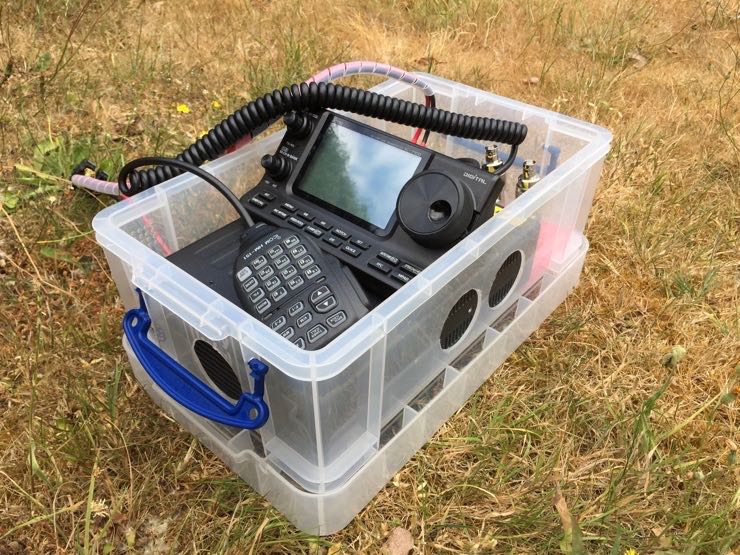
How does this work? Users can purchase most of the materials at local markets. A small transmitter is built into a waterproof bucket with a fan, a charge-controller and a smartphone, which is connected to an antenna and a solar panel.
The radio stations are really small and can serve a village or a couple of villages reaching to 10,000 listeners. The content produced by the radio hosts lives in the cloud so stations are able to share content with other stations.[…]
From the Isle of Music, April 22-28:
Our celebration of Jazz Appreciation Month continues with special guest Michel Herrera, an important young saxophonist/composer/bandleader/producer, who will converse with us about his newest recording and the newest generation of Jazz musicians in Cuba. We will also listen to some of his excellent music.
Four opportunities to listen on shortwave:
1. For Eastern Europe but audible well beyond the target area in most of the Eastern Hemisphere (including parts of East Asia and Oceania) with 100Kw, Sunday 1500-1600 UTC on SpaceLine, 9400 KHz, from Kostinbrod, Bulgaria (1800-1900 MSK)
2. For the Americas and parts of Europe, Tuesday 0000-0100 UTC on WBCQ, 7490 KHz from Monticello, ME, USA (Monday 8-9PM EST in the US). This has been audible in parts of NW, Central and Southern Europe with an excellent skip to Italy recently.
3 & 4. For Europe and sometimes beyond, Tuesday 1900-2000 UTC and Saturday 1200-1300 UTC on Channel 292, 6070 KHz from Rohrbach, Germany. In recent weeks, the Tuesday night transmission has been heard well in the UK and in Western Russia along with a VERY long skip to parts of New Zealand….
Uncle Bill’s Melting Pot, Sunday, April 22, 2018:
We are fond of telling people that UBMP covers Afghanistan to Zimbabwe, and Episode 59 proves it – we’re off to Afghanistan!
Afghanistan is a collage of several ethnic groups, and some of the music may surprise you.
Sundays 2200-2230 UTC (6:00PM -6:30PM Eastern US) on
WBCQ The Planet 7490 KHz shortwave from the US to the Americas and parts of Europe
In recent weeks the signal has had a nice bounce to Spain, Italy and Switzerland as well as Iceland, Ireland and parts of the UK. Also audible in Brasil, Paraguay and points North. Starting May 1, UBMP will be adding a Tuesday night transmission on Channel 292, 6070 Khz from 2000-2030 UTC.
Many thanks to SWLing Post contributor, Gary DeBock, who shares the following notes from his Cook Islands Ultralight DXpedition:
Cook Islands (Aitutaki) Ultralight DXpedition from April 8-13
A gorgeous environment, with thrilling long range DX! Ruth and I took this trip as the 38th anniversary of out first meeting at Victoria Peak in Hong Kong (April 10, 1980).
DXing highlights were the reception of 693-Bangladesh, 918-Cambodia and 1431-Mongolia on the 7.5 inch loopstick C.Crane Skywave SSB Ultralight and 5 inch “Frequent Flyer” FSL antenna (designed to provide inductive coupling gain equal to that of a 4 foot air core box loop, but in a much more compact size).
693-Bangladesh 1652 UTC April 10 (mention of Bangladesh at 8 second point; thanks to Chuck Hutton for listening):
Location: Tamanu Beach Resort ocean shore, Aitutaki, Cook Islands (in the South Pacific)
Amazing catches, Gary–thank you for sharing! It seems your modified CC Skywave SSB is serving you well. Looks like you were chasing amazing DX from an amazing part of our planet!
On April 18, consider setting your scanner or handheld VHF radio to 145.80 MHz around 15:57 UTC; you may be able to hear the downlink from the International Space Station. The Amateur Radio on the International Space Station (ARISS) contact will be between between NA1SS (on the ISS) and KD2IFR at a school in Central Islip, NY.
As long as you’re within the ISS’ signal footprint (which is rather large) you should be able to easily hear NA1SS’ side of the conversation. I’ve listened to the downlink in the past using an Icom ID-51a and the super compact Yaesu VX-3R:
The frequency of the downlink will be 145.80 MHz. As the ISS climbs above your horizon, because of doppler-shift, listen on 145.805, then move to 145.80 as the ISS approaches zenith and finally move to 145.795 MHz as the ISS drops toward the other horizon. As we’ve mentioned in past posts, you’ll know when to switch frequency when the audio gets bad.
Upcoming ARISS contact with Central Islip Union Free School District, Central Islip, NY
An International Space Station school contact has been planned with participants at Central Islip Union Free School District, Central Islip, NY on 18 April.
The event is scheduled to begin at approximately 15:57 UTC. The duration of the contact is approximately 9 minutes and 30 seconds.
The contact will be direct between NA1SS and KD2IFR. The contact should be audible over the state of New York and adjacent areas. Interested parties are invited to listen in on the 145.80 MHz downlink. The contact is expected to be conducted in English.
Welcome to the Central Islip Union Free School District – Home of the Musketeers and a proud Suffolk County, New York school system, where approximately 8,000 students in grades Pre-Kindergarten through 12 receive their formal education. Our School District’s motto is Children Our Future ~ Diversity Our Strength. The Central Islip Union Free School District is comprised of eight schools: one district-wide early childhood center, four elementary schools, two middle schools and a high school.
The Hamlet of Central Islip is a vibrant, culturally-diverse community. A suburban community with urban demographics. We are a positive and progressive school district whose teachers are dedicated to helping students achieve their maximum potential and to develop academically and socially. Our district offers an array of afterschool activities including sports, music, theatre arts and much more.
Participants will ask as many of the following questions as time allows:
1. What are the challenges of spending so many months constantly around the same people?
2. What is the best way to describe the feeling of zero gravity?
3. Have you experienced anything unexpected while in space that could not be explained?
4. Have you experienced any significant changes, either physically or emotionally, since being in space?
5. What type of robots do you use on the ISS and how are they helpful?
6. What is your advice for young people who want to become involved in programs at NASA?
7. What is the biggest challenge about being on a long duration space mission?
8. How does digestion in microgravity compare to digestion on Earth?
9. Have you experienced anything in space that has made you change your perspective on life?
10. Are there any plants aboard the ISS and if so, what’s different about how they meet their daily requirements?
11. What are the long term effects of reduced leg muscle use in long duration space travel?
12. Is your circadian rhythm affected by multiple sunrises and sunsets each 24 hour period, perhaps making it difficult to sleep for long periods of time?
13. Can you describe the types of training that prepared you for this mission?
14. Can you catch a cold on the Space Station?
15. Do the properties of light appear to be different in space?
16. Are there differences in how your body responds to physical exertion while in microgravity?
17. Would it be possible to transmit a mechanical wave on a rope onboard the space station or outside the station?
18. What are the hardest tasks to perform in space that are routine on Earth?
19. Could you blow a bigger than normal gum bubble in space?
20. Are there precautions that you take BEFORE going into space that can help to prevent bone weakness when you return?
PLEASE CHECK THE FOLLOWING FOR MORE INFORMATION ON ARISS UPDATES:
Visit ARISS on Facebook. We can be found at Amateur Radio on the International Space Station (ARISS).
To receive our Twitter updates, follow @ARISS_status
Next planned event(s):
1. King’s High School, Warwick, UK, direct via GB4KHS
The ISS callsign is presently scheduled to be OR4ISS
The scheduled astronaut is Ricky Arnold KE5DAU
Contact is a go for: Thu 2018-04-19 12:05 UTC
2. Russian school TBD
The ISS callsign is presently scheduled to be RS?ISS
The scheduled astronaut is Alexander Skvortsov
Contact is a go for Tue 2018-04-24 11:05 UTC
3. Russian school TBD
The ISS callsign is presently scheduled to be RS?ISS
The scheduled astronaut is Alexander Skvortsov
Contact is a go for 2018-04-25 08:35 UTC
About ARISS:
Amateur Radio on the International Space Station (ARISS) is a cooperative venture of international amateur radio societies and the space agencies that support the International Space Station (ISS). In the United States, sponsors are the Radio Amateur Satellite Corporation (AMSAT), the American Radio Relay League (ARRL), the Center for the Advancement of Science in Space (CASIS) and National Aeronautics and Space Administration (NASA).
The primary goal of ARISS is to promote exploration of science, technology, engineering, and mathematics (STEM) topics by organizing scheduled contacts via amateur radio between crew members aboard the ISS and students in classrooms or informal education venues. With the help of experienced amateur radio volunteers, ISS crews speak directly with large audiences in a variety of public forums. Before and during these radio contacts, students, teachers, parents, and communities learn about space, space technologies, and amateur radio.
Radio receiver ‘listens’ for dark matter particles
Researchers have developed a way to “listen” for the signs of dark matter axions, the particles that may make up dark matter.
Forty years ago, scientists theorized a new kind of low-mass particle that could solve one of the enduring mysteries of nature: what dark matter is made of. Now a new chapter in the search for that particle has begun.
The Axion Dark Matter Experiment (ADMX) is the world’s first and only experiment to have achieved the necessary sensitivity to “hear” the telltale signs of dark matter axions.[…]
Many thanks to SWLing Post contributor, David Iurescia (LW4DAF), who shares the following news from Radio Slovakia International:
RSI addressed by President
On Thursday, RSI celebrated 25 years of its existence at a special event. Besides welcoming the newly appointed Culture Minister ?ubica Laššáková, the Education Minister Martina Lubyová, the US Ambassador Adam Sterling, the Russian Ambassador Alexej Fedotov, other diplomats and representatives of RTVS, the editorial team was also addressed by the Slovak President Andrej Kiska.
At the beginning of his video speech, Andrej Kiska congratulated the team on their 25 years of broadcasting abroad. He underscored the role of public service radio at a time when there is an array of questionable and doubtful sources of information. “A public service radio which is – quite rightly – subject to public control; which verifies the sources of its information. A public radio whose editorial team can be sure of their information.” Said the President, adding that the issue of freedom of speech and its limits is a big subject of debate globally. “But it is also a key factor because … it is not only those of our citizens who may find themselves for a certain time outside Slovakia’s borders, who live or work abroad, who deserve verified and truthful information. Our fellow Slovaks living abroad also deserve it. And in fact everyone who takes an interest in what is happening in Slovakia or Central Europe and wants to find out more deserves it”, concluded Andrej Kiska.
On the occasion of the 25 years since the launch of the independent foreign broadcast by the public Slovak Radio, Radio Slovakia International was also addressed by the Foreign Minister Miroslav Laj?ák: ” 37 years ago, Music TV aired the hit “Video kills the radio stars”. I am very happy today that this black vision has not come true and radio was, is and will be.” The Foreign Minister continued with a remark on the important anniversaries to be remembered in 2018. To the centenary of the former Czechoslovakia, 50 years since the Prague spring and 25 years of an independent Slovak Republic, Miroslav Laj?ák added 25 years of the Slovak Radio foreign service.
According to the the RTVS General Director, Jaroslav Rezník, broadcasting abroad should be part of the fully-fledged portfolio of every public media. Back in 1993, Radio Slovakia International informed about the establishment of the new country, later on about its transformation and success story. Today, RSI represents the primary source of relevant information about Slovakia on the internet, too. In his speech given on the occasion of its 25th birthday, Jaroslav Rezník called RSI the media foreign affairs ministry. “I am very happy that today I can meet people who were at the beginning as well as those who today are preparing broadcasts not only for RSI but also for the Slovak Radio as a proud and patriotic company”, said the current RTVS General Director.