Tag Archives: David Iurescia (LW4DAF)

World Radio Day 2018: Radio Romania International seeks listener input

(Source: Radio Romania International via David Iurescia, LW4DAF)

February 13 is a day to celebrate radio, to improve international cooperation between broadcasters and to encourage major networks and community radios to promote access to information, freedom of expression and gender equality over the airwaves. The theme of World Radio Day this year is “Radio and Sports”.

As we look forward to a year of momentous sporting events, events that have the ability to unite the hearts and minds of people everywhere, UNESCO calls on all radio stations around the world to showcase the beauty of sports in all of its diversity.

Radio Romania invites you to bring your contribution to our World Radio Day show by telling us what sports topics you would prefer hearing about in our programmes.

World Radio Day, celebrated on 13 February, marks the anniversary of the first broadcast by UN Radio in 1946, when it transmitted its first call sign: “This is the United Nations calling the peoples of the world.”

World Radio Day seeks to raise awareness about the importance of radio, facilitate access to information through radio, and enhance networking among broadcasters.

To celebrate World Radio Day, we invite you, dear listeners and Internet users, to send us short messages, by email, at [email protected]

Click here to view this post on RRI’s website.

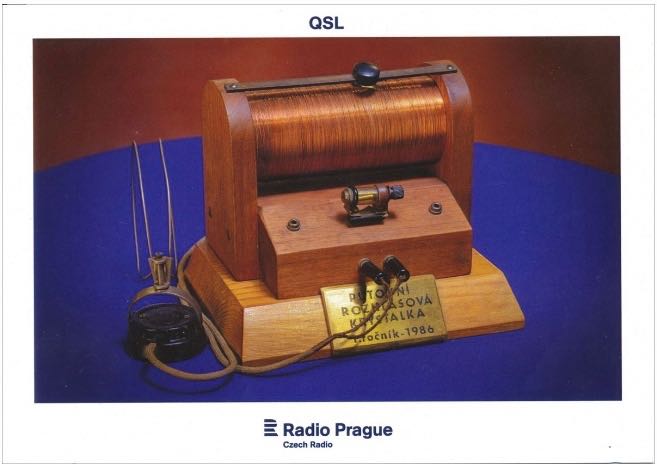
Radio Prague reveals 2018 QSL card gallery

Many thanks to SWLing Post contributor, David Iurescia (LW4DAF), who shares this news from Radio Prague:

The three letters – QSL – constitute one of the codes originally developed in the days of the telegraph. All codes consisted of three letters beginning with “Q”. Later some of these “Q” codes were adopted by radio-telegraphists and radio listeners. QSL means “contact confirmed” or “reception confirmed”.

The expression “QSL card” or just “QSL” gradually came to be used among radio-amateurs and then more broadly as radio began to develop as a mass medium. Radio stations were keen to know how well and how far away their programmes could be heard and began to send their listeners “QSL cards” in return for reception reports. The card would include letters making up the “call sign” of the station – the system still used in the United States – or the broadcasting company’s logo or some other illustration. The card would also include a text stating the frequency and the transmitter output power, and a confirmation of when the listener heard the station.

Domestic broadcasters do not tend to use QSL cards these days, but their popularity remains among radio stations broadcasting internationally. They are still keen to know how well they can be heard in the parts of the world to which they broadcast. In the era of shortwave broadcasts Radio Prague sent out QSL cards for reception reports received. After curtailing our shortwave transmissions as of February 1, 2011 we will continue issuing QSL cards for reception via the Internet.

Click here to read this article and view the new QSL card gallery at Radio Prague.

2017 RRI Personality of the year poll

Many thanks to SWLing Post contributor, David Iurescia (LW4DAF), who shares this news from radio Romania International:

Dear friends, RRI continues its traditional polling of listeners on short wave, the Internet and social media, with a new challenge.

We would like to ask you which personality you think left their imprint on the world, in a positive way, in 2017.

We are preparing to designate, based on your options, “The Personality of the Year 2017 on RRI”.

Will this person be a politician, an opinion leader, a businessman, an athlete, an artist, a scientist, or even a regular person with a special story? It’s up to you to decide! We would also want to ask you why you picked that particular person.

You can send your answers, as usual, by commenting on our website, at rri.ro, by e-mail at [email protected], on our Facebook, Google+, Twitter and LinkedIn profiles, by fax at 00.40.21.319.05.62, or by post, at 60-64, General Berthelot street, sector 1, Bucharest, area code 010165 (PO Box 111), Romania.

Click here to read at RRI.

Radio Romania International launches a weekly “experimental” show in Hebrew

Many thanks to SWLing Post contributor, David Iurescia (LW4DAF), who writes:

Radio Romania Internationas has started a new service every Sunday in Hebrew language, since October, 29th. All the info here:

http://www.rri.ro/pages/october_29_2017_update-2571263

“As of Sunday, October 29, RRI broadcasts a weekly, experimental show in Hebrew, devoted to Jews born in Romania and their families, but also to all Hebrew speakers who are interested in learning about Romania. The show will be broadcast every Sunday, from 7:05 pm to 8 pm Romania’s time, on short waves and via the internet. Also, contents in Hebrew will be available on RRI’s web site, Android and iOS applications, on Facebook, Twitter and SoundCloud. RRI boast a rich experience in producing shows devoted to the hundreds of thousand of Jews originating from Romania, who since 1990 have had the opportunity to listen to a show in the Romanian language. Their descendants, now at the third generation after Aliyah, the immigration of Jews from the Diaspora to the Land of Israel, speak Hebrew and their ties with their parents’ and grandparents’ birth country should be developed and maintained, including with the help of RRI.”

Wow! Thank you for the tip, David! I’m simply amazed at the amount of content Radio Romania International produces.  Certainly one of my favorite shortwave broadcasters.

Radio Romania International celebrates 89 years of broadcasting

(Source: Radio Romania International via David Iurescia, LW4DAF)

Ten years after WWI and the unification of Greater Romania, the most efficient and popular means of communication was first introduced in Romania: the radio. On November 1, 1928, the newly founded Romanian Radio Broadcasting Corporation aired its first broadcast. From the very beginning the radio was described as a means of public information, education and entertainment.

This year Radio Romania celebrates 89 years of continuous radio broadcasting. Despite having to constantly adapt its editorial policies, the public radio survived each radical change on the political spectrum, from the interwar democracy to right-wing dictatorships around the Second World War, and from the communist dictatorship to the democracy restored after the anti-communist revolution of 1989. For years now the Romanian Radio Broadcasting Corporation has been considered one of the most trustworthy and reputed media institutions in Romania, due to its large number of listeners.

Radio Romania addresses all generations and caters for all tastes, addressing society as a whole. It consists of channels with nationwide coverage, Radio Romania News and Current Affairs, Radio Romania Culture, Radio Romania Music and the Village Antenna, as well as regional and local studios, Internet platforms and a children’s and youth station. The Romanian public radio has started broadcasting abroad ever since the 1930s.

Today, Radio Romania International tries to keeps both international audiences and Romanians living abroad up to date with news from Romania and our traditional values. RRI broadcasts in 11 languages: Arabic, Chinese, English, French, German, Italian, Serbian, Spanish, Russia, Ukrainian and starting this year, Hebrew, as well as in Romanian and the Aromanian dialect. Its target audience virtually includes the entire world, from Alaska to Australia, from Argentina to the Russian Far East.

Nearly nine decades since its first broadcast, Radio Romania continues to innovate, to reinvent itself and to adapt to the ever-increasing market competitiveness and legislative changes. One such change was the recent scrappage of the radio license fee, traditionally covered by taxpayers, which now means the institution is fully funded by the state, amidst criticism from the political, civil and journalistic fields over editorial interference.

Similarly, other voices from outside or within the institution have over the years signaled controversial managerial practices of successive administrations. Thanks to its professionals, however, Radio Romania remains the leading media institution in the country to date. (translated by Vlad Palcu)

Click here to read this article at Radio Romania International.

Changes to Radio Exterior de España shortwave frequencies

Many thanks to SWLing Post contributor, David Iurescia (LW4DAF), who notes that Radio Exterior de España’s has announced winter frequency changes on their website.

David passed along an English (Google) translation of the REE notice:


Due to the winter time change, from October 29, Radio Exterior of Spain changes its emission frequencies in Short Wave.

From Monday to Friday, between 19 and 23 hours, universal time coordinated, Radio Exterior of Spain will offer its emissions in 11,685 kilohertz for West Africa and the South Atlantic. At 15,390 kilohertz for South America and the Pacific Ocean. At 9,690 kilohertz for North America and Greenland. And at 15,500 kilohertz for the Indian Ocean, Middle East and Great Sun.

On weekends, for West Africa and the South Atlantic, between 15 and 19 hours, universal time coordinated, at 17,755 kilohertz; and between 19 and 23 hours at 11,685 kilohertz.

On Saturdays and Sundays, between 15 and 23 hours, at 15,390 kilohertz for South America and the Pacific Oceans; at 9,690 kilohertz for North America and Greenland; and 15,500 kilohertz for the Indian Ocean, Middle East and Great Sun.

These are the frequency changes of the Spanish Foreign Radio Broadcast Wave emissions that will come into effect on October 30 due to the time shift to the winter.

Radio Exterior of Spain can be followed through satellite radio in all parts of the planet 24 hours a day uninterruptedly:

SES Astra 1M: frequency 11,626.5 MHz. Vertical polarization.
Hispasat 30W-5: frequency 12,015 Mhz. Vertical polarization.
Asiasat 5: frequency 3,960 Mhz. Horizontal polarization.
Eutelsat 5 West A: frequency 3,727 Mhz. Circular polarization.
Intelsat Galaxy 23: Frequency 4,191.35 Mhz. Vertical polarization.
Radio Exterior of Spain is heard on the Internet, in streaming or in the podcast of all its programming.

There are also mobile applications (link for Apple app or Android) for mobile applications, such as phones and tablets. And from any municipality and province of Spain you can enjoy, through television, Radio Exterior of Spain by DTT.

Click here to read the original notice in Spanish.

Thanks for the tip, David!

Radio Romania International: 2017 Listener’s Day

Many thanks to SWLing Post contributor, David Iurescia (LW4DAF), who shares the following from Radio Romania International:

(Source: Radio Romania International)

2017 Listener’s Day on RRI

You are invited to take part in our 2017 edition of Listener’s Day on RRI, a show devoted entirely to you, our listeners

Dear friends,

Sunday, November 5, 2017, we will be airing our annual show “Listener’s Day on Radio Romania International”. As usual, we will be happy to take your contributions which will form the basis of our show. Our topic for this year is fake news and confidence in mass-media.

The last few years have seen a sharp drop in public trust in the media. This development has, to a certain extent, been affecting the press, radio and television, both in the private and public sectors. From the media’s ingressions in politics and the economy to sensationalizing the news and the consumerist rush to control the audience, the reasons behind this waning public confidence are diverse. They often include error-filled reporting and more often than not reflect people’s reliance on social media as a source of information. The latter are in most cases ridden with fake news, a phenomenon very widespread across social networks, whose general purpose is to manipulate public opinion.

So, this year on “Listener’s Day” we are asking you “How much confidence do you have in the media?”

We look forward to receiving your contributions, whether in writing (by e-mail, on Facebook, through the form on the RRI website, or by fax or post) or in audio format (if you agree, we can call to record your contributions). Our contact details are, as always: Radio Romania International, 60-64 General Berthelot, sector 1, Bucharest, PO Box 111, post code 010165, fax 00.40.21.319.05.62, e-mail [email protected]. Our web page is at www.rri.ro.
Hope to hear from you soon!