Shortwave listening and everything radio including reviews, broadcasting, ham radio, field operation, DXing, maker kits, travel, emergency gear, events, and more
Many thanks to SWLing Post contributor Don Moore–noted author, traveler, and DXer–who shares the following post:
Two Portable Antennas for Remote DXing (Part Two)
By Don Moore
Don’s traveling DX stories can be found in his book Tales of a Vagabond DXer[SWLing Post affiliate link].If you’ve already read his book and enjoyed it, do Don a favor and leave a review on Amazon.
In my initial comparison of the PA0RDT mini-whip and the MLA-30+ MegaLoop, the mini-whip performed best on medium wave and the lower shortwave bands, while the loop worked better on the higher bands. But, I wondered, why should the MLA-30+ be restricted to that small steel loop? The wire loops I use with my Wellbrook ALA-100LN typically range from twenty to fifty meters in circumference.
I threw a twenty-five-meter wire over a tree branch and formed it into a delta with the MLA-30+ in the bottom center. Remember, I was testing in the northern Chicago suburbs. My SDRs were completely overloaded. Medium wave was useless and I had strong MW stations all over the shortwave bands. The MLA-30+ doesn’t have the same strong-signal handling capabilities as the Wellbrook. And there are a lot of strong medium wave signals in the Chicago suburbs.
So I took that wire down and replaced it with a loop of twelve meters circumference.
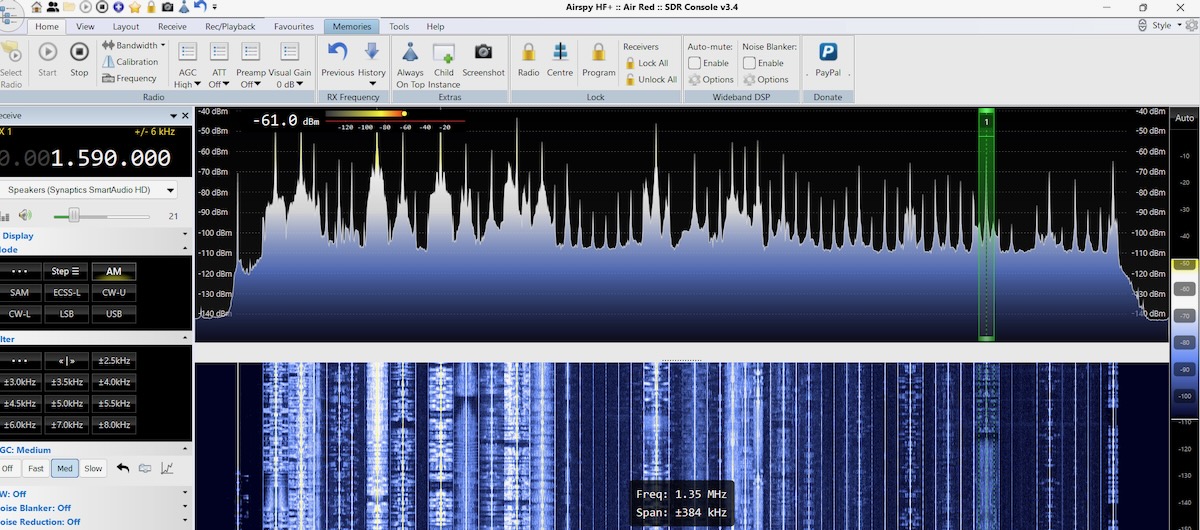
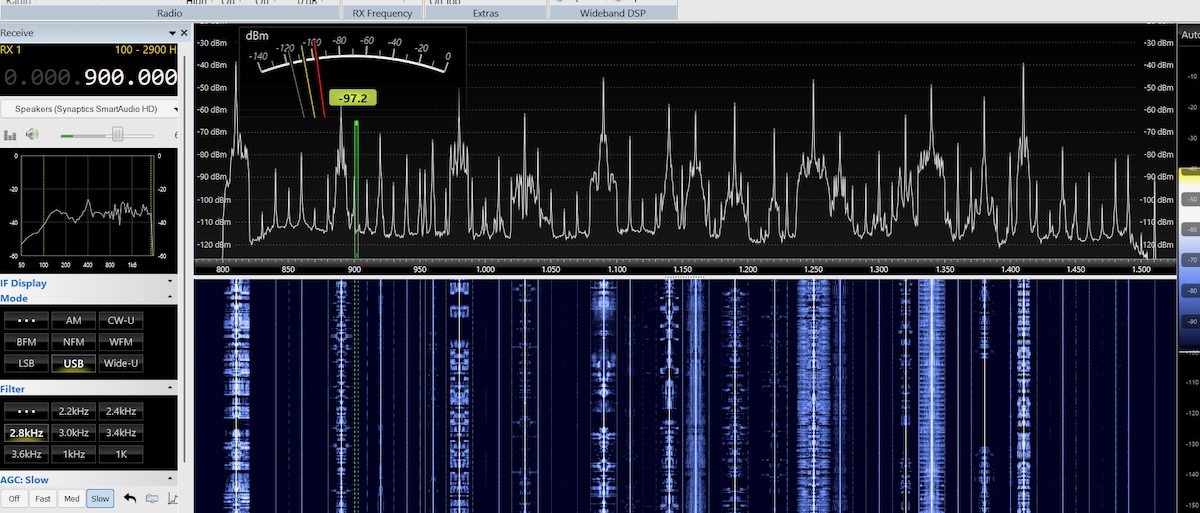
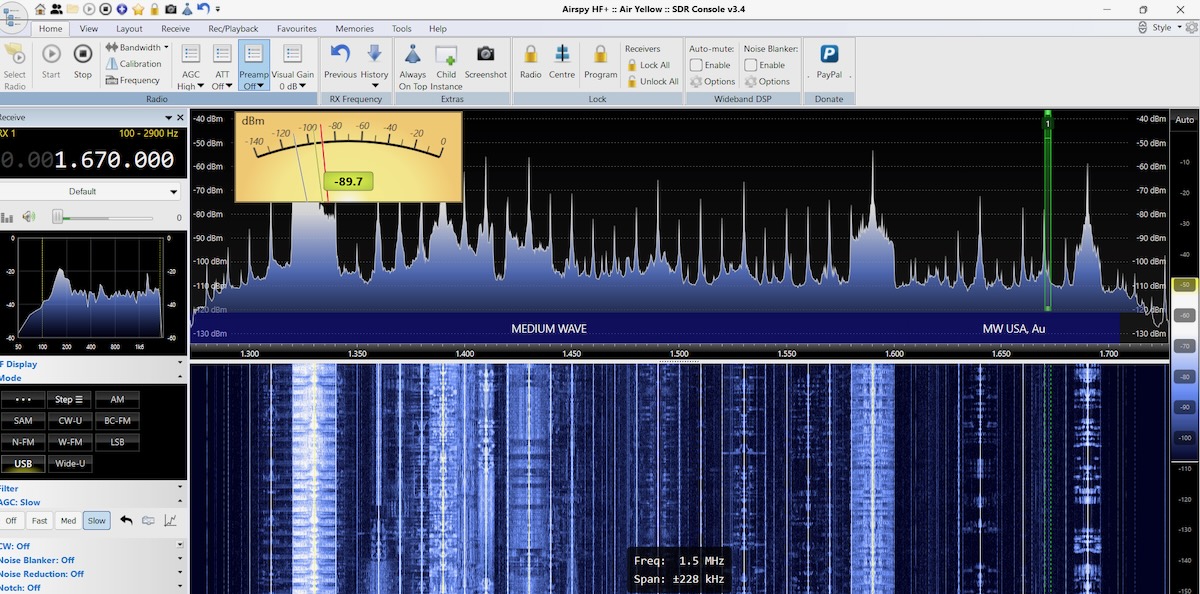
That did the trick. I had lots of signals on medium wave without the overloading. Here’s what the upper end of the MW band now looked like with the MLA-30+.
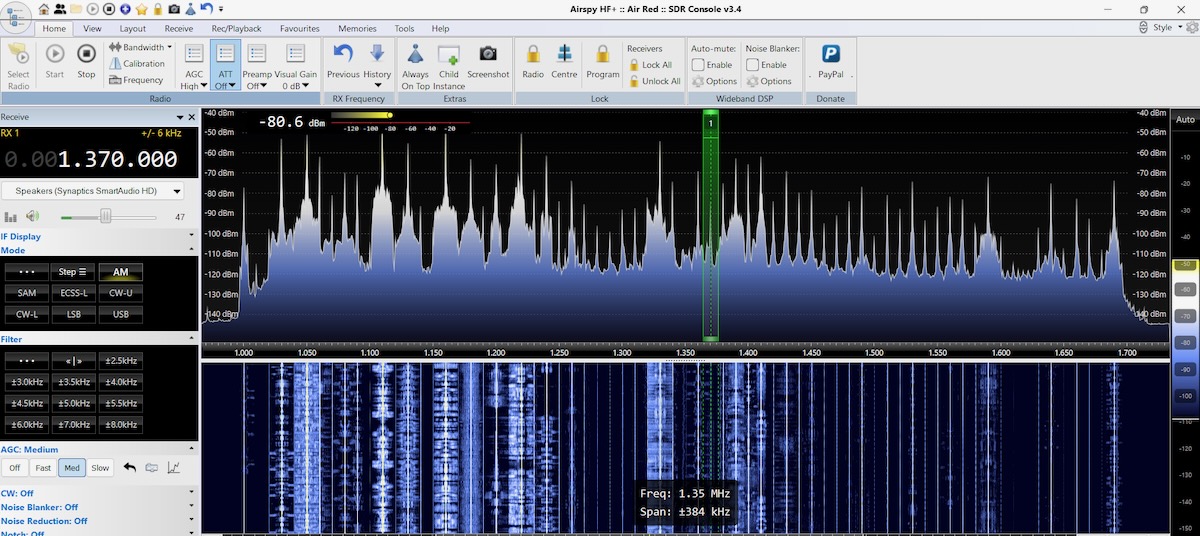
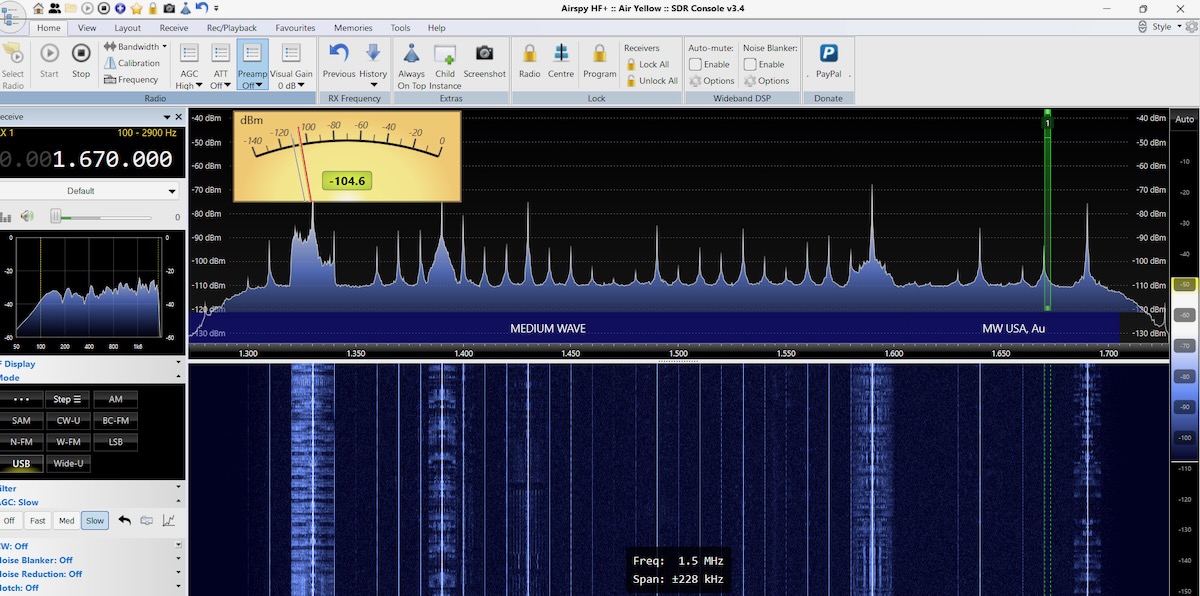
For comparison, here’s the same wire loop using the Wellbrook ALA-100LN. The Wellbrook has a slightly lower noise floor but otherwise the signals are about the same.
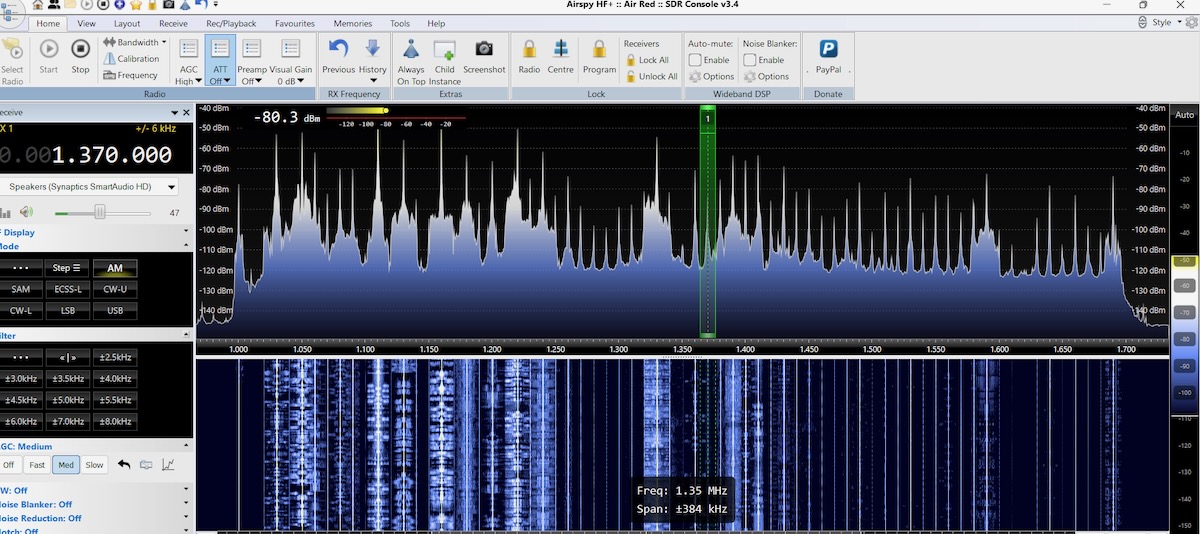
Out of curiosity, I replaced the Wellbrook power unit with the Bias-T from the MLA-30+ but left the Wellbrook antenna head unit in place. With this hybrid setup there’s no visible difference with the full Wellbrook.
I was satisfied with my findings but I still wondered how much wire the MLA-30+ could handle. A few weeks later I ran some more tests in Kansas, where I knew the dial wouldn’t be as crowded. The MLA-30+ easily handled a 25-meter delta loop without overloading.
Two weeks after doing the Kansas tests I was at a DXpedition in rural western Pennsylvania. The MLA-30+ worked fine with a 40-meter circumference loop, other than being a tad noisier than the Wellbrook with the same wire. So how much wire you can use with the MLA-30+ components depends on how strong your local medium wave stations are.
Findings
From the SDR images above it would be easy to conclude that with the right length of wire an MLA-30+ is just as good as a Wellbrook ALA-100LN even though it is significantly cheaper. But that’s not the full picture. Back in the 1990s my Drake R-8 cost about three times what my Sony ICF-2010 did. All other things being equal, I would say that 95% of the DX heard on the Drake could have been heard equally well on the Sony. I wanted the Drake for the other five percent.
I have no doubt that if I did a very careful head-to-head comparison of the two units under serious DX conditions on the same wire that the Wellbrook would get things the MLA-30+ couldn’t. But I suspect the difference would be around that five percent mark. I’m willing to accept that tradeoff for an effective cheap light-weight travel antenna. And the MLA-30+ is like having two antennas in one. I can use it with the steel loop in limited space situations or with a larger wire loop when I have access to some garden space with a tree. Together, the MLA-30+ and the PA0RDT make the perfect DX travel antennas.
The only thing I didn’t like about the MLA-30+ was that pre-attached coax cable. It’s not the best quality and I’d rather carry my own cable. I’m not very handy with a soldering iron in tight spaces but at our recent DXpedition my friend Bill Nollman replaced the coax with a BNC jack for me.
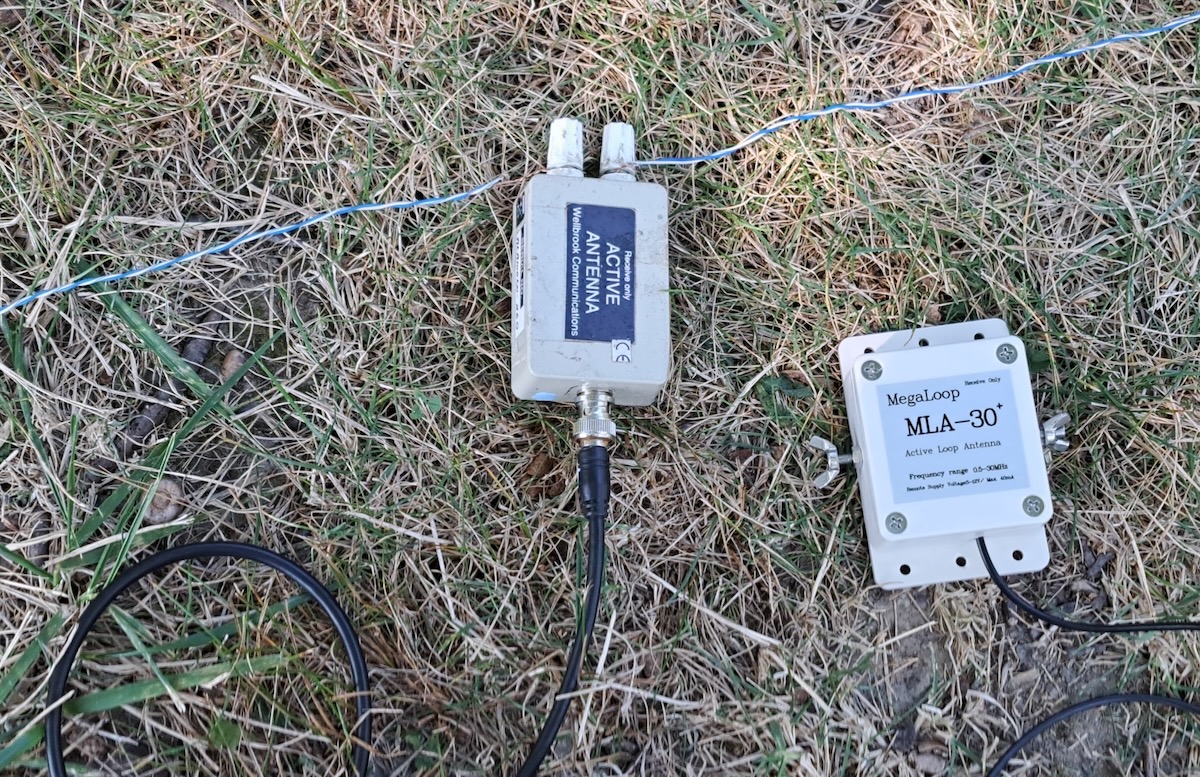
The MLA-30+ now looks like this when connected to a wire loop.
Finally, I should address powering the MLA-30+ via USB. While it can be connected to a spare USB port on your laptop, I found doing that sometimes introduced a tad more noise. Instead I’ve been using one of those battery packs used for recharging cellphones. Mine is rated at 6700 mAh and it can power the MLA-30+ for over 48 hours before needing a recharge. But be sure to test yours before doing any serious DXing. I’ve read that some power packs have a minimum required power draw and will automatically shut off if the draw is too low.
Another Option?
While I was finishing this article I heard about another option from my friend Guy Atkins. This antenna is a combination of the YouLoop with a low-priced Chinese made clone of the LZ1AQ amplifier. Some users say it’s better than the MLA-30+. Guy says it works well on shortwave up to 16 meters but he hasn’t tried it on medium wave. Guy says it’s a “low price, good value” antenna. I’m traveling in Southeast Asia for the winter but will definitely have to try this antenna when I get back to the USA. So maybe there will be a follow-up article next summer.
Links
[Note: Amazon links are affiliate and support the SWLing Post at no cost to you.]
Info on ordering a quality PA0RDT from Roelof Bakker. (Other cheaper versions have had issues with quality control.)
Many thanks to SWLing Post contributor Don Moore–noted author, traveler, and DXer–who shares the following post:
Two Portable Antennas for Remote DXing (Part One)
By Don Moore
Don’s traveling DX stories can be found in his book Tales of a Vagabond DXer[SWLing Post affiliate link].If you’ve already read his book and enjoyed it, do Don a favor and leave a review on Amazon.
Once upon a time, I had a traditional DX shack with an L-shaped desk and shelves of receivers, radio gadgets, and DX books. Everything I wanted or needed as a DXer was right at hand. Then I retired and was finally able to pursue my lifelong itch for serious travel. But there was no way to carry that DX shack along with me. Fortunately, modern technology was there to help. SDRs are significantly more travel-friendly than my old Sony ICF-2010 (let alone the Drake R-8). Instead of books and bulletins, my DX reference materials are websites and PDF files on my laptop.
I spend several months a year traveling internationally with just a suitcase and knapsack. That doesn’t leave much room for DX equipment. Several years ago I described my approach to vagabond DXing in an article here.
Since writing that article in 2019, I’ve continued to work on making my portable DX shack better and more compact. Recently, I replaced the Elad FDM-S2 with three Airspy HF+ Discovery SDRs. Not only are they smaller and lighter, but I can record three different band segments at once. Next up was rethinking my travel antennas. A wire loop with the Wellbrook ALA-100LN is still, in my opinion, the best travel antenna. But the components are heavy and are now irreplaceable since they are no longer made. So over the summer, I set about testing and comparing both old and new options. But you don’t have to wander the globe for my findings to be useful to you. This can be just as helpful for DXing from a nearby park. That’s how I did my testing.
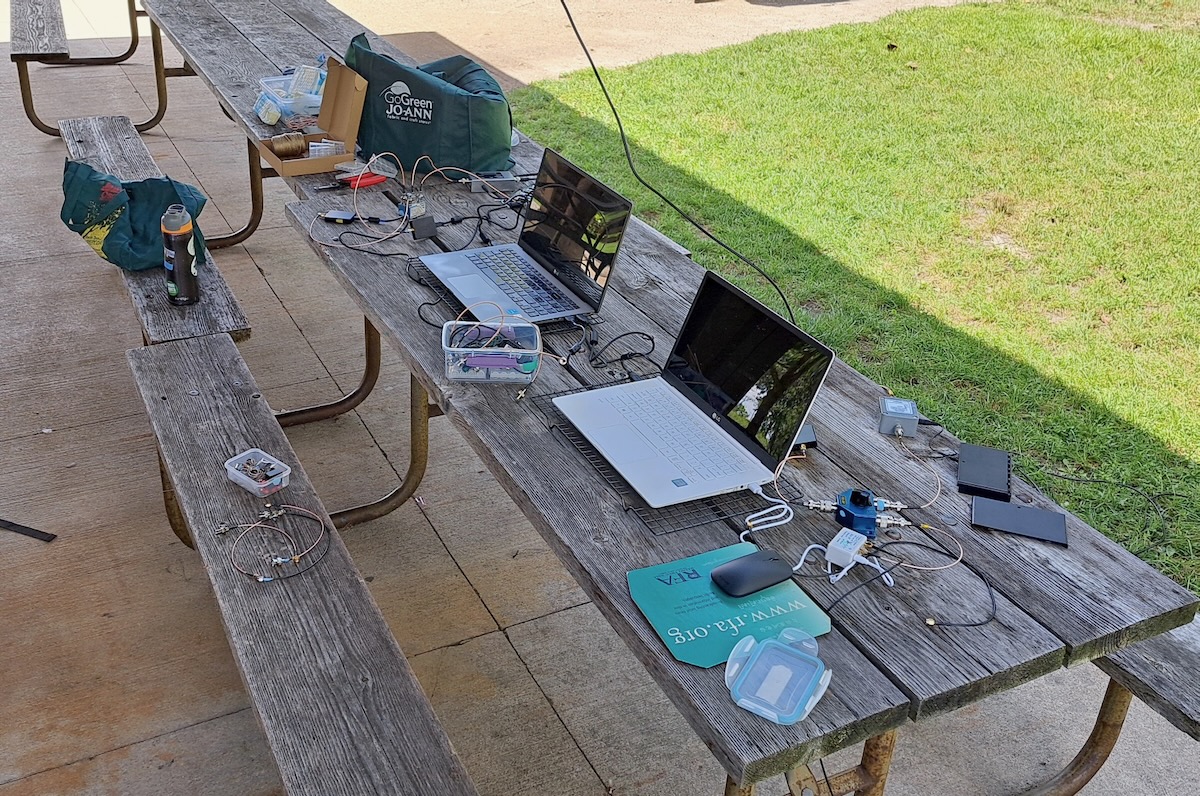
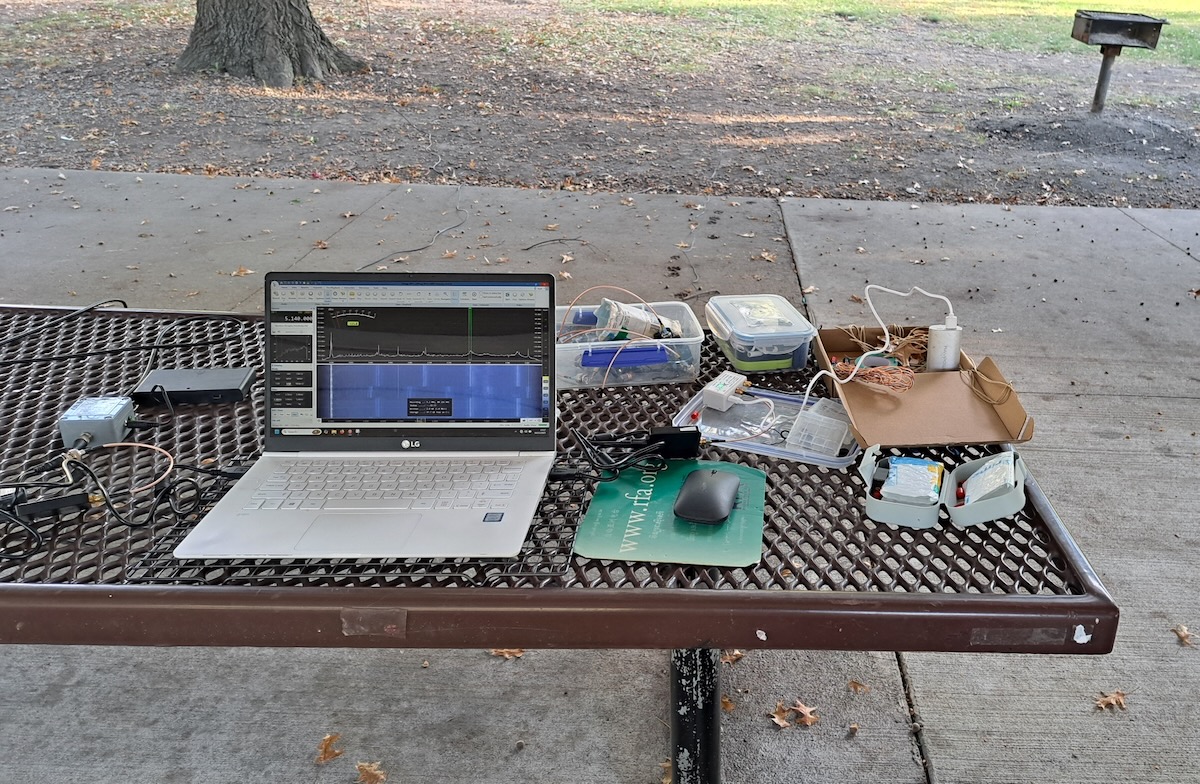
I spent the past summer staying at an AirBnB in the north Chicago suburbs. I wanted a better location for testing so I checked out parks in the area and finally settled on Preserve Shelter B (42.26797, -87.92208) at the Old School Forest Preserve, east of Libertyville in northern Illinois. The shelter was entirely wood, with standard asphalt shingles (rather than steel), and had no nearby power lines. I made four daytime DXpeditions there to do some utility DXing and to run my tests. Here’s a photo of my setup.
I decided I should rerun the tests at least one other location. So while driving across the US in mid-October, I stopped for a few hours one morning at Park Shelter A (39.11144, -94.86629) in Wyandotte County Park, just west of Kansas City, Kansas. There, I just had a minimum setup.
The Antennas
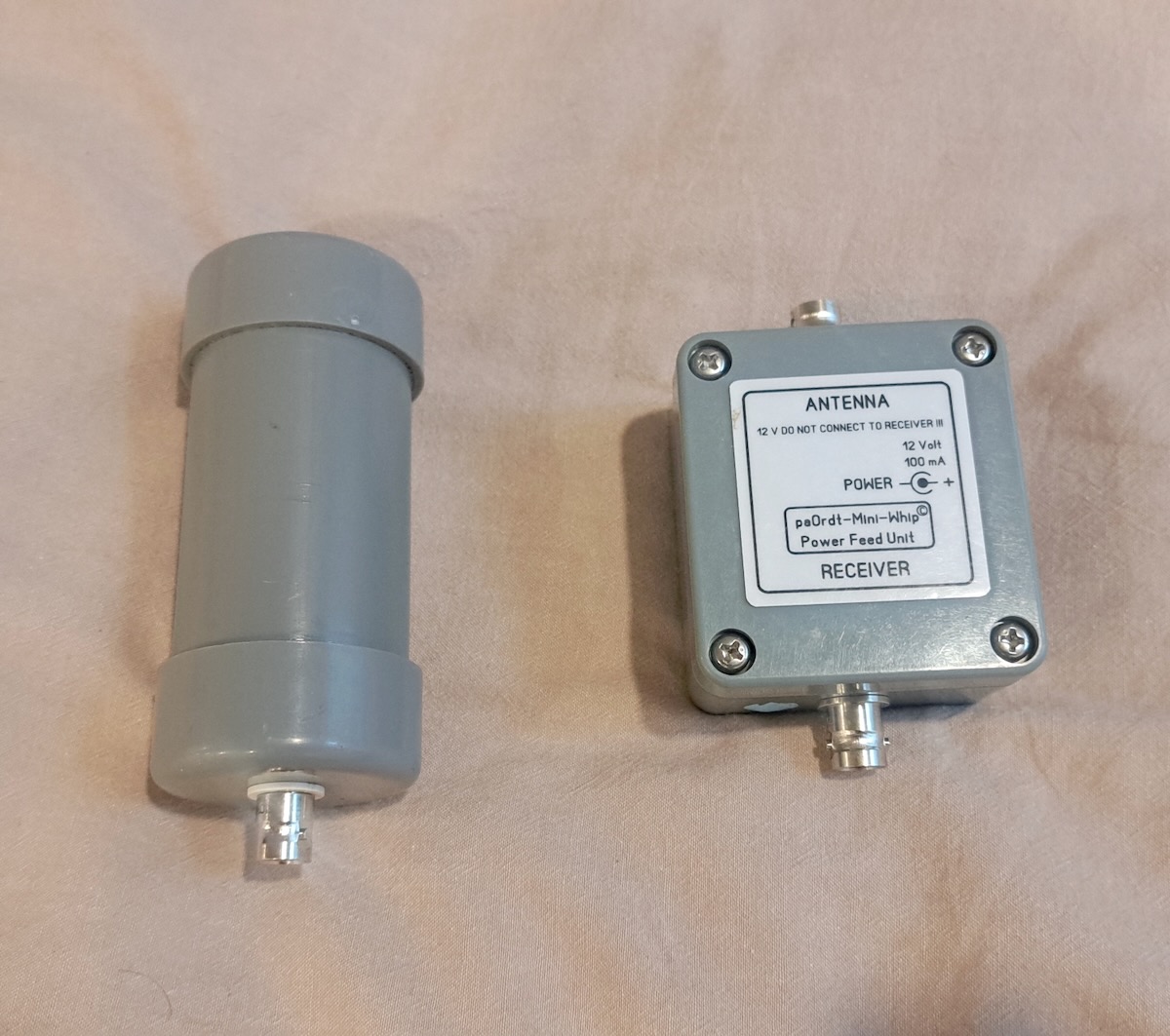
So, what were the antennas I was testing? The first was the tried-and-true PA0RDT mini-whip from Roelof Bakker. The PA0RDT is described in my 2019 article and is probably the most portable quality antenna you can get. To power it I use a battery box and eight rechargeable lithium-ion AA cells.
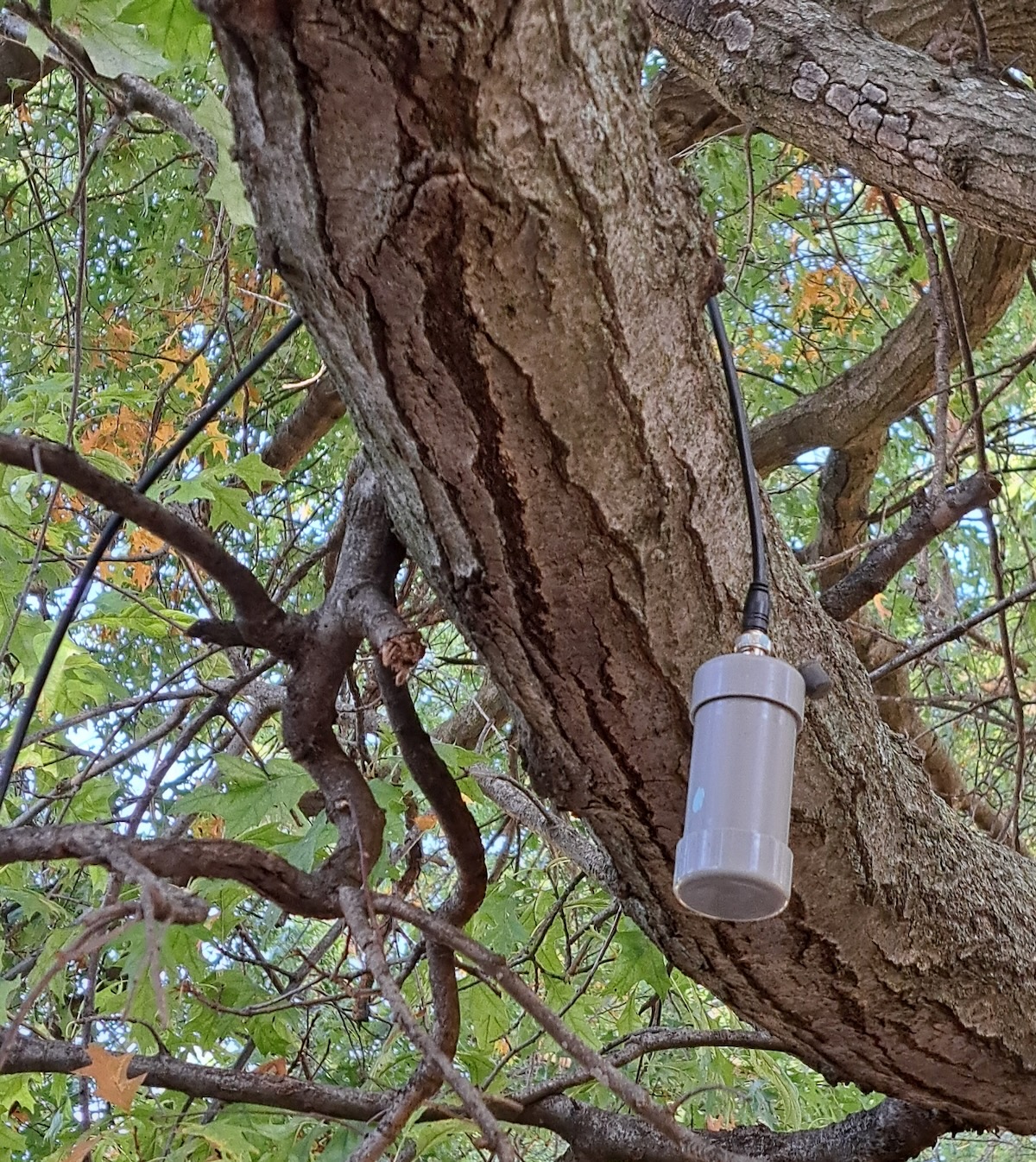
For the traveling DXer, setting up the PA0RDT is as easy as it comes. I just attach the coax cable and throw it over a support, such as a picnic shelter beam or a tree branch.
But I’ve always believed that the best antenna is another antenna. That is, every antenna works differently, and therefore the more options you have, the more likely you will have something that works well in any situation. So if I wanted to leave the Wellbrook at home, what might complement the PA0RDT? I contacted my friend Mark Taylor, who I knew had a large collection of the various inexpensive Chinese-made amplified loops. With his help, I settled on the MLA-30+ MegaLoop from DmgicPro.
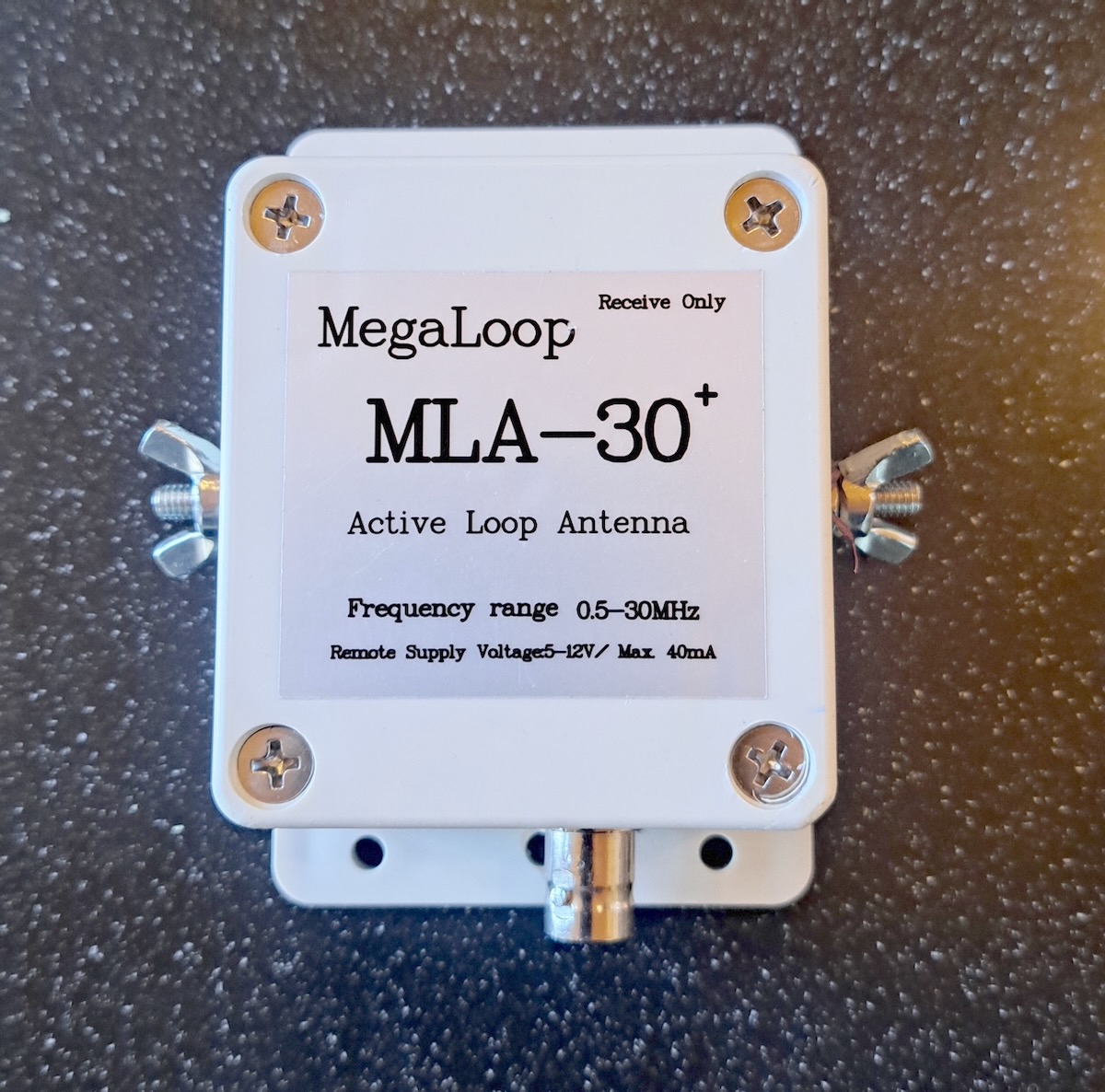
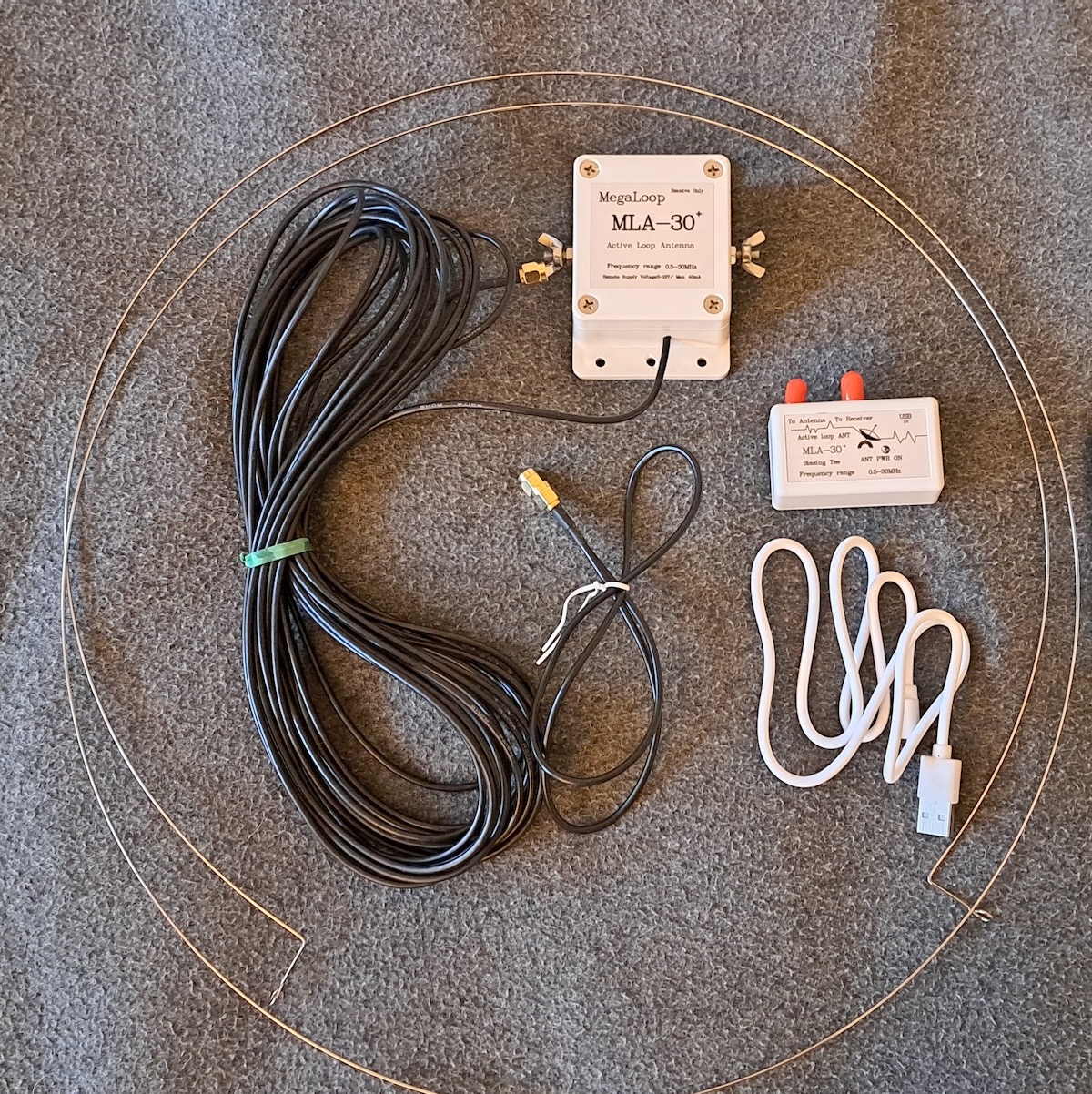
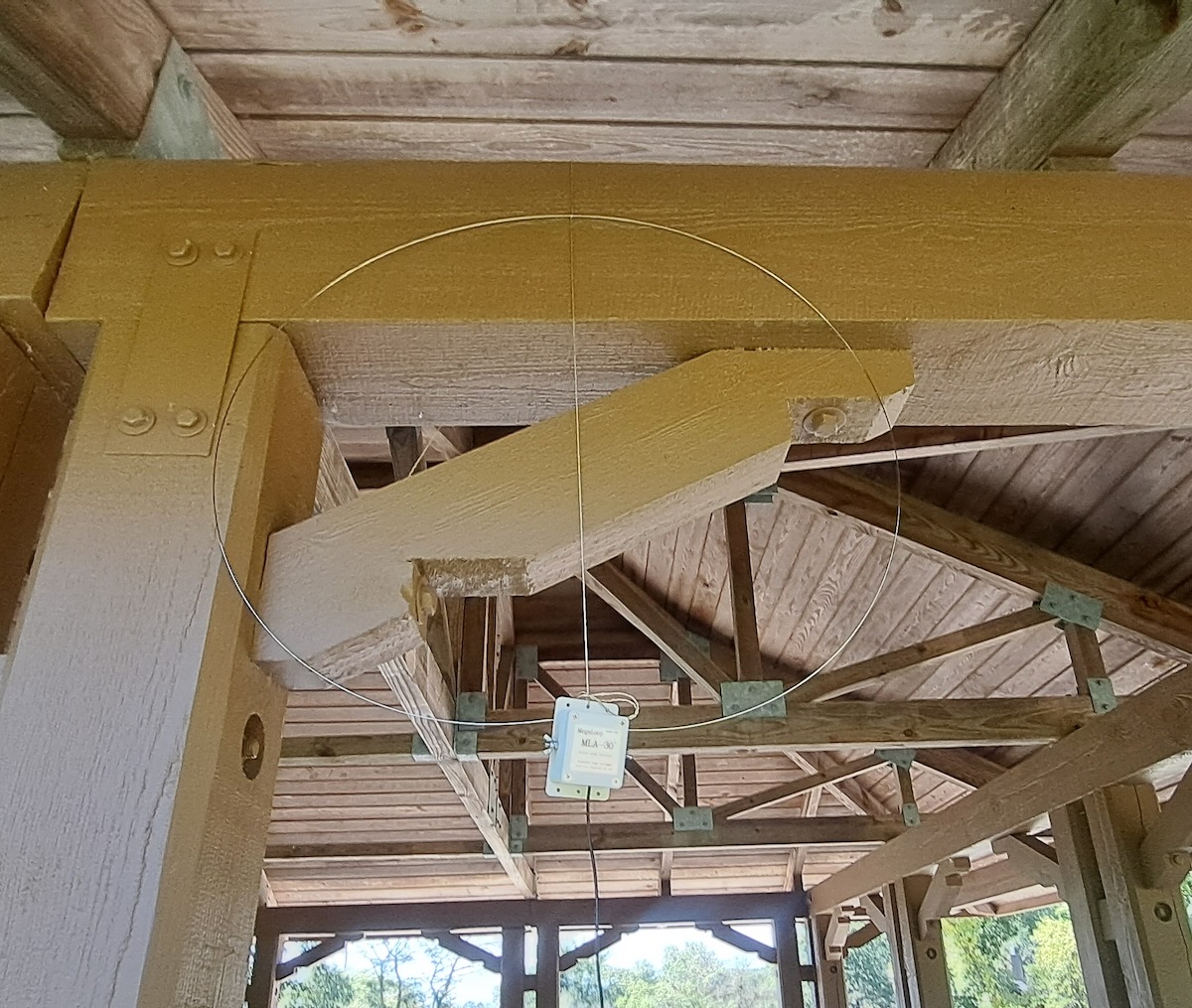
This antenna consists of a steel wire loop that connects to terminals on the amplifier box. The amplifier has a ten-meter coax cable, which in turn is connected to a small bias-T power supply, which gets its power via a USB connection. The MLA-30+ is designed to be used in a permanent installation with some sort of vertical support, such as a PVC pipe. Some users replace the wire loop with copper tubing.
Those options aren’t practical for me, and simply hanging the antenna from the top would cause the steel loop to stretch and deform. So I came up with the idea of tying a strong cord from the top to the bottom of the loop so that the cord, and not the loop, bears the weight. To hang the antenna, I throw the cord over the support, attach the antenna, and then pull it up into place. That works well if you have rear support to hold it in place, such as the beams of a picnic shelter.
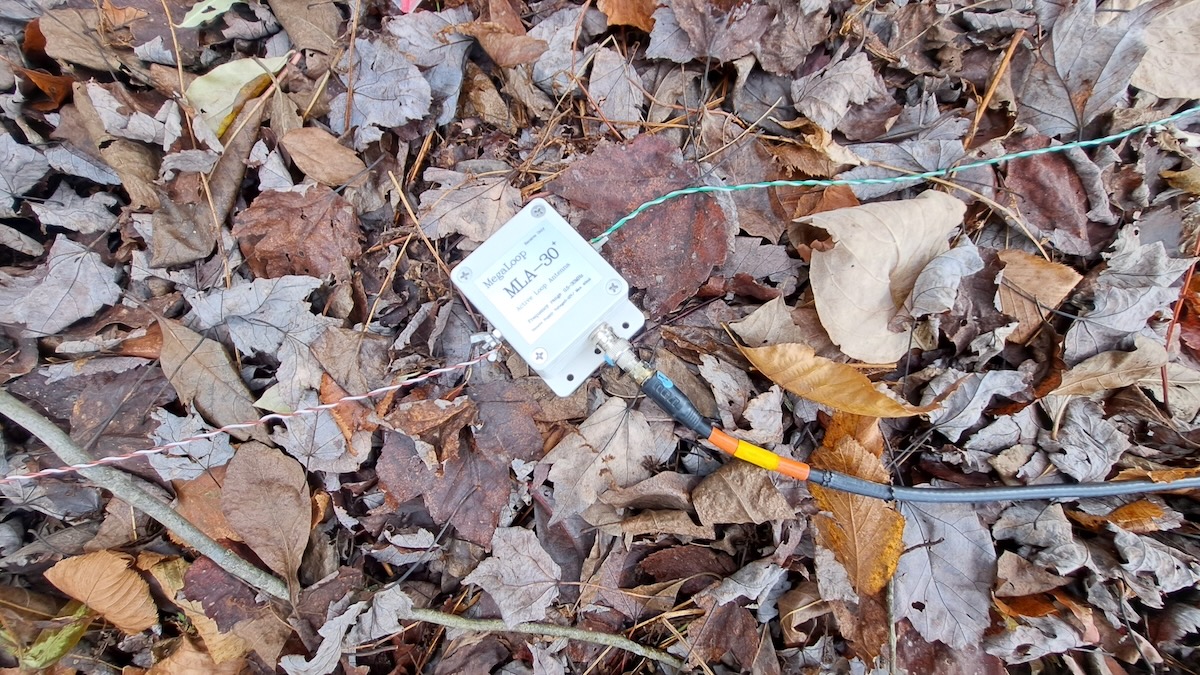
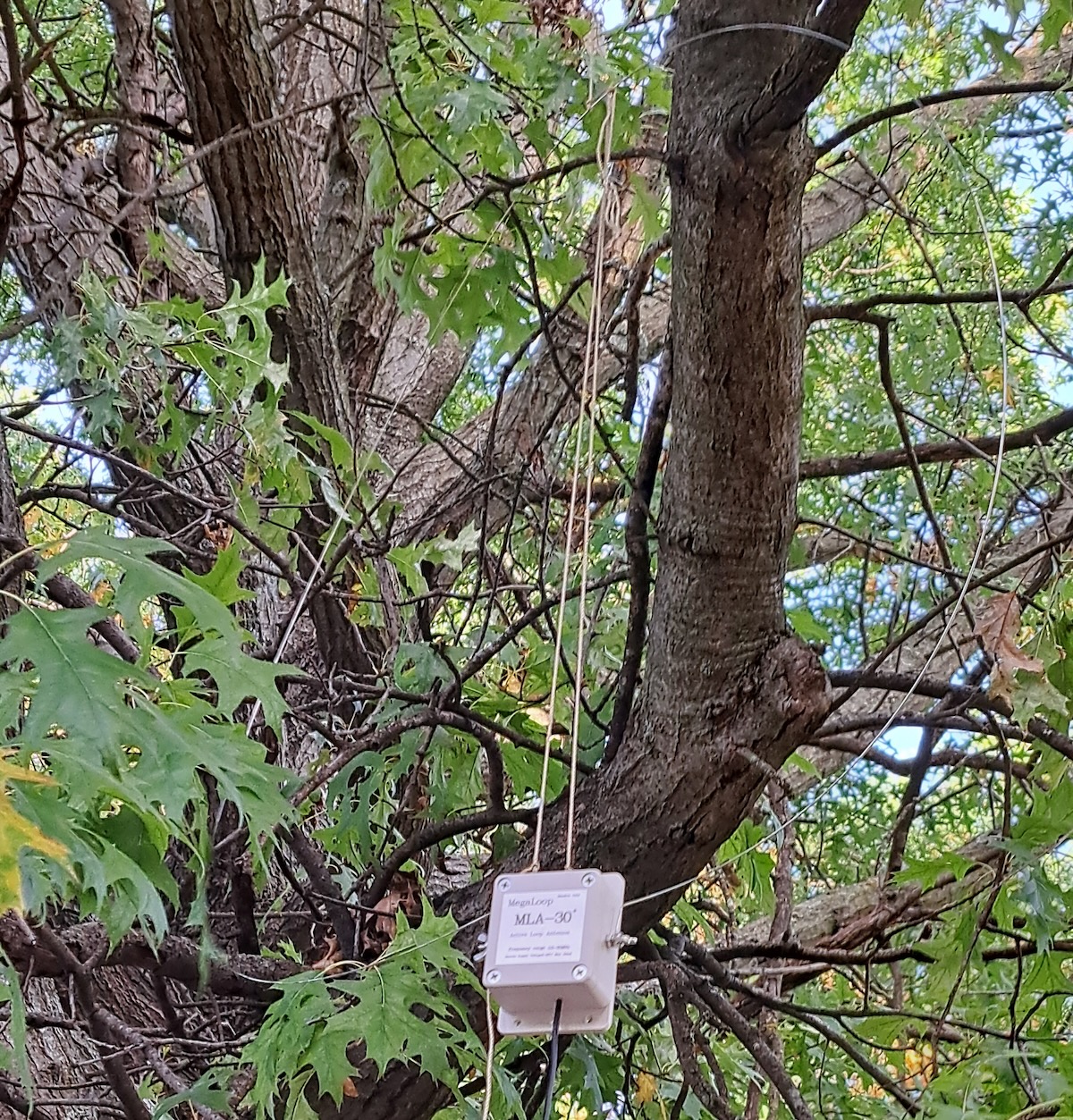
It’s a bit more difficult to mount the MLA-30+ in a tree.
Comparing the Antennas
I ran comparisons between the antennas several times at Old School Forest Preserve and then again at Wyandotte County Park. The results were practically the same every time. The images below were made at Old School unless otherwise stated.
The PA0RDT was designed to be a good performer on longwave and medium wave. Unsurprisingly, it shows a lot of signals on the upper end of the medium wave band, even during the daytime. Except for being non-directional, the PA0RDT is an excellent MW antenna.
The MLA-30+, on the other hand, isn’t good for much beyond hearing the strongest local signals on medium wave.
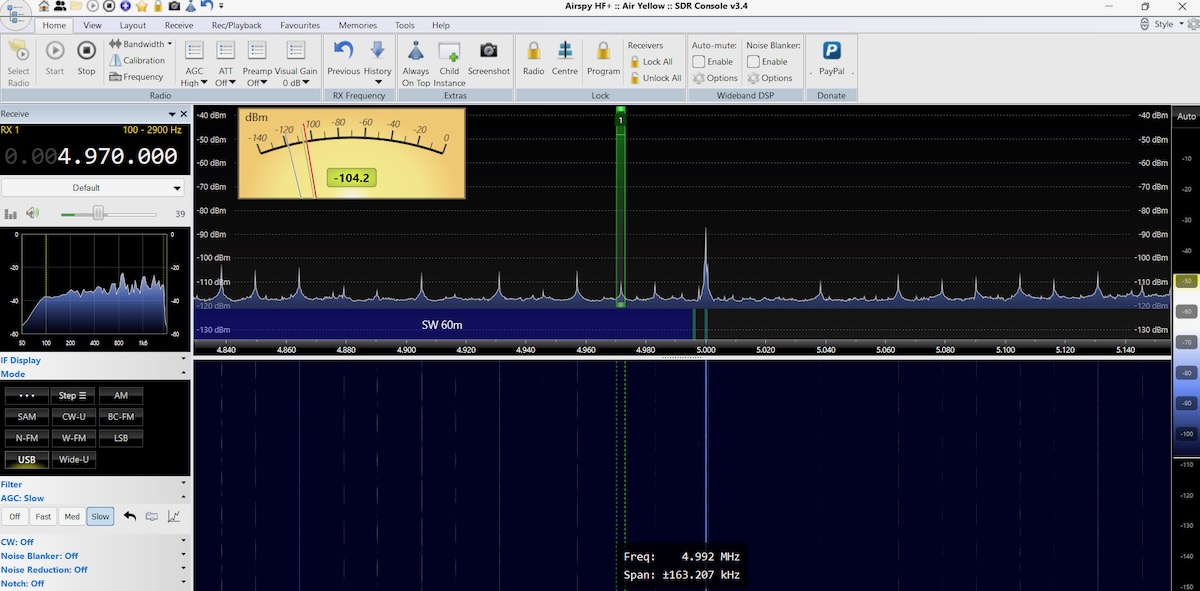
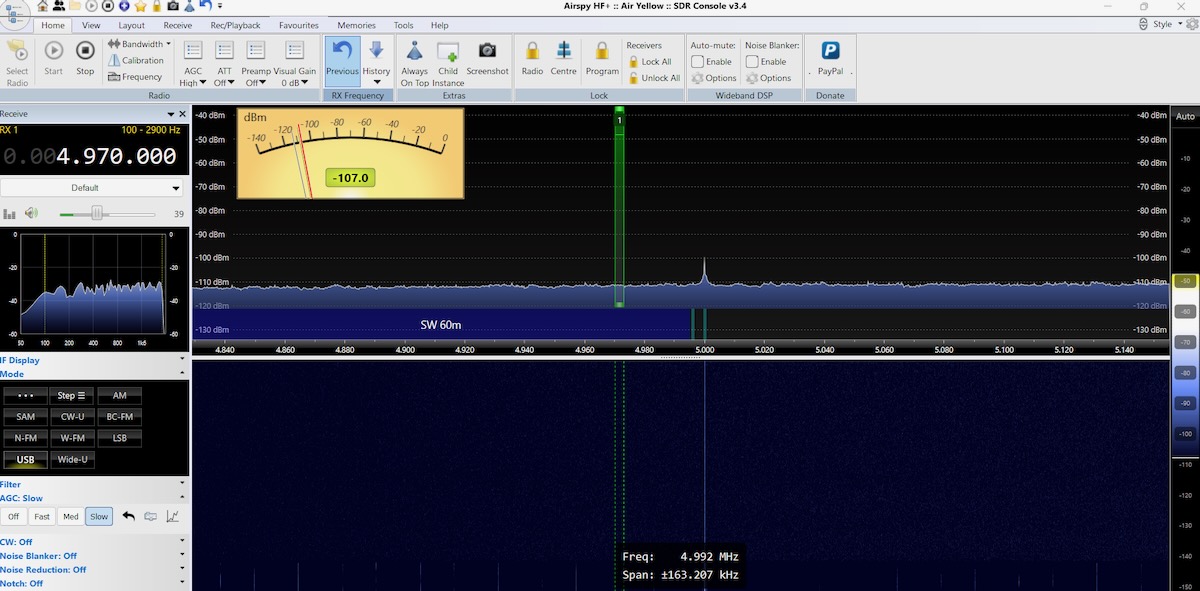
When I ran these tests in the late morning, WWV on 5 MHz was the only signal in the 60-meter band. It had a very listenable signal on the PA0RDT.
But on the MLA-30+, WWV was barely there.
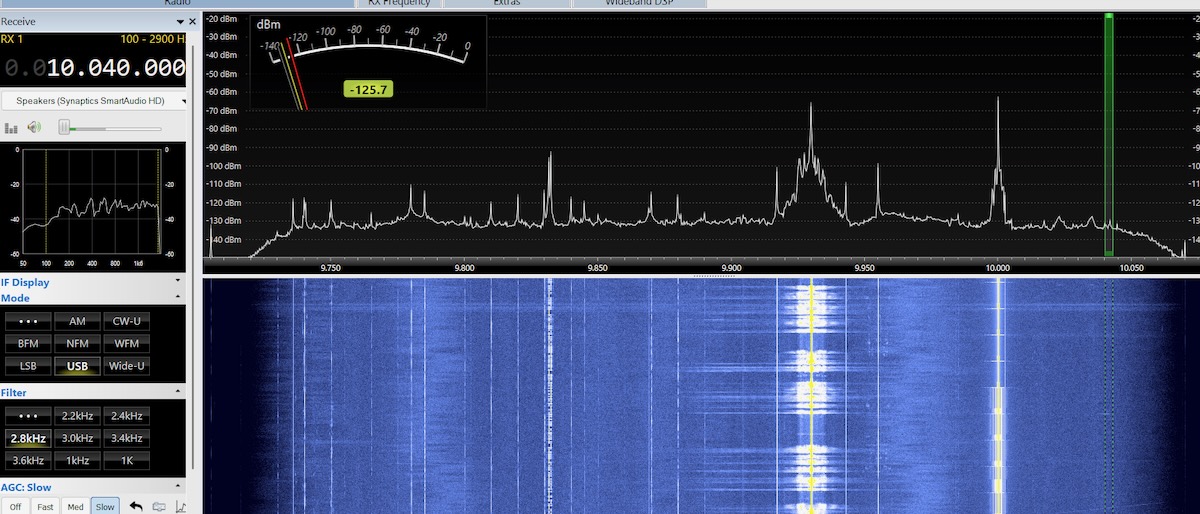
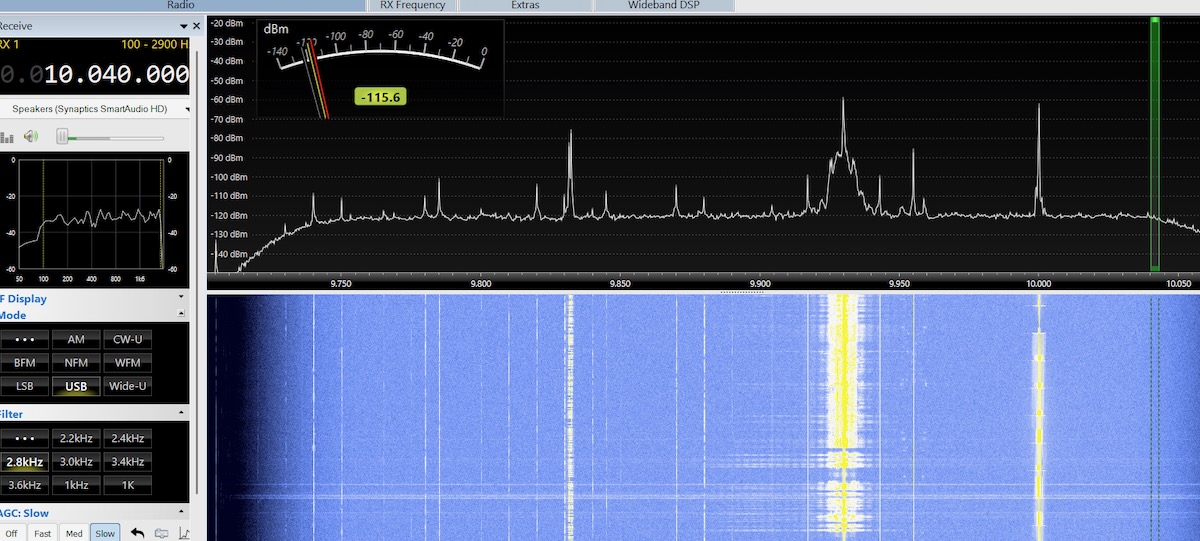
Likewise on 49 meters, CFRX on 6070 kHz was very clear on the PA0RDT but barely listenable on the MLA-30+. But when I moved up to 31 meters, the difference between the antennas mostly disappeared, as in these images made in Kansas. The PA0RDT is top and the MLA-30+ on the bottom.
On 25 meters, the PA0RDT is picking up a lot of noise and the signals are not that strong. Nor were signals very strong on 19, 16, 0r 13 meters.
However, on 25 meters with the MLA-30+ there isn’t much noise and the signals are booming in. And 19, 16, and 13 meters likewise had strong signals.
So the PA0RDT is clearly the best antenna for MW and the lower shortwave bands, but it doesn’t do as well on the higher bands. This wasn’t a surprise to me as I’ve always felt that the PA0RDT underperformed above nine or ten Megahertz. The MLA-30+ was abysmal at the lower frequencies but worked better or just as well in the middle and higher shortwave bands. The best antenna is another antenna. Each one performs better in different situations. But I couldn’t help but wonder … was the problem with the MLA-30+ that small steel wire loop?
Look for Don’s Part 2 article next weekend on the SWLing Post!
Many thanks to SWLing Post contributor, Dan Robinson, who shares the following guest post:
ICOM’s IC-R8600: Can this mega-radio stay in the ring with big gun “legacy” receivers when it comes to shortwave band reception?
by Dan Robinson
When ICOM rolled out its new wideband receiver, the IC-R8600, I immediately took an interest in it. I have been primarily a hardcore DX’er and SWL and avoided purchasing wideband receivers, including the predecessor IC-R8500, because they were limited in areas such as selectivity.
My experience with ICOM includes owning a IC-R71A and R72, both of which I found to be strong performers, as well as a IC-R75. The R75 as everyone knows established a reputation as an excellent receiver that delivered bang for the buck, including for example 1hz readout and extreme stability.
In its design decisions with the 8600, ICOM clearly intended to hit it out of the park, taking a huge step from the 8500. That can be seen in the amazing color 4.3 inch LCD display with fairly fast spectrum scope and waterfall displays, coverage from 10 kHz to 3 gHz, decoding capability in multiple protocols, (Baudot RTTY, D-STAR™, NXDN™, dPMR™, DCR (Digital Communication Radio) and APCO P25, and the combination of SDR and superheterodyne circuitry, with 2000 memories.
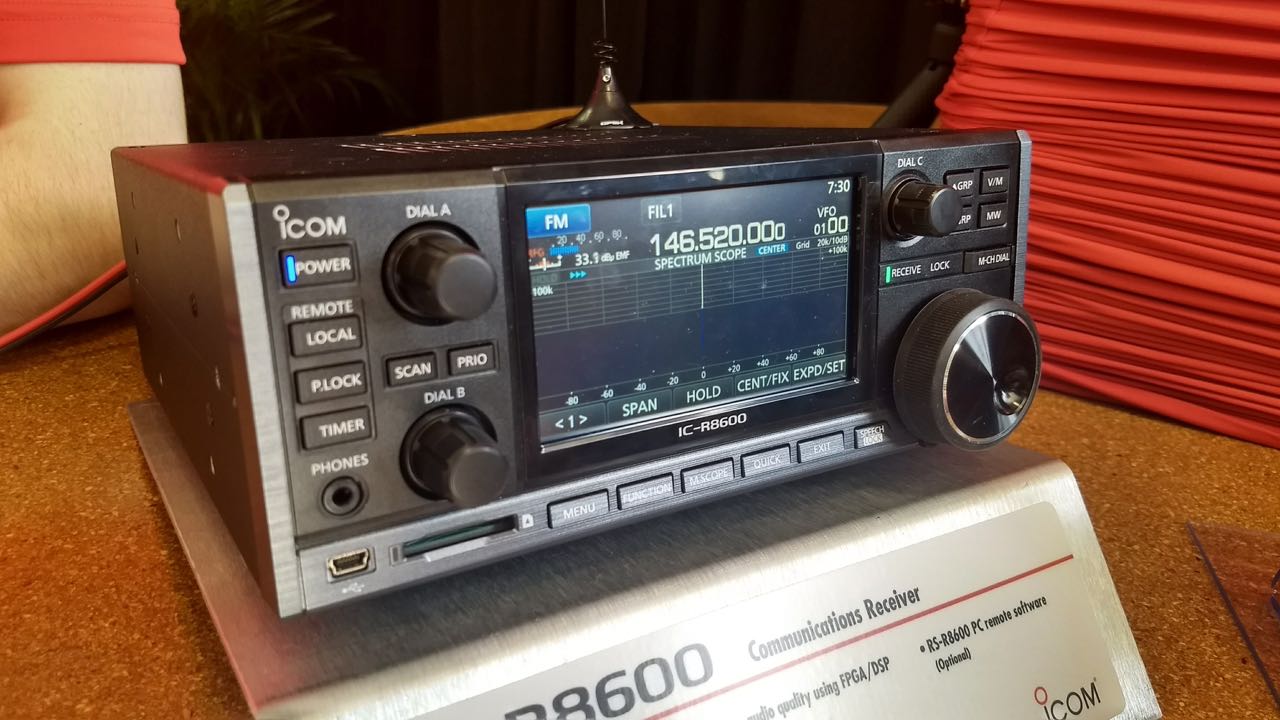
The new Icom IC-8600 at the 2017 Hamvention
At this point, there have been numerous reviews of the 8600, and videos are all over YouTube showing the basics of its operation and features. It has numerous flexibilities selected from the front panel and within the menu system. The ability to record directly to SDHC cards eliminates the need to attach an external solid state recorder (over the course of my DX career I accumulated many of these). I can’t say enough about this capability which automatically keeps fully labeled logs.
Other features include ICOM’s wonderful Twin Passband Tuning, combined with the ability to adjust filters 1/2/3, adjustable attenuation, Digital AFC, tone controls, noise blanker digital noise reduction, speech enunciator, main tuning dial tension adjustment, synchronous L/U/Double sideband, adjustable panel brightness . . . in short, just about everything one would think should be included in a 21st century receiver of this kind, ICOM put in the 8600. The firmware update released recently (1.30) added the capability to use the radio’s IQ output with HDSDR software, which means that the receiver is now not only a standalone but also functions easily with a PC.
Since the 8600 has been on the market for some time now, I discussed with Thomas Witherspoon of SWLing Post, the idea of obtaining an 8600 for the specific purpose of comparing it to some of the top receivers in my collection.
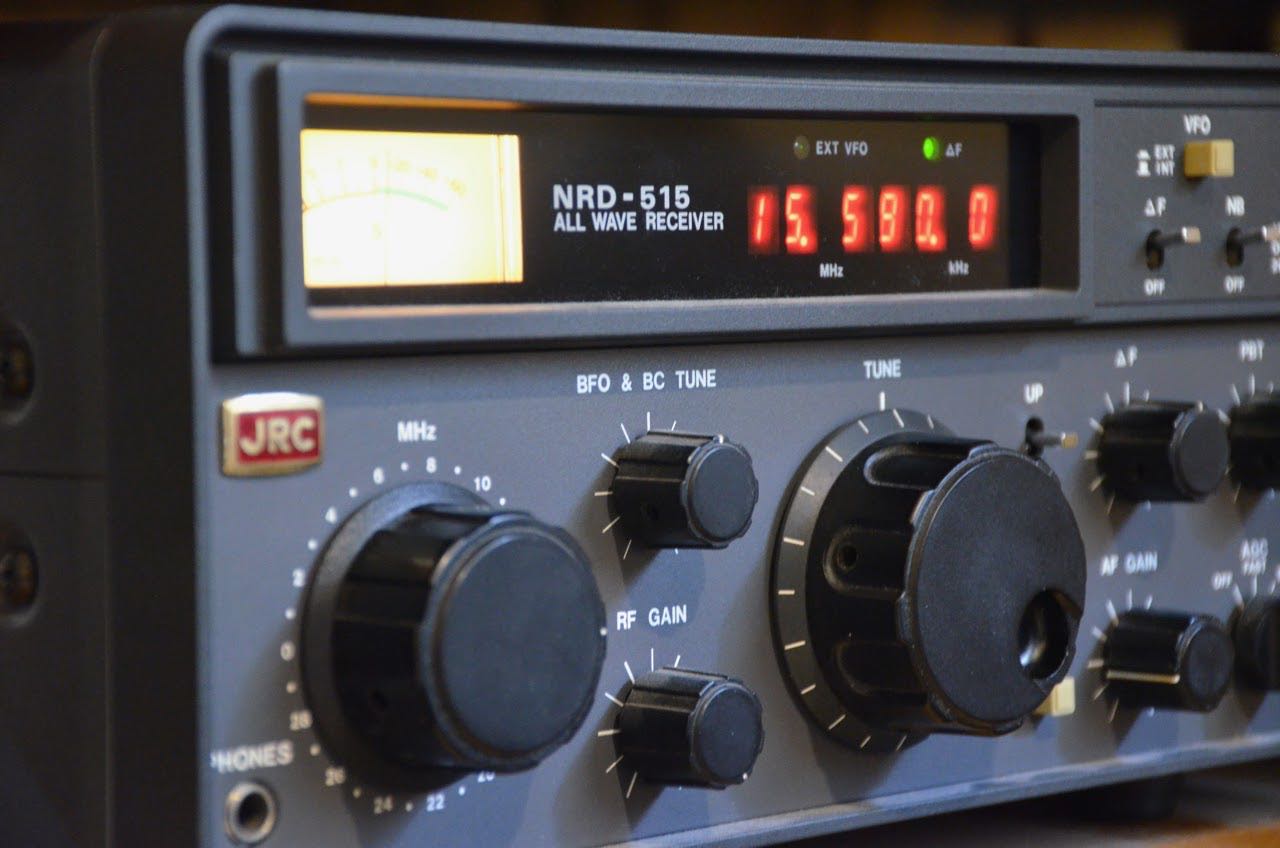
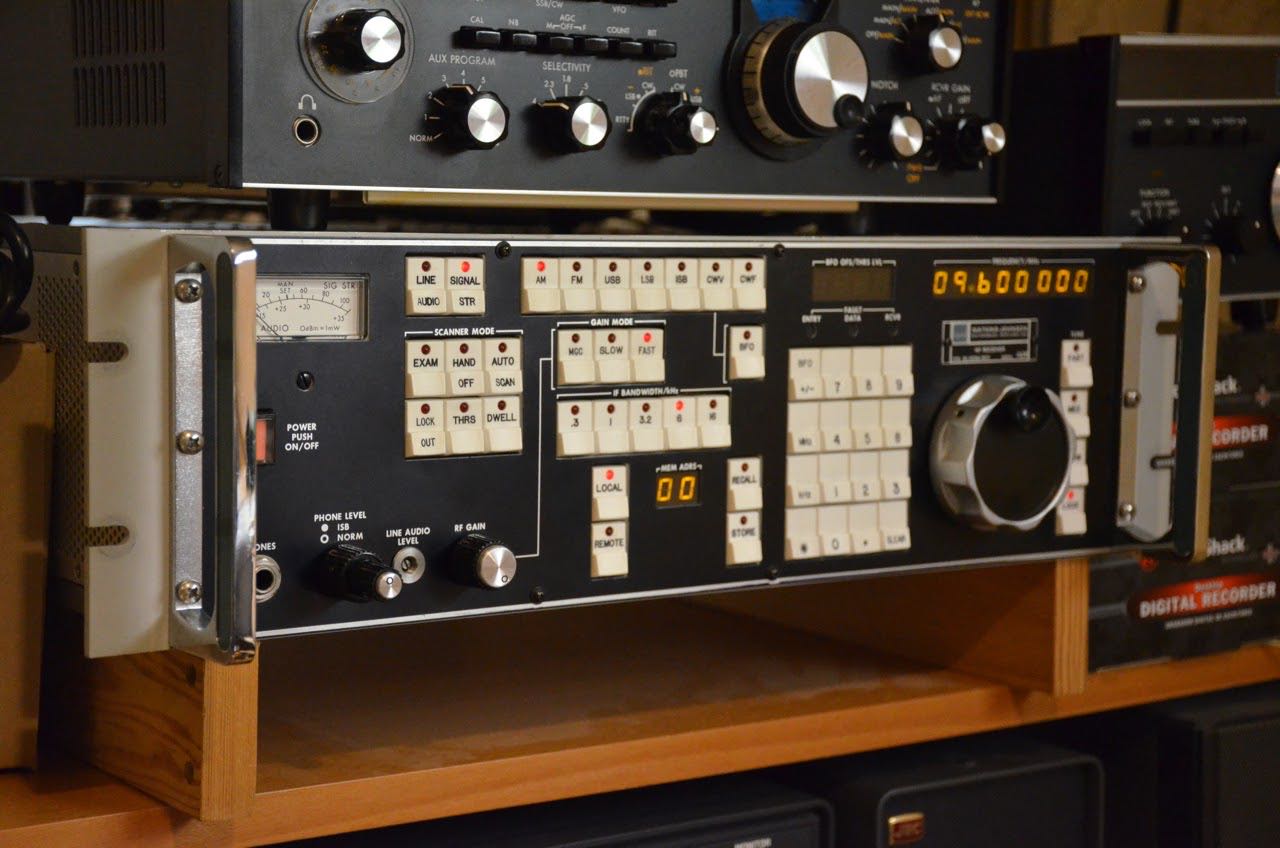
JRC NRD-515
At the current time, that list includes a JRC NRD-545, the Drake R-8 (original version purchased in 1993), JRC NRD-515, Watkins Johnson 8718A/MFP, Cubic R-2411, and a McKay Dymek DR-33C. All of the radios in my shack use a Wellbrook 1530 loop, fed through a RF Systems DA-8 Distributor/Amplifier which maintains signal levels from all outputs.
Watkins Johnson 8718A/MFP
A surprising outcome of my comparisons of the 8600 to these radios is that my appreciation of the qualities of these older receivers was actually re-ignited–so much so that some that had been on my ‘to sell’ list are now back in the ‘keepers’ column. This is not as much a criticism of the 8600, as it is a reaffirmation of the quality that was built in to some of the great receivers of yesteryear.
Because my collection actually extends across 2 or 3 rooms, moving the 8600 away from my central receiver “stack” was not possible, so testing comparisons were limited to the sets mentioned above. I would have liked to compare the 8600 with, for example, some classic tube receivers (HQ-180A, Eddystone 830/7), but they have been mostly inactive and located away from incoming antenna inputs.
Here in Potomac, MD outside of Washington, DC, the addition of the Wellbrook a few years ago, after years suffering with long wires, fundamentally changed a difficult situation. Signals were boosted, noise reduced. I wish things had continued this way. Unfortunately about a year ago, my area began to be plagued by a troubling ignition-type buzz, source unknown, targeting 11,500 to 12,100 khz though noticed elsewhere in the shortwave bands. It has continued, usually worse in summer than in winter.
I begin with this to underscore what I noticed as a high point for the 8600: its Noise Blanker and digital noise reduction are in my opinion quite effective, so much so that when properly adjusted, they can eliminate troublesome ignition-type noise. While NR is useful, as noted in other reviews it needs to be used carefully so as not to introduce too much digital suppression.
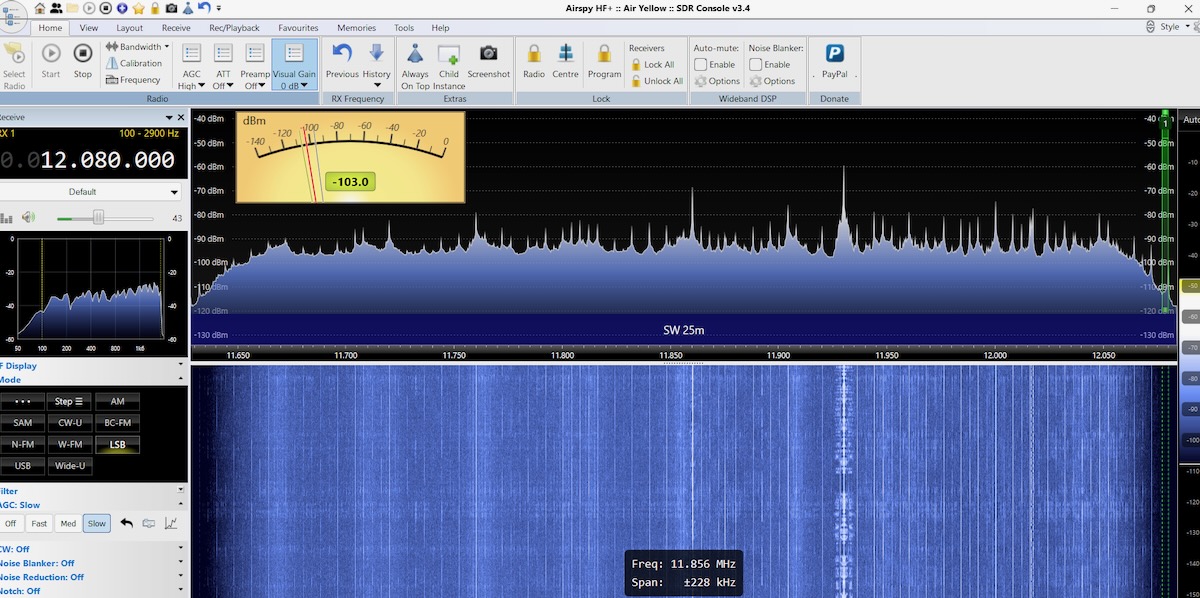
Here is an example of NB and NR in use against severe ignition-type noise at my location:
In August of 2017, I had my first experience tuning a 8600 at a DXpedition in Ohio.
So, I had a basic grasp of the various controls — the A/B/C knobs, and the menu system. When I received my review unit from ICOM last November, I was up and running quickly, but still puzzled over some aspects of the receiver’s operation.
Thanks to Dave Zantow who alerted me to a possible issue involving firmware 1.30 which appeared to introduce an increase in audio harshness (ICOM has been alerted to this). Dave also had suggestions (see his full review of the 8600 and other receivers on his site) about audio adjustment and speakers, and tweaking of the front display to make maximum use of the Peak and Waterfall settings. Dave emphasizes that careful adjustment is required of the 8600’s tone controls and AGC decay settings to get the most out of the receiver.
Because it is among the receivers in my shack in close proximity to the 8600, I chose to perform a number of tests comparing the ICOM to the Japan Radio Company NRD-545. As everyone knows, the 545 was the last in JRC’s prosumer line of receivers. It is feature-rich — JRC threw everything into this receiver. But one issue followed JRC receivers through the 5xxxx series — noisy audio. After finally acquiring a 545 some years ago (a high serial number unit formerly owned by the late Don Jensen) I jumped on that bandwagon of criticisms about the 545’s audio. However, in terms of sensitivity and numerous tools to hear and process signals, the receiver remains among my favorites, and this remains the case after my comparisons with the 8600.
When I compared signals heard by the 8600 with the 545, I found that while the JRC does have that ‘DSP’ sound, it was in many situations actually clearer than the ICOM. That was the case even when following advice on adjusting the 8600’s tone controls and AGC. The following two videos compare the 545 and 8600 on 5,905 khz and 17,655 khz. A third shows the receivers on 6,040 khz demonstrating effectiveness of their notch filtering capabilities:
My next comparison was the Drake R8. Little can be said about the Drake R8xxxx series of receivers that hasn’t been said. That superb Drake audio, established with the R8 and continued through the R8B, puts these receivers at the top of the heap and makes stations stand out. So, it’s little surprise then when compared to the 8600, which is an SDR in the HF range up to 30 mhz or so, the R8 still sounded superior on many, though not all, stations. Use of the SYNC mode (not adjustable on the original R8, but was on the R8A/B) also improves recoverable detail on the Drake.
The following video shows the 8600, 545 and finally the R8 on 5,995 khz (Mali), and the three receivers compared on 9,650 khz (Guinea), and a third comparing the 8600 with the full range of receivers in my main receiver stack, tuned to 9,415 khz which at the time was China Radio International.
Despite what some critics have said, I believe that the 8600’s synchronous detection modes are actually pretty good, helping with fading and stabilizing signals. I think the ICOM’s sync is certainly superior to what I experienced with the IC-R75. I would rate the SYNC on the AOR 7030+ superior to the 8600, with the NRD-545 a bit behind the 8600.
Acquired about 2 years ago, my AOR-7030+ is a late serial number version of this fantastic receiver. If I were to sell every radio in my shack but 5, the 7030 would not leave. Put simply, it is among the top shortwave receivers ever made, with off-the-charts audio, and if one has the rare NB7030 card, amazing notch and other capabilities. Comparing the 7030 to almost any other shortwave receiver ever made is like putting a Ferrari on the track with the competition. The audio, and reception tools are just that good.
At the same time, in the 8600 ICOM has produced a receiver that has as many of the essential tools required to manipulate and clarify signals as exist. The twin passband tuning continues to be superb. Being able to vary bandwidth in conjunction with the PBT, and do so even in SYNC mode, further enhances reception powers. Combine this with the ability to actually see signals on the 8600’s beautiful color LCD — we’re getting pretty close to the ultimate receiver (though I would love for someone to drop the successor to ICOM’s IC-R9500 on my front doorstep).
The following videos compare the 8600 to the same full range of receivers, ending with the Watkins Johnson 8718A/MFP, all tuned to 5,935 khz, followed by a comparison of receivers tuned to 5,000 khz
In the following videos, I compare the 8600 to other receivers 11,810 khz (BBC) which shows
the superb audio of the Drake R8xxxx series, yet the 8600 does quite well, and another video
compares the 8600 with the 545 and R8 tuned to 6,070 khz.
In the months that I have had the 8600, I did some comparisons with other receivers, among them my Watkins Johnson 8718A/MFP, which you saw in several videos. WJs prior to the 8711/HF-1000s were built like boat anchors and are QUIET. WJ, Cubic and similar sets manufactured for government and intelligence agencies, shared superb sensitivity, and most cases, excellent audio.
Comparisons of the 8600 on shortwave frequencies had the so-called Premium radios out front. The ICOM clearly shined when it comes to modern signal processing and adjustment tools such as PBT, Notch, and infinitely variable selectivity.
Summary
So, here’s a summary of my impressions after weeks of testing the ICOM IC-R8600 against some of the top gun receivers of yesteryear.
The 8600 scores a 10 on reception tools that are useful — though not crucial in these days of waning shortwave broadcasting activity — in producing and processing listenable audio: Twin PBT, Notch and Auto-Notch, Variable Bandwidths (though limited at the high end to 10 kHz), Pre-Amp and Attenuation, and that beautiful color LCD that allows one to see signals.
Predictably, the 8600 doesn’t blow away premium receivers that were manufactured to pick up the signal equivalent of butterflies and targeted government and spy agencies, and it also does not out-perform a range of other classic receivers whose reputations are well-established.
From a sensitivity and audio perspective, there is no real competition with the Drake R8, which time and time again excels in producing superior easy-to-listen audio. And the same holds for the AOR 7030+.
JRC’s NRD-515 more than holds its own and in many cases exceeds the 8600 in signal sensitivity, and producing listenable audio, despite its selectivity limitations.
The NRD-545 — maligned by critics for its DSP audio, often produced highly-listenable audio even in comparison with the 8600. The ICOM and the 545 share features that provide tremendous flexibility, the tools required to slice and dice signals. If the JRC NRDxxx receivers were the modern equivalent of such boat anchor classics as the Hammarlund HQ-180A, the 8600 is certainly at the top of the heap when it comes to having those same tools in a 21st century receiver.
Audio Samples
I performed some additional audio only tests between the 8600 and NRD-545 on several frequencies. In each, I carouseled from wide to narrow on the 8600, and did the same on the NRD-545. Here are the results:
You may have noticed that while on some examples the 8600 appears to sound better, the 545, with DSP technology born in the 1990’s is more than competitive with the ICOM.
Conclusion
In conclusion, with the 8600 we have a receiver that tunes up to 3 gHz, with highly flexible color scope, usable with HDSDR, with every tool imaginable for sifting through signals from 10 kHz up to 30 MHz, which is the area I have focused on for decades.
ICOM’s superb Twin PBT knocks out interference and narrows the heck out of any signal, with highly adjustable notch capabilities, customizable bandwidth functions, and what I consider to be highly effective noise blanking and noise reduction. Add to this 2,000 memory channels, multiple antenna inputs, adjustable attenuation and AGC and you have far more than what is needed given the current state of shortwave broadcasting.
Here’s the tough question: Would I recommend that a shortwave listener focused on what remains of listening in the SW bands purchase a 8600? Or to put it another way: Is the 8600 that much of a better radio in the SW spectrum? The answer has to be no.
Numerous receivers from the classics to even the latest portables with multiple selectivity flexibility (see the XHDATA D-808 or Eton Satellit) work for that. The used market overflows with superb HF communications receivers. Any of the Drake R8xxx series receivers, available on the used market for $400 to $1,000, now constitute overkill when it comes to reception in the MW to 30 mHz range.
But if you can project someday to having the time and patience to apply yourself to what is available above 30 MHz, and have the appropriate antenna(s) for those ranges, then by all means, the 8600 is the radio for you. It is the Babe Ruth’s bat of the receiver world — AND it has numerous flexible tools (though one wishes that ICOM had included DRM capability).
As I finalized this review, I continued to wrestle with the decision of purchasing the 8600 that was so generously provided by ICOM. You won’t read here what my final decision was–but anyone who is interested can contact me in coming days and weeks to learn the answer.
Last minute update Just before this review went to press, I discovered an issue of concern: when the 8600 was left on overnight, or for any period of multiple hours, upon awakening from “sleep” (screen off) mode, nothing but distortion is heard from the speaker. The only solution was to perform a POWER OFF/POWER ON, after which normal audio was heard. This issue was I brought to the attention of ICOM.
I want to thank Ray Novak and Faheem Hussain of ICOM for providing the 8600 used in this comparison, and for their patience as I encountered several delays completing my review and getting to print. And thanks to Thomas Witherspoon without whose initial encouragement, this review would not have been possible.
Dan, thank you for an amazing IC-R8600 review and comparison with your benchmark commercial grade receivers! Thanks for taking the time to make thorough comparison video and audio recordings. Your guest posts are always most welcome on the SWLing Post!