Tag Archives: RFI

Radio France International features Ears To Our World

RFI-RadioFranceInternationalMany of you know how important I consider shortwave radio to be in the third world and for those living under repressive regimes. Radio France International recently interviewed me regarding these views and my position as the founder and director of the charity, Ears To Our World.

Click here to download the interview, or listen on RFI’s website.

Many thanks to RFI’s Brent Gregston for giving Ears To Our World air time!


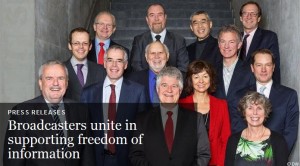
International Broadcasters support freedom of information

JointStatementThe international broadcasting arms of France, Australia, the US, the United Kingdom, Germany, Japan and the Netherlands issued a joint statement in support of press freedoms across the globe. With the exception of the Netherlands (RNW), all of these countries still broadcast over the shortwaves.

(Source: BBC Media Center via Kim Elliott)

We, the representatives of Audiovisuel Extérieur de la France (AEF), Australian Broadcasting Corporation (ABC) [Australia], British Broadcasting Corporation (BBC) [United Kingdom], Broadcasting Board of Governors (BBG) [US], Deutsche Welle (DW) [Germany], Nippon Hoso Kyokai (NHK) [Japan] and Radio Netherlands Worldwide (RNW), have met in Berlin to discuss common concerns.

We find international journalism is facing unprecedented challenges from countries that seek to deny their own citizens access to information from outside their borders in violation of Article 19 of the Universal Declaration of Human Rights, which states:

“Everyone has the right to freedom of opinion and expression; this right includes freedom to hold opinions without interference and to seek, receive and impart information and ideas through any media and regardless of frontiers.”

We call upon the world’s nations to strengthen their commitment to Article 19 and to support expanded opportunities to share information across borders through digital and mobile technologies.

Yet we note with dismay that certain governments continue to control the flow of information. For example, China routinely blocks the Web and social media sites of our broadcasters and jams our shortwave signals, or Iran and Syria interfere with the satellite signals that carry our programs. Governments in Eurasia, Africa, the Middle East and Latin America also seek to control what their own citizens can see, hear and read.

Many of these actions, including intentional jamming of satellites, violate international regulations. We condemn them without reservation.

We also call attention to troubling new challenges to free expression. Some governments are seeking to enact far-reaching telecommunications regulations to stymie free speech.

At the World Conference on International Telecommunication (WICT) in Dubai, representatives of the world’s nations have considered telecommunications rules that might explicitly apply to the Internet for the first time.

We cast a wary eye on such efforts to control the Internet, and we denounce efforts to identify and track Internet users in order to stifle free expression, inquiry and political activity.

We have agreed to increase, whenever possible, our support for efforts to circumvent Web censorship through the use of new and innovative hardware and software tools. We also agreed to increase our advocacy for Internet freedom.

Guinea imposed temporary ban on Radio France International

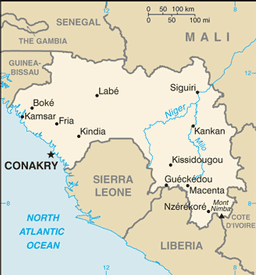
Map of Guinea (Source: CIA World Fact Book)

(Source: Committee to Protect Journalists via RNW Media Network)

On Monday [25 July], Guinea’s state-controlled media regulatory agency imposed a “temporary” ban on media coverage of the July 19 attack on the private residence of President Alpha Conde, silencing private radio and television talk programmes in which critical questions were being raised about the episode.

In such circumstances, Guinean listeners turn to foreign media outlets such as France’s state-funded international broadcaster, Radio France Internationale (RFI), the most popular station in Francophone Africa. With programmes such as “Appels Sur L’actualite”, a daily news call-in show, RFI is considered by millions of African listeners to be an essential source of news and information.

Wednesday’s “Appels Sur L’actualite” began with an ominous statement read by host Juan Gomez. “We had planned this morning to debate the attack last week against the residence of the Guinean president, but yesterday the National Communications Council of Guinea decided to temporarily suspend any programme or article about the attempted assassination against the head of state as well as all call-in programmes.” Gomez told listeners they would have to debate another topic.

Squeezed between the expectations of listeners and the conditions set by governments leasing the local frequencies it needs, RFI found itself in a difficult position. “We are not submitting to a censorship measure; we regret it and we hope that it will be temporary.” RFI deputy director Genevieve Goetzinger told CPJ today [28 July].

RFI has suffered for its critical reporting on current events in Africa. The station has seen its reporters expelled from Chad, Rwanda, and Senegal, its local correspondent jailed in Niger, and another correspondent killed in the Ivory Coast.

RFI has had its broadcasts temporarily banned in a number of countries, most recently in the Democratic Republic of Congo where the government of President Joseph Kabila sought the removal of RFI senior reporter Ghislaine Dupont, the station’s DRC specialist who was expelled from the country in 2006. Nevertheless, RFI management remains adamant the station will continue to report without interference. “Our editorial line is set in Paris, in complete independence from all the governments in the world,” Goetzinger said.

As a follow-up, RNW Media Network noted that the temporary ban was eventually lifted.

As with Fiji, Burma, Zimbabwe and many other countries where the ruling party arbitrarily tries to block free speech, shortwave radio cuts through censorship without regard for national borders.

Shortwave plays vital roll in Somalia

I found this BBC profile on Somalia quite indicative of many countries in Africa. In light of cuts that the BBC World Service has been facing, this short article, about Somalia’s fragmented media landscape, admits that shortwave plays a vital roll in domestic news.

The TV and press sectors are weak and radio is the dominant medium. There are around 20 radio stations, but no national, domestic broadcaster. Many listeners tune to Somali-language media based abroad, in particular the BBC Somali service. The latter is available on shortwave, and via FM relays in Mogadishu (91.1), the Somaliland capital Hargeisa (89.0), and elsewhere.

They go on to say:

The Somali diaspora – in the West, the Gulf states and elsewhere – sustains a rich internet presence. But domestic web access is hampered by practicalities such as limited access to mains electricity. There were 102,000 internet users by September 2009 (Internetworldstats). In secessionist Somaliland and Puntland the authorities maintain a tight hold on broadcasting.

Shortwave listeners in Somalia, one should note, also listen to the likes of the Voice of America, Radio Netherlands Worldwide, Radio France International and many others. Most of whom are facing cuts right now as national budgets are being tightened in the economic recession. To those living in Somalia, where the media is fragmented and untrustworthy, shortwave radio represents a lifeline of information.

As we mentioned in this previous post, please consider speaking up on behalf of those without a voice. Let international broadcasters and their governing bodies know how crucial shortwave services are into impoverished regions of the world.