Tag Archives: Shortwave Music

Justin Moore on Making Music with Radios

Many thanks to SWLing Post contributor, Justin Patrick Moore (KE8COY), who is a radio host, radio enthusiast and musician. At my request, Justin has shared the following article excerpts from his blog that discuss the convergence of music and radio:


Imaginary Landscapes

The development of telecommunications technology and electronic circuits had a major impact on the creation of new musical instruments from the very beginning, but it was only in 1951 that a composer first got the idea that the radio itself could be used as a musical instrument.  Since then the use of radio as a source for live, unpredictable sound, music, and voice has become commonplace across the genres of contemporary classical music, and various styles of electronic, rock and pop music. Using the radio as an instrument has become part of what composer Alvin Curran has called a “new common practice” and is just one of many methods being used to create the sonic backdrop of the landscape we now inhabit in this age of electronic multimedia.

“It’s not a physical landscape. It’s a term reserved for the new technologies. It’s a landscape in the future. It’s as though you used technology to take you off the ground and go like Alice through the looking glass.” John Cage wrote this about his series of Imaginary Landscape compositions. Imaginary Landscape No. 4 was first performed in 1951 and is scored for 12 radios played by 24 musicians, two on each radio, one to control the tuning, the other to control the volume. It is a great example of indeterminate music. The only guarantee about the piece is that no performance of it will never be heard the same way. This is guaranteed because John incorporates chance operations to determine how much the dials of each radio are to be turned by each performer. The novelty of each performance is also guaranteed by the nature of radio itself. Depending on the place and time of a performance, the things coming out of the radio speakers are going to be different. During its premier concert at Columbia University’s McMillin Theater those in the audience heard the word “Korea” over and over again, as well as snippets of a Mozart violin concerto, news about baseball, static, and silence. The performance took place around midnight and many of the stations in New York had already gone off the air for the night.  Of course the silence never bothered Cage, who considered  in an integral part of the experience. He had said that “silence, to my mind is as much a part of music as sound.”

Read the full article at Sothis Medias.

The Radiophonic Laboratory

Radio is the perfect medium for the diffusion of electronic music. The unpredictable sounds coming from radios are also a perfect source material. In many cases the production studios available at broadcast facilities made them the first laboratories for the scientific investigation of sound, for the sole purpose of making music, to be used by electronic music pioneers. Likewise these stations became the first to introduce electronic and other avant-garde music to the public. Such was the case with Westdeutscher Rundfunk, or WDR, the German public broadcasting institution located in Cologne. Their Studio for Electronic Music was the first of its kind in the world and became an epicenter for musicians working in the new medium. On the broadcasting side the WDR promoted new music through unique programming that included radio lectures, the playing of live and recorded music, and commissioning new works from composers working in the field.

Read the full article at Sothis Medias.

Telemusik

As the world caught wind of the work being done at the WDR’s Electronic Music Studio, other radio stations and broadcasting corporations followed suit. NHK (Nippon HosoKyokai) in Japan built their electronic music studio in 1955, directly modeling it on the one at WDR. In 1958 the BBC created their famous Radiophonic Workshop. (I blame starting to watch Doctor Who as a ten year old, with its strange soundtrack and incidental music, for what became my lifelong fascination with electronic music.) The studio at NHK was just over ten years old when they invited Karlheinz Stockhausen over to work there and create two pieces for their airwaves.

When he arrived in Japan Karlheinz was severely jet lagged and disoriented. For several days he couldn’t sleep. That’s when the strange hallucinatory visions set in. Laying awake in bed one night his mind was flooded with ideas of  “technical processes, formal relationships, pictures of the notation, of human relationships, etc.—all at once and in a network too tangled up to be unraveled into one process.” These musings of the night took on a life of their own and from them he created Telemusik.

Read the full article at Sothis Medias.

Kurzwellen

Starting in the early 1960s Karlheinz Stockhausen composed several instrumental works which he called “process compositions”. These did away with traditional stave notation and instead used symbols including plus, minus, and equal signs that indicated the successive transformations of sounds that were otherwise unspecified or unforeseeable by the composer. In this way he brings elements of improvisation into the fold of Western classical music where the strict adherence to a fixed score left little room for interpretation by musicians. The scores in his process pieces don’t dictate specific notes or ways of playing but rather specify the way a sound is to be changed or imitated. Taking a cue from his studies of information theory Stockhausen created a way of writing music that is similar to computer programming. The program “determines the way information is processed while leaving the choice of information to be processed to the individual user.” (Maconie 1990, 156-157)

Stockhausen’s process pieces include Plus-Minus (1963), Prozession (1967), Kurzwellen, and Spiral (both 1968). Eventually they led to the text based processes of his intuitive music compositions in the cycles Aus den sieben Tagen (1968) and Für kommende Zeiten (1968–70).

Kurzwellen (Short waves), the third of the process pieces also marks the beginning of Stockhausen’s magnificent voyage using shortwave receivers as a medium for musical transportation. The formal procedures in Kurzwellen (and the others) are fixed. Stockhausen thinks of these not as fixed in the way Beethoven’s Fifth symphony is a fixed piece that will sound the same to a greater or larger degree from recording to recording or performance to performance. Only the processes themselves are fixed. These are indicated primarily by plus, minus, and equal signs and constitute the composition.

Yet the sound materials themselves, like the knobs on the tuners, are variable. The process scores can be followed and bring about very different results each time they are played and yet somehow still sound similar. The sound material coming in from the shortwave radios is unpredictable. Yet the prescribed processes themselves can be heard from one performance to another as being “the same”. These developments in musical theory and practice make live performances and new recordings exciting events.

Read the full article at Sothis Medias.

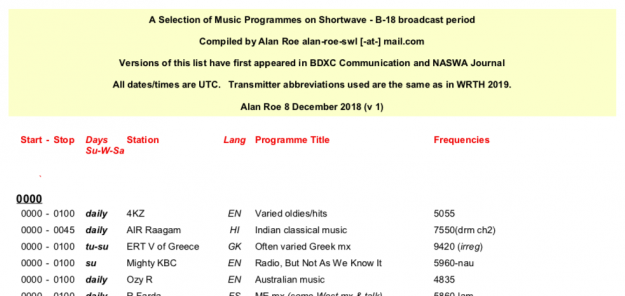
Alan Roe’s updated A18 season guide to music on shortwave

Many thanks to SWLing Post contributor, Alan Roe, who notes:

I have now updated my Music on Shortwave listing for A-18, and attach version 2.1.version 2.0.

Alan, thanks so much for keeping this excellent guide updated each broadcast season and for sharing it here with the community!

Click here to download a PDF copy of Alan Roe’s Music on Shortwave A-18 v2.1

Alan Roe’s A18 season guide to music on shortwave

Many thanks to SWLing Post contributor, Alan Roe, who notes that he has now compiled his Music on Shortwave listing for the A18 broadcast season.

Alan, thanks so much for keeping this excellent guide updated each broadcast season and for sharing it here with the community!

Click here to download Alan Roe’s A18 Shortwave Music Guide version 1.0 (PDF).

Jazz From The Left: A slight schedule change

Many thanks to Raoul with Jazz From The Left, who writes:

My program, Jazz from the Left, continues on WRMI. With a slight schedule change.

From Jeff White:

“We now have Jazz from the Left on at 0000 UTC Wednesday on 7730 kHz, and at 0100 UTC Thursday on 5850, 9395 and 9455 kHz.”

By the way, for fans of jazz on shortwave radio, I recently found dozens and dozens of air checks of Willis Conover playing jazz on the VOA. These are all excellent quality recordings from the 1950’s through 1970’s [at the University of North Texas Library]. Click here to browse the recordings. Enjoy!

Thank you, Raoul! Your show is excellent–the new time on WRMI has been noted in my calendar.  And thanks for mentioning the UNT archive–it is indeed a superb collection (click here to read an archived post).

Alan Roe’s updated B17 season guide to music on shortwave

Many thanks to SWLing Post contributor, Alan Roe, who notes:

I have now updated my Music on Shortwave listing for the B17 season, and attached version 2.0.

Alan, thanks so much for keeping this excellent guide updated each broadcast season and for sharing it here with the community!

Click here to download Alan Roe’s B17 Shortwave Music Guide version 2.0 (PDF).

Alan Roe’s B17 season guide to music on shortwave

Many thanks to SWLing Post contributor, Alan Roe, who notes:

I have now compiled my Music on Shortwave listing for B17. Extracts listing music programmes in English language transmissions have been listed in BDXC-UK Communication and in NASWA Journal. I now attach a consolidated version listing a selection of music programmes in a variety of language transmissions. If of interest, please go ahead and post it on your excellent SWLing site.

Alan, thanks so much for keeping this excellent guide updated each broadcast season and for sharing it here with the community! When people claim that there’s nothing to listen to on shortwave, I often send them a link to your excellent guide!

Click here to download Alan Roe’s B17 Shortwave Music Guide (PDF).

Good Times Bad Times: Luke’s nighttime listening rewarded

Many thanks to SWLing Post contributor, Luke Perry, who writes:

Hi Thomas,

Just [wanted to share] a little bit of shortwave good luck that I had when tuned to 3925 kHz. That is the frequency for Radio Nikkei 1 if I am not mistaken. They have a similar frequency that I can usually get at about the same time in 3945, but from my location in the Pacific Northwest the former usually comes in better until about 13:00 UTC or so.

To any SWL listeners on the west coast can tell you, there are not a whole lot of choices anymore for the listeners who like the exotic DX catches, whereas 20 years ago you had many choices like Vanuatu, Papua New Guinea, Radio Vladivostok on 5015 kHz that was a special station for Russian boats at sea, etc. These stations all played exotic and sometimes even current music, not to mention lots of ‘oldies’ and classics.

So I am left with the few that are left and I usually tune in late at night as the static lulls me to sleep.

Last night, I was listening to 3925 kHz at about 12:00 UTC or so and I got quite the surprise. Usually when I tune in at about 2:30 AM my time they are playing classical music or some other relaxing music. I think their sister station on 3945 kHz plays more of the current music and I believe that they even have a special hour or more that they play newish music. When I first tuned in it was their typical show where they start with about an hour or so of relaxing music and then the announcers come in with news, talk, or whatever? Truthfully, I don’t speak Japanese so I really can’t say! I do remember reading somewhere though that they broadcast horse races on that channel and sometimes it does sound like that.

But last night I still hadn’t fallen asleep for whatever reason so I kept hitting the ‘Sleep’ button on my trusty Panasonic RF-9000. After the announcers talked for a bit they played a few hard rock songs back to back. Quite a few of them but a couple that I remember off of the top of my head were “Smoke On the Water” and “I Remember You” by Skid Row. That kind of stuff and this went on for a good half hour or so uninterrupted so my ears were perked up at this point. What came next really blew me away and really made my staying up worthwhile.

They first started off with Led Zeppelin’s “Good Times, Bad Times”, and then proceeded to play the whole first Led Zeppelin album straight through! No interruptions and they went straight from Side A to Side B with only a moment pause. After that, they started in on Led Zeppelin III but after “Immigrant Song” the signal was really fading bad but I could still make out that it was the might Zeppelin. It kind of reminded me of old pirate radio stations on shortwave or even FM radio in the 70’s when they would play whole album sides.

So anyway, just a quick update on that station and for people who have given up on finding good programming on shortwave radio…it is still out there, but it takes a bit more time to find nowadays.

Thank you for sharing your listening experience, Luke! Yes, shortwave is still a medium for this sort of serendipity–a space where you can listen to broadcasts that are free of commercial breaks. I image Led Zeppelin must have sounded pretty amazing on that Panny RF-9000!