Tag Archives: Shortwave Radio

Al Jazeera: Radio Free Sarawak offers alternative voice ahead of elections

Clandestine station, Radio Free Sarawak, offers an alternative voice in Malaysia ahead of elections next week. For those living in remote jungle communities–places where the Internet is not readily available–Radio Free Sarawak can be heard on shortwave radio.

Al Jazeera’s Florence Looi reports from a village in Sarawak:

Added to other posts tagged: Why Shortwave Radio?

MP criticism over BBC World Service’s uncertain budget

BBC-WorldService(Source: BBC News)

Uncertainty about the BBC World Service budget as the corporation prepares to take on full funding of the service is “unacceptable”, MPs have warned.

Foreign Office funding for the service will stop in April 2014 when it will be paid for out of the licence fee.

The Foreign Affairs Committee said the World Service could not “plan properly” because the BBC had yet to issue an operating licence to define its budget.

[…]A World Service spokesman said the change in funding next April, when it will be integrated with the BBC’s domestic news services, “provides certainty and stability”.

But the committee of MPs said it did not see how the World Service could prepare when it would not know “either the priorities, targets or characteristics which have been set for it, or its budget” until a few months before the change came into force.

[…]The committee also warned that, while it was logical to withdraw shortwave radio in dwindling markets where audiences had access to the internet and TV, such services still had a place.

“The World Service must continue to take into account significant audiences in certain parts of the world, such as rural India and Africa, who currently rely on shortwave radio,” it added.

The committee’s report, which also covers the work of the Foreign Office and the British Council, also warns that the UK risks losing credibility if more senior diplomats are not fluent in a range of languages.

Read the full article at: http://www.bbc.co.uk/news/entertainment-arts-22208426

Thanks for the tip, Andy.

Shortwave Radio Recordings: NHK Radio Japan

Tokyo, Japan (Source: Wikimedia Commons)

Tokyo, Japan (Source: Wikimedia Commons)

For you listening pleasure: thirty minutes of NHK Radio Japan’s English language service.

This broadcast was recorded an hour ago, at 10:00 UTC on 9,625 (April 19, 2013).  Though NHK has dropped their English language services into North America, you can still receive their broadcasts targeting other regions quite easily.

Click here to download the full recording, or simply listen via the embedded player below. note that I include a full five minutes of their interval signal:

Enjoy!

Heritage Foundation: BBG isn’t listening

BBG-Logo(Source: Heritage Foundation)

U.S. international broadcasting strategy again landed under congressional scrutiny in Wednesday’s House Foreign Affairs Committee hearing.

Representative Brad Sherman (D–CA) wanted to know why the Broadcasting Board of Governors (BBG) ignored the congressional mandate to keep broadcasting to Pakistan in several local languages. In spite of a specific $1.5 million appropriation for broadcasting to Pakistan, everything has been cut except programming in Urdu. “You would not dream of broadcasting to Los Angeles in only one language,” said Sherman.

While Secretary of State John Kerry did not offer an explanation, the problems at the BBG cry out for a solution. The agency leadership time and time again has angered and frustrated Congress by ignoring its mandates to keep radio broadcasting lines open to areas of the world where free and dependable media do not exist. Instead, the broadcasting governors and the BBG bureaucracy are grappling with their own agenda and the impact of technological advances, with the result that the core mission gets short shrift.

In the President’s fiscal year 2014 budget request, the BBG accounts for $731 million, a not insignificant amount of funding. Yet at the same time, deep cuts in language services positions and broadcasting hours are proposed in the budget following already announced cuts resulting from sequestration.

[…]There is no doubt, though, that the BBG structure itself stands in dire need of overhaul. The nine-member, part-time board (on which the Secretary of State or his designate sits) is a poor mechanism for executive oversight of a complex broadcasting system, and board member terms are routinely allowed to expire without timely replacement. The most recent board meeting on April 12 was attended by just two board members.

A composite map of the world at night produced by NASA shows the vast areas of the globe—mainly Asia and sub-Saharan Africa—where there is no power grid to light up cities at night. Many of those areas, where reliance on Internet or television is impossible, are precisely the beneficiaries of U.S. international broadcasting. Let us not lose sight of that fact.

Read the full article on the Heritage Foundation website.

For those of you not familiar, note that the The Heritage Foundation is a US conservative think tank based in Washington, D.C. whose mission is to “formulate and promote conservative public policies based on the principles of free enterprise, limited government, individual freedom, traditional American values, and a strong national defense.”

Thanks, Ted, for the tip!

Shortwave Radio Recordings: Radio New Zealand International

The New Zealand Bellbird (Anthornis melanura) provides the interval signal for RNZI (Photo: Wikimedia Commons)

The New Zealand Bellbird (Anthornis melanura) provides the interval signal for RNZI (Photo: Wikimedia Commons)

One of my favorite shortwave radio broadcasters is Radio New Zealand International. RNZI has authoritative news–with a focus on NZ and the Pacific islands–music, sports and their own unique character, though they operate on a very modest budget by international broadcasting standards.

The RNZI interval signal is charming and unmistakable: the call of the New Zealand Bellbird.

Fortunately, in the 3 hour recording of RNZI below, I caught not only the interval signal as the broadcast began, but also as it went off the air. This recording was made on March 14th 2013 starting around 8:00 UTC on 9,765 kHz. (You’ll note news of the Pope.)

Click here to download the full broadcast as an MP3, or simply listen via the embedded player below:

Note to SWLing Post reader, Mike:
I hope you enjoy these sounds from home!

BBC World Service program discusses Chinese jamming

BBCSWOverToYouIn the latest episode of Over To You, host Rajan Datar discusses how the BBC World Service’s shortwave transmissions are being affected by jamming in parts of Asia. It’s a short but informative episode.

Even Datar and his guest, Nigel Fry (Head of Distribution for BBC Global News), could appreciate the irony that while China is investing a substantial number of resources in jamming BBC WS English broadcasts, the BBC World Service is voluntarily trimming their English offerings anyway. What a gift to those in China trying to control access to the global press!

Thanks to the Southgate ARC for the tip.

(Source: Over To You)

Over To You explores the way that the World Service’s shortwave transmissions are being affected by jamming in parts of Asia, following up from an email from a listener in West Bengal who was having problems listening to the service. With the help of the World Service’s head of business development, we find out how jamming of the World Service shortwave transmissions inside China is spilling over into neighbouring countries, and explore what the BBC can do to redress the situation through international organisations.

Click here to listen to the full interview.

SW Radio Africa: Police targeting children in radio raids

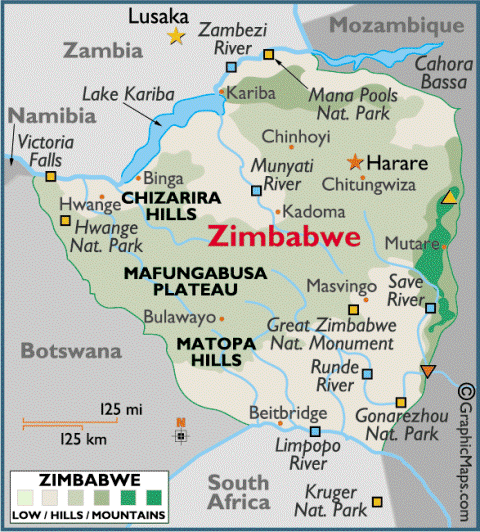
Zimbabwe-Map(Source: SW Radio Africa)

By Nomalanga Moyo
14 March 2013

The illegal seizure of wind-up radios reached new levels this week with reports that the police are now using primary school pupils to source information about the receivers.

Villagers in Lupane revealed that the police have been visiting schools and asking little children in Grade 0 and Grade 1(aged between 4 and 6 years) whether their parents own or listen to any radios.

This follows reports that suspected state security agents on Tuesday raided several homesteads at Mpofu village in the Gwampa area and confiscated the wind-up radios.

Speaking to SW Radio Africa one villager who asked not to be named for fear of reprisals, said the police have been going to schools, writing down names, and then visiting those suspected of owning the radios by night.

She said although the agents will be wearing civilian clothes, the villagers know it is the police since they have been announcing their ban on radios.

Our source said she suspects the police are aware of the popularity of shortwave radios in the area, hence they are now confiscating them.

“The police have been announcing that villagers should not be in possession of these radios. Their reason is that we listen to news broadcasts from outside the country which criticise ZANU PF.

“Such harassment by the state security agents normally escalates during election time, which indicates that we are not free to exercise our individual choices if we can’t even listen to different views offered by these shortwave radio stations,” she added.

On Tuesday an MDC official from Mpofu Village, Cosmas Phiri, told the NewsDay newspaper that MDC members were raided shortly before midnight on Monday.

Phiri, who was with some of the affected villagers, told NewsDay that a group of state security agents confiscated at least 10 radios from more than 10 people.

The night raids have stirred up fear within the community, following threats that those who refused to surrender their radio receivers will be abducted and “made to disappear” invoking memories of Gukurahundi.

Since the announcement of the constitutional referendum date on February 15th, Zimbabwean police have embarked on a nationwide campaign targeting civic society organisations and individuals.

On February 19th the police announced a ban on ‘specially designed’ radios, which they argued will be used to promote hate speech ahead of the polls.

Following the ban several organisations have been raided, including community radio initiative Radio Dialogue where police seized more than 180 wind-up radio sets and arrested its managing editor.

Last month, officers ransacked the offices of poll observers ZESN as well as those of violence monitoring group the Zimbabwe Peace Project (ZPP), in search of the so-called “illegal” radios.

The police have since arrested ZPP head Jestina Mukoko and charged her with, among other things, illegally importing short wave radios.

Thanks, Rich, for passing this news along. Read the full article and follow news on the radio ban at SW Radio Africa.