Tag Archives: Shortwave Radio

Radio World: “The Internet’s Impact on International Radio”

The Edward R. Murrow Transmitting Station Control Room

Many thanks to SWLing Post contributors, Dennis, Eric, and Michael who share the following story from Radio World. Please note my comments below following a short excerpt from this piece:

OTTAWA — During the height of the Cold War (1947–1991), the shortwave radio bands were alive with international state-run broadcasters; transmitting their respective views in multiple languages to listeners around the globe.

The western bloc’s advocates were led by the BBC World Service, and included Voice of America, Radio Liberty/Radio Free Europe, Radio Canada International and a host of influential European broadcasters. The eastern bloc’s de facto team captain was the USSR’s Radio Moscow (with its unique hollow, echoing sound), supplemented by broadcasters in Soviet satellite countries (like East Germany’s Radio Berlin International) and allies like Fidel Castro’s Radio Havana Cuba.

Then 1991 arrived, and the Cold War apparently ended with the fall of the Soviet Union and the destruction of the Berlin Wall.

In the seeming peace that followed, many governments no longer saw the sense in spending millions on multi-megawatt transmitters and vast antenna farms to keep broadcasting their messages globally.

The leader among them, the BBC World Service (BBCWS), trumpeted the web and webcasting as modern, cost-effective alternatives to expensive shortwave broadcasting (along with satellite radio and leasing local FM airtime in the countries they used to broadcast to). This is why the BBCWS ceased shortwave transmissions to North America and Australia in 2001 and Europe in 2008, while retaining SW broadcasts in less-developed parts of the globe.[…]

The full article is available here and quite a good piece exploring how the Internet has had an impact on shortwave radio broadcasting.

I, along with a number of fiends in the shortwave community–Bob Zanotti, Jeff White, Colin Newell, and Ian McFarland to name a few–we’re quoted in this piece.

As with most any published piece, quotes and statements are trimmed and edited to fit the print space. If you read the full article, you will have noticed some quotes from me. Here’s a larger portion of my full statement for this piece:

Most audience analysts agree that the number of shortwave listeners has been on the decline at the same time Internet access has been on the rise. Moreover, shortwave listener numbers are hard to quantify due to the very nature of anonymous listening; no one can truly “track” a shortwave radio listener. On the other hand, there is nothing anonymous about those who listen to or watch Internet content–not only can the audience be measured by numbers, but a much deeper and more invasive set of data can be gleaned from an online audience. Thus the decline in shortwave also denotes a loss of anonymity on the part of the listener.

This is not to say there aren’t shortwave listeners. A significant number of listeners are radio enthusiasts/DXers who appreciate the shortwave medium. But perhaps more meaningfully, shortwave listeners are those living in rural and remote parts of the world who benefit from the instant, free, and anonymous information shortwave provides.

At Ears To Our World, we received this photo from a school in rural Tanzania in June 2019. The teacher has been using one of our self-powered shortwave radios to listen to news and improve language skills.

Some broadcasters effectively target both of these audiences. Large government broadcasters, however, have always tried to reach the “influencers” in a country–those who might eventually help guide a country’s policy and international relationships. And the great majority of these influencers, according to audience research, have moved to social media and the Internet as a source of information.

Note that I received the photo above in June. At Ears To Our World, we still work with communities that appreciate the accessibility of radio. Perhaps our partners are more the exception than the rule, but there are still those who benefit from radio–especially those living in rural and remote areas. Where large government shortwave broadcasters are pulling out of the scene, often community-driven stations are taking their place. We’ve been working with Radio Taboo in Cameroon, for example, and they are an amazing case in point.

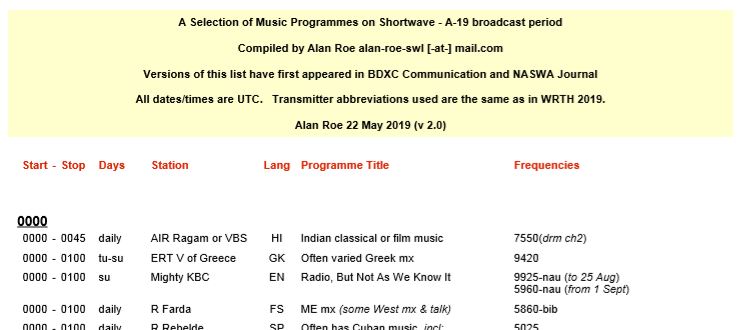
As a radio enthusiast, I’ll also add that I love the homegrown nature of shortwave broadcasting these days. As private broadcasters have a larger market share of the airwaves, individuals have an opportunity to buy their own broadcast time and produce amazing, unique shows like VORW, Free Radio Skybird, Encore, From the Isle of Music and Uncle Bill’s Melting Pot. These are just a few examples–if you’d like more, just check out the latest edition of Alan Roe’s guide to music over shortwave.


Do you enjoy the SWLing Post?

Please consider supporting us via Patreon or our Coffee Fund!

Your support makes articles like this one possible. Thank you!

“Father Knows Best” episode features shortwave radio

Many thanks to SWLing Post contributor, Dave Zantow (N9EWO), who notes the following episode of “Father Knows Best” (link below) features shortwave radio. Dave also points out that the website streaming this episode can be somewhat slow to load, but is very watchable.

Click here to view on Shout Factory TV.

Thanks for the tip, Dave!

What’s your favorite shortwave listening story?

Many thanks to SWLing Post contributor, Zack Schindler (N8FNR), who writes:

Back in the 1980’s I was tuning around and came across two guys talking back and forth in a non-ham portion of the HF spectrum. They were not using any callsigns which I found weird so I kept listening. It became obvious that one guy was on the ground and the other was in a plane. The guy on the ground was trying to give the other guy instructions on where to land. The pilot kept saying that he was not seeing any of the landmarks that the other guy told him to look for. The man on land then gave the pilot a beacon callsign to navigate by so I looked it up and it was in the Yucatan. The pilot said that he was not receiving the beacon but after a bit said that he could see a water tower in a town. He flew near the tower and read off the name and it was a town in the panhandle of Florida.

So it appears to me that they were probably drug smugglers and the pilot was so bad that he was off course by 700 miles or so. I always wondered how this story played out.

Please reply with your favorite SWLing story here. I look forward to reading yours.

What a great idea, Zack!

In fact, I’ll sweeten the pot…

Next Sunday (July 14t, 2019) I will pick a commenter at random from this post and send them a copy of Joe Carr’s Loop Antenna Book which has been graciously donated by Universal Radio.

This is open to anyone, anywhere–I’ll ship it globally.

Please comment with you favorite shortwave listening story!

[Note: Please include a valid email in the email address field of the comment form, else I will not be able to contact you to get your shipping address. We never share your email or use it for any other purpose.]


Do you enjoy the SWLing Post?

Please consider supporting us via Patreon or our Coffee Fund!

Your support makes articles like this one possible. Thank you!

The Hindu: “AIR may have to power off short wave transmissions”

(Source: The Hindu)

If Prasar Bharati has its way, All India Radio will have to stop all global short wave transmissions — eighty years after it began international broadcasting in 1939. AIR is resisting the move arguing that it will curtail its global reach.

There are about 46 short wave transmitters that run both domestic and external services. Out of these, 28 are used for the external services alone. Barring three transmitters that were recently installed, all the others will have to be shut down over the next six-months. The external services are broadcast to 150 countries in 13 Indian languages and 15 foreign languages.

Prasar Bharati had written to the AIR in May third week asking it to come up with a proposal to phase out the short wave transmitters.[…]

Read the full article at The Hindu.

All India Radio: Prasar Bharati seeks proposal to phase out shortwave broadcasting

All India Radio (AIR) Headquarters in Dehli, India. Photo courtesy of Wikipedia.

(Source: The Hindu)

by Sobhana K. Nair

Prasar Bharati has asked it to come up with a proposal to phase out SW transmitters

If Prasar Bharati [India’s largest public broadcasting agency] has its way, All India Radio will have to stop all global short wave transmissions — eighty years after it began international broadcasting in 1939. AIR is resisting the move arguing that it will curtail its global reach.

There are about 46 short wave transmitters that run both domestic and external services. Out of these, 28 are used for the external services alone. Barring three transmitters that were recently installed, all the others will have to be shut down over the next six-months. The external services are broadcast to 150 countries in 13 Indian languages and 15 foreign languages.

Prasar Bharati had written to the AIR in May third week asking it to come up with a proposal to phase out the short wave transmitters.

‘Whimsical’

A high-ranking AIR official called it a whimsical decision. “There will be a huge implication on external services. The short wave is the only effective way to reach to any part of the world. FM and other modes don’t work. Even live streaming on web can’t be complete substitute to this due to varied penetration of internet connectivity. Any country that wants to scuttle Indian radio can just shut down our web channel.”

Prasar Bharati CEO Shashi Shekhar Vempati denied that discontinuing short wave will impact global outreach. He said there would be fresh investments in expanding in DD India, AIR World Service and Prasar Bharati’s Gobal Digital Platform. “Going forward, AIR world service will be primarily a digital service which will leverage FM and Medium Wave capabilities where available and short wave in a limited way for strategic purposes. We will also explore hiring airtime in transmitters outside India on a need basis where feasible,” he told The Hindu.

China has recently started buying air time on Nepalese radio channels for its programmes. India too may soon follow suit.

Limited audience

A study on short wave transmitters conducted by the Prasar Bharati had revealed that shutting down these transmitters would save the AIR nearly ?60-70 crore. The majority of the transmitters were nearly 25 years old and obsolete. “Short Wave, as a mode of transmission, has very limited audience, which is further dwindling with time. The short wave network will be rationalised so we are able to invest more in content and in newer ways of broadcasting, like Internet streaming, digital radio and in future satellite radio. We will, however, preserve a limited set of short wave for strategic purposes and national interest,” Mr. Vempati added.[…]

Click here to read the full article at The Hindu.

Alan Roe’s updated A19 season guide to music on shortwave

Many thanks to SWLing Post contributor, Alan Roe, who notes:

I attach an updated version (version 2) of my “Music Programmes on Shortwave” PDF list for the current A-19 broadcast season for you to consider adding to your SWLing Post pages. I hope that you find it of interest. As always, I appreciate any updates or corrections.

Alan, thanks so much for keeping this brilliant guide updated each broadcast season and for sharing it here with the Post community! I always keep a printed version of your guide at my listening post!

Click here to download a PDF copy of Alan Roe’s Music on Shortwave A-19.

Gene seeks input on source of HF voice chatter

Many thanks to SWLing Post contributor, Gene Paradis, who writes:

I have something to share…It is on every night on 5.620 MHz around 010 UTC some folks talking language unknown..It goes on most of the night..This is an aero frequency but these folks are there every night. Hope to find out more. Maybe fishing vessels or something else–? It is these mysteries that make this hobby fun!

My schedule as of late has not allowed dedicated listening time on this frequency. I would certainly suspect fishing vessel communications, but can’t confirm.

Post readers: can you help Gene identify this over-the-air chatter? Please comment!