By Jock Elliott, KB2GOM
My friend Andy, who is an expert medium wave DXer, calls it his “weapon of choice” and a “DX machine.” In fact, just a night ago, using a YouLoop passive antenna hanging from a birdfeeder on his porch in upstate New York, he snagged a couple of tiny Mexican stations above 1600 kHz at a distance of over 2000 miles. He was surprised the stations were there, and it was a bit of a hunt on the internet to find their livestreams and ID them.
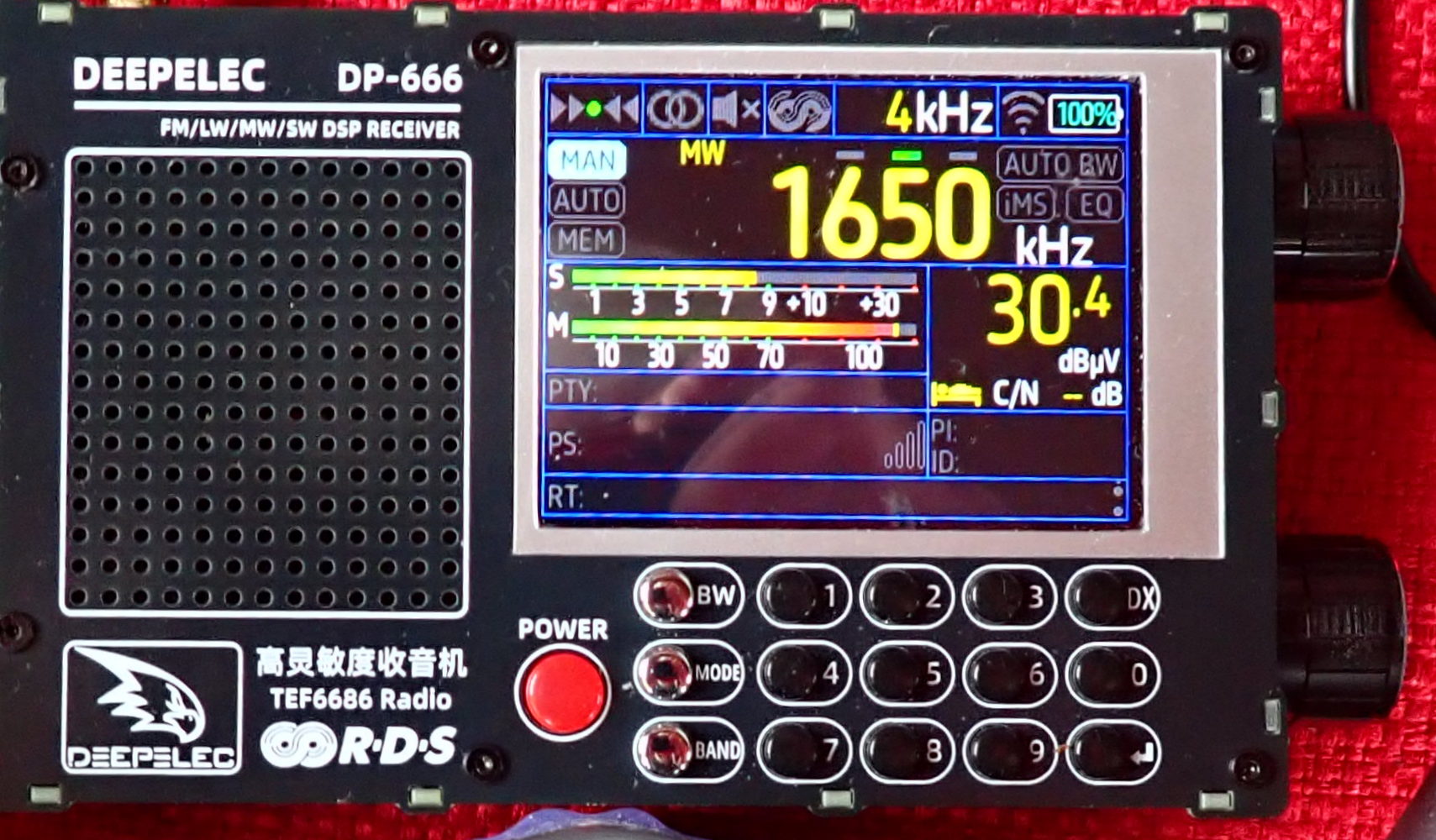
The radio that made hearing these diminutive stations possible is the Deepelec DP-666, a radio based on the high-sensitivity, high-selectivity TEF6686 chip which is used in automotive radios. The DP-666 measures 5 inches wide (excluding knobs) by 3 1/8 inches high by 1 1/8 inch deep. On the front panel are a speaker grill, a 2.8-inch color display, and 15 buttons for various radio functions (including a full numeric keypad for direct frequency entry) and a red power button. On the right side are tuning and volume knobs. On the bottom panel is a master switch for power. On the left panel are a 1/8-inch headphone socket and a USB-C port for a communication interface and for charging the 5000 mAh rechargeable battery, which is not user-accessible.
The DP-666 can receive FM (from 65-108 MHz with various frequency ranges selectable for different parts of the world and over a dozen different bandwidths), SW (from 1700-27000 kHz), MW (522-1791 kHz, 9 kHz steps; 520-1720 kHz, 10 kHz steps) and LW 144-513 kHz. In AM mode, 3/4/6/8 kHz bandwidths are available. The DP-666 does not offer single-sideband reception.
You won’t hear anything, however, unless you connect an antenna to the standard SMA female connector on the top panel of the radio, because the DP-666 has no internal antenna. The DP-666 comes with a 29 ½ inch whip antenna that does a yeoman job of receiving MW and FM. For MW DXing, Andy prefers the passive YouLoop, and he uses the DP-666/YouLoop combo frequently. “It’s quiet,” he says.
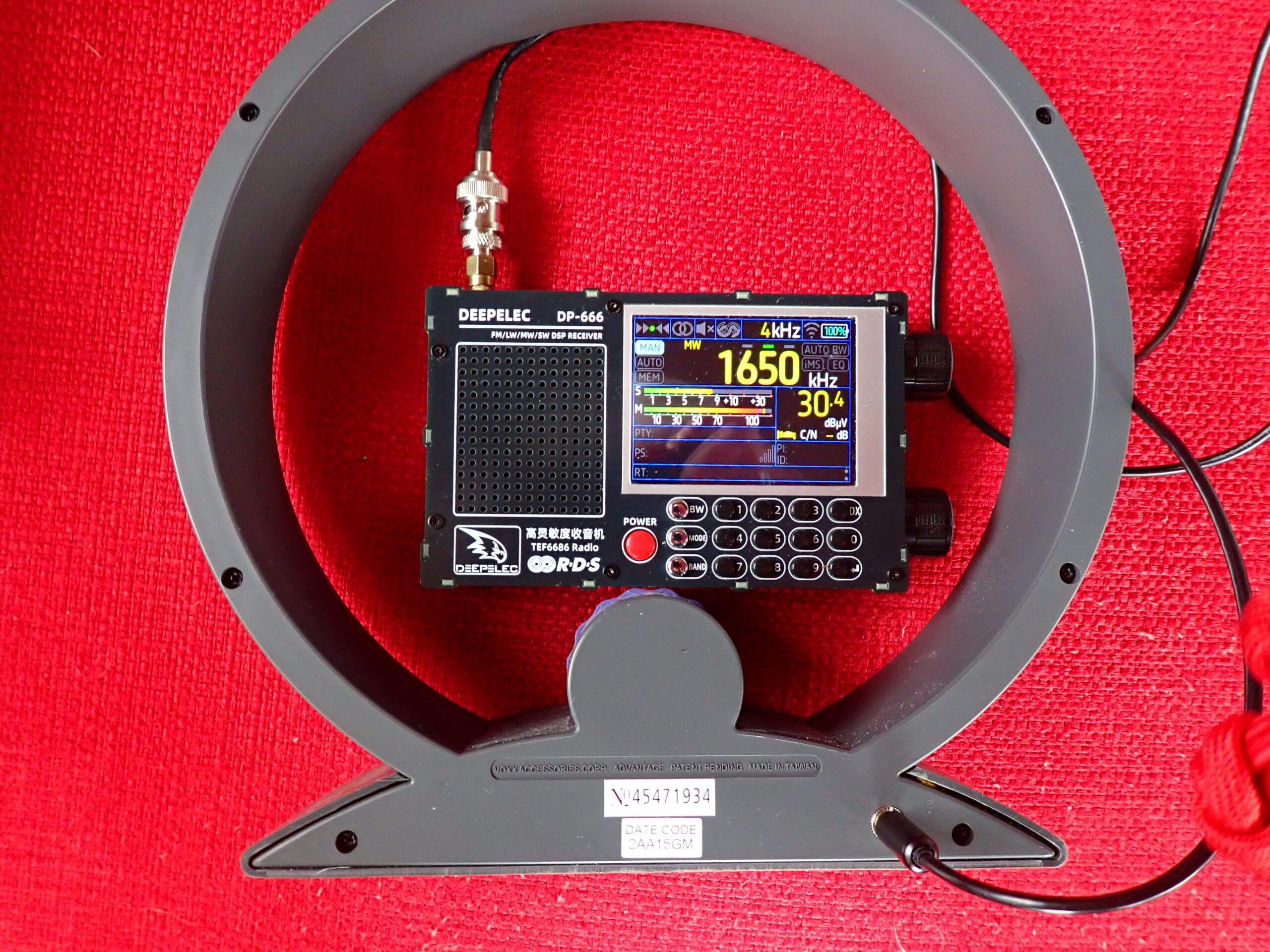
For MW reception, I like a direct cable connection between the DP-666 and a Terk AM Advantage, which is an un-amplified loop antenna with capacitive tuning. I can hold the Terk antenna in my left hand (which allows me to rotate it from side to side and even tilt it for improved reception), and with my thumb, I can rotate the antenna’s tuning wheel for peak reception. At the same time, I hold the DP-666 in my right hand and operate the tuning knob with my thumb and forefinger. It looks a little weird, but works really well.
For FM reception, I use a scanner antenna, a Comet W100RX extended to about 31 inches. The DP-666 display offers a full complement of RDS information if transmitted by the FM station. I am not, by any means, an expert FM DXer, but it seems to be a “hot” receiver.
For SW reception, the DP-666 also works pretty well with the whip antenna that comes with it. When connected to my 50-foot indoor horizontal room loop antenna, it detected a lot of shortwave stations on auto-scan. My guess is that dedicated shortwave DXers will be pleased with this pocket-sized radio.
In addition to its excellent electrical performance on MW, SW, and FM (I did not test LW), there are a couple of things about the DP-666 that I really love. The first is that, straight out of the box, the DP-666 is easy to use without consulting the manual. However, if you want tons, and tons, and TONS of customizability, press and hold the MODE button to access the MENU screens, where you can “fiddle the bits” to your heart’s delight. I have never used any of these settings, but they are there if you want them. (I think I consulted the manual just once to learn how to store stations in memory.) The well-written manual can be downloaded in PDF format here: https://deepelec.com/files/dp-666/DP-666_Product_Manual_EN.pdf .
The second thing that delights me about the DP-666 is that it is a quiet radio to operate. The clicks from the buttons are soft, and the tuning knob has detents that are felt, not heard. With headphones on, I can seek distant stations without disturbing others in the room.
Bottom line, the Deepelec DP-666 is a sensitive and easy to use radio that delivers pleasing results on MW, SW, and FM. I would be delighted to hear from others who have used it, particularly with high-performance antennas.