
 by Paul Jamet
Looking for a versatile radio?
Which radio listener hasn’t dreamed of owning a portable multi-band receiver allowing them to explore the widest possible radio spectrum?
For nearly a year now, walkie-talkies have appeared on the market which, beyond the classic VHF–UHF functions, also allow listening and transmitting on CB (27 MHz) as well as listening to LW/MW/SW bands (LSB/USB/CW). The RADTEL RT-860 has won over those who have tested it.
Read here: Dan Reviews the Radel RT-860
The arrival of the Quansheng TK-11 — available in three versions — has caused quite a stir on social networks. Then, almost at the same time, the RADTEL RT-880 and RT-880G (G for GPS) appeared, also sold under other names such as iRadio UV98.
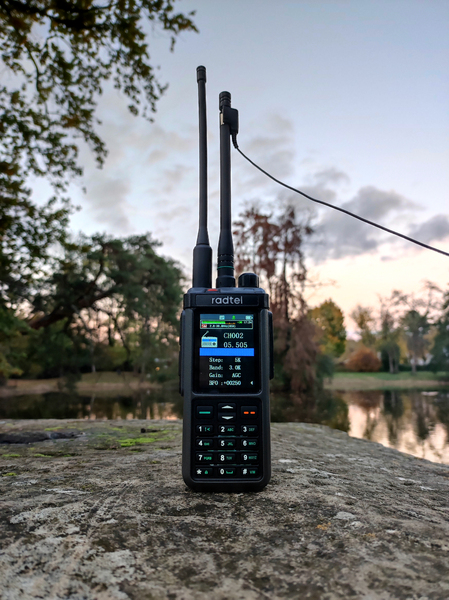
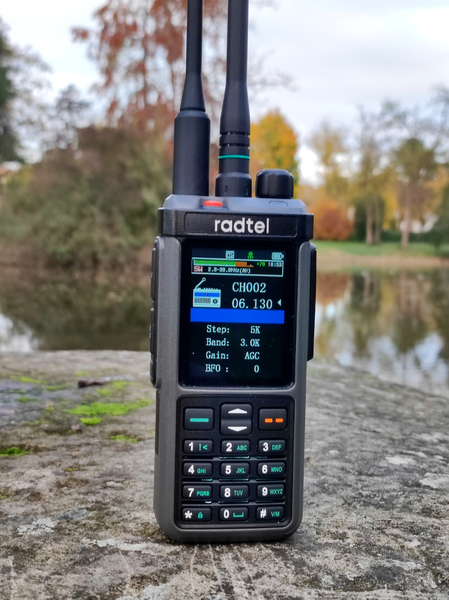 Among all these available models, I chose — as a radio listener, especially when I’m traveling — the RADTEL RT-880G. My choice is explained mainly by its antenna connectors (SMA-Female and SMA-Male), its large color display, its GPS module, its thousand memory channels, and the possibility of simultaneously monitoring three VHF/UHF frequencies. This device is highly customizable, but its user manual would deserve to be much more detailed and explicit.
The RT-880G comes with a “standard” 18 cm antenna for VHF-UHF bands, which is also used for FM station reception. I haven’t yet tested the device on the 27 MHz (CB) band, for which a dedicated antenna is preferable. No antenna is provided for LW/MW/SW listening.
For listening to LW/MW/SW bands, the device is often shown with small donut-type loop antennas (10 cm diameter).
 However, for easier transport, I simply chose this small telescopic SMA-Male antenna, 48 cm long (weight: 20 g): to which it is possible to clip a wire antenna, such as the SONY AN-71, which can prove very useful.
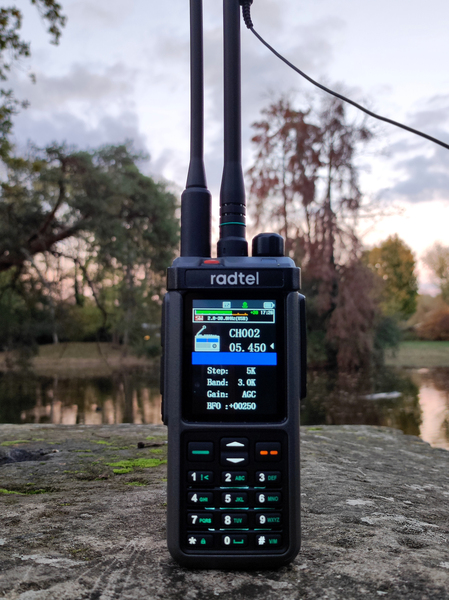 I also used an antenna normally intended for CB, the ABBREE 27 MHz telescopic antenna (130 cm), admittedly heavier (weight: 78 g) and bulkier, but which gives very good results for the HF band.
The purpose of this contribution — which concerns only listening — is to arouse curiosity among mobile (or stationary) listeners, to invite those who own this walkie-talkie to come here and share their experience, and to collect your comments. It is therefore not a full review of the RT-880G, but simply an illustration of what it offers for listening to LW/MW/SW bands.
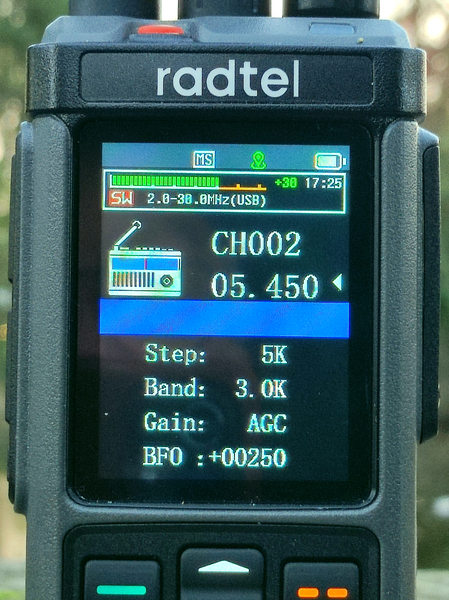
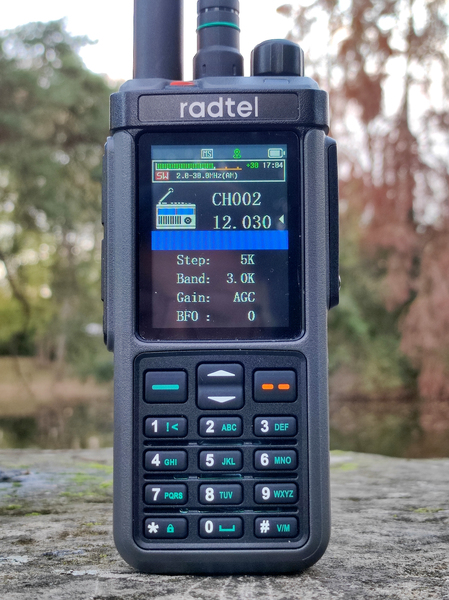
For LW/MW/SW bands, the RT-880G allows you to set the:
- step to 1 – 5 – 10 – 50 – 100 – 500 – 1,000 – and 9 kHz],
- bandwidth [0.5 – 1.0 – 1.2 – 2.2 – 3.0 – 4.0],
- AGC (Automatic Gain Control)
- BFO – (Beat Frequency Oscillator) – used for fine tuning SSB reception (the minimum step being 1 kHz).
Sample Recordings

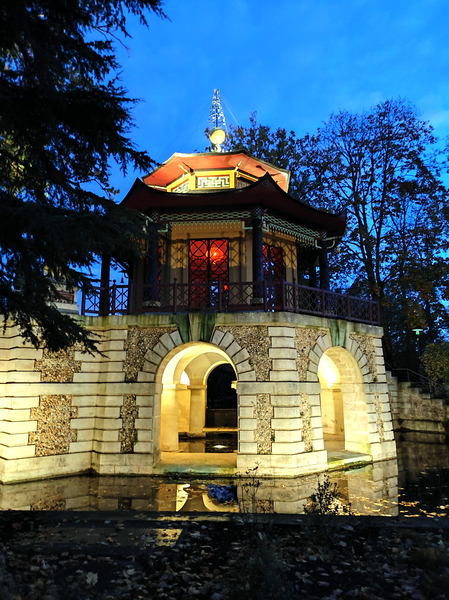
Local park where some of the recordings were made.
Here are a few audio files that will help you form an opinion. The recordings were made with a smartphone placed near the receiver. The recordings were made using a smartphone placed near the receiver. The sound quality is quite good, even surprising.
LW – Long Waves
In Europe, most LW transmitters are now off the air.
The BBC still broadcasts Radio 4 on 198 kHz from Droitwich — distance: 467 km:
My DSP receivers (Tecsun PL-330, XHDATA R-108 and D-808) do not allow me to listen to BBC 4!
MW – Medium Waves
Medium waves are still widely used in Europe. Among the many stations received with the RT-880G:
- Lyca Radio broadcasting from the United Kingdom on 1458 kHz with a 125 kW transmitter from Brookmans Park Transmitting Station, north of London — Distance: 337 km
- Nemzetiségi Adások broadcasting from Marcali, South-West Hungary with a 300 kW transmitter — Distance: 1167 km
- Radio Alger International on 531 kHz from F’kirina Wilaya with a 600 kW transmitter — Distance: 1548 km
For MW, reception is at least as good as with the previously mentioned DSP receivers.
SW – Shortwave
But of course, it’s on shortwave that the RT-880G is really expected to shine, particularly in SSB. Here are some examples:
From my balcony:
- The Voice of Vietnam – VoV5 – in English, broadcasting from Sontay — Distance: 9156 km
From parks near my home (along the Oise River or a pond — reception is better near water). I mainly tried to catch low-power transmitters such as:
- Radio Slovakia International on 6005 kHz broadcasting from Kall Krekel in Germany with a 1 kW transmitter — Distance: 350 km
- Radio Europa — Dutch station on 6130 kHz broadcasting from Alphen with a 1 kW transmitter — Distance: 327 km
Cf. https://swling.com/blog/2025/11/radio-europe-shares-station-details-and-photos-with-paul-jamet/
- REE – Radio Exterior de España — Spain on 12030 kHz broadcasting toward the Middle East from Noblejas with a transmitter of 200 kW — Distance: 1111 km
Finally, I compared the reception of two VOLMET broadcasts — RT-880G and XHDATA D-808 — using a 7-meter SONY AN-71 wire antenna:
- Shannon VOLMET from Ireland on 5505 kHz USB — Distance: 875 km
- RAF VOLMET from Croughton on 5450 kHz USB — Distance: 401 km
Amateur Radio
Regarding amateur radio, here are two short clips:
What do you think?
 Personally, this receiver offers many possibilities. With a minimum of equipment — the receiver (RT-880G: 341 g with the supplied VHF/UHF antenna and the small 20 g antenna), possibly a SONY AN-71 wire antenna (54 g), and the smartphone that will inevitably come along to record received stations, check frequency tables, etc. — the total weight is under 400 g, not counting the smartphone!
The RT-880G is currently available for about €80; without the GPS module, the RT-880 costs about €60.
The RT-880G has not yet revealed all its secrets! Its firmware is constantly evolving… There is still much to discover.
For reference, see the RT-880G manual and a few videos available on YouTube.
Paul JAMET
Purchasing Options
- Radtel Website
- Amazon.com (note: this is an affiliate link that supports the SWLing Post at no cost to you)
- Aliexpress
Thanks for the review Paul. I checked out their website and am very impressed with the many radios they offer for sale. I especially like the many different colors. Tnx es 73’s.
Thanks for the review Jock. I checked out their website and am very impressed with the many radios they offer for sale. I especially like the many different colors. Tnx es 73’s.
Sorry, I meant this post for Paul.
Hi, Jock,
Thank you, Jock, for your very kind comment.
I wish you a wonderful day and look forward to reading your comments again soon.
Paul JAMET
Doesn’t it use SI4732 for shortwave reception? 🙂
Indeed it does use the Si4732 chip. Unfortunately, in Radtel’s implentation they have not enabled more than the 10 kHz bandwidth on AM. Tuning in ECSS mode (SSB) is always an option for narrower filters, but then you are slowed by having to adjust the BFO, sometimes as much as 300+ Hz per band to achieve clear speech. The radio does not remember your previously used BFO settings, either! The Tecsun and XHDATA receivers with SiLabs chips are usually not *that* far off from even kHz alignment.
I like the Radtel HTs a lot for their usual VHF/UHF coverage and they are a great value for the money! Unfortunately in my opinion they need to incorporate some of the “ease of use” features found in the competing brands such as Tecsun and XHDATA.
The RT-880, like the RT-920 and RT-950 Pro that I have owned, only lets you use a single 10 kHz wide bandwidth in AM mode. This is a big drawback, as other SiLabs based radios like most Tecsuns give you a variety of AM filters.
Only the SSB modes in the Radtel models allow use of the multiple bandwidths. In addition you are always needing to use the BFO to get ham radio SSB voice clearly, as it is not spot-on 1 kHz increments, and the radios do not remember the settings between band changes on HF or MW.
I had hoped the Radtel radios would be useful portable shortwave radios in the HT form factor, but I was left disappointed.
Thank you very much for your comment. Have a nice day.
Can you transmit on CB without a license?
No sure about your location, but no license is needed for 11-meter CB in the United States. Several other countries have “citizen’s band” allocations around the 26-28MHz spectrum, though the channel frequencies can be different.
https://en.wikipedia.org/wiki/Citizens_band_radio
That said, AFAIK, this portable only supports FM transmitting. FM CB is authorized in the US, but finding other FM CB users could prove elusive as AM and SSB are the far more popular options.
Paul,
Thank for for doing this. I am “officially” impressed . . . and I don’t impress easily.
Cheers, jock