Author Archives: Thomas

John’s In-Depth Review of the Choyong LC90 (Export Version)

Many thanks to SWLing Post contributor and WWLG author, John Figliozzi, who shares the following review:

A Review And Analysis Of The Choyong LC90 (Export Version)

By John A. Figliozzi

General

To my knowledge, this is the first radio to combine AM Shortwave with Internet Radio.  This makes it the first true “full service” radio incorporating ALL of radio’s major platforms.  Many radio listeners question why this hasn’t been done sooner, so this very good first effort is most welcome.

The initial presentation of the radio to the new owner is impressive.  The stylish box in which it arrives is worthy of a respected instrument of high quality.  The radio has the solid substantial feel of a device with excellent build quality.  Its sizing – that of a paperback book along the lines of some previous well-respected AM/FM/SW receivers like the Grundig YB-400 – gives it the perfect form factor for a radio that can be enjoyed both in the home and as a portable.

There is so much to like here.  Over and above its unique combining of Internet radio and shortwave, there’s a “permanent” battery that offers many hours of use before it needs recharging, ATS tuning, the ability to save frequencies and stations in several preference lists, several ways of searching for Internet radio stations, an easy way to add Internet stations not already listed by the manufacturer, and others.

But the LC90 really shines with its fantastic audio on FM and Internet radio.  There’s a woofer, a tweeter and a low frequency diaphragm inside the speaker cavity that occupies the left half the case – and nothing else.  The radio’s excellent build quality and its developers’ efforts to produce a world class audio section in a portable radio really pays off.

But no radio is perfect, and this one obviously is a work in progress.  So, being critical – which is what a review and analysis like this does — should not imply disapproval on any level.  On the contrary, the LC90 is already a well-formed radio worthy of consideration by any purchaser.

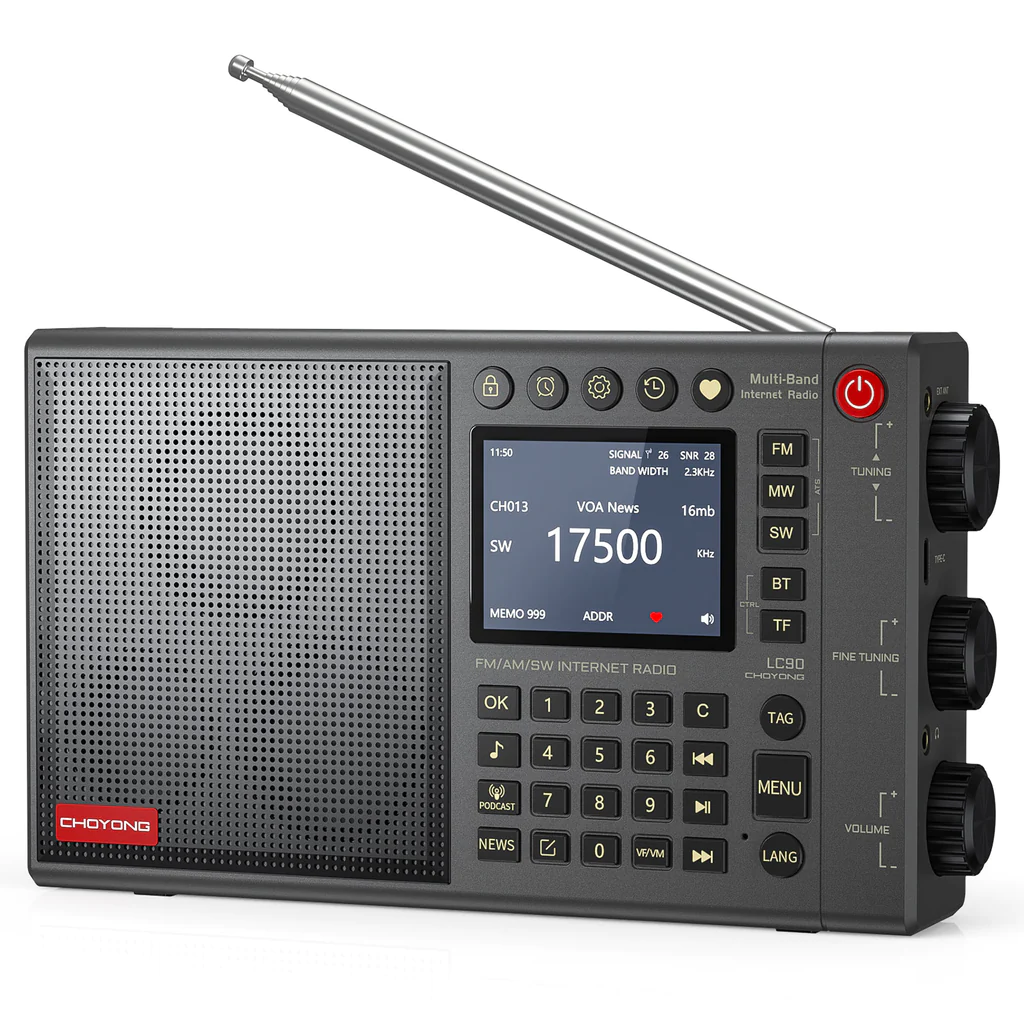
The Screen

The screen that is the center of the LC90 provides much information depending on the platform being used.  But in some cases, useful information is missing and in other cases the information provided seems unnecessary or of questionable utility.

In AM (MW), FM and SW, it is not readily apparent what all the symbols mean or why they are there.  The time, signal strength and SNR (signal to noise ratio), bandwidth, meter band, heart (for including a frequency in “favorites”) and the “Freq. vs. Addr.” indicators are all helpful and understandable.  But what is meant by “Memo” isn’t entirely clear.  Is it holding just my preferences?  Or the number of stations found by ATS?  Or something else?

So, too, with the Internet Radio screen.  What do the three dots, the speaker icon and the return icon mean?  The ability to tune stations in sequence as they appear across the bottom of the screen depending on mode is both unique and helpful.  But the use of a timer to tick off how long one might listen to a particular station seems of dubious value.

Some suggestions for better use of the screen in some circumstances are detailed below.

Operation

Initial setup matching the radio to home internet service proceeded flawlessly.  The time clock is in 24-hour mode and showed correct time and date in my time zone.  Some purchasers had previously noted that the clock showed a time one hour earlier than the actual time.  I surmise that this is because the clock remains in standard time year-round.  There is no facility to reset the clock, compensate for seasonal time changes or set the clock manually.  This is an oversight that should be addressed.

This is a sophisticated, multi-faceted radio.  As impressive as it already may be, it should be perceived as a work in progress in need of the improvements it will get eventually through firmware updates and design modifications.  It would be helpful if those updates could come directly and seamlessly through the Internet, something that apparently can’t be done currently.

The LC90 comes with a rather short, almost cryptically worded pamphlet.  This can serve as an ok quick start-up guide.  But after using the radio, it’s obvious that there’s need for a comprehensive operation manual with copious directions for the user, along the lines that Eton provided for the E1.  A radio of this quality and at this price point demands such consideration.

In short, becoming fully familiar with and comfortable using all the features of the LC90 requires a prodigious learning curve, one that is not intuitively discerned.  I have to say that even after using it almost constantly for a few weeks, I feel I am still missing things.

Just a few examples of aspects that go unexplained include:

  • What does “Auto Play” mean in Settings?
  • Getting to preferences (the “heart” icon) is confusing and I’ve inadvertently removed them without learning how it happened.
  • Why does the screen show “Please add radio channel first” when I think I’ve already done that?
  • Why does screen alarmingly show “Saved channels removed”, having done so when I press the tuning dial thinking I am obtaining a list of my preferred or saved stations?

The cleverness behind the LC90 is not intuitively apparent.  If I hit the wrong keys in combination or hard press instead of soft press a key, I get a result I don’t understand and for which there is no explanation in the exceedingly short manual provided now.  In some cases, I put myself in a corner I can’t get out of, so I must reset by shutting down and restarting the radio to get back to base.

Following are my observations on the performance of the LC90 by platform:

FM

The LC90 has a very good FM section that is quite sensitive.   Using the ATS feature, (automatic tuning) it found 37 stations in Sarasota FL, for example.

For its size – and even considering many larger radios — the LC90 has an excellent audio response on FM.  However, although it has activated stereo capability, it does not appear to actually provide stereo through its ear/headphone jack. This is because the same output is used to provide audio to the speakers and the ear/headphone jack.  This feels like an oversight that should be rectified.  The radio does “recognize” a stereo plug and audio does play into both ears.  It’s just not stereo audio.

As currently configured this LC90 does not offer RDBS (RDS in Europe) on FM.  This should be incorporated into a radio of this quality being offered at this price point.

Even so, in this user’s opinion it earns a 4.5 on scale of 5 on FM.  But if it had stereo and RBDS, it would easily earn a 5.

A question arises:   Were HD Radio (in North America) and DAB+ (in Europe and Australia – if these are targeted markets for the LC90) considered for incorporation into this radio by its developers?  If not, why not; and, if so, why was a decision taken not to include them?

Shortwave

Performance of the LC90 on shortwave is very good, especially since it clearly is not intended as a hobbyist’s DX machine.  As such in my opinion, it doesn’t require the SSB capability that some have said they wish it has.

Rather, this radio is intended for the content-focused listener.  I view the AM (MW), FM and SW platforms as back-up alternatives for and secondary to the primary focus — Internet Radio.  Nonetheless, the LC-90’s performance is above average on both FM and SW which should be assuring to anyone considering its purchase.

The LC90 is quite sensitive on SW for a small portable using just its built-in expandable and rotatable 9 stage rod antenna.   But it does especially well when a common clothesline reel external antenna is extended and plugged into the receptacle provided for that purpose on the radio’s right-hand side.  (Similar improvement is noted for AM (MW) and FM, as well.)

Complaints about placement of this receptacle close to the tuning knob is of no concern when an external antenna of the type described above using a 3.5mm plug connector is used.  Any more sophisticated an external antenna would likely overload this radio considering that “birdies” – false signals internally generated by the radio itself — can be detected throughout the SW spectrum even when just using its built-in rod antenna.  This flaw should be addressed in any future modification or upgrade.

The audio enhancements made on this radio through unique use of speakers and their orientation are not as apparent here as they are when listening to FM and Internet Radio.

On AM signals generally — both SW and AM (MW) – a listener can detect artifacts in the audio.  Audible random “clicks” often can be heard – usually when receiving weaker stations – which sounds as if the radio’s audio section is clipping.   Adjusting the bandwidth appears to offer only minimal help with this.

Indeed, the audio produced by SW and AM (MW) sounds somewhat mechanical except on very strong stations.  It seems to lack body or depth on SW and AM.   Some of this undoubtedly is due to the quality of AM audio to begin with.  But the latter does sound more natural on other receivers.  The 7 bandwidths provided (1, 1.8, 2, 2.5, 3, 4, 6 kHz) do help to somewhat shape the audio, but it appears that there could be better choices for what this radio is trying to achieve.

Nonetheless on SW, the LC90 rates a comparative 3.75 on a scale of 5 for sensitivity off its built-in antenna.  That rises to a 4.0 when the external antenna described above is connected.

An unrelated anomaly was noted from using the radio on SW:  The LC90 (or at least this test unit) apparently cannot be tuned directly to frequencies in the 25 MHz (11m) band.  The radio will only accept 4 integers here, so it reverts to 120m instead of 11m.  Instead, one must press the tuning knob to change the display to 11m and then tune manually via the knob to the desired frequency.

AM (Mediumwave)

All Internet-capable radios up to now have avoided including AM – both MW and SW – into their designs due to noise and interference issues generated by the radio’s internal control signal and screen, and the difficulty involved in shielding both.

While acknowledging the considerable effort put forward by the LC90’s developers to ameliorate this problem, the radio does not fully overcome these challenges to producing “clean” AM audio.

The developers themselves seem to recognize this problem.  While they have incorporated an internal ferrite MW antenna in the radio’s design, its utility is overwhelmed by internal interference.  Rotating the radio to emphasize or null certain signals yields no apparent difference.  Consequently, the developer suggests that the listener extend the internal rod antenna for “best results”.

The AM (MW) section is unfortunately the weakest aspect of this radio.  Daytime reception is very poor – rated comparatively a 1.5 on a scale of 5.  The LC90 receives and saves through ATS only very local stations and misses several of them.

Reception does improve after dark, largely due to skywave propagation.  But it is only comparatively fair – 2.5 on a scale of 5.

Using the external clothesline antenna described above improves daytime reception to a 2.0, but those purchasing this radio should expect only marginal pedestrian – even comparatively substandard — results with AM (MW).

In sum, the audio improvements the LC90’s developers have successfully worked to provide elsewhere in the LC90 are almost undetectable here unless one is listening to an exceptionally strong AM (MW) station.

Internet Radio

To this observer, this is the core of the LC90.

There are three equally important tasks that an Internet radio must achieve to serve as a quality example for the genre:

  • Stability of signal reproduction,
  • Superior audio quality,
  • Easy user interface.

Let me begin by pointing out that it is readily apparent that the developers put lots of work into this aspect of the LC90.

The stations that do play successfully sound very good with excellent stability.  But compared to other internet radios I own and have experienced, there are just too many stations that lack that stability (characterized by frequent audio breaks or “hiccups”) or don’t load at all.

Here are some specific observations from use over several weeks:

Simply put, the user interface needs work.  While the LC90 offers several flexible tuning assists, there seem to be too many that overlap and others missing.  The effort does not seem to be centrally focused enough.  For example, listings within each category appear randomly, and many unexplainably with what looks like the same links that are indistinguishable and scattered throughout a given category.

Indeed, there are many individual listings that are repeated within the same and different lists which are found via the Tag, Menu, News. Music, Language buttons on the radio.  Why?  Is it to provide different codecs or levels of streaming quality?  There is no indication as to the way each might differ one from another, if at all.

As mentioned earlier, there is much going on here that cannot be intuitively discerned by the user/listener — and it must be!  Comparing it to other Internet radios such as the Pure Elan Connect, which uses the constantly updated Frontier Silicon station and podcast database, the LC90’s Internet radio operation is confusing and the logic behind it is difficult to perceive.

Some stations appear in Chinese and Cyrillic script, and others just as dots across a line.  This is unhelpful to listeners outside these cultures.  Also, there appear to be features within the LC90’s architecture that are “hidden”.  For example, through an inadvertent combination of key presses I found myself briefly in a listing that appeared designed solely for the Chinese market until I reset the radio by turning the radio off and then on again.

The developers appear to have created their own stations database rather than use one of the others already in use on other Internet radios.  Since it is apparently an entirely new approach, it’s impossible to determine if it is continuously updated, systematically modified or updated periodically according to some schedule.  This observer did not see any activity or change that would indicate that anything was updated over the weeks he was using the LC90.

Many domestic BBC links (Radio 3,4,5,6, e.g.) just don’t work.  When ostensibly “loading” them after selecting them, the percentage just stays at zero.  Given the importance of the BBC internationally, this is concerning and should be corrected with all deliberate speed.

In fact, this observer experienced an inordinate number of links that didn’t seem to work at all.  Some links also play initially, but then just “hang” or stop working or “hiccup” periodically (RTE, RTHK, e.g).

When comparing the LC90’s admittedly many offerings with those on Internet radios using the Frontier Silicon database, many stations appear to be missing.  However, the LC90’s developers have included in the radio’s architecture a very accessible means for the radio’s users to add stations that are not already in the radio’s database.  Whether these are just added only to the user’s radio or added globally to the LC-90 database is unknown.

In short, the way these lists — and the way the user tunes them in — work now appear to detract from rather than enhance the performance and user’s overall experience with the LC90.  This situation leads this observer to the perception that the developer’s concept(s) behind station lists and tuning is unfocused and disorganized.  This situation cannot be allowed to continue.  As stated, this user interface needs reconsideration and refinement in the opinion of this observer to make its use more intuitive for the user.

The LC90’s display for Internet radio is attractive but supplies only stream loading percentages and the station name.  There is no means of knowing the actual quality of the audio signal other than by ear.  The timer provided counting how long the station has been playing is not really of any practical use when listening to an Internet radio station.

A better use of the LC90’s screen would be to include visuals like station logos and station-provided metadata, neither of which are present now.

An anomaly that came to light through use:  The “Podcast” button only seems to provide stations like other buttons, not podcast lists.  This observer could find no way to access or listen to podcasts.  Again, this needs to be corrected.

In the opinion of this observer, the Internet section of the LC90 earns an overall 3.5 on a scale of 5 with the proviso that the radio’s audio performance with the highest quality Internet streams earns a clear 5.

Bluetooth

The LC-90’s Bluetooth feature works well.  Audio volume is jointly controlled by the source and the radio.  Its set-up and operation appear seamless.

TF and SIM cards

Not tested.  Since most SIM cards are tied to phones here, I anticipate that Internet access for the LC90 Export Version will remain with WiFi for the vast majority or, when and where WiFi is unavailable, by linking one’s phone to the radio using Bluetooth.

Neither was the timer or sleep function tested, but it can be assumed that both work as they should.

Final Notes

Other reviewers have expressed a desire for an air band, SSB capability and a fold out strip on the rear of the radio’s case so that it might be angled when used.

Frankly, I don’t see the need for any of these with the LC90 or any future enhancement or modification of it.  Anyone wishing to angle the receiver can find an inexpensive tilt stand on which to place it.  But, in that regard, I would suggest that the developer recreate the rod antenna so that it clears the perimeter of the case and allows it a full 360-degree rotation.

Otherwise, my preference would be that any such effort and the resources necessary to pursue them be concentrated on the more important matters I highlight for improvement in this analysis.
Last ‘From the Isle of Music’ from WBCQ on March 3, 2024

Many thanks to SWLing Post contributor, Bill Tilford, who notes:

The last broadcast of From the Isle of Music from WBCQ The Planet will be March 3 from 2200-2300 UTC on 7490 kHz.

He mentions that there simply hasn’t been the support from listeners in North America to continue broadcasting via WBCQ, thus listeners may need to use a WebSDR in order to listen to the regular broadcasts from Europe. Bill also notes:

The last episode will be a killer Cuban dance party – I am going out with a bang, not a whimper.

We look forward to tuning in! Thank you, Bill, for your dedicated music services over shortwave!

Dan’s Overview of the Stampfl Stressless Receiver Kit

Many thanks to SWLing Post contributor, Dan Robinson, who shares this review of the new Stampfl Stressless receiver:


The Stampfl “Stressless”

by Dan Robinson

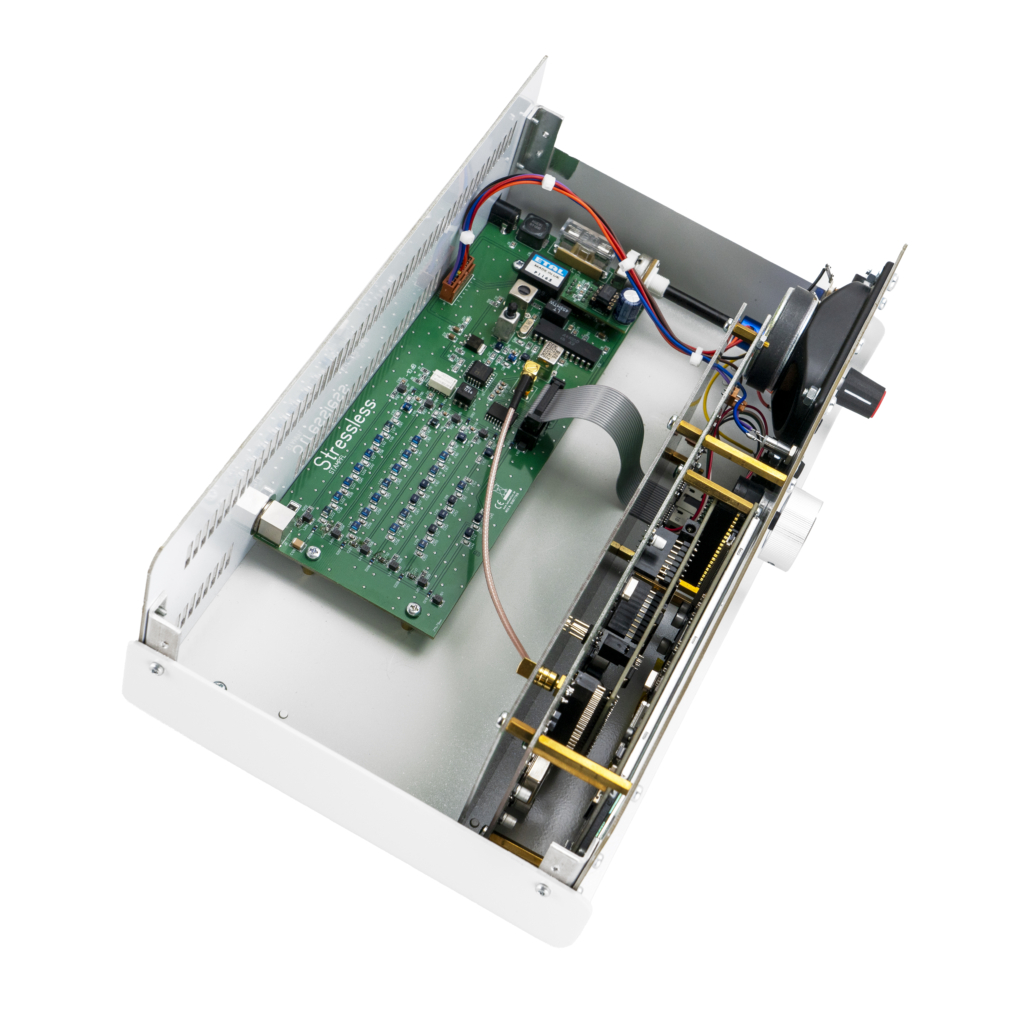
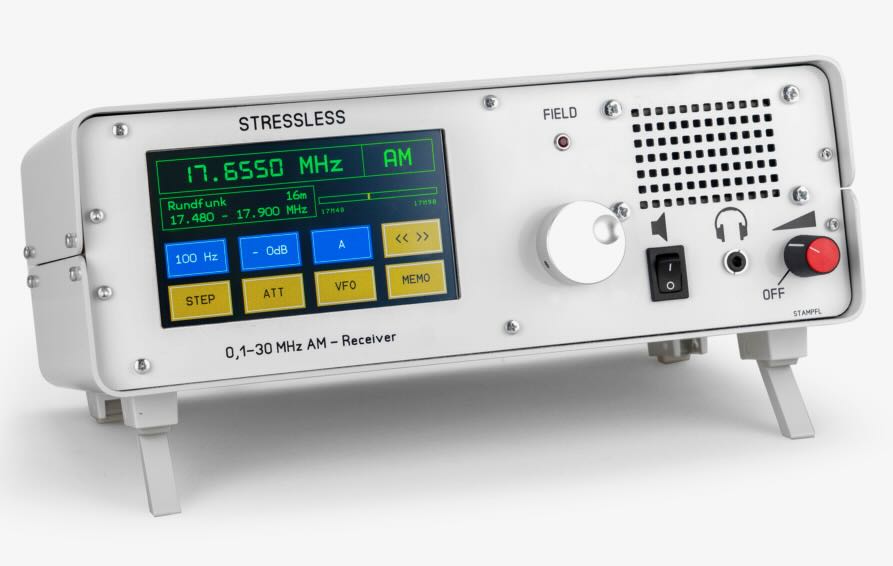
Stampfl based in Switzerland is well known as a manufacturer of excellent antennas, morse keys, and other equipment for amateur radio operators and SWLs. Now, Stampfl is offering what it calls the “Stressless” HF receiver. Housed in a beautiful heavy metal cabinet, one would think that there would be more to this than there is actually is — it’s a very basic receiver made, as the name implies, for those who want a minimum of stress in their HF listening.

Note: All photos have been sourced from Stampfl.

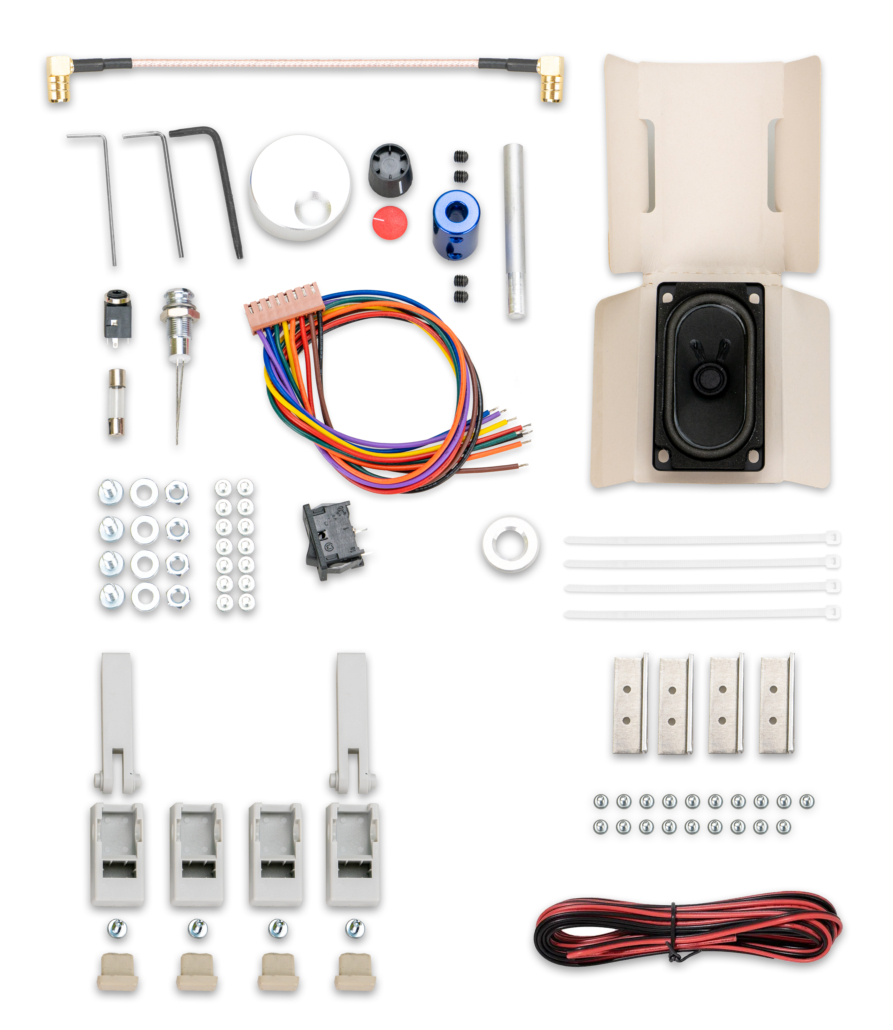
It is intended as an assembly kit, with some minimal soldering required. Heinz Stampfl notes that the VFO and RX board are fully assembled and tested. Total construction time is estimated a 1-2 hours. Star of the show on the Stressless is the large color display which enables changing of colors, tuning step, VFO A/B, attenuation, and memories. The single bandwidth has been well chosen — I had no problems listening to Voz Missionaria in Brazil on 9,665 khz though any stations requiring separation will be a challenge for this receiver since there is no SSB and that one bandwidth. The receiver tunes from 100 kHz to 30 MHz.

One would hope that firmware might be upgradeable, but Stampfl states that this is not possible, which is a bit of a puzzle. The receiver runs on 11-15V DC — the only other thing on the back of the cabinet is the BNC antenna input.

I’ll have more thoughts on the “Stressless” after I complete additional testing. So far, it has appeal as a very simple receiver with high sensitivity and a beautiful front interface. It might be a good choice for beginning SWLs, as many of them as there are out there, but the price/feature ratio is a bit of steep climb against the background of Tecsun portables with multi-bandwidth and SSB capabilities, not to mention the recently released Choyong LC90 which combines good SW, AM, and FM with Internet radio.

The “Stressless” — for those who can afford the price — would be good as an easy-to-use main listening receiver for stations not requiring much DXing skill or tools to separate. These days with the SW bands populated by fewer stations, this receiver might be fun to have around and it is certainly a good way to teach the radio hobby to newcomers.

The “Stressless” I am testing arrived well-packed in a clam-shell style inner box — it was already assembled by Stampfl for which I am grateful. The company also makes the X One Active Dipole antenna, which I am also testing at the moment and will have more on at a later date.

Click here to check out and order the Stampfl Stressless.

Video:

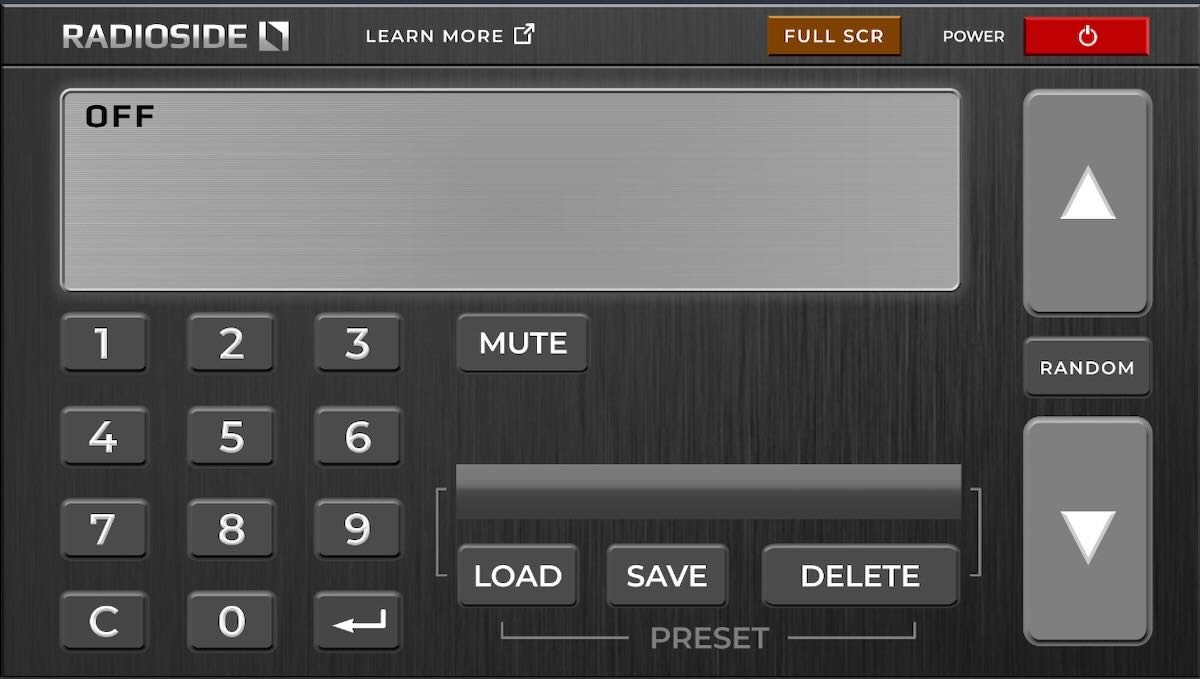
RadioSide: A cool, web-based, portable internet radio interface

Many thanks to SWLing Post contributor, Alex, who writes:

Thomas,

I am Alex and a reader of SWLing for quite a while, particularly in
terms of reviews and tests, very helpful and I appreciate your work.

As a listener myself enjoying my Tecsun PL-680 among others, I have
also created a website that looks like a radio, turning your spare
device into a radio, giving one similar experience to shortwave
radios, particularly in the aspect of operation and in the serendipity
of discovery new stations.

I figured I’d share it with you an would love to hear your thoughts.

This is something I enjoy using, not making any money from it and the
main purpose is the enjoyment I get, hoping others feel the same.

You can check it out at radioside.com

Sincerely,
Alex Dragusin

I think this is brilliant! Thank you for sharing–I love the auto-resizing SW portable interface! Very nice I’m bookmarking this right now. Thanks again, Alex.

Eclipse Radio: Several NASA-Funded Science Projects

Many thanks to SWLing Post contributor, David Iurescia, who shares the following article via NASA:


The Aug. 21, 2017, total solar eclipse douses Umatilla National Forest in shadow, darkening the sky and rimming the horizon with a 360 degree sunset. Credit: NASA/Mara Johnson-Groh

NASA-Funded Science Projects Tuning In to ‘Eclipse Radio’ (NASA)

On April 8, 2024, a total solar eclipse will cross parts of the United States. For millions of people along the path of totality, where the Moon will completely cover the Sun, it may feel like an eerie daytime darkness has descended as temperatures drop and wind patterns change. But these changes are mild compared to what happens some 100 to 400 miles above our heads in an electrically conductive layer of our atmosphere known as the ionosphere, where the “false night” of an eclipse is amplified a hundredfold. Three NASA-funded experiments will investigate the eclipse’s effects on the ionosphere through the power of radio, a technology well suited to studying this enigmatic layer of our atmosphere.

Whether you’ve heard of the ionosphere or not, you’ve likely taken advantage of its existence. This electric blanket of particles is critical for long-distance AM and shortwave radio. Radio operators aim their transmitters into the sky, “bouncing” signals off this layer and around the curvature of Earth to extend their broadcast by hundreds or even thousands of miles.

The ionosphere is sustained by our Sun. The Sun’s rays separate negatively charged electrons from atoms, creating the positively charged ions that the ionosphere is named for. When night falls, over 60 miles of the ionosphere disappears as ions and electrons recombine into neutral atoms. Come dawn, the electrons are freed again and the ionosphere swells in the Sun’s illumination – a daily cycle of “breathing” in and out at a global scale.

A total solar eclipse is a scientific goldmine – a rare chance to observe a natural experiment in action. On April 8 the three NASA-funded projects listed below are among those “tuning in” to the changes wrought by a blotted-out Sun.

SuperDARN

The Super Dual Auroral Radar Network, or SuperDARN, is a collection of radars located at sites around the world. They bounce radio waves off of the ionosphere and analyze the returning signal. Their data reveals changes in the ionosphere’s density, temperature, and location (i.e. movement).

The 2024 eclipse will pass over three U.S.-based SuperDARN radars. A team of scientists led by Bharat Kunduri, a professor at the Virginia Polytechnic Institute and State University, have been busy preparing for it.

“The changes in solar radiation that occur during a total solar eclipse can result in a ’thinning’ of the ionosphere,” Kunduri said. “During the eclipse, SuperDARN will operate in special modes designed to monitor the changes in the ionosphere at finer spatiotemporal scales.”

Kunduri’s team will compare SuperDARN’s measurements to predictions from computer models to answer questions about how the ionosphere responds to a solar eclipse.

HamSCI

While some experiments rely on massive radio telescopes, others depend more on people power. The Ham Radio Science Citizen Investigation, or HamSCI, is a NASA citizen science project that involves amateur or “ham” radio operators. On April 8, ham radio operators across the country will attempt to send and receive signals to one another before, during, and after the eclipse. Led by Nathaniel Frissell, a professor of Physics and Engineering at the University of Scranton in Pennsylvania, HamSCI participants will share their radio data to catalog how the sudden loss of sunlight during totality affects their radio signals.

This experiment follows similar efforts completed during the 2017 total solar eclipse and the 2023 annular eclipse.

“During the 2017 eclipse, we found that the ionosphere behaved very similar to nighttime,” Frissell said. Radio signals traveled farther, and frequencies that typically work best at night became usable. Frissell hopes to continue the comparison between eclipses and the day/night cycle, assessing how widespread the changes in the ionosphere are and comparing the results to computer models.

RadioJOVE

Some radio signals don’t bounce off of the ionosphere – instead, they pass right through it. Our Sun is constantly roiling with magnetic eruptions, some of which create radio bursts. These long-wavelength bursts of energy can be detected by radio receivers on Earth. But first they must pass through the ionosphere, whose ever-changing characteristics affect whether and how these signals make it to the receiver.

The RadioJOVE project is a team of citizen scientists dedicated to documenting radio signals from space, especially Jupiter. During the total solar eclipse, RadioJOVE participants will focus on the Sun. Using radio antenna kits they set up themselves, they’ll record solar radio bursts before, during, and after the eclipse.

During the 2017 eclipse, some participants recorded a reduced intensity of solar radio bursts. But more observations are needed to draw firm conclusions. “With better training and more observers, we’ll get better coverage to further study radio propagation through the ionosphere,” said Chuck Higgins, a professor at Middle Tennessee State University and founding member of RadioJOVE. “We hope to continue longer-term observations, through the Heliophysics Big Year and beyond.”

Find out more about the April 8, 2024, solar eclipse on NASA’s eclipse page.

By Miles Hatfield
NASA’s Goddard Space Flight Center, Greenbelt, Md.

Radio Waves: Radio Bulgaria’s Polish Service, AM Support, HBCU Radio Preservation Project, Golden Age of Radio Exhibition, and EAS Alert Language

Radio Waves:  Stories Making Waves in the World of Radio

Welcome to the SWLing Post’s Radio Waves, a collection of links to interesting stories making waves in the world of radio. Enjoy!

Many thanks to SWLing Post contributors David Iurescia and NT for the following tips:


When the BNR “spoke” Polish (BNR)

Radio Bulgaria is trying to track down old recordings of its radio programmes

Today, the Bulgarian National Radio’s foreign language service Radio Bulgaria “speaks” 11 languages. Through the years, languages have been added, others have been dropped – something that happened to the Polish-language programmes. They were aired by Radio Sofia, as the Bulgarian National Radio was called then, and by Radio Varna channel in the seaside city of the same name, but today they are rarely made mention of in the history of the BNR.

We were contacted by ham operator Jaros?aw Jedrzejczak from Poland who helped us pick up the missing information, putting an enormous amount of effort into tracing the history of the undeservedly forgotten programmes in Polish.

“Radio is a hobby of mine. When shortwave radio stations started closing down their Polish-language services, I took an interest in their history,” Mr. Jedrzejczak says. “In the Polish weekly “World of radio” I came across an advert for Radio Sofia from 1946, from which I found out it had aired 10-minute broadcasts in Polish from Bulgaria. That was when I started looking for information about Radio Sofia and to listen to these broadcasts. That was 30 years ago.”

Jaros?aw set about tracking down the Polish broadcasts. He got in touch with the first anchors and translators of Radio Sofia and Radio Varna’s Polish-language programmes, their heirs, collected the memories of the first people working at the foreign-language programmes, kept up a correspondence with the BNR. Who were they, who were the people speaking their own language from faraway Bulgaria? [Continue reading…]

Your Phone Has Nothing on AM Radio (The Atlantic) 

Why Ted Cruz and Bernie Sanders are teaming up to save the century-old technology

By Jacob Stern

There is little love lost between Senator Ted Cruz and Representative Rashida Tlaib. She has called him a “dumbass” for his opposition to the Paris Climate Agreement; he has called her and her allies “shills for terrorists” on account of their support for Palestine. Lately, though, the right-wing Cruz and the left-wing Tlaib have found a cause they can both get behind: saving AM radio.

In recent years, a number of carmakers—BMW, Volvo, Tesla—have stopped offering AM radio in at least some models, especially electric cars. The problem is that their motors cause electromagnetic interference on the same frequency bands in which AM radio operates, in some cases making the already fuzzy medium inaudible. Carmakers do have ways to filter out the interference, but they are costly and imperfect—all to maintain a format that is in decline anyway. AM radio was eclipsed by the superior-sounding FM in the late ’70s, and the century-old technology can seem akin to floppy disks in the age of Spotify and podcasts. According to Ford’s internal data gathered from some of its newer vehicles, less than 5 percent of all in-car listening is to AM radio. Which is perhaps why Ford decided last year to drop AM from all of its vehicles, not just EVs.

Because so much listening happens in the car, the Ford news seemed like the beginning of the end for the whole medium. But just a few weeks after announcing that decision, the company reneged in response to political pressure. Before Ford’s reversal, Cruz and Senator Ed Markey, a Democrat from Massachusetts, had introduced the AM Radio for Every Vehicle Act, which would require exactly what its title suggests. [Continue reading…note: paywall]

The HBCU Radio Preservation Project (WYSO)

The HBCU Radio Preservation Project is dedicated to honoring and preserving the vibrant history and cultural resource that is HBCU radio.

Nearly a third of the 104 Historically Black Colleges and Universities (HBCU) have radio stations, and many have been on the air for more than fifty years. Much of the material created at these stations is at risk of being lost. Magnetic tape and other obsolete formats are deteriorating, and with them the primary source material that documents the rich history and diversity of the Black experience through the Civil Rights era and beyond. Present day digital material is also at risk.

The HBCU Radio Preservation Project grew out of a 2019 survey of HBCU radio stations to assess their preservation practices and needs. We collaborated with the Northeast Document Conservation Center (NEDCC) on a follow up pilot project. With the generous support of the Mellon Foundation, we are now in the implementation phase of the project, partnering over the next four years with WYSO, NEDCC, the Margaret Walker Center at Jackson State University and the American Archive of Public Broadcasting. The goals of the project are to foster an ethos of preservation at HBCU radio stations, to preserve the stations’ audio collections, and to facilitate capacity-building and sustainability through connecting and supporting the stations and the institutional archives on campus.

We will be able to serve all 29 HBCU radio stations through the project. Our replicable model will serve not only HBCUs, but ultimately any college radio station—and tribal stations, rural stations, and other public and community stations. [Continue reading…]

Golden Age of Radio in US (DPLA)

Tuning into the radio is now an integrated part of our everyday lives. We tune in while we drive, while we work, while we cook in our kitchens. Just 100 years ago, it was a novelty to turn on a radio. The radio emerged at the turn of the twentieth century, the result of decades of scientific experimentation with the theory that information could be transmitted over long distances. Radio as a medium reached its peak—the so-called Radio Golden Age—during the Great Depression and World War II. This was a time when the world was rapidly changing, and for the first time Americans experienced those history-making events as they happened. The emergence and popularity of radio shifted not just the way Americans across the country experienced news and entertainment, but also the way they communicated. This exhibition explores the development, rise, and adaptation of the radio, and its impact on American culture.

Explore Exhibition here

FCC Report 2/18: Should Stations Be Required To Offer EAS Alerts In The Language Of Its Programming? (Radio Insight)

The commission is opening a comment period for a proposed rulemaking for a “simplified multilingual alert processing approach for EAS alerts through which pre-scripted alerts that have been pre-translated into non-English languages can be initiated by alert originators for distribution to the public by the TV and radio broadcasters, cable service providers, and other services that make up the EAS public alert distribution system.” Among the topics the proposal seeks comments are whether stations should be required to transmit alerts in the language of the program content it carries, whether stations should also be allowed to transmit templated alerts in languages that do not correspond to the content offered on the station or whether to limit it to the language that corresponds to the station’s programming.

The proposal would see alerts offered in Arabic, Chinese, French, German, Haitian Creole, Hindi, Italian, Korean, Portuguese, Russian, Spanish, Tagalog, and Vietnamese along with English and ASL. The FCC noted that the preliminary 2023 national EAS test revealed that already 2% of EAS participants transmitted alerts in Spanish, while 0.1% did so in other non-English languages. [Continue reading…]


Do you enjoy the SWLing Post?

Please consider supporting us via Patreon or our Coffee Fund!

Your support makes articles like this one possible. Thank you!