Shortwave listening and everything radio including reviews, broadcasting, ham radio, field operation, DXing, maker kits, travel, emergency gear, events, and more
Many thanks to SWLing Post contributor, Dan Robinson, who writes:
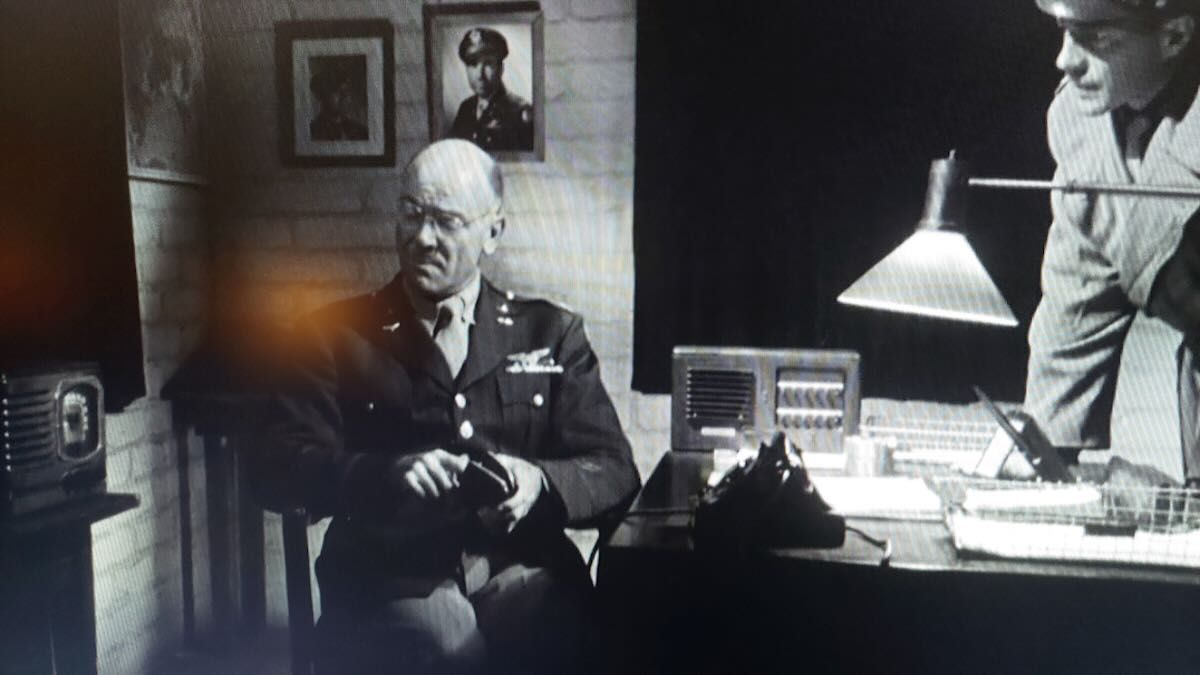
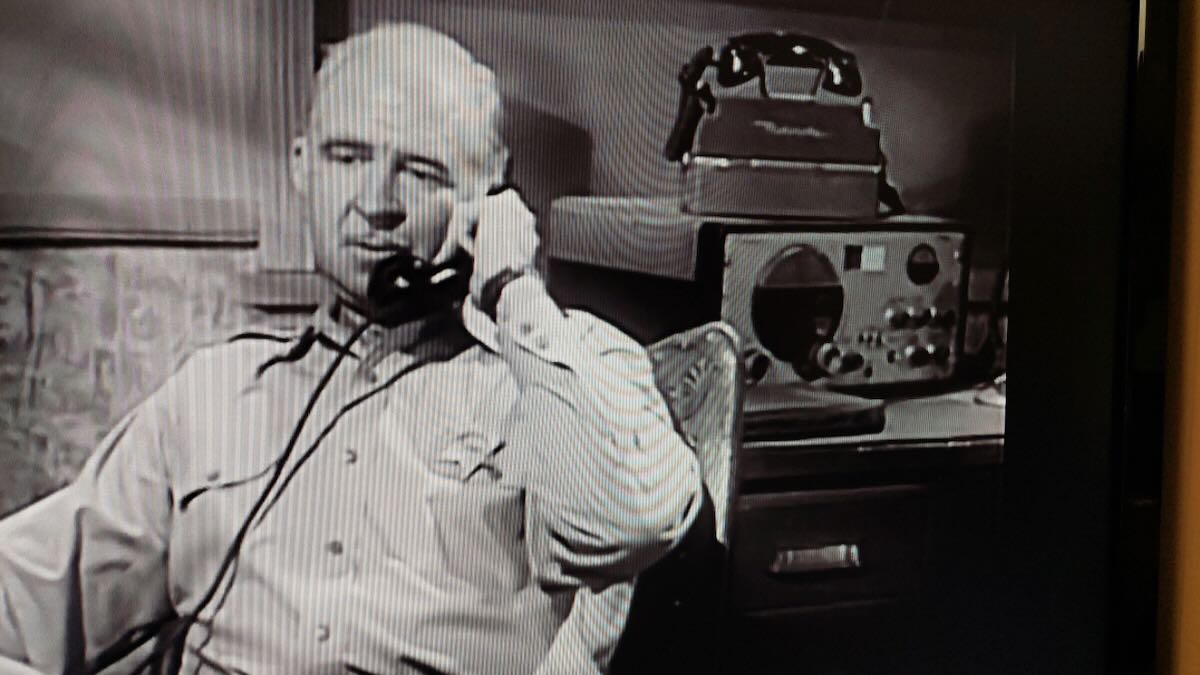
At about the 15 minute mark in the classic movie, Twelve O’Clock High, about B-17 bomber groups in England during WWII, this scene shows a commander and his assistant listening to Lord Haw Haw from Nazi Germany on a small console radio. Anyone recognize it?
Brigadier General Frank Savage is played by Gregory Peck, his second-in-command by Hugh Marlowe, and Robert Patten and Dean Jagger also star.
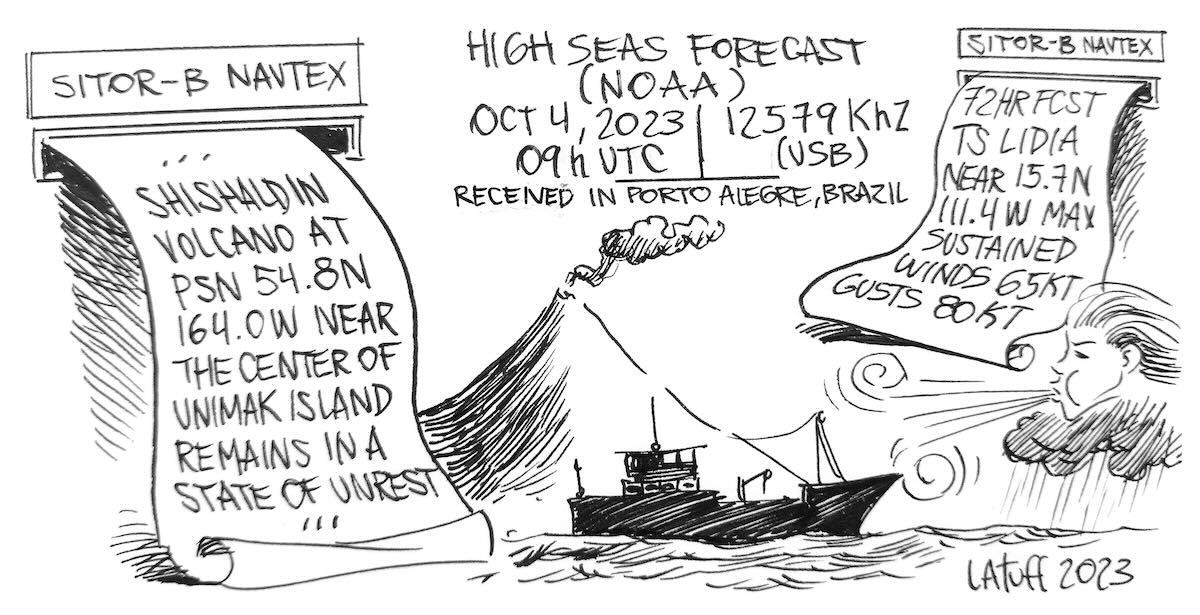
Many thanks to SWLing Post contributor and noted political cartoonist, Carlos Latuff, who shares his radio log art of a recent NOAA forecast. Carlos writes:
Recently I have been receiving NOAA’s Pacific high seas forecast via 12579 kHz USB. According to the NOAA schedule these SITOR-B transmissions come from the USCG base in Guam (NRV). But I’m not sure about that, since the signal is very strong to come from so far away. Attached is the illustrated report.
Signal received with XHDATA D-808 receiver and long wire antenna.
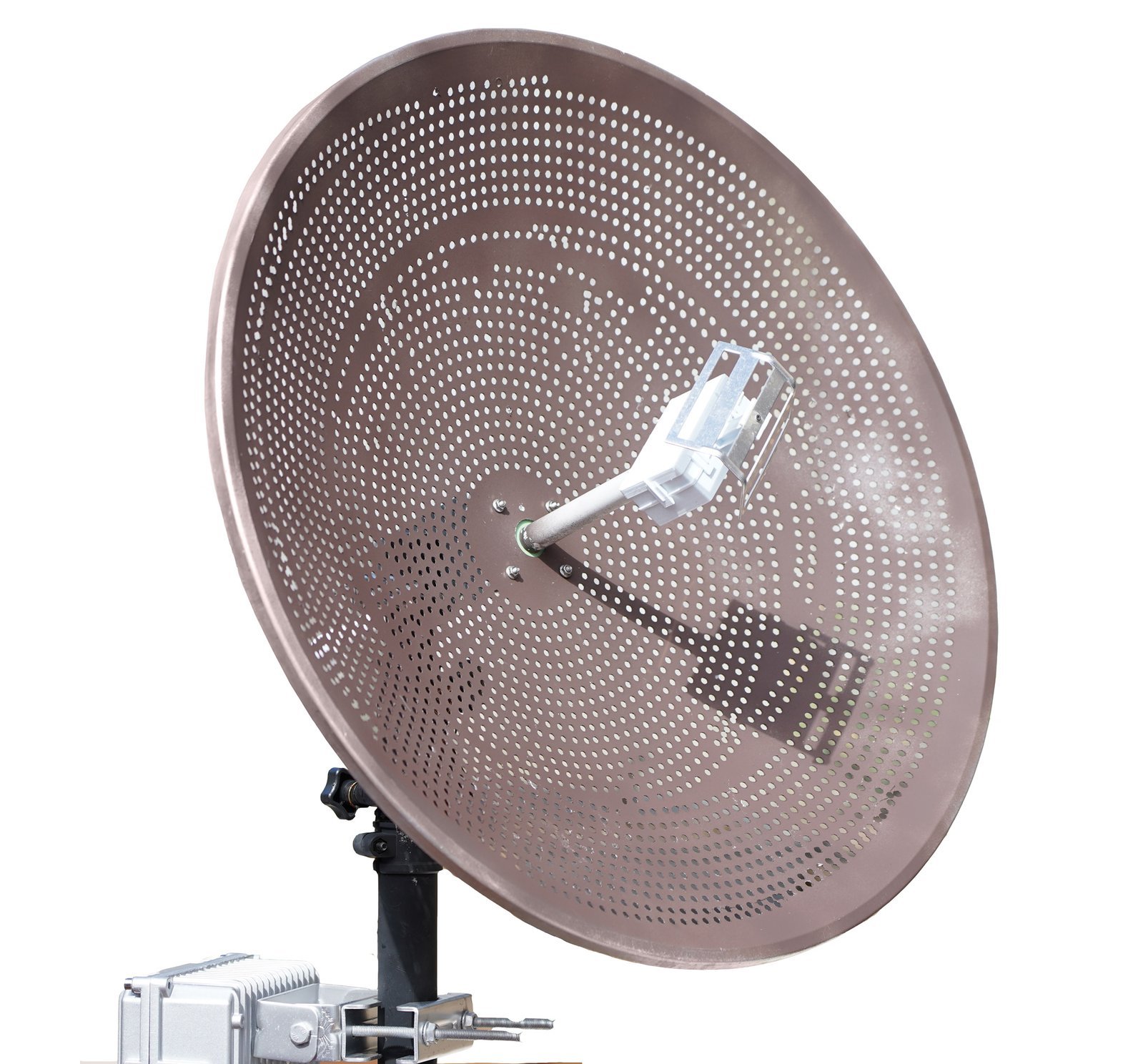
For the past few years we have been working on finding the best way to help beginners get started with L-band weather satellite reception and basic radio astronomy. We have now come up with a solution that we’re calling the ‘Discovery Dish’ – a lightweight 65 cm diameter dish and active filtered feed set.
Discovery Dish is a 65-cm diameter aluminum satellite dish and active filtered feed designed for receiving GOES HRIT, GK-2A LRIT, FengYun LRIT, NOAA HRPT, Metop HRPT, Meteor M2 HRPT and other weather satellites that operate around 1.69 GHz. The dish is designed to weigh under one kilogram, and it splits into three petals, making it easier to ship worldwide. The 1.69 GHz feed contains a built-in LNA right at the feed point, as well as filtering, which means that there is almost no noise figure loss from cables or connectors.
Note that the prototype images show an early non-petalized prototype with rough laser cut wind holes. The production version will obviously be a lot neater looking! […]
State-owned China Radio International is airing its content without attribution on commercial radio stations in Europe.
China has consistently and systematically pursued the dissemination of its narratives on the global stage, with the primary aim of shaping the international landscape to align with its strategic interests and ideological perspectives. These endeavors encompass a diverse array of tactics, including the acquisition of media enterprises, active engagement by Chinese ambassadors in both mainstream and fringe media outlets, the utilization of paid supplements, collaboration with pro-Kremlin media, and the steadily expanding presence of China across various social media platforms.
Recently, China Radio International (CRI), an official Chinese state media outlet broadcasting in multiple languages, has garnered attention for its establishment of partnerships with and provision of content to radio stations worldwide. Remarkably, CRI has effectively outsourced the production of China-related programming to local partners, often without transparently disclosing the sponsorship of content creation to the listeners. This strategy, known in Chinese as “borrowing a boat to go out on the ocean,” plays a pivotal role in laundering Beijing’s propaganda and fostering the acceptance of its messaging among local audiences.
One illustrative case of this approach within Europe involves two Czech radio stations, namely Radio HEY, a nationwide commercial radio station airing rock music, and Radio Color, which positions itself as “one of the last independent radios.” From 2019 to May 2023, these radio stations broadcasted a program titled “Barevný sv?t” (Colorful World), a nearly 30-minute segment aired six times a week, with the objective of acquainting Czech listeners with Chinese culture, language, and history. [Continue reading…]
When cheap digital TV dongles enabled radio enthusiasts to set up software defined radio (SDR) systems at almost zero cost, it caused a revolution in the amateur radio world: now anyone could tune in to any frequency, with any modulation type, by just pointing and clicking in a computer program. While this undoubtably made exploring the radio waves much more accessible, we can imagine that some people miss the feeling of manipulating physical buttons on a radio while hunting for that one faint signal in a sea of noise. If you’re one of those people, you’re in luck: [Kaushlesh C.] has built a portable, self-contained SDR system with real knobs and switches, called SDR Dock 1.0.
The heart of the system is a Raspberry Pi running GQRX, an open-source SDR program that supports many different RF modules. [Kaushlesh] used an Airspy HF+ Discovery, a compact receiver that can work the HF and VHF bands, but it’s easy to modify the SDR Dock to accept other types like those ubiquitous RTL dongles. A seven-inch LCD screen with integrated speakers forms the main output device, with everything powered by a 10,000 mAh lithium-polymer battery. [Continue reading…]
From the article: “Radio JOVE hopes to improve our understanding of the ionosphere… if you’re a ham radio operator, you can get involved with HamSCI, which also plans to observe the upcoming eclipse.”
Sounds like fun!
Regards,
Marty
This is a brilliant idea and Radio Jove is a solid project. You’re right that enthusiasts should also follow HamSCI as they have many opportunities to be a citizen scientist in the radio realm! Thank you for sharing, Marty!
Many thanks to SWLing Post contributor, Gérard Koopal, who notes that Radio Northern Europe International will be broadcasting from Woofferton today beaming to Europe. Here are details from the RNEI Twitter page:
Woofferton confirmed: 3955kHz, 19:29:30UTC, 28th September! Europe beam 🙂
ITS HF application’s prediction of 3955kHz; we’re feeling it’s going to go further than this but this is the “guaranteed” reception areas! 🙂
Gaston County resident Oscar Norris, also known by his call sign W4OXH, is turning 106 on Sept. 25.
Norris is not only the oldest living amateur radio operator in North Carolina, but according to information from the American Radio Relay League he is also the oldest living operator in the United States.
The Gaston County Amateur Radio Society and the Gaston Radio Club, both of which Norris is a long-time member, have come together to host a special airwave event for him from Sept. 20 – Oct. 1.
This event will honor Norris and his life, and will be hosted by operators in three different states, according to Gaston County Amateur Radio Society president Tony Jones.
Both on and off the air, Norris “is one of the most gentle and kind people,” a person could encounter in life, according to fellow amateur radio operator and friend, Mike Harvey. [Continue reading…]
Radio Taiwan International (Rti) celebrated its 95th anniversary with an event featuring remarks by Taiwan President Tsai Ing-wen on Tuesday. Additional speakers included Legislative Speaker You Si-kun, Ambassador of Saint Vincent and the Grenadines to Taiwan Andrea Bowman, and Rti Chairperson Cheryl Lai.
In her speech, President Tsai said that Rti has witnessed important events in the development of Taiwan’s democracy over its 95-year history. Tsai says Rti has carried out its responsibilities from then until now by continuing to cover Taiwan’s growing engagement with the world. Tsai also said Taiwan’s ability to connect people all over the world was demonstrated by the many postcards received in various languages on display at the event. She thanked Rti for its past work and says she hopes Rti will continue to bring the voices of Taiwan to the world.
Rti Chairperson Cheryl Lai also gave remarks at the event. Lai says Rti is Taiwan’s only public media company to broadcast in 20 languages across multiple platforms. Lai says Rti has been an important channel for people in Southeast Asian countries to understand Taiwan. She says the Indonesian, Vietnamese, and Thai language services have a long history at Rti, and are important resources for Taiwan’s new immigrants and migrant workers. Lai says that Taiwan also began a Ukrainian language social media service following the outbreak of the Russo-Ukrainian war. Lai concluded by saying that as Taiwan grows more vibrant and diverse, Rti will continue to spread Taiwan’s voices to all corners of the world.
Ambassador Bowman said in her speech that reaching 95 years of service is not an easy accomplishment to achieve. She says Rti represents an excellent model for how to spread the message of democracy and peace across the globe. [Read this article on the Rti website…]
It was 1923, and radio was the phenomenon of the day. Over 600 broadcast stations were on the air, and Americans bought 100,000 receivers that year. (Sales would jump to 1,500,000 in 1924.)
This new instant mass medium flashed news of important events around the country in minutes instead of days. In addition to news, tens of thousands tuned in to hear music and learn from lecturers holding forth on their areas of expertise. A few tried to make sense of broadcast guitar or swimming lessons.
Those without radios gathered in taverns and restaurants to listen to election returns and descriptions of baseball games.
New radio owners everywhere strung wire across their rooftops to make aerials, and then puzzled out how to connect a loudspeaker to the set, along with the A, B, and C batteries the setup required. (Soon enough, “house-current” radios would come along; most of the early ones were designed to draw power from fittings screwed into lamp sockets.)
Once the radios were set up, many owners hosted “radio parties” and danced to the latest jazz music with their friends.
At the same time, the game of Bridge was sweeping the country. It had been brought to New York from England in 1893. Here, as across the Atlantic, Bridge replaced the popular game of Whist as a top pastime, and quickly spread across the nation. [Continue reading…]

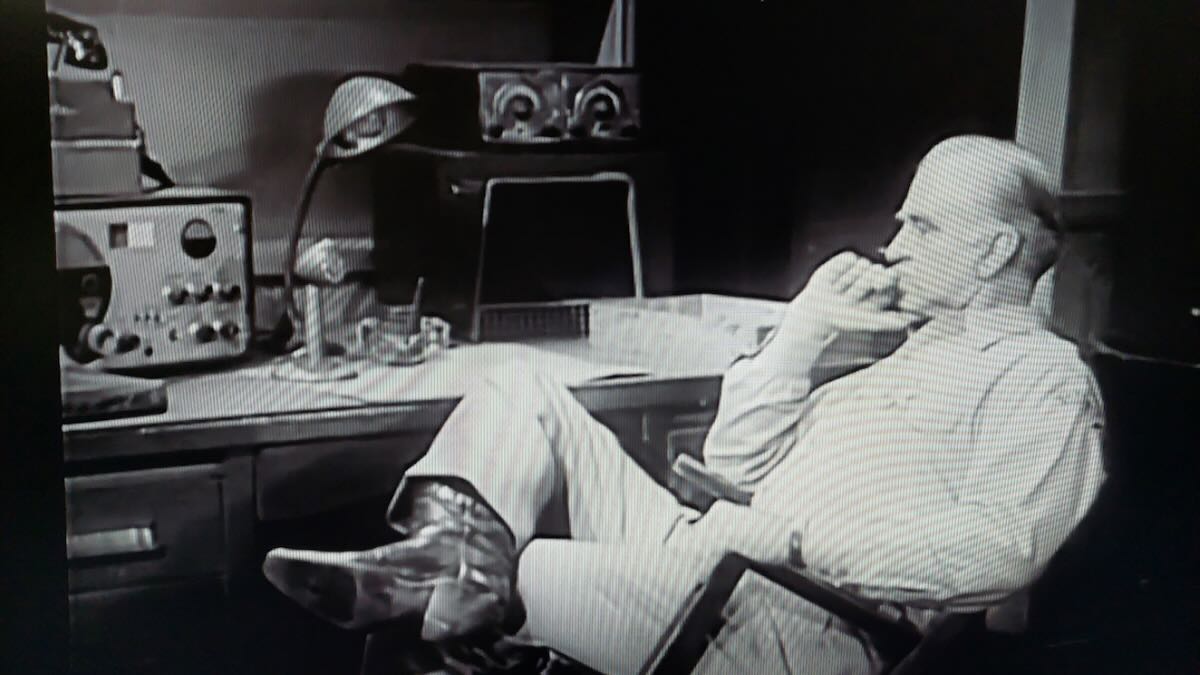
 Many thanks to SWLing Post contributor, Dan Robinson, who writes: