Author Archives: Thomas

Campaign to help WRMI after extensive hurricane damage

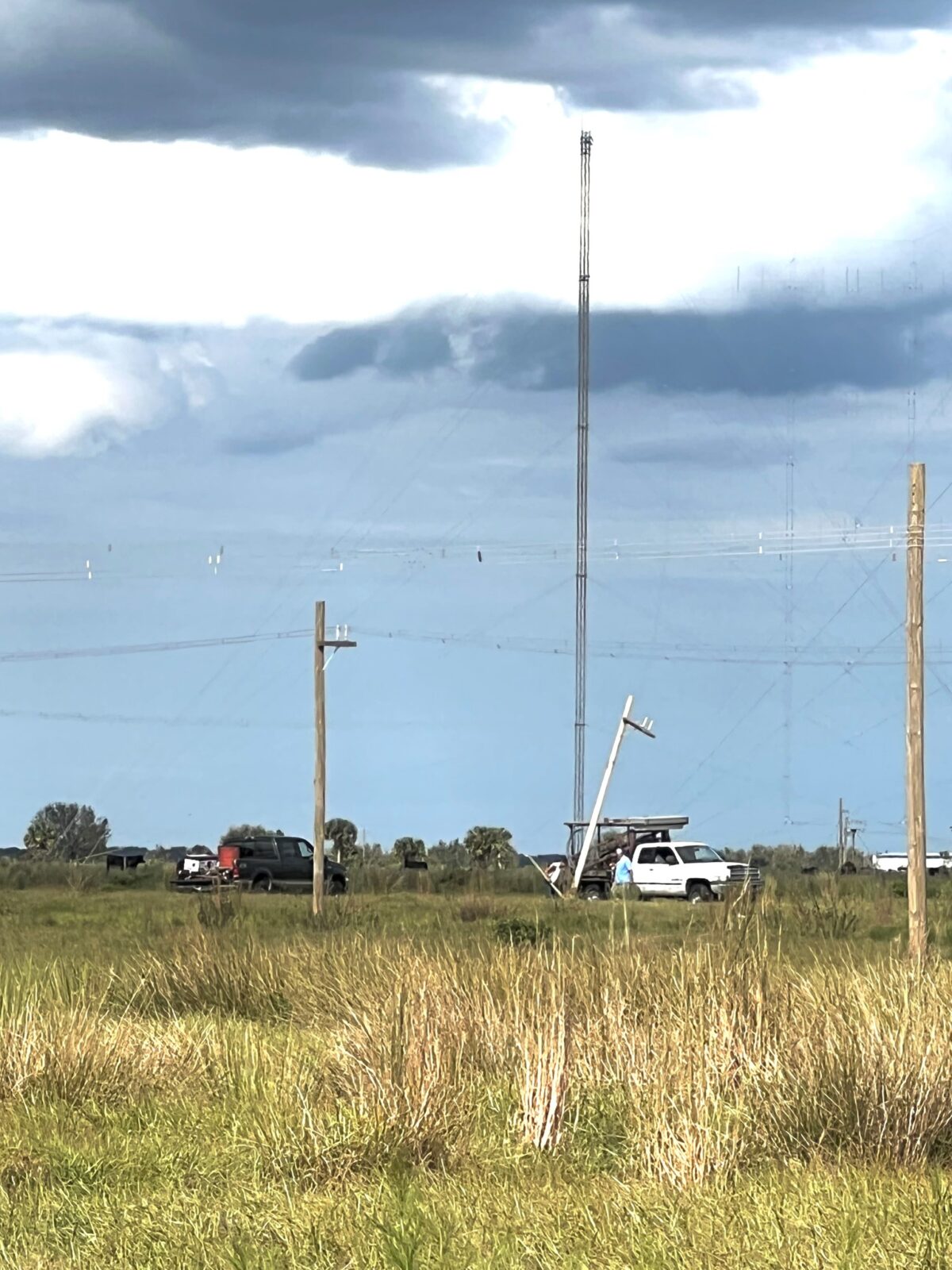
Our friend Jeff White, General Manager of WRMI is trying to repair extensive damage to the WRMI antenna farm post hurricane Ian. A GoFundMe has been created to help WRMI with repair costs. Even small donations add up!

Jeff White provides the following details:

Hello,

WRMI has a rich history of supplying news, information and entertainment to the world from our Okeechobee, Florida Transmitters.

Hurricane Ian damage to our antenna farm is so extensive, it has knocked us off the air to Europe and Africa.

We need your help to get us back on the air again to transmit to Europe and Africa news, information, religious programming and entertainment.

We have no insurance for the antenna farm due to the huge cost of insurance premiums.

We are desperately asking for help around the world to get us back on the air again to Europe and Africa. Your help is paramount to WRMI returning to the air in the many countries in Europe and Africa.

Your help will allow WRMI to rebuild the transmission towers destroyed by Hurricane Ian that are pointed towards Europe and Africa.

We thank you for your support of WRMI. Hurricane Ian knocked us down pretty hard. But we know with your help, we can rise back up and provide programming in many languages again to Europe and Africa.

Sincerely,

Jeff White
General Manager WRMI
Okeechobee, Florida

Click here to support WRMI via GoFundMe.

Sangean ATS-909X2: Uli is seeking information about firmware version 78

Many thanks to SWLing Post contributor, Uli (DK5ZU), who writes:

Hi Thomas,

I hope you are fine! I just bought a Sangean ATS-909X2 despite of the mixed reviews it earned in the beginning. There are a lot of reviews as on SWLING and other sources. But I think no newer models have been reviewed.

Mine is build in May 2022 and has a firmware version 078. This is quite ahead of the reviewed versions with 073. Unfortunately, I cannot find any information throughout the net, what changes where made since the version 073.

I just have the radio for one day, but for example the noise when touching the display is gone and I found no birdies so far. The SSB is still low concerning the audio level compared to AM but the SSB sounds much better as on my Tecsun 501x I had once.

As of now, I am really happy with this rig, and if current production line and firmware fixed some issues of the older one’s I guess this should be known since there may be folks interested in the radio which do hesitate to buy one because of the probably outdated reviews.

Do you know a source, where a firmware update log could be found? I just found this:
https://www.qsl.net/n9ewo/ats909x2_firmware_log.pdf

But this one ends with version 073.

Would you mind to post this question on the blog?
If you need more infos please let me know.

Best regards and 73,
Uli
DK5ZU

Post readers: If you can share a link to firmware revision logs or any information regarding the latest firmware updates for the ATS-909X2, please comment!

UPDATE

Sangean America Notes in our comments:

[S]oftware version 0.78 is a compatibility update for the new LCD hardware in the ATS-909×2 this update is only for units that use the new BU91510KV LCD display. it does not improve the performance of the ATS-909×2

2022 Listeners’ Day on Radio Romania International

Many thanks to SWLing Post contributor, David Iurescia (LW4DAF), who shares the following item from Radio Romania International:


Listeners’ Day on Radio Romania International

Sunday, the 6th of November 2022, is Listeners’ Day on Radio Romania International

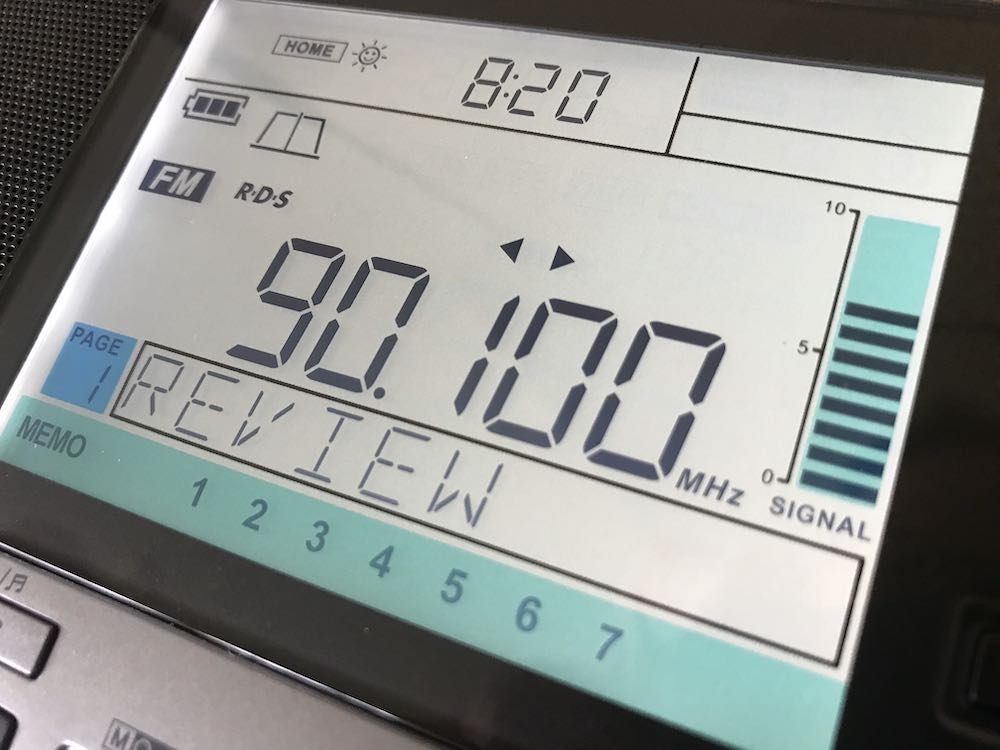
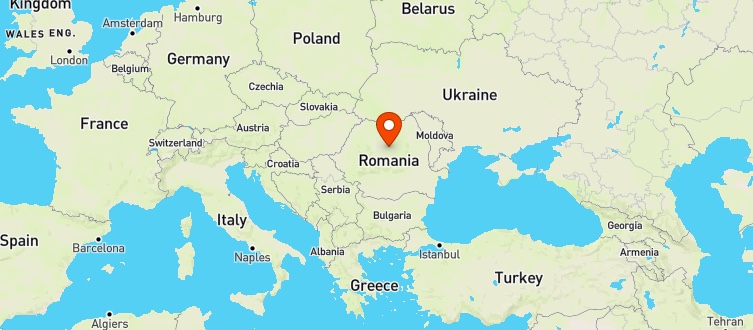
Dear friends, Sunday, the 6th of November 2022, will be Listeners’ Day on Radio Romania International, celebrated a week after the Romanian Radio Day marked on the 1st of November.

2022 will go down in history and, equally, in the collective memory, as a very special year, but not like the year when the whole world emerged out of the pandemic, as most of us would have expected.

On the morning of February 24, the old continent was shattered by an armed conflict, after almost 80 years of peace. Large-scale propaganda and disinformation campaigns, meant to create chaos and confusion, have also become part of the confrontation.

The information warfare is not a new kind of reality. However, its effects have become more visible than ever against the backdrop of the war in Ukraine, because the war has brought a real explosion of fake news and disinformation with it.

In this year’s edition of Listeners’ Day on RRI we ask you what sources of information about the war in Ukraine are the most reliable for you? How can you identify fake news from real news? How vulnerable you think you are to disinformation? Have you removed from your list the sources of information proven to be spreading fake news and disinform the public? Which is the role that public radio, and an international radio station in particular, plays in your life during this period of time?

We are looking forward to receiving your answers, which will be included in our show on the 6th of November! You can email them to us, at [email protected], post them on Facebook or send them as a comment to this article on RRI’s website at  www.rri.ro. If you like, you can also send us pre-recorded answers via WhatsApp, at +40744312650, or you can send us your telephone number so we can call you from the studio and record your opinions. Thank you!

Tokyo Rose: Exploring the Story of Iva Toguri and Genesis of “The Zero Hour”

If you’ve been an SWLing Post reader for long, you’ll likely know that I’m a Word War II history buff and I especially enjoy exploring the deep rabbit hole that is WWII radio and propaganda.

Radio broadcasts were heavily used by all of the players in WWII, and some prominent personalities emerged from the Axis propaganda machines: most notably Axis Sally and Lord Haw Haw in the European theatre, and Tokyo Rose in the Pacific theatre.

Iva Toguri

Toguri being interviewed by the press in September 1945 (Source: Public Domain)

Although Tokyo Rose was the name given to an array of female personalities on Radio Tokyo (NHK), at the end of WWII Iva Toguri was widely accused of being the “real” Tokyo Rose. After attempting to return to her native US, she was arrested, tried, and became the seventh person in U.S. history to be convicted of treason.

Her trial in 1949 resulted in a conviction on one of eight counts of treason and she received a 10 year sentence. Her sentence was eventually cut to 6 years due to good behavior.

U.S. President Gerald Ford pardoned Toguri in 1977 based on new evidence that important witnesses in her treason trial had been forced to lie.

The story of Iva Toguri is truly one of being in the wrong place at the wrong time.

Tokyo Rose – Zero Hour: A Japanese American Woman’s Persecution and Ultimate Redemption After World War II

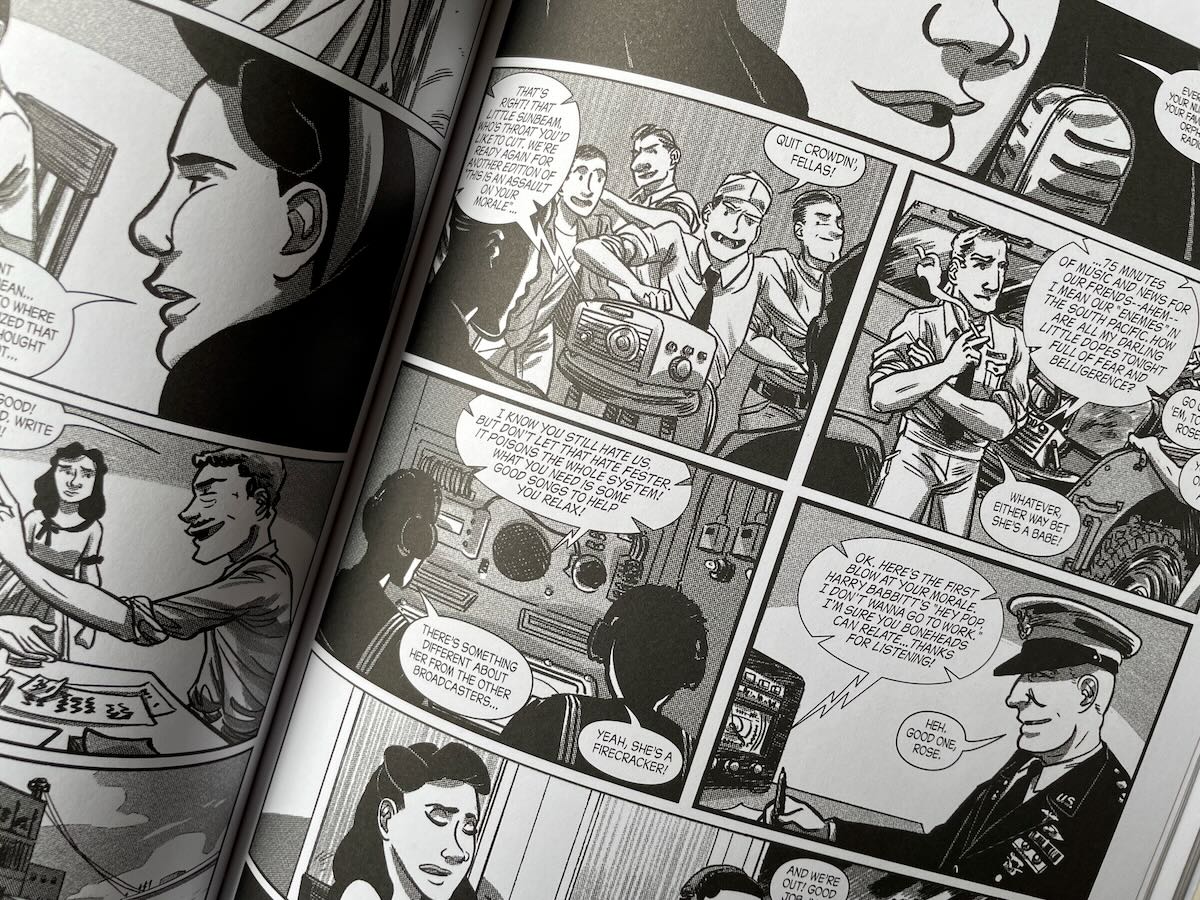
If you enjoy comics/graphic novels and WWII history, then you’re in for a treat. Last week, I purchased a new graphic novel about the life and trial of Iva Toguri written by Andre Frattino and illustrated by Kate Kasenow.

This book is beautifully illustrated in black and white and the author does an amazing job of telling the story of Toguri, woven into a narrative, while keeping it historical accuracy.

It’s obvious a lot of research went into this particular graphic novel.

If this sounds like something that would interest you, I highly recommend it.

Tokyo Rose – Zero Hour the graphic novel is available at Amazon.com as a hardcover or Kindle ebook. (Note: this is an affiliate link that supports the SWLing Post)

Twenty Thousand Hertz: Tokyo Rose

Image Source: Twenty Thousand Hertz. Art by Jon McCormack.

Many thanks to SWLing Post contributor, Wilbur Forcier, who recently shared a link to the latest episode of the excellent Twenty Thousand Hertz podcast. This entire episode also explores Iva Toguri’s life and involvement in NHK’s propaganda broadcasts.

I also highly recommend listening to this episode.

Read the show notes and listen to this episode at 20K.org.

Mario shares a short review of the Airspy HF+ Discovery SDR

Many thanks to SWLing Post contributor, Mario Filippi (N2HUN), who shares the following guest post:
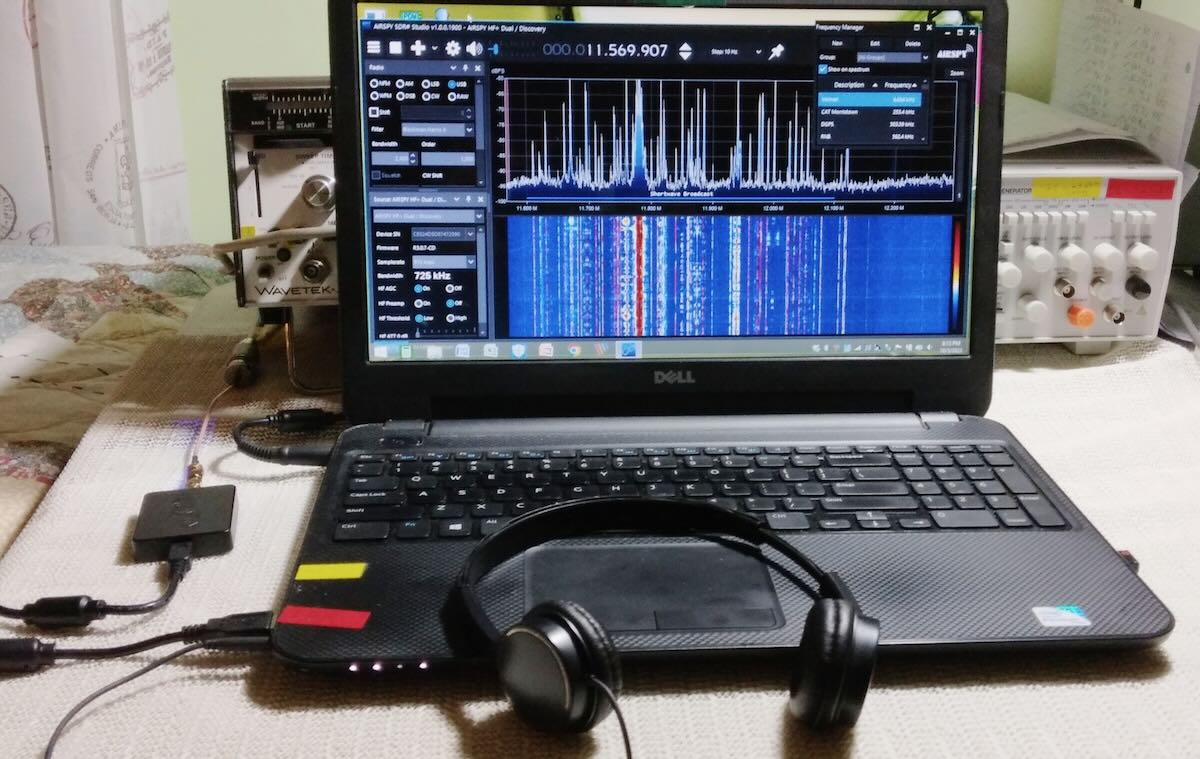

Author’s Airspy HF+ Discovery (small black box to the left of the laptop)

A Short Review of the Airspy HF+ Discovery SDR

by Mario Filippi (N2HUN)

I recently purchased an AirSpy HF+ Discovery.  As a SWL for over 60 years who’s owned many shortwave radios by manufacturers such as Drake, Yaesu, Icom, Zenith, Kenwood, Panasonic, Sony, Radio Shack, Grundig, CountyComm, MFJ, Sears, AOR and have used a number of different SDRs such as the RTL-SDR.com, HackRF, NooElec and many other rudimentary inexpensive first generation SDR dongles, I feel the AirSpy was an excellent choice. It cost $169 plus shipping.

For LW/MW/HF reception, I use a 30’ ground mounted vertical with about 50 buried radials in different stages of decomposition hihi. For VHF, a roof mounted 2m/70cm SlimJim antenna is used, but I haven’t done much listening in that portion of the spectrum yet except for occasional foray into the aero, 2m ham, NOAA satellite and public service bands.  Note that the AirSpy also covers 60 – 260MHz.

An older Dell Inspiron laptop and SDR# are used in conjunction with the AirSpy.  For decoding, MultiPSK, FLDigi, MTTY, Yand (for NAVTEX), along with VB cable are the accompanying software to make the digital modes intelligible.

So far I’ve logged a few local LF aeronautical beacons and some DGPS beacons on longwave but will be in a better position to judge its performance when winter sets in.  As for the medium (520 – 1710 kHz) wave AM broadcast band, the AirSpy easily brings in both local stations during daytime and distant stations at night with no adjacent channel interference whatsoever.  Even low powered community Emergency Alert Stations in the 1600 – 1710 kHz portion of the band can be heard daily from this QTH. A rotatable loop would certainly improve reception though.

As for shortwave listening the AirSpy HF+Discovery is, in my opinion, great for listening to both shortwave broadcasts and utility stations though I tend to concentrate on UTES mostly such as VOLMET, WEFAX, RTTY (the few that remain unencrypted), CW marker stations (e.g. XSG and XSQ from China) NAVTEX (519 kHz), aero/maritime SSB, time signal stations (WWV, CHU) and many of the other esoteric digital utility signals populating the band.  As for SW broadcast stations, WRMI, Radio Exterior, RFI, R. Marti,  BBC, WWCR and Radio Algerienne, to mention a few have been received.  The Frequency Manager (memory storage) in SDR# has quickly filled up with intercepts using the AirSpy.

As a ham and CB operator (yes, the two can mutually coexist in the same human body), I’ve found the AirSpy HF+ Discovery to be a trouper on all the HF ham and CB bands. One of my favorite hangouts is the 28.100 – 28.300 MHz slice of 10m where domestic and international low power CW beacons transmit their callsigns (and at times their grid squares and power output) into the ionosphere and achieve great distances.  Recently, beacons from 5, 6 and 7 land in the US along with DX prefixes ED4, PY4 and XE1 were logged.  If you’re into 10m FM operation you can also tune the AirSpy to hear local and distant repeaters on 29.62 – 29.68 MHz.  When the band is open, .62 and .64 seem to be the most active here in Central NJ.

If you’re a CB (aptly named the Citizen’s Band) op, the AirSpy HF+ Discovery does a stellar job on Channels 1 – 40 which is especially exciting when the band’s open.  While domestic (USA)  CB’ers are limited to frequencies from 26.965 – 27.405 MHz you’ll nonetheless hear DX ops below our (USA) channel 1 and above channel 40 conversing in French, Spanish and German in LSB/USB.  Add to this mix the fact that the FCC dropped the 150 mile limit for US ops a few years back and now the advent of the FM mode operation in the US, you’ll find the AirSpy won’t disappoint.  In my opinion the AirSpy HF+Discovery was an excellent choice and I’m more than satisfied with its performance.

In the matter of honesty and full disclosure, I purchased the AirSpy HF+ Discovery completely on my own in an effort to upgrade my station.  My choice was based on information gathered from the Internet and YouTube video reviews.  The performance of this receiver was based on my experience using the vertical antenna described earlier, the hours spent at my QTH (location) listening to stations of interest to me and my six decades experience as a SWL.  No test equipment to assess sensitivity, selectivity or other empirical methods to measure performance was used. That information can be found on the Airspy website.  The main purpose of this article was to craft a rudimentary review for those interested with the caveat that reception will vary depending on many factors such as location, antenna, ionospheric conditions, feedline quality, computer/software variations, QRN, QRM, and operator experience.  The results presented in this article are typical for my location; others may experience different results.  Thanks very much.

Dan spots an ultra-rare National HRO-600 on Buyee

Many thanks to SWLing Post contributor, Dan Robinson, who writes:

Wow. Appearing on the Japan Buyer site is one of the top rarities, the National HRO-600
https://buyee.jp/item/yahoo/auction/m1066450646

As veteran SWLs may recall, the HRO-600 was pictured in the old Communications Handbook receiver sections.

The radio sold for the then astronomical price of $5600 US. Produced just as National was declaring bankruptcy, the 600 was the final radio from the company.

The last time one of these appeared on the used market was in 2015 and the best writeup on the receiver can be found here.

The condition if this HRO-600 is poor so it may not be salvageable, but it’s nice to see another one show up on the used market since supposedly only 200 or so were made.

Thank you for the tip, Dan! I hope someone grabs this HRO-600 and does a proper restoration job!

Andy finds his late model PL-660 lacking compared with an earlier model

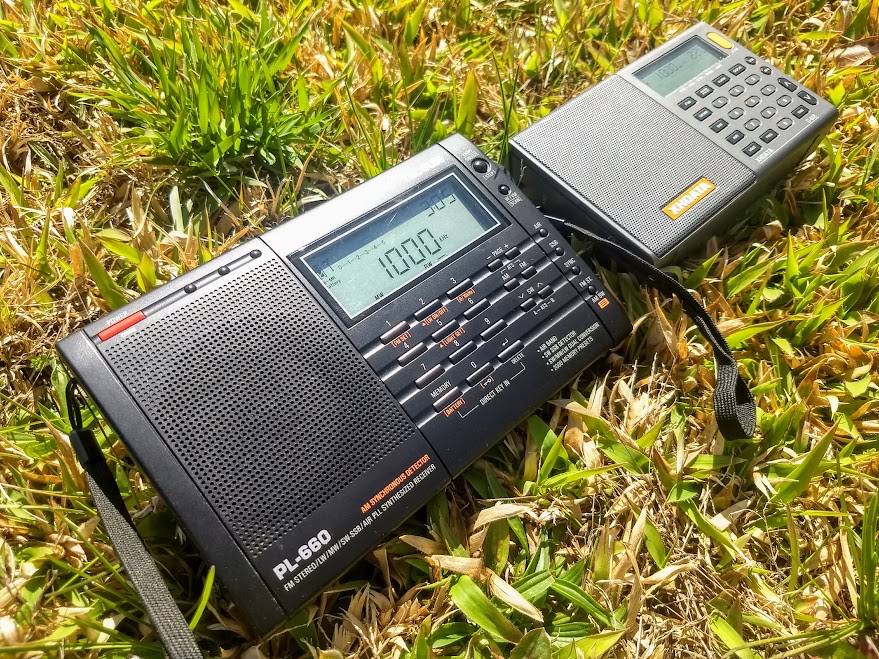
The Tecsun PL-660 (left) next to the XHDATA D-808 (right)

Many thanks to SWLing Post contributor, Andy, who writes:

Hi Tom,

I wonder if any of your readers has noticed anything with later model PL-660s.

My old PL-660 met with an accident recently (purchased about 2015?).

I bought a new one and was disappointed by what appears to be
a difference with the narrow and wide filter.

My old version seemed to work well, with 3kHz and about 6kHz
widths as one would expect.

The new one is a disaster, you seem to get 3kHz and 18kHz widths roughly
resulting in poor performance, especially on local AM stations.

It’s like the same station appears twice.

Also the filter is not symmetrical.

It’s all on the HF side of the signal and it’s awful.

The older model centred the correct bandwidths properly.

I’ve tried to do a bit of research, not much really but the little info that I have found appears to show that others have the same problem.

It makes the use of the wide filter in any mode useless.

I’m gonna send mine back.

73 de Andy G0FTD

Thanks for sharing this, Andy. I haven’t purchased a PL-660 in ages–in fact, I gave mine to a friend interested in shortwave a few years ago. I still use my PL-680 regularly. I suppose it’s possible you might have received a lemon; this isn’t uncommon as quality control varies with production batches.

SWLing Post readers: If you have noticed these symptoms–especially an abnormally wide filter width–with your late model PL-660, please comment.