Author Archives: Thomas

Carlos’ Illustrated Radio Listening Report and Recording of NOAA via USCG, October 27, 2025)

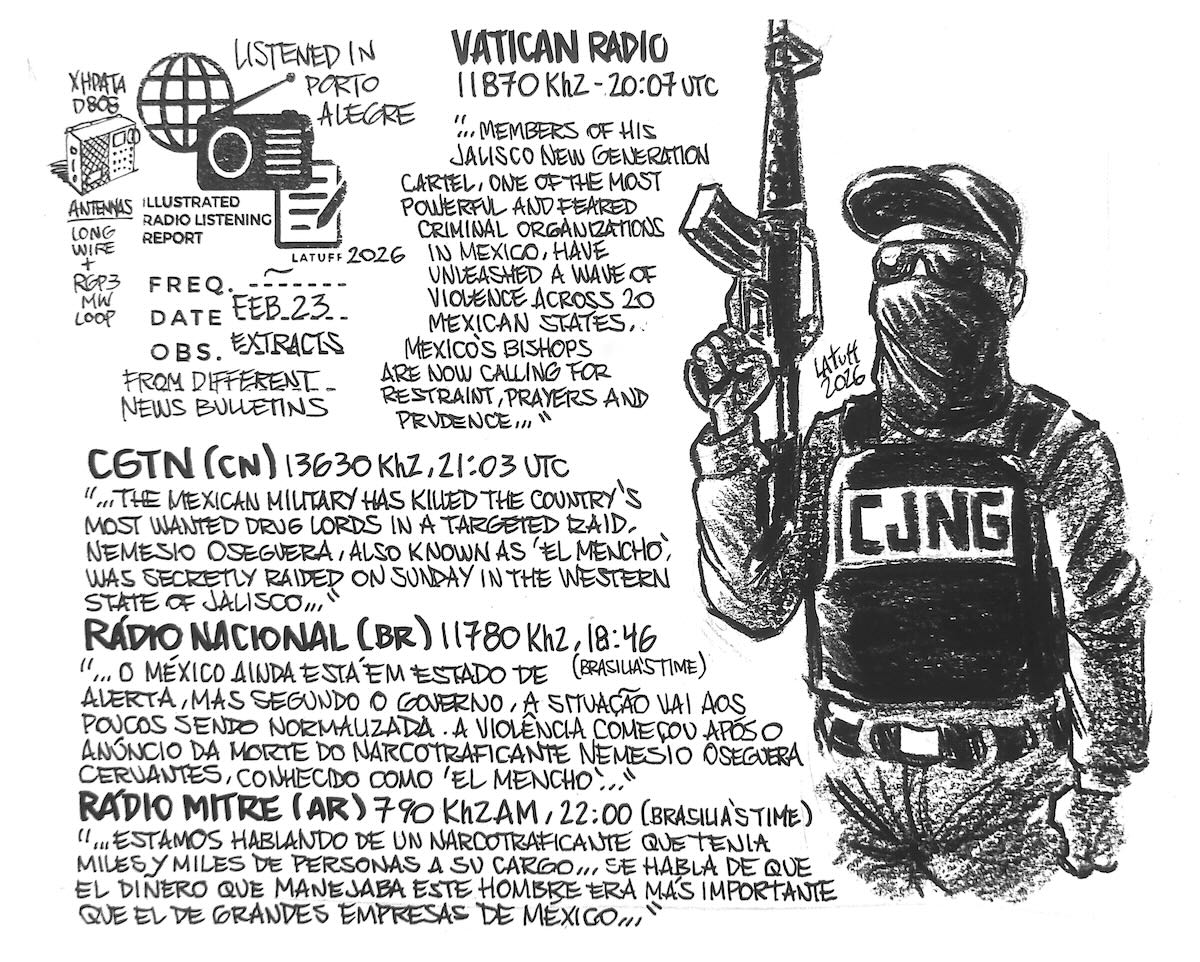
Many thanks to SWLing Post contributor and noted political cartoonist, Carlos Latuff, who shares the following illustrated radio listening report of a recent NOAA broadcast.


Carlos notes:

Hurricane Melissa, NOAA HF Voice Broadcast via USCG Chesapeake VA, 13089 kHz USB

Click here to view on YouTube.

The radiofax of destruction: Hurricane Melissa approaching Jamaica.

NOAA Surface Analysis, NW Atlantic. USCG Boston, Mass.
9110 kHz, Oct 27, 22h15 UTC
Received in Porto Alegre, Brazil
Xhdata D808 receiver, telescopic antenna.


Voice of Hope Africa Is Off the Air

Voice of Hope antenna farm (Source: Voice of Hope Africa)

Many thanks to SWLing Post contributor Dan Greenall, who writes:

Hi Thomas

I just heard on the latest program of Wavescan that the Voice of Hope Africa from Lusaka, Zambia is now off the air. It has been a few months since I heard them on a KiwiSDR from that area so I guess that explains why. Too bad since there are so few African broadcasters remaining.

Listen to their podcast here: https://www.podomatic.com/podcasts/wavescan

Here are a couple recordings of the station I made back on January 6 of this year on 4965 kHz using a Kiwi located on Reunion Island:

73

Dan Greenall, Ontario, Canada

Surprisingly Capable: Mario Checks Out the Raddy RF750 Plus

Many thanks to SWLing Post contributor Mario Filippi, who shares the following review:


Raddy RF750 Plus AM/FM/SW/NOAA Radio

by Mario Filippi

I purchased one of these tiny radios several months ago. It’s my daily go-to AM broadcast band  radio.  So far, it performs excellently on AM.  Using the rotatable ferrite antenna,  I’ve received stations as far away as Chicago and Detroit at night.  FM broadcast band capability is also excellent in my experience for such a small radio.  As for SW, the only luck I’ve had is with powerful broadcasters when the Raddy’s telescoping antenna is connected to an outdoor ham antenna.  It receives local NOAA WX as good as any other radio I’ve owned.

Raddy 750 Plus

The case is all metal, feels nice and hefty in the hand.  A shade under a half-pound in weight. 3 3/4 inches high (approx. 9 cm) with attached rotatable antenna.   The speaker size is exceptional for such a small radio and the audio’s very acceptable to the ear.  The speaker grill can be used to tune the radio manually by the way. The fit and finish are excellent.  Has a rechargeable battery with included USB charging cord.  Excellently-written 25-page owner’s manual in English.

?I use the Raddy app to control the radio.  You can opt not to use it though.  You’ll definitely need to read the manual then, due to the plethora of options.

Raddy’s SmartPhone App Works Great

All said, since I bought this radio mainly for daily AM broadcast reception and occasionally checking NOAA weather, I’m very pleased.  Price is very reasonable, mine was under $40 at the time.

Wonder if anyone else has one of these radios and what their opinion is?  Thanks for reading and 73’s.

You can purchase the Raddy RF750 on Amazon.com or at Radioddity.com (affiliate links).

Astrad “Mikado” F8-TR17-B205: Mark discovers this USSR radio at his local charity shop

Many thanks to SWLing Post contributor Mark Hirst, who writes:

This gem arrived in the charity shop where I volunteer yesterday, a radio made in the USSR (Minsk) in around 1975.

It was in fantastic external condition, although after checking it out discovered that the band changing control on the right hand side had been disconnected.

I suspect something went wrong with the very mechanical way it switched frequencies (shown in the video below), which rotated individual circuit boards into play.

Somebody seems to have opened it up, set it permanently on VHF, and then disconnected the control to prevent any further changes.

It was evidently sold in the UK as it has BBC radio stations on the dial and I even found a UK service manual for it.

I was tempted for a while, but I’m learning these days that this sort of thing just ends up as clutter.

Hard to believe that only five years after this electro-mechanical radio was made, Sony would release the ICF-2001 !

Mark

Manual:
https://archive.org/download/Trader_ASTRAD_B205/b205_text.pdf

Radio Museum:
https://www.radiomuseum.org/r/minsk_radi_astrad_f8_tr17_b205f8tr17.html#

YouTube – Astrad “Mikado” F8-TR17-B205:
https://www.youtube.com/watch?v=osDxKNdun98

Algeria on Shortwave – Then and Now

Many thanks to SWLing Post contributor Dan Greenall, for sharing the following guest post:


Algeria on Shortwave – Then and Now

by Dan Greenall

In the early 1970s, Radiodiffusion-Television Algerienne ran a modest shortwave service (no English) mainly for North Africa, the Middle East, and Europe. A copy of their schedule from the 1972 World Radio TV Handbook is shown.

As a fledgling DXer in 1971, I was fortunate to hear their signal on 9510 kHz from my listening post in southern Ontario, Canada. Even better, they responded to my request for a QSL with this attractive card.

Fast forward a quarter century to 1996. The international service of Radio Algiers could be heard at times here in eastern North America on 15160 kHz with broadcasts that included English. Here is a brief recording from November 3 of that year that I am lucky to have saved.

In July 2022, two new 300 kW transmitters located at Ouargla and Bechar were put on the air after several years of planning. These were to be used for the Radio Coran service in Arabic, but in May 2023, Ifrikya FM (the African Voice) was born with the objective of providing a pan-African voice by broadcasting educational, informative, and cultural programming from an African perspective.

Although there is no English, they can be spotted on shortwave on 13640 and 13855 kHz after their 1900 UTC sign on. If you can hear the same programming on these two frequencies, you will know you have them.

Here are two recordings made on October 19, 2025 using a KiwiSDR near Sao Paulo, Brazil. They were made one hour apart, the first at 2000 UTC and the second at 2100 hours.

13855 was noticeably stronger than 13640 on this receiver.

Taming the Noise: Don Moore’s Simple, Cheap Filter Solution for Traveling DXers

Many thanks to SWLing Post contributor Don Moore–noted author, traveler, and DXer–who shares the following post:


A Cheap and Simple Noise Filter

By Don Moore

Don’s traveling DX stories can be found in his book Tales of a Vagabond DXer [SWLing Post affiliate link]. If you’ve already read his book and enjoyed it, do Don a favor and leave a review on Amazon.

My DXing career started over fifty years ago in an upstairs bedroom in tiny Milesburg, Pennsylvania. I had a consumer-grade multi-band radio and some copper wire strung from the roof to a nearby tree.  It was a simple setup but it worked very well. Do you know what I didn’t have? A noise problem. The only time I remember noise ruining my DX was when my mother was using the electric mixer and that meant she was making cookies or a cake. I never complained.

Times have changed, haven’t they? What DXer doesn’t complain about noise these days? I know people who have left the hobby because the place they lived at and DXed at for decades gradually became so noisy they couldn’t DX anymore.

Unsurprisingly, a lot has been written about how to find and eliminate noise in your home. However, most of my DXing is done as I wander the globe. I try to find places to stay at that should be good for DXing. But no matter how good a place looks beforehand, there’s no way of knowing what the noise level will be until I get there.

As a traveling DXer, I need quick, easy, and compact noise solutions. The best solution I’ve found are these CCTV distortion filters (ground loop isolators) that Brett Saylor recommended to me several years ago.

No, these weren’t designed for radio use. And they aren’t a miracle solution that will eliminate all the noise that plagues DXers. Sometimes they’re no use at all. But I’ve DXed in dozens of locations over the past ten years and there have been multiple occasions where one of these filters has turned what would have been a disappointing stay into a good DX session. I don’t go anywhere without two of these packed in my mobile DX shack.

But let me show you some results. All of these SDR screenshots were made with SDR-Console using an Airspy HF+ Discovery SDR connected to a PA0RDT mini-whip antenna.

I spent last summer in the north suburbs of Chicago and several times went to a park to test my DX equipment. Around midday, the lower shortwave frequencies were filled with noise peaks. On this first image, it’s hard to pick out WWV on 5 MHz from all the noise peaks. In the second image the filter hasn’t totally eliminated the noise, but WWV’s signal is now strong and clear.

The noise was nearly as strong on 49 meters but the filter almost totally eliminated it. CFRX’s signal on 6070 kHz was slightly weaker with the filter, but it was significantly more listenable without the noise.

Which frequencies noise affects can vary between locations. At that park the noise was gone above about 11 MHz.  While traveling across the US in mid-October, I stopped at a park just west of Kansas City to do some more DXing and equipment tests.  The noise there was bad in the middle shortwave bands, such as in the 25 meter band.

But the filter did a good job cleaning it up.

Finally, about two years ago when I was DXing in Rafina, Greece, the noise was bad on the higher bands. Here are before and after screen shots on the 16-meter band.

These filters should work with any coax-fed antenna. I’ve used them with beverages, Wellbrook loops, the PA0RDT, and the MLA-30+ loop. If the antenna has an interface, such as the last three mentioned, the filter goes between the interface and your receiver (and not between the interface and the antenna).  I’m not sure what the impedance on these is, but I’ve used them with both 50- and 75-ohm coax cable.

Sources of the Filters

An Internet search for “CCTV Ground Loop Isolator” brings up all kinds of products. They are probably all the same but I have no way of knowing that. So I recommend getting the exact ones that I have purchased. Just compare the product to the pictures of mine.

Here are links to three current sources for these exact ones on Amazon. They can also be found on eBay and other sites. [Note that all of these links are affilliate links that support the SWLing Post at no cost to you.]

A Few More Ideas

At just a couple dollars each, every DXer should have a few of these filters in their shack. But types of noise vary and at several places I’ve DXed from using one of these filters made no difference at all. When that happens I have a few other solutions to try.

The first thing I try is to either move the antenna or, if it’s directional, to point it in a different direction. On several occasions that’s all it has taken to totally eliminate what at first seemed like an impossible noise problem.

If the noise is coming in through the power lines, unplugging the laptop and DXing off of battery power might do it. (I only use SDRs powered off the USB connections on my laptop.)  If you do that, be sure to unplug the cord from the outlet and move it away from the wall.  If you unplug the cord from the laptop and leave the other end plugged into the outlet, it may act as an antenna and radiate the noise from the power lines into your SDR. And, yes, I learned that lesson the hard way!

Do you have any interesting experiences or solutions to the DX noise problem? Please leave them in the comments section. 

Michael Reviews the Choyong WT2 Multifunction Handheld Radio

Many thanks to SWLing Post contributor, Michael (BD4AAQ) who shares the following guest post:


WT2 Mini Handheld With Everything Radio

by Michael Ye (BD4AAQ)

What Exactly Is the WT2?

No exaggeration. The WT2, a recent radio developed by Choyong, includes nearly every type of radio imaginable: ham radio, traditional shortwave and medium-wave radio, internet radio and, last but not least, push-to-talk over cellular radio!

The radio is powered by the TEF6686 chip, which has an excellent track record in high-performance radios. This suggests the WT2’s performance will surpass that of the highly regarded LC90. Packing so many features into a handheld device would have been unimaginable a decade ago without state-of-the-art technology and the internet.

I’m fortunate to be among the first to get my hands on the WT2. I’d seen its picture before but was still pleasantly surprised when I unboxed the real thing and saw its actual size. The picture below shows my iPhone 12 Pro next to it for comparison. At this small size, it fits sleekly into one’s pocket. I’ve always wanted a radio to listen to while walking or jogging. Now, I have one.

Continued Success of Choyong Radio Receivers

As a young and innovative technology company, Choyong was the first to launch a radio receiver combining traditional radio with internet radio: the LC90. The LC90 has been a resounding success. An improved version, the LC95, has been launched domestically in China. Rumours suggest that the LC100 is in development to build on the success of the LC90 and LC95.

Now, powered by the TEF6686 chip, the WT2 delivers even greater sensitivity and selectivity. Its unique combination of multiple radio types in a single, compact handheld form factor makes it highly competitive. In fact, I’m unaware of any other radio that packs so many features into such a sleek design. The young team at Choyong boldly leads the way, fearlessly testing the market waters.

Internet Radio

Choyong has confirmed that the WT2, like the LC90, will be available in both export and Chinese versions.

“In terms of the stations that can be heard, the internet radio exhibits significant differences from that of the Chinese version. The Chinese version is designed to exclusively feature Chinese language stations (and a few English language stations) in China. If we liken the Chinese internet radio to a closed system such as iOS, it is stable, reliable but restrictive. In contrast, the export version could be compared to Android, offering more open, inclusive and customisable user experience.

On the export version, the MENU button provides access to the main menu, which begins with the six continents (excluding Antarctica) and allows users to navigate to the desired country and then select a specific station.”

The WT2 supports Wi-Fi for indoor use and comes with a built-in eSIM for 4G cellular connectivity. This allows you to easily carry the WT2 in hand or slip it into a pocket, making it ideal for listening to internet radio while walking or jogging.

Traditional Radio

Shortwave performance is impressive, especially considering the small antenna. Surprisingly, the 13.6cm walkie-talkie antenna extends to a full 48cm. This significantly improves shortwave reception, as well as FM reception. Unfortunately, the WT2 lacks SSB demodulation on shortwave, which is a bit disappointing.

Medium-wave reception is poor with the receiver’s whip antenna. Indeed, what can you expect from a whip antenna without a ferrite bar? However, I experimented by connecting a longer wire to the antenna’s SMA connector, and MW reception improved remarkably, much to my surprise.

Arguably, the WT2’s FM reception is outstanding. I compared this compact radio with various others, large and small, old and new, and the WT2’s FM performance is simply the best. Its sensitivity generally surpasses that of competing models, allowing me to receive stations that were inaudible on others. A prime example is Shanghai’s Classic Music Channel on 94.7 MHz, which many report as having medium to weak signal strength. Yet, the WT2 pulled it in with exceptional clarity, free of the occasional hissing I noticed on other radios.

Ham Radio and Walkie-Talkie

Amateur radio operators will appreciate the WT2, as it covers the standard Ultra High Frequency (UHF) amateur band, with a maximum transmitting power of 2 watts. It also includes the FRS/GMRS bands (not for use in China). The Very High Frequency (VHF) band is expected in future models.

Caution: When transmitting with the WT2, retract the extended antenna to avoid damaging the device.   

Although the WT2 is a compact handheld, it includes features found in other walkie-talkies, such as squelch, tone squelch and scanning, all packed into this sleek device.

PoC Talking

Push-to-talk over cellular (PoC) is not new, but it has gained popularity in recent years with the rise of 4G and 5G mobile communications.

A decade ago, taxi drivers in Shanghai used traditional walkie-talkies to communicate within their network for vehicle dispatch or casual rag-chewing. Some were radio amateurs, but I suspect others were not and were thus operating illegally without a proper license. Years later, most of them, if not all, had switched to PoC, a modern method offering legal communication with crystal-clear audio and virtually no distance limitations.

I gave it a try, and of all the people who could have answered, it was BA8BM, a fellow ham in Sichuan, China. Needless to say, the audio was excellent!

With the WT2, users can create as many groups as they like, each supporting up to 10,000 members!

Other Features

The WT2 features a TF card slot that accepts cards with a maximum capacity of 32 GB. This storage can be used for playing music or serving as an external data drive.

The Bluetooth connection supports internet radio but not traditional radio. I successfully connected my AirPods and Bose headphones. They work well for internet radio but by design not for traditional radio.

The WT2 is equipped with a 2,500 mAh rechargeable lithium battery. Unlike the LC90, the battery is not user-replaceable. For a lightweight radio like the WT2, I’d say 2,500 mAh is sufficient for most daily use.

Key Takeaways 

The WT2 is a remarkable compact radio that combines traditional and modern radio technologies. It features a 240×283 mini screen with a vibrant, high-quality colour display that’s truly impressive. The extendable antenna enhances shortwave and FM reception. The audio is crisp and clear but slightly soft. Bluetooth supports internet radio but does not work with traditional radio.

With its four-in-one radio capabilities, users can communicate or listen however they prefer. Want to make a CQ call with a fellow ham? You have amateur radio. Craving crystal-clear conversation? PoC is available. Feel like tuning into nostalgic, sometimes noisy broadcasts over the airwaves? Shortwave, medium-wave, and FM are ready. Eager to explore internet-based radio? There’s a wealth of stations from across the country or around the world.

The WT2 is much smaller (though slightly thicker) than an iPhone and can be used handheld or, via Bluetooth, slipped into a pocket for walking or jogging.

The WT2 has a voice assistant to help you navigate its internet radio and other features with ease.

A versatile little gadget for radio hams, shortwave listeners (despite lacking SSB), and broadcast listeners alike!