Category Archives: Broadcasters

VOA Radiogram, 29-30 November 2014: Dim the lights

VOARadioGram(Source: VOA Radiogram)

Flmsg returns this weekend on The Mighty KBC. See details below.

This week on VOA Radiogram, the “surprise mode of the week” becomes the “bonus mode of the week.” Because many of you have problems with the RSID, I will divulge the bonus mode so that you can make manual adjustment if necessary.

Here is the lineup for VOA Radiogram, program 87, 29-30 November 2014, all in MFSK32 centered on 1500 Hz except where indicated:

1:37 Program preview
2:39 Dimming lights to see the night sky*
11:27 Cambodian rice wins “world’s best” title*
19:53 Color photos of 1963 Soviet Union*
26:29 Closing announcements
27:20 Bonus mode of the week: MT63-2000L

Please send reception reports to [email protected]

VOA Radiogram transmission schedule
(all days and times UTC):
Sat 0930-1000 5910 kHz
Sat 1600-1630 17860 kHz
Sun 0230-0300 5745 kHz
Sun 1930-2000 15670 kHz
All via the Edward R. Murrow transmitting station in North Carolina.

The Mighty KBC will transmit a minute of MFSK64 Saturday at about 1230 UTC on 6095 kHz, and Sunday at about 0130 UTC (Saturday 8:30 pm EST) on 7375 kHz. Both frequencies are via Germany. Reports to Eric at themightykbc (at) gmail.com.

This weekend, the MFSK64 transmissions on The Mighty KBC will be in Flmsg format. If you do not have the Flmsg software, download it from the same source as Fldigi: http://w1hkj.com/download.html.

To make Flmsg work with Fldigi, in Fldigi: Fldigi: Configure > Misc > NBEMS > Under “Reception of flmsg files” check both “Open with flmsg” and “Open in browser.” Under that indicate where your Flmsg program is located, for example C:Program Files (x86)\flmsg-2.0.5\flmsg.exe.

If all goes well, the text from The Mighty KBC will pop up on your web browser.
A digital announcement from STF Radio International

STFradioSTF Radio International just shared the following digital announcement. Yes, you’ll need to decode this message from SoundCloud with an application like FLDigi:

STF also mentioned that a text version of this announcement with follow in the next few days (but surely it’s more fun to decode the digital version!).

You should make the time to decode STF Radio International broadcasts if at all possible.  Their QSL cards are some of the best in the business.

Chelmsford Calling adds shortwave relay in Finland

ChelmsfordWorldService(Source: Southgate ARC)

The Chelmsford Calling World Service produced by Jim Salmon 2E0RMI has added a shortwave relay from Finland

Chelmsford Calling is currently relayed on shortwave by Radio Miami International WRMI on the 2nd Friday of each month at 2300 UT on 9955 kHz. The additional relay will be by Scandinavian Weekend Radio (SWR) which is located in Virrat city, Upper Tampere Region, Liedenpohja village, Finland.

The show will be broadcast on the first Saturday of the month starting on December 6 on a selection of the following frequencies – 1602 kHz, 5980 kHz, 6170 kHz, 11690 kHz, 11720 kHz, & 94.90 MHz.

Chelmsford Calling
Web http://www.chelmsfordcalling.com/
Facebook https://www.facebook.com/ChelmsfordCallingWorldService
Twitter https://twitter.com/ChelmCalling

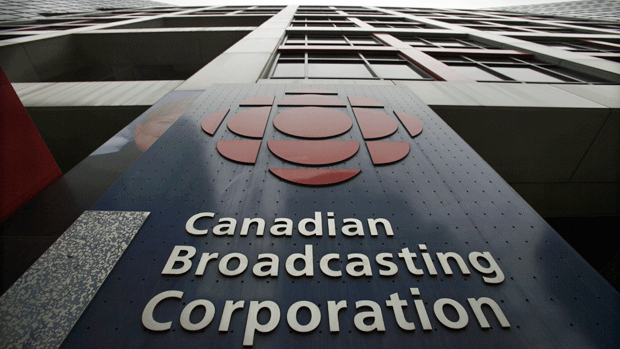
Thousands protest cuts to CBC

CBCbuilding

Many thanks to SWLing Post reader, David Iurescia, for sharing this story from Radio Canada International:

“Thousands of people marched in several cities in the province of Quebec and the New Brunswick city of Moncton on Sunday to protest ongoing cuts to the public broadcaster CBC/Radio-Canada.

Beginning in the 1990s, successive Canadian governments cut funding to the service. The latest round will lead to 1,500 job losses by 2020. That represents almost 20 per cent of the current, total number of employees.

Cultural groups in particular are concerned about the cuts to the English-language CBC and the French-language Radio-Canada. Preserving culture is particularly sensitive issue in the French-speaking province of Quebec.

Radio Canada International has also suffered from the budget cuts and had to dismantle its international shortwave service in 2012. RCI is now only accessible by internet.”

Also check out this article on the Montreal Gazette.

BBC Relay Station handed back to Seychelles

BBC Seychelles Relay Station (Photo: Vijay.sc)

BBC Seychelles Relay Station (Photo: Vijay.sc)

(Source: Seychelles News Agency via Andy Sennitt)

Tuesday November 18 marked the closure of an iconic chapter of Seychelles’ history, signalling the end of an era when information was much more difficult to come by. With much of Africa joining the internet and mobile phone revolution, the times of trying to glean information about happenings in the rest of the world on a crackly AM radio station have now passed by.

Over 25 years after its establishment, the site of the BBC’s former Indian Ocean Relay Station (IORS), located at Grand Anse, on the western side of the largest inhabited island in the archipelago, was handed back to the government of Seychelles by the country’s British High Commissioner, Lindsay Skoll.

The station transmitted BBC World Service programmes since 1988 via shortwave to listeners across East Africa in a range of languages, including the BBC’s English-language output for Africa as well as programmes in Swahili, Kinyarwanda, Kirundi, Somali and French.

In November 2013, the BBC announced its intention to cease all its shortwave transmission services from Seychelles due to a gradual and irreversible fall in demand for shortwave radio services, and on March 29 this year, the BBC IORS retransmission services from Seychelles were officially switched off. BBC World Service broadcasts in East Africa are still available via the internet and also via various other localised frequencies.
The handing over of the site to the Ministry of Land Use and Housing (MLUH) also included the station’s buildings and equipment, all of which are still in working order. The site is spread over a 32,000 square metre property, occupied under a lease dating back to March 27, 1985.

[…]The station is equipped with 33KV high-voltage equipment and transformers which will now go into the possession of the Public Utilities Corporation, while the Seychelles Civil Aviation Authority (SCAA) will take over three of the BBC’s four steel communications towers and the annex building.

The SCAA will use the towers to strengthen its air communication and surveillance capabilities and the annex building will be used to house a new high-frequency aviation communications radio system to help control air traffic coming in from the west of the island.

The fourth steel tower will be allocated to the local telecommunications company Cable and Wireless for mobile based telecommunications.

Read the full article on the Seychelles News Agency’s website.

Global 24 special broadcast to Asia on December 7

global24-smallMany thanks to Keith Perron at PCJ Media for sharing the following info:

“On December 7, 2014 from 1500 to 1558 UTC [updated – 19 Nov 2014], PCJ Radio International will broadcast a special program produced by Global Radio 24 for listeners in Asia. The frequency will be 13,720 kHz.”