Category Archives: Broadcasters

New shortwave radio station, Madagascar World Voice Radio, to begin testing this year

An update on the Madagascar World Voice Radio station via Glenn Hauser and the DX Listening Digest:

(Source: DX Listening Digest)

Gayle Crowe, the VP of Programming, World Christian Broadcasting [see our previous post] via DX Listening Digest: “The transmitters are sitting on the dock in Houston awaiting the ship that will take them to the west side of Madagascar. Best estimates are that the trip will take between 60 and 90 days. Once they make it through customs (which sometimes has been a lengthy, uncertain process) and are in place at the station, a technician will have to come from Continental Electronics to install them. Best case scenario for the beginning of testing is probably June 1.”

(Source: FinnDXer)

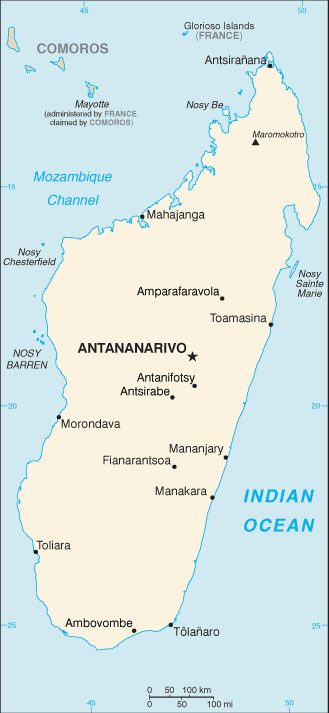
A new short wave radio wills start this spring or next summer in the Indian Ocean, “Madagascar World Voice Radio” broadcasting from Mahajanga on seven frequencies:
7355, 9565, 9585, 11870, 13630, 13635 and 13650 kHz.
Madagascar World Voice (MWV) is a member of World Christian Broadcasting Corporation (WCBC) in Nashville Tennessee (USA).

TEST SCHEDULE FREQUENCIES 2012
06H00-06H30 UT 7355
06H30-07H00 UT 9565
07H00-07H30 UT 11870
07H30-08H00 UT 13635
08H00-08H30 UT 9565
08H30-09H00 UT 11870
09H00-09H30 UT 13630
10H30-11H00 UT 9585
11H00-11H30 UT 11870
11H30-12H00 UT 13650
(Bernard Grondin via dxld)

Hear WTWW’s new transmitter – 22:00 UTC on 9,990 kHz

Here’s your chance to catch the first broadcast of the new shortwave transmitter installed at WTWW in Nashville, Tennessee. Ted Randall will be hosting a show called, “This is Only A Test.” Here’s the press release:



(Source: Ted Randall)

It is not very often that you can hear a new HF shortwave radio station sign on the air. WTWW, a new International Shortwave Radio facility just outside of Nashville, TN is launching a new transmitter this Saturday with a broadcast we are calling ‘This Is Only A Test’ starting at 4 pm Central Standard Time. This is a 100,000 watt transmitter running into a full size rhombic antenna.

This is a global radio event with radios being tuned in all over the world.

The QSO Radio Show has requested that we could air this broadcast as a amateur radio event to promote amateur radio along with shortwave listening. Why? Well, the shortwave listening audience is huge.
The typical shortwave radio listener is a great potential candidate for amateur radio.

There are more than 1.5 billion shortwave receivers in use worldwide, the BBC estimates that at any given moment, over 200 million sets are tuned to shortwave broadcasts.

This is the second time WTWW has allowed us to conduct this kind of broadcast on a powerful new shortwave facility.

The purpose of this broadcast is to demonstrate HF communications and to put radio amateurs on the air to a worldwide audience to tell their story.

This is not a commercial venture in any way.

So spread the word to all of your amateur radio friends and call us on Saturday on “This Is Only A Test” and talk to the world about Amateur Radio!

Thanks and 73
Ted Randall
QSO Radio Show
http://www.qsoradioshow.com

YOU ARE INVITED TO SHARE THE MAGIC OF HF BROADCASTING AND AMATEUR RADIO TO A WORLD WIDE LISTENING AUDIENCE.
YOU ARE INVITED TO CALL IN AND SHARE WITH A HUGE GLOBAL RADIO AUDIENCE.
WHAT YOU LOVE ABOUT AMATEUR RADIO
YOUR FAVORITE MODES KHZ
YOUR LOCAL AMATEUR RADIO CLUB AND ITS ACTIVITIES
YOUR PERSONAL ACCOMPLISHMENTS IN AMATEUR RADIO THIS SATURDAY Feb 11 at 4 PM CENTRAL

FROM 4 – 6 PM / 2200 – 2400 UTC THE FREQUENCY IS 9990

6 – 10 PM / 2400 – 0400 UTC THE FREQUENCY IS 5085 KHZ

THE CALL IN NUMBER IS 615-547-9520

Radio República: shortwave broadcasting 24/7 on a budget

In this Miami Herald Op Ed piece, Orlando Gutierrez-Boronat, the national secretary of the Cuban Democratic Directorate, defends his organization and their clandestine station, Radio Republica. It’s worth noting that in an effort to use their limited funds effectively, and to get their message into Cuba, they use shortwave radio as their medium of choice:

(Source: Miami Herald)

Radio República, the Directorate’s 24-hour, seven-day-a-week shortwave radio station, has provided a voice to Cuba’s resistance from the smallest provincial towns to the largest Havana neighborhoods. Its format has been strategically designed to enhance the natural self-defense mechanism of nonviolent struggle generated by Cuban society. Costing between $1.5 million to $2 million a year, Radio República’s budget accounts for over 50 percent of the Directorate’s annual funds from federal grants. These costs are far below the annual budgets of both public and commercial shortwave radio stations.

Likewise, it is undeniable that Directorio has made a vital contribution to the changing attitudes of the international community towards the Castro regime. The Cuban pro-democracy leadership has moved from international neglect to international recognition, winning prestigious awards like the European Parliament’s Sakharov Prize and nominations for the Nobel Peace Prize in the process.

[…]The truth is that the testimony of hundreds of civic resistance leaders throughout the island shows that Radio República has become an essential tool for social organization.

Read the full Op Ed article on the Miami Herald website.

Though they carry a different message, the choice in shortwave radio is the same for Charles Caudill and WCB.

Guardian article on “the rise and rise of radio”

(Source: Susanna Rustin, The Guardian)

What is it about radio that has made it so durable, and able to coexist not only through the age of television, but the age of new media too? As social networking giant Facebook prepares to float itself and raise an astonishing £5bn, what has enabled radio to stand its ground?

[…]Radio can be made at a fraction of the cost of television, meaning that programme-makers, DJs and entrepreneurs can all have a crack at it. Commercial broadcasters as well as the BBC value it as an incubator for future TV talent. Added to which, radios themselves are cheap, and all over the place: by people’s beds, in the bathroom, in the car.

“Despite the fact you think we’re a visually saturated culture, there are all sorts of places where you get radio and nothing else. The technology of radio is cheap, simple and idiot-proof, and older listeners in particular are going to be very reluctant to let it go,” says [Mark] Damazer.

[…]There is a confidence among many of those who work in radio that what they do will carry on. We remain attached to radio and its rhythms, to the hum and the sound of it. And we get attached to the people who present it, when we don’t violently take against them. Radio is personal.

Couldn’t have said it better myself. Another article filed under “why radio?”

Read Rustin’s full article at The Guardian website.


London pirate radio documentary offers insight

This documentary certainly touches on the motivation behind most pirate radio stations. I should note that while many FM pirate stations are dissapearing with the advent of online sources, shortwave pirates seem to be going strong and they use many of the same remote transmitter tactics that appear in this short film.

If you have trouble watching the embedded video above, please click here for the documentary video page.

Charles Caudill believes in the power of shortwave radio

Charles Caudill, is president & CEO of World Christian Broadcasting. This week, he wrote a piece in Radio World about why his organization still firmly believes in shortwave radio.

(Source: Radio World)

In order to make [our] budget go as far as possible, there is no question that we can reach more people on a regular basis with shortwave than with any other method. With an annual budget of something over $3 million, we will be able to broadcast 50 to 60 hours daily from our two broadcast facilities. Those 50 to 60 hours will be produced by six different services: English, Russian, Chinese, Arabic, Latin American and African.

Obviously, we cannot do everything on that limited budget, but we can literally talk to millions of people using shortwave. We don’t have the luxury of being able to cut $40 million or even $14 million from our budget as some international broadcasters can. Our idea is that God has given us the ionosphere. Our job is to make use of it.

There are millions of analog receivers in the world — some say 600 million, some say 1.5 billion, some say as many as three billion. Regardless of the number, those receivers will not be turned off tomorrow. Those receivers will have listeners for years and years.

Look around; even though technology advances with great rapidity, there are still newspapers. I receive mine every morning. There are still AM radios and FM receivers and they are still making more. And you can still buy books. They are still being published. Even though Amazon is making a fortune selling electronic digital reading devices, they still sell books.

[…]My point is, no medium disappears overnight. Our belief is that shortwave will be here for a long, long time.

Read Caudill’s full article on Radio World’s website.

“VOA Looks to Future on 70th Anniversary”

(Source: Voice of America Press Release)

Washington, D.C. — February 1, 2012 — Voice of America turned 70 on Wednesday, and VOA Director David Ensor says the international broadcast agency is aggressively moving forward with new programs that ensure it remains an “information lifeline to people in closed societies like Iran.”

Addressing VOA journalists at the agency’s Washington headquarters, Ensor pointed to a television news show for Burma that began airing in January, a popular video blog that has been viewed more than 7 million times in China, expanded TV broadcasts to Iran, and new health programs on radio in Africa. He also described plans for a Russian language TV program that will harness popular social media programs to make citizen journalists and the audience a key part of the show.

Ensor said the one-time cold war broadcaster is “as relevant today as it was February 1st, 1942,” the date of the first shortwave radio broadcast to Germany.”

Created by the U.S. government in the opening days of World War Two, the Voice of America has evolved into a global multi-media organization, broadcasting balanced and comprehensive news in 43 languages to an estimated weekly audience of 141 million.

The first shortwave radio transmission, spoken in German just weeks after the Japanese attack on Pearl Harbor, began with the words “Here speaks a voice from America.” The broadcast went on to promise, “The news may be good. The news may be bad. We shall tell you the truth.” Ensor, the 28th Voice of America director, says the agency continues to be guided by those words.

VOA radio remains highly popular in many markets, including Somalia, parts of Pakistan and Haiti. Ensor says the agency is moving forward with new television and Internet programs that target countries like Iran, where the government restricts the free flow of information.

VOA programs are delivered on satellite, cable TV, mobile, shortwave, FM, medium wave, the Internet, and on a network of about 1,200 affiliate stations around the world. In addition to more than 1,100 employees in Washington, VOA works with contract journalists in trouble spots around the world. Last month the Taliban claimed responsibility for the murder of a reporter working for VOA in Pakistan.