Category Archives: Broadcasters

For the Virginia National Guard in Afghanistan, shortwave is the solution

Photos by Spc. Crystal Davis, 55th Signal Company

(Source: NATO Press Release)

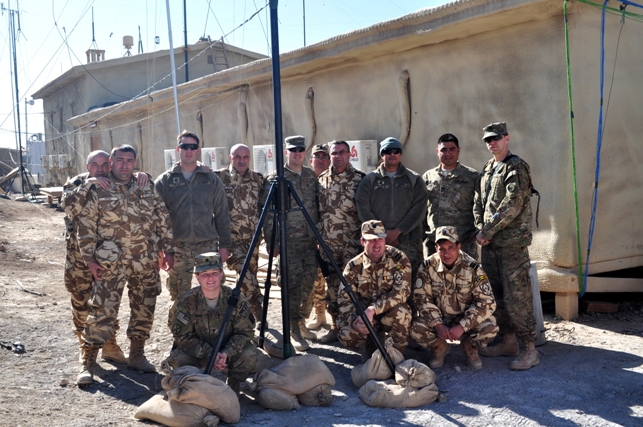
Soldiers of the Virginia Army National Guard’s 116th Infantry Brigade Combat Team are deploying technology in a revolutionary way in Afghanistan using a short wave radio transmitter that can reach almost every radio in Zabul province.

This is the first time a province-wide transmitter has been used in Afghanistan. The transmitter allows the Zabul provincial and district government to send messages to rural Afghan homes.

“No other unit in the International Security Assistance Force has ever done this at any level,” said Master Sgt. Joel E. Fix of Fort Belvoir, Va. speaking of the novel application of the technology. “We have the ability to target the signal toward specific districts or the whole province.”

Radio and word of mouth are the primary means of spreading news and information in rural Afghanistan. Listening to the radio – thousands of which were distributed by NATO-ISAF – is a cultural norm for Afghans, many of whom follow both the BBC and Voice of America.

Fix, a 14-year veteran of the Guard on his third overseas deployment, came up with the transmitter solution in response to a problem raised in discussions with Afghan officials: “How could the Government of the Islamic Republic of Afghanistan communicate to their people in remote areas?”

It was a particularly timely dilemma. As GIRoA expanded its influence into every district, GIRoA’s continued legitimacy rested on the ability to reliably reach and involve ordinary Afghans in their parliamentary democracy. Specifically, the district governors of Mizan and Day Chopan in Zabul province each wanted to invite the elders of their districts to grand shuras in September 2011.

Day Chopan has the highest elevations of Zabul province with deep valleys unreceptive to radio signals.

The 116th “Stonewall Brigade”, in partnership with Romanian troops and Soldiers of the Alaska-based 1st Battalion, 24th Infantry Regiment, all members of Combined Team Zabul, came together to brainstorm a solution. Traditional options raised by CTZ such as leaflet drops, broadcasting radio transmissions from aircraft and even flying aircraft with loudspeakers attached were all denied.

“The government was looking for ways to communicate with people on a greater scale, but there were gaps in the coverage. Short wave radio is the solution we came up with,” said Fix.

Short wave radio is known in the U.S. as ham radio which allows two way communications. The Zabul transmitter is one way. Most radios used by Afghans are receive-only.

“I was soliciting for bids for a transmitter and was referred to Don Butler to assist with the project,” said Maj. William R. O’Neal a Smithfield, Va. native with the 116th.

Butler, an Air Force veteran from the ‘60’s, is a ham radio enthusiast from Gun Barrel City, Texas who provided design help for the transmitter. Butler’s call sign is N4UJW.

“Ham radio is two way communications over short wave. Our transmitter is one way,” said Fix. “With this configuration, no matter where they are, there’s no reason the Afghan’s can’t get a signal. The frequency is close to but not the same as the one for the BBC. That makes it easy to find and remember,” he added.

The transmitter owes its success to a technique called NVIS – Near Vertical Incidence Skywave – which involves bouncing radio signals off the ionosphere – a layer of the atmosphere. Two NVIS antennas are placed horizontal to the ground unlike a traditional vertical transmitter. The second part of the NVIS antenna is called a ground wire and helps to boost the signal by forcing it to go straight up instead of outward and limited by the curve of the earth.

“In a traditional short wave broadcast, you get your antennas up as high as you can go,” said Fix. “It bounces off the F2 layer of the ionosphere but gives you limited coverage with ‘skip points’. Using NVIS and our reflector wire, the signal goes up at a very steep angle and straight back down which can penetrate deeper into mountain valleys. When we were looking at this system, it was a no brainer,” he added.

The transmitter is operated and maintained by coalition forces including the U.S. and Romanian soldiers and broadcasts content from the local government. At first glance it doesn’t seem very impressive: two antennas, the ever-useful 550 cord, and some wire that feeds into a box with one port and an on/off switch.

“Our goal is to transfer the transmitter to the provincial government as part of the transition,” said O’Neal.

Unlike some new technologies developed and used as part of Operation Enduring Freedom, this transmitter is inexpensive and effective.

“It has resulted in a savings of around 3,100%,” said Fix. “It would take 30-32 FM systems to cover the same area.

(Above Source: NATO Press Release)

We added emphasis (bold) in the press release above. We also filed this article under “Why shortwave radio?” Feel free to check out all of our articles with the same tag.

Radio Australia increases shortwave broadcasts into Papua New Guinea on 17,750 kHz

(Source: Radio Australia News)

Papua New Guinea’s parliament was resuming on Monday, despite no clear resolution to the country’s political crisis. 

Peter O’Neill says his government has taken control of the police and state offices.

[…]Earlier he said: “This clear direction now – this building will be in lockdown, only accessible to the Prime Minister (myself) and the Public Services Minister, who’s got an office in this office, and only the workers of this office. 

“No other members of the public will be allowed to come into this office.”

[…]ABC Radio Australia has increased its shortwave broadcasts to Papua New Guinea to help inform people about developments in the PNG political crisis.

Between 0930 and 1700 Port Moresby time, an extra frequency, 17750 kHz, will be added to the broadcast services for PNG.

CS Monitor: Don’t let Voice of America broadcasts go static

(Source: Christian Science Monitor)

Voice of America (VOA), the jewel in America’s public diplomacy effort abroad, is set to be streamlined. Some programs can be downsized. But VOA is in the national interest, especially as Russia, China, and Iran expand state-supported media. Cuts should be handled with care.

[…]An earlier BBG decision to shut down VOA’s Mandarin and Cantonese services to China, in favor of TV and social media, produced a firestorm not only among VOA staffers but also with members of Congress who support VOA and preside over its budget (and who temporarily blocked the move). Though shortwave radio may be in eclipse, there are still remote areas of the world dependent on it.

This article is authoritative in that it’s author, John Hughes was once director of VOA during the Reagan administration.

We’ve echoed so many times on this website what Mr. Hughes puts forth in his argument, that any downsizing should be handled with care. There are still many communities on this planet where shortwave radio is literally a lifeline of information.

BBG: Radio audience far exceeds that of TV, internet

(Source: BBG)

(WASHINGTON, D.C.—November 15, 2011) U.S. government funded international broadcasters reached an estimated 187 million people every week in 2011, an increase of 22 million from last year’s figure, according to new audience data being made public by the Broadcasting Board of Governors.

[…]The record numbers, released in the BBG Performance and Accountability Report (PAR), measure the combined audience of the Voice of America (VOA), Radio Free Europe/Radio Liberty (RFE/RL), Radio and TV Martí, Radio Free Asia (RFA) and the Middle East Broadcasting Networks (Alhurra TV and Radio Sawa). The report details impact on audiences around the globe including people in the world’s most repressive media and political environments.

[R]adio remains the BBG’s number one media platform, reaching 106 million people per week, [while] television’s growth puts it at 97 million people. The Internet audience was approximately 10 million, with the largest online audiences measured in Iraq, Russia, Indonesia, Egypt and Iran.

In summary, BBG’s stats show that radio has fully 10 times the audience of the internet/SMS, and radio listeners surpass television viewers by 9 million. Clearly, radio leads the way because it is a basic technology that has been in place for decades, building a lasting infrastructure and audience. We’ve posted numerous articles proving that radio–specifically, shortwave radio–is still a viable and dynamic information medium, with no regard for borders, for the party in power, or for the economic status of the listener.

Indeed, radio is perhaps the only information medium–other than word-of-mouth–that informs both some of the most wealthiest and some of the most impoverished people on our planet.

Let’s keep it alive: remind your broadcasters that radio is a lifeline for many listeners across the planet.

Read the full BBG report here (PDF).

Chase some pirates this weekend!

Start your search for pirate radio stations in the watering hole at 6,925 kHz and tune up to 7,000 kHz.

As I sit here in front of my radios this Friday evening, I notice the news on National Geographic that we have one of the largest sun spots to face us since 2005. This sunspot is the size of Jupiter! It’s all a little too coincidental on 11-11-11.

It can only mean one thing…

Turn on your radio and tune in some pirates!

For those of you new to pirate radio, most–but not all–activity can be found between 6,925 – 7,000 kHz (i.e. just below the 40 meter ham radio band). Pirates are not professional broadcasters, thus work  a day job during the week. That’s why you’re most likely to hear pirates Friday, Saturday and Sunday evenings.

Pirate signals are often faint–though perhaps old Sol may help a bit, depending on other conditions. For what it’s worth, I just heard a pirate on my tiny Degen DE321 portable (that review out tomorrow). Very good sign, indeed.  Just in case, consider reading our post on using SSB to help dig pirate signals out of the static.

What are you waiting for? Go chase some pirates!

BBG meets to discuss strategic management of U.S. international broadcasting

(Source: BBG)

The Broadcasting Board of Governors (BBG) will meet on Friday, November 18 at BBG headquarters in Washington, D.C., with a focus on its strategic management of U.S. international broadcasting.

The Board will consider recommendations from the BBG’s Governance Committee including the 2012 meeting schedule and receive briefings on the Agency’s Performance Accountability Report and global audience estimate. In addition, broadcast executives will update the Board on programming and coverage issues.

The meeting, which is scheduled to begin at 4:00 p.m., will be webcast both live and on-demand, at www.bbg.gov.

To express your opinion about the future of US International Broadcasting, please write the BBG:

Broadcasting Board of Governors (BBG)
330 Independence Avenue, SW
Washington, DC 20237