Category Archives: Ham Radio

St. Bandon (3B7A): An all-SDR DXpedition

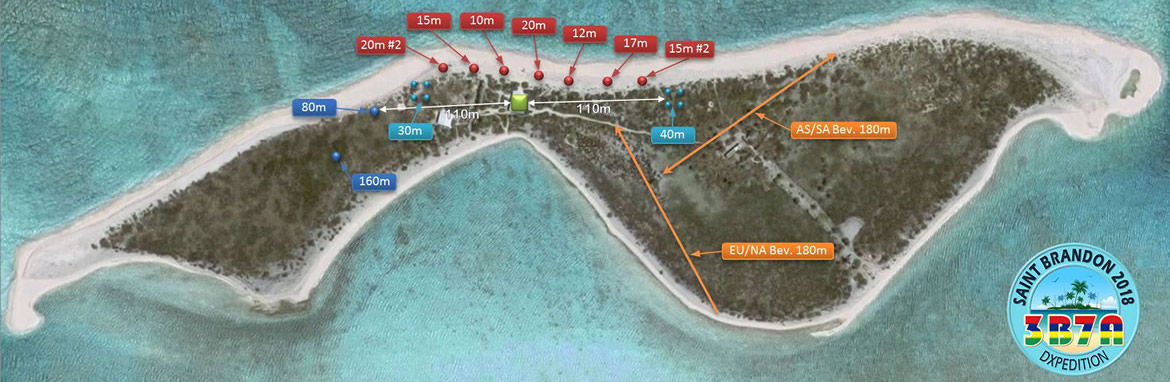
3B7A Antenna Layout (Source: SunSDR)

Many thanks to SWLing Post contributor, Mike Hansgen (K8RAT), for passing along this press release from SunSDR:

The 3B7A Saint Brandon team is now active from Saint Brandon and we are exited! This is the first major DXpedition that will be using only SDR transcievers in its setup.[…]

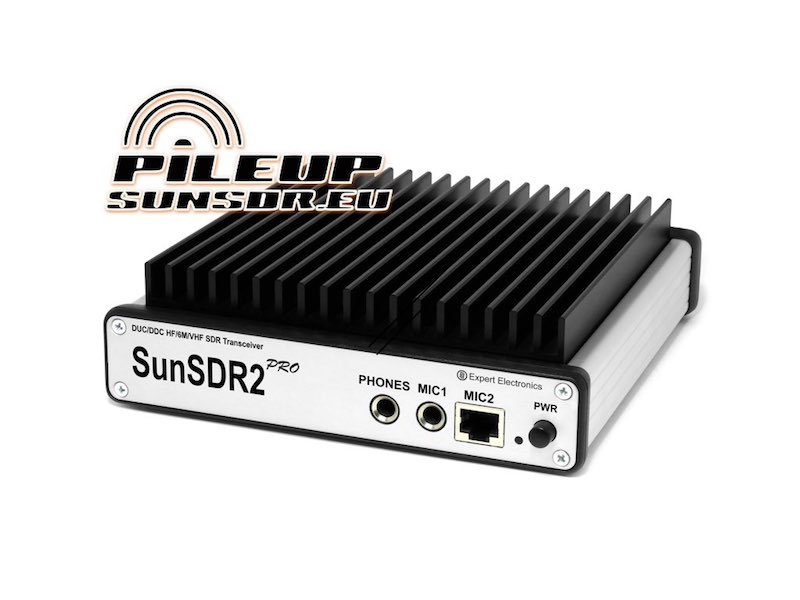
SunSDR2 Pro

Using past experience from their successful FT4TA expedition to Tromelin island and FT4JA Juan de Nova island Expedition, the experienced team lead by F5UFX Seb build their St Brandon setup around the SunSDR2 PRO transceiver, the SPE 1.3K-FA amplifier and ModMic attachable boom microphone.

3B7A will have 5 x HF stations on air simultaneously. Each station will have a SunSDR2 PRO with E-Coder hardware controller, an amplifier, and a ModMic. Logging is done using WinTest in network configuration and all stations will be able to operate CW, SSB or RTTY.

All 5 stations will have will have identical configuration from the keyboard to the amplifier. This will keep the operator focused on the pile-up and improve redundancy in case of any equipment failure.[…]
Click here to read the full article at SunSDR.

Note that I believe the January 2018 Bouvet Island (3YØZ) DXpedition would have also been one of the first major ham radio DXpeditions to use SDRs (FlexRadio SDRs). Sadly, due to weather and engine problems, 3Y0Z were not able to activate.


Shortwave Radio Recordings: Ham radio contacts between W2PVF (SK) and two Antarctic Stations, circa 1974

Palmer Station (Photo Credit: Ryan Wallace and the USAP)

Many thanks to Bill Hemphill (WD9EQD) who is one of our newest contributors at the Shortwave Radio Audio Archive (SRAA). Bill approached me at the Winter SWL Fest this year noting that he has a wide variety of radio-related audio recordings to share with the SRAA and the SWLing Post.

This week, Bill shared two fascinating tape recordings he originally acquired from an estate sale box.  These recordings were originally made in 1974 by the late Jim Hayward (W2PVF) in Absecon, New Jersey (USA) with two different ham radio stations in Antarctica.

This first recording is between W2PVF and KC4AAC of Palmer Station. The audio starts mid conversation:

Click here to download.

The second recording is between W2PVF and LU1ZE of the Argentine Antarctica Station. The operator at the microphone is W1PV. The recording even includes a phone patch:

Click here to download.

Bill, thanks so much for sharing these recordings–I thoroughly enjoyed them!

I’m so impressed with the audio and signal quality of the Antarctic stations.  In 1974, we were approaching a solar minimum in Solar Cycle 20. Still, I bet conditions were better than anything we’ve seen in over a decade!

I’m curious if any Post readers have ever made contact with either of these stations or even know the operators in the recordings? Bill notes that  Jim (W2PVF) was president of the local Atlantic City Electric Company for many years. Would be fun to share these recordings with the some of the original operators, if they’re around!

Possible First 2200-Meter Transatlantic Ham Radio Contact

(Source: ARRL News via Mike Hansgen)

In late March, Paul Kelley, N1BUG, of Milo, Maine, completed what may have been the first transatlantic 2200-meter contact by a US radio amateur under Amateur Radio rules. Signals in this part of the spectrum and lower previously have spanned the Atlantic in one direction, and Canadian radio amateurs have reported transatlantic contacts on the band dating back several years.

“To the best of my knowledge this is the first transatlantic two-way QSO from the US on 2200 meters under Part 97 operation,” said Kelley, who told ARRL that he gravitates toward the more challenging, “weak-signal” aspects of Amateur Radio and has been experimenting and DXing for 37 years now.

“2200 meters is my new passion, and I am having a lot of fun with it!” he said. I had been dreaming of — and working toward — a transatlantic QSO on 2200 meters for some time. Recently, I asked Chris Wilson, 2E0ILY, if he would be interested in trying to work me on DFCW60 mode. Chris and I have heard each other on WSPR, but he does not hear me well enough yet for a JT9 or other digital QSO. Chris agreed to try DFCW60 — dual-frequency CW, 60 second dit length.”

This was not a quick contact. It took four nights to complete, using night-by-night sequencing. Kelley called that “the minimum possible time” for such a contact, which included an exchange of complete call signs, signal reports, and acknowledgements. Kelley said they used the TMOR reporting system, borrowed from the moonbounce world.

“The QSO was completed at 0020 UTC March 28 when I received ‘R’ from Chris,” Kelley said.[…]

Click here to read the full article on the ARRN News site.

Dave launches the WIRES-X SWL Receiver Net: Test run this week!

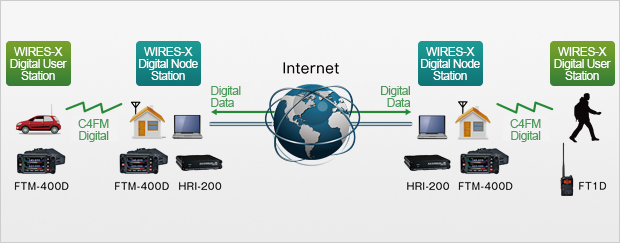
Many thanks to SWLing Post contributor, Dave Zantow (N9EWO), who follows up after his post last week about a possible SWL Net via the Yaesu WIRES-X network. Dave’s making the net a reality–here are the details:

YAESU “WIRES-X” SWL – RX Net : Right now considering once a month on the FIRST Thursday at 7 PM CDT (8 PM EDT or 0000 UTC Friday) but only if enough activity / check-ins happen. (Updated : April 02)

TEST NET : Thursday April 05, 2018 at 7:00 PM CDT (8 PM EDT. 0000 UTC Friday)
NODE : 30778
ROOM : 40778
Marked as “Dave’s Radio Receiver Page”

Many thanks, Dave, for organizing this!

Post Readers: If you’re interested in this SWL net, please follow updates on Dave’s website.

Video: Professor Joe Taylor K1JT talks FT-8 and WSJT-X

(Source: Southgate ARC)

Work the World with WSJT-X

Video of the talk given by Professor Joe Taylor K1JT about the FT-8 and WSPR modes at the 2018 MicroHAMS Digital Conference on March 24

Budd Churchward WB7FHC writes:

Dr. Joe Taylor, K1JT, author of many of the weak signal digital modes and co-author of the very popular FT-8 mode presented: “Work the World with WSJT-X”  at the 2018 MicroHAMS Digital Conference in Redmond, Washington about the WSJT-X Digital Software Suite for Amatuer Radio.

Dr. Taylor gives a detailed description of both the FT-8 and WSPR modes that so may Hams are using all over the world.

Watch Work the World with WSJT-X – Dr. Joe Taylor

Click here to view on YouTube.

The ISS will be sending SSTV in April

(Source: ARRL via Eric McFadden, WD8RIF)

Space Station’s Slow-Scan Television System to be Active in April

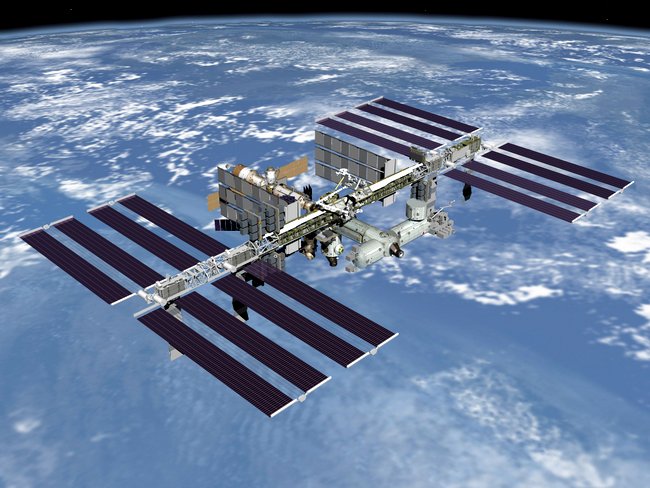
The Amateur Radio Slow-Scan Television (SSTV) system on the International Space Station (ISS) is expected to be active in April on 145.800 MHz (FM). The Russian segment’s MAI 75 SSTV has announced transmissions on Monday, April 2, 1505 – 1830 UTC, and on Tuesday, April 3, 1415 – 1840 UTC.

“Reviewing the crew schedule, the SSTV activity, which uses Amateur Radio on the International Space Station (ARISS) radios, was coordinated around ARISS school contacts and is listed for April 2 and April 3,” said NASA ISS Ham Project Coordinator Kenneth Ransom, N5VHO.

The SSTV system, which uses the call sign RS0ISS, is also expected to be active from April 11 – 14 worldwide to mark Cosmonautics Day in Russia on April 12. Specific transmission times are not yet available. Images on all dates will be related to the Soviet Union’s Interkosmos cooperative space ventures project.

SSTV images will be transmitted in PD-120 format on 145.800 MHz (FM) using the Kenwood TM-D710 transceiver in the ISS Russian Service Module. ISS transmissions use the 5-kHz deviation FM standard. It’s possible to receive SSTV transmissions with only a handheld transceiver and appropriate SSTV software[…]

Click here to read the full article on the ARRL website.

The HF Voyager: Make contact with an “autonomous ocean-going drone”

The HF Voyager (Source: JRF Amateur Radio Club)

(Source: Southgate ARC)

David, AA6YQ, author of DXLab – ‘Better DXing Through (Free) Software’, posted the following: ‘Jupiter Research Foundation Amateur Radio Club (JRFARC) has integrated an HF transceiver with an autonomous ocean-going drone. Our mission is to deploy a ham radio station that roams the world’s oceans while providing an opportunity for amateur radio operators everywhere to make contacts with rare locations.’

“We sent this new Voyager out to the open ocean on its way to California on January 15th, 2018 as a passenger on the JRF HUMPACs mission. As they search for ‘missing’ humpback whales, JRF’s pilots will guide HF Voyager to sections of the Equatorial North Pacific that are not normally available to ham operators. The station will use FT8 and PSK-31 on the 20 meter band as its primary operating modes. You may also find it using WSPR in times of poor propagation.”

See http://www.jrfarc.org/hf-voyager/

The portal in http://hfvportal.jrfarc.org/ takes a minute or two to display data.

The club plans to give a certificate of recognition to operators world-wide that have a confirmed contact with the HF Voyager. In the future we hope to collaborate with Amateur Radio organizations and publishers to sponsor operating events and contests for HF Voyager contact milestones.

Gridsquare collectors, maritime operating fans, Islands on the Air participants, and all other hams interested in this unique opportunity to make a contact with an autonomous roving maritime station should find this to be an exciting new aspect of their favorite hobby.

Be sure to check out our HF Voyager Blog for updates and schedules:
http://www.jrfarc.org/hf-voyager-updates

I think this is a pretty fascinating project–especially if the system can withstand the rigors of ocean travel and can be tracked and picked up later for replacement and upgrades.

I had never spent much time on the HF digital modes until last year when I caught the FT8 bug. While FT8 lacks some of the social nuances of, say SSB voice and CW, it is a fascinating mode that seems to defy HF propagation rules. It’s certainly an accessible way to work HF stations across the globe with a very modest setup. I think it’s an ideal pairing for a project like the HF Voyager.

Even if you don’t have a ham radio license, with an HF receiver and a free PC application, you can receive/decode FT8 contacts from across the globe.