Category Archives: Ham Radio

This weekend: MARS communication exercise

Hammarlund-HQ-120X-DialLightMany thanks to SWLing Post contributor, Dan (K2DLS), who writes:

There is a MARS communication exercise taking place this weekend. As
part of the exercise, a MARS station on the east and west coasts will
broadcast a bulletin which will be verified by a QSL.

Please see the notice below:
A HIGH POWER 60 METER BROADCAST WILL BE MADE TO THE AMATEUR RADIO
COMMUNITY THIS SUNDAY 30 OCT AT 2300 HOURS ON 5330.5 USB (60 M). IT
WILL REPEATEDLY RUN A 5 MINUTE BROADCAST FOR AN HOUR ALTERNATING
BETWEEN AN EAST COAST AND WEST COAST STATION. THE BROADCAST WILL
INSTRUCT AMATEUR RADIO STATIONS TO MAKE CONTACT WITH A MARS STATIONS ON
60 METER CHANNELS (INCLUDING 5330.5 USB) AND REPORT LOCAL CONDITIONS.
AMATEUR RADIO OPERATORS WHO RECEIVE THE HIGH POWER 60 METER BROADCAST
WILL ALSO RECEIVE A QSL CARD BY ENTERING A RECEPTION REPORT ON THE
WWW.USARMYMARS.ORG WEBSITE.

Carver W2TFM
MARS Region 2 (NY & NJ) Director, AAA2RD
——–

73, Dan

VEry cool! Thank you, Dan!

Radio Eritrea and Radio Ethiopia jamming intrudes on amateur frequencies

eritrea-ethiopia

Many thanks to SWLing Post contributor, Vlado (N3CZ), for sharing the following story from the South African Radio League newsletter:

Broadcasters, jammers wreak havoc on amateur radio frequencies

The ARRL reports the battle in the amateur radio 7 MHz band continues between Radio Eritrea and Radio Ethiopia, which is said to be jamming the Eritrean broadcaster with broadband white noise

The problem for radio amateurs is that the battle is taking place in the 40 meter phone band 7,145 and 7,175 MHz with the jamming signal reported by the IARU Region 1 Monitoring System (IARUMS) to be 20 kHz wide on each channel.

The on-air conflict has been going on for years; Ethiopia constructed new transmitting sites in 2008 and is said to use two or three of them for jamming purposes. The interfering signals can be heard in North America after dark.

According to IARUMS Region 1 Coordinator Wolf Hadel, DK2OM, Radio Eritrea is airing separate programs on each frequency. He said in the IARUMS September newsletter that telecommunications regulators in Germany, Austria and Switzerland have been informed, so they could file official complaints.

Read the full ARRL story at
http://www.arrl.org/news/broadcasters-jammers-wreak-havoc-on-amateur-radio-frequencies

IARU Region 1 Monitoring System latest news
http://www.iarums-r1.org/iarums/latest.pdf

BITX40: A Fully Assembled $45 SSB QRP transceiver

bitx40v3_main

Many thanks to Pete (WB9FLW) who writes:

Don’t know if you have seen this or not. VU2ESE of BITX20 Fame has just introduced the BITX40.

This is a fully assembled and tested SSB Transceiver for $45 including shipping from India!

http://www.hfsigs.com/

Wow! I may have to purchase one of these and try it out.

I’m currently teaching a HamRadio 101 course to a group of 13 year olds. One of them recently asked how much it would cost to get a basic HF radio kit with SSB mode.  HF rigs–even basic ones–tend to be quite expensive if they include SSB.

Here are details from the BitX40 order page:

BITX40
Work the world on 40 meters

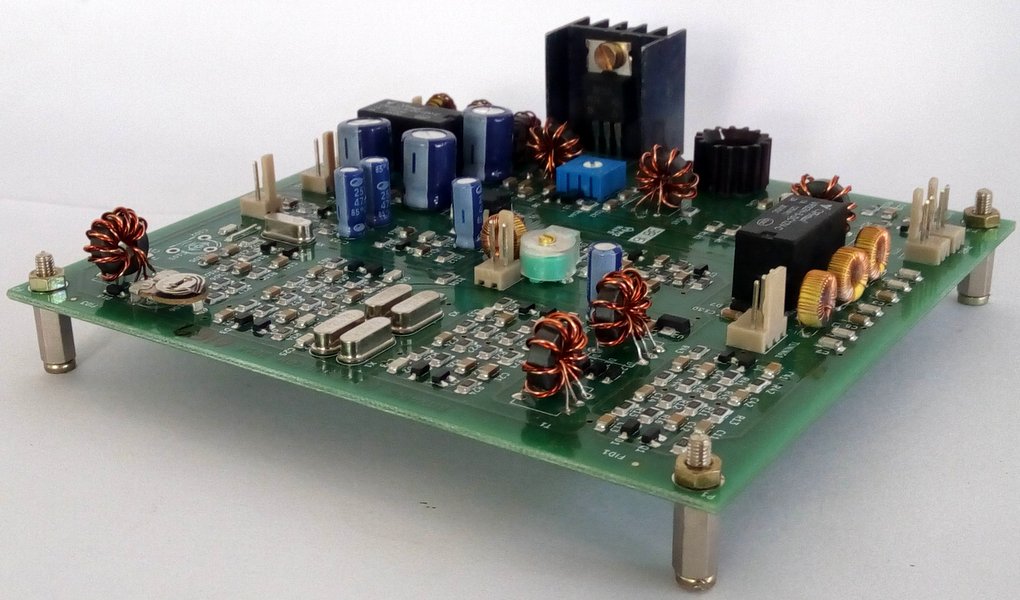
When was the last time you used a radio you had built? The BITX40 board is single circuit board 40 meter SSB transceiver module. Inside an evening, you can be on-air with this SSB transceiver module, chatting with the local gang or chasing DX. Plug in the earphones, the included electret mic, tuning and volume controls and you are on air! Included are high quality connectors, all the needed sockets and jacks, tuning and volume controls, mounting hardware, etc.

Technicals

The BITX40 is a very clean, crisp and quite receiver. The front-end has a triple tuned circuit that cuts out-of-band signals from getting inside, a diode ring mixer front-end with a very low phase noise, all analog oscillator makes this a crisp receiver that doesn’t overload easily. The all analog signal path to your ear makes provides outstanding signal clarity that is to be heard to be believed.

7 watts of SSB provides you with enough juice to have thousands of contacts on 40 meters, daily rag chew and occasional DX chasing. Any common 2 ampere 12 linear volts supply will provide enough juice for this transceiver. Or you could simply run it from a battery!

Hackable

The BITX40 will inspire you to experiment. Modify it, mount it, tweak it, change it.

The PCB uses all analog large sized SMD components that are laid out on an easy to understand manner on a double sided board with broad tracks. This can be your main module around which you can start experimenting. There are jump-points from where you can add more modules like the DDS, more bands, better audio amplifier, etc. Imagination is your limit. You can separately increase the power amplifier’s supply voltage to 25 volts to be more than 20 watts of power : You will have to add a better heat sink. The mods are on the way!

The board can be installed inside any box that you like. Make your own station rigs, man-packs, trail radios or mount it in a cigar box and leave it on your bedside table. The tuning capacitor has been replaced by a varactor tuning so you can place the tuning knob anywhere as it only carries a DC voltage. Watch the instructions video.

Box Contents

We have tried to include connector/hardware you might possibly need to build a full radio. However, we also had to balance the shipping weight to keep the overall cost down. You will have to supply your own box, power supply and earphones/headphones/speaker.

  • 4-1/2 inches by 5 inches tested SSB transceiver module, covering any 150 KHz segment of the 7 MHz band
  • Small electret microphone
  • High quality BNC connector for the antenna
  • Two earphone style audio jacks for the mic and the earphones/speaker
  • A set of DC power socket and plug
  • Volume control with on/off switch
  • 100k linear pot for tuning
  • 4 Brass stand-offs with mounting nuts and bolts
  • Connectors with wires for all connections on the board

* Note : A speaker is not included in the kit as earphones/headphones/speakers are easily available locally. No cabinet is included to save on the postage cost. Almost any box maybe used.

Manufacture

The BITX boards are hand assembled by a collective of women. Each of the toroids is hand wound. This provides these women with livelihood. The assembled boards are then DC checked a final RF check is performed to check the receiver’s sensitivity as well as transmitter’s output before being shipped. Each board is individually numbered.

Click here to view the BITX40 ordering page. 

Winners of the SWLing Post “Dream Radio” Contest

dial_closeup_1

Many thanks to the 86 responses we received from the SWLing Post dream radio contest!

Also huge thanks to Universal Radio who sponsored this contest and made it possible!

This morning, I entered the numbered contest entries into a tool on Random.org. The following two winners were selected at random–one from the US, and one from Australia:

Thomas in Florida, USA:
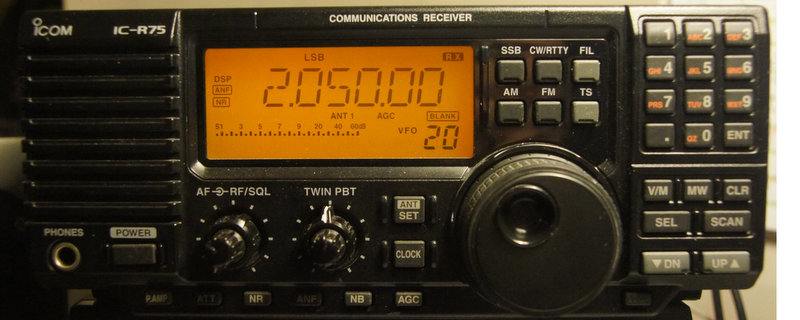
ICR75

Icom IC-R75

“I’ve been interested in all aspects of radio since I was a small child. My grandfather got me interested in the radio hobby . As a teen I acquired an old Hallicrafters S-40B. I would listen across the SW bands for hours each evening. This was back in the day when the Russians were running various jammers across the SW bands and OTH radar other wise known as the famous Wood Pecker.

I always wanted to upgrade to a more modern receiver that would have special filters to help reduce the interference caused from those types of man made devices. However, as the years went on, and I got married and raised a family my hobby fell to the wayside. It’s taken me almost 30 years, but I recently purchased an Icom R-75 and have gotten back into active SWLing again.

It is an enjoyable hobby and looking to one day spark an interest in radio in my own grandchildren.”

Adam Ellis in Melbourne, Australia:
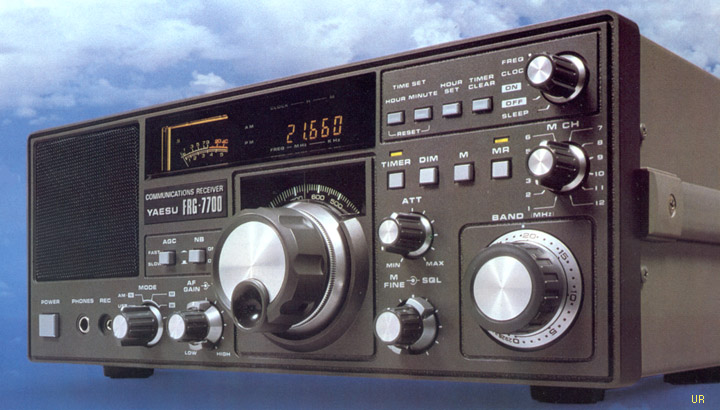
The Yaesu FRG-7700 (Photo: Universal Radio)

The Yaesu FRG-7700 (Photo: Universal Radio)

“As a school kid, growing up in the 80’s, I had a friend who’s father owned (a then) brand new Yaesu FRG-7700 with matching FRT-7700 tuner. Every time I visited at my friends house, I would look at the Yaesu in awe and ask to have a listen.

His father was a VERY strict man and forbid any of the children from touching his radio or HiFi equipment. The combination of parentally installed fear and the mystique of such a military looking and expensive piece of kit meant that my curiosity grew and grew. One day, with his father safely away at work, we powered it up and had a tune around. After a few minutes, I was instantly hooked, having now heard SSB properly for the first time. My friend quickly got concerned that his younger siblings would tell their father that we had dared to use the Yaesu so it was quickly turned off.

Well! My friend still got into trouble because we had left it tuned to an obscure frequency, along with several controls in the wrong position and his father realized it had been fiddled with! The feel of the controls and the glow of the dial lighting made that radio seem like the best thing I had ever seen and just had to own one. Of course, as a 12 year old, owning one meant selling many hundreds of newspapers! A feat all but impossible on my limited paper round.

Fast forward 30 years and I came across a used example at a Hamfest, complete with FRT-7700 tuner in near mint condition. I made an offer which was accepted (AUD$150) and it came back to the shack with me, in it’s original box! Upon testing it out, it works flawlessly with no fading of the display or noise from any of the control pots.

My only real disappointment with the radio is the minimum 1Khz tuning steps. It makes SSB a bit painful to tune. You need to save a frequency into to memory to use the memory fine tune control. It sounds very nice on AM and is mostly used for broadcast reception with a Wellbrook ALA1530 loop.

Even today, looking at the Yaesu brings back the fear laden excitement of tuning around as a kid, with a petrified friend begging me to turn it off! I never did find out what his punishment was. The Yaesu FRG-7700 is now a part of a large collection of receivers, but is one I will not part with because it has taken me so long to finally get one! 73’s, Adam.”

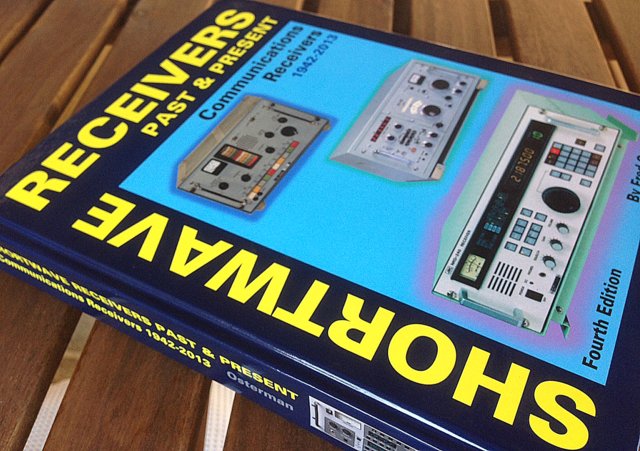
Thanks to the generosity of Universal Radio, Thomas will receive a new copy of Shortwave Receivers Past and Present by Fred Osterman. As our international winner, Adam will be given a choice of  Joe Carr’s Loop Antenna Book or Buying A Used Shortwave Receiver: A Market Guide To Modern Shortwave Radios.

I’ve truly enjoyed reading each listener’s account about their dream radio–these stories bring back so many memories of my own!

Once I discover a way to display the results here on the SWLing Post, I will publish them. To keep the post from being too long, I’m trying to investigate a way that the results can be embedded, much like an image slideshow. Stay tuned!

The new CommRadio CTX-10 QRP general coverage transceiver

commradioctx-10

Many thanks to Fred Osterman and Dave Zantow for sharing information about the new CommRadio CTX-10 transciever.  Here is the description from Universal Radio’s catalog:

AeroStream Communications near Golden, Colorado entered the hobby radio market in 2013 with their revolutionary CommRadio CR-1 and follow up CR-1a SDR receivers. The success of these innovative radios left many asking for a transceiver of similar size and capability.

The answer is the just announced CTX-10.

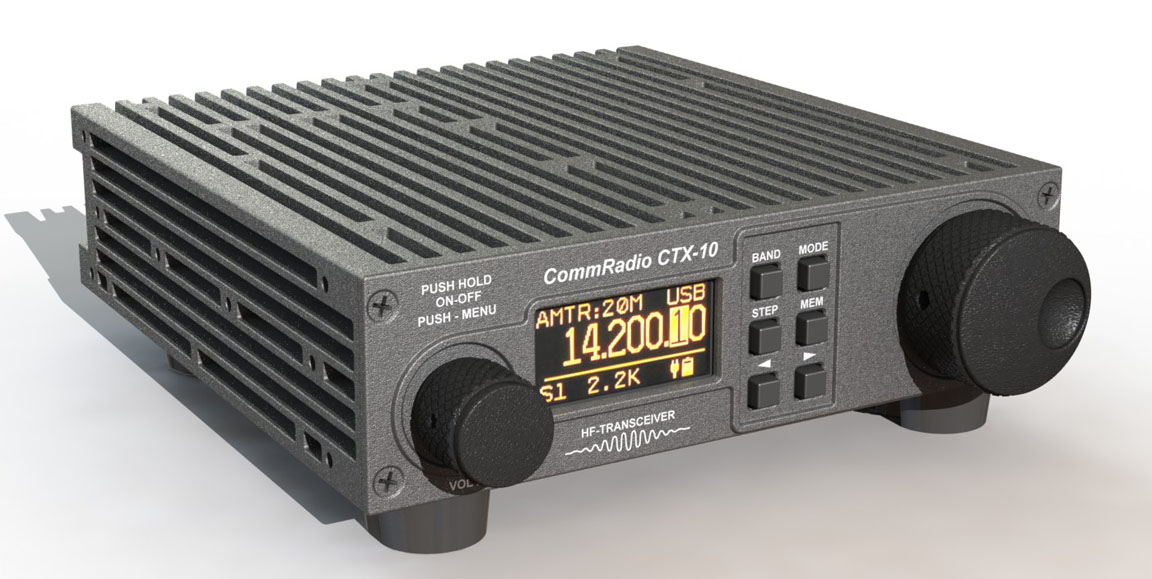
The CommRadio CTX-10 blends high performance, internal SDR technology, high efficiency circuit design, compact size and simple operation. This multi-mission QRP radio is ideal for field use and emergency operations. Transmitter covers 160-10 meter amateur bands with output power adjustable from 1 to 10 watts. The new design uses ruggedized land mobile power amps in push-pull. Every aspect of the radio design is optimized for low power consumption.

The efficient and sharp OLED display is readable in low or high lighting conditions. The radio has three built-in #18650 3.7V 2600 mAh Li-ion batteries providing 28.8 watt-hours of operation. A built-in intelligent charger provides seamless power management.

The general coverage receiver section uses multiple preselectors for optimized reception from 200 kHz to 30 MHz. An integrated CW reader and antenna tuner enhances portability. The premium tuning knob optical encoder is rated at a million revolutions.

Entire enclosure is aluminum with metal knobs and front panel. External connections are through-hole mounted for durability. Includes USB cable, DC power cord and manual. DC power requirements: receive 1.5 W, transmit 20 W. This quality device is robustly built in Colorado, U.S.A.

I’m really looking forward to reviewing the CTX-10. If the CR-1 and CR-1a are indicators, this could be a very well-built unit with a top-notch receiver!

Follow the tag CTX-10 for updates.

Contest Reminder: Your “dream radio”

dial_closeup_1

Think back to your first days in radio…What was your “dream” receiver?  And why?

Or–if you’re new to shortwave radio–what is your “dream” receiver currently, and why?

Many of us had a radio they dreamed of in their youth, or when they first began to hanker after the radio experience. What was yours?  For newer hobbyists, what is yours? And just what made–or makes–this radio so special? Did you ever obtain one?  And if so, did it live up to your expectations?

Share your experiences with the Post for a chance to win a prize from Universal Radio!

The winners of this contest will be chosen at random, using a randomizer application; an independent non-entrant will make these selections.

Thanks to Universal Radio and Fred Osterman’s generosity, there will be two winners of this simple contest–a US winner and an international winner.

The US prize will be a copy of Shortwave Receivers Past and Present by none other than Fred Osterman. I reviewed this book a couple years ago: it is an invaluable reference tool and also a fun “dream” book.  With sincere apologies to my international friends, this prize must be limited to the US simply because shipping this weighty volume internationally would cost more than the book itself.

ShortwaveReceiversPastAndPresent

The international winner may select between the following (less weighty!) books, also very good references: Joe Carr’s Loop Antenna Book or Buying A Used Shortwave Receiver: A Market Guide To Modern Shortwave Radios.

Entering the contest is easy. Simply go to our entry form (below or click here) and fill in the required fields.  Be descriptive! This will make the contest fun. Let us know in detail why that radio was (or is) so significant to you.

Your entry will be recorded, and the winners chosen at random on Sunday October 16, 2016. We’ll publish the responses once the contest concludes, sharing only the name you provide.

George Knudsen (W4GCK): A Life in Apollo

800px-apollo_11_launch2

I’m very proud to note that my good friend, George Knudsen (W4GCK), has been featured on the excellent omega tau podcast.

The interview is absolutely fascinating–here’s a description:

George Knudsen started working in 1958 on the Redstone missile, and moved on to working on the Atlas ICBM. Later he worked on the Saturn 5 launch vehicle, where he was responsible for the fuel tanks. He was on the launch team at Cape Canaveral for various Apollo missions. In this episode [we] talk with George about his work in this fascinating period of science and engineering history.

Click here to listen via the omega tau site.

omega tau, hosted by Markus Völter, covers a wide variety of topics from engineering and science. It’s one of my favorite podcasts, so I would encourage you to not only listen to this episode, but subscribe to the podcast.