Category Archives: Ham Radio

Radio Waves: Canada Radio Stamps, Across the Pacific, Satellite Talk Presentation, and BBC Radio 6 Breaks Records

Radio Waves:  Stories Making Waves in the World of Radio

Because I keep my ear to the waves, as well as receive many tips from others who do the same, I find myself privy to radio-related stories that might interest SWLing Post readers.  To that end: Welcome to the SWLing Post’s Radio Waves, a collection of links to interesting stories making waves in the world of radio. Enjoy!

Many thanks to SWLing Post contributors Richard Langley, Charlie Liberto, and Mike Terry for the following tips:


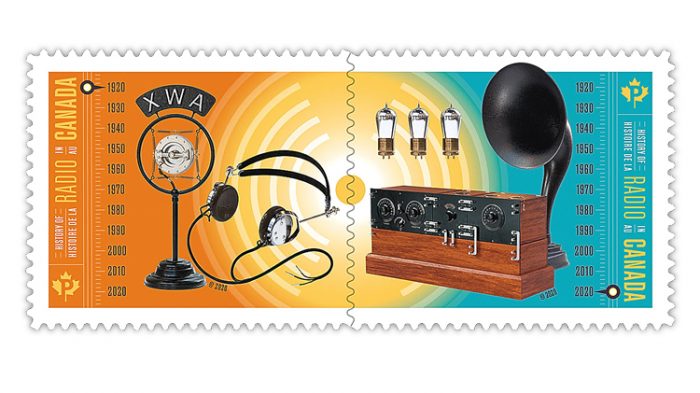
History of Radio in Canada stamps available May 20 (Linn’s Stamp News)

On May 20, Canada Post is issuing a se-tenant (side-by-side) pair of nondenominated permanent-rate (currently 92¢) History of Radio in Canada stamps. The new issue comes in a self-adhesive booklet of 10.

The stamps commemorate Canada’s inaugural radio broadcast, which hit the airwaves a century ago on the evening of May 20, 1920. According to Canada Post’s Details magazine for collectors, the radio program came from Marconi Wireless Telegraph Company’s studios in Montreal, Quebec, and was a closed broadcast for a Royal Society of Canada gathering at the Chateau Laurier hotel in Ottawa, Ontario.

The show featured a live performance by soprano Dorothy Lutton.

“As reported in the Ottawa Journal by one of the journalists invited to listen in, when ‘the latest one-step’ was played, the clarity was so impressive that several of the newspaper writers began to dance,” the May Details magazine said.

The stamp designs list the 10 decades of radio from 1920 to 2020 on the outside edges.[]

A New PBS Documentary Series about Pan American Airways  (Pan Am Historical Foundation)

When the China Clipper took off for the first scheduled flight to Manila on November 22, 1935, it riveted the attention of people around the world. At that moment Pan Am vaulted to a commanding position and the world changed forever as a result. That’s the story brought to life in “Across the Pacific.” Newly unearthed archival motion pictures, photographs, and original sound recordings as well as stunning graphics, help bring this history back to life. The film by Moreno/Lyons Productions tells the epic story of how Pan American Airways became the first to bridge the mighty Pacific – the first airline to cross any ocean. Focusing in particular on the contributions of Pan Am’s visionary leader Juan Trippe, aircraft designer Igor Sikorsky, and radio engineer Hugo Leuteritz, the three-part program will be broadcast on public television, beginning May 18th, 2020.[…]

Charlie notes that this documentary series will feature radio as seen in the following trailer:

Zoom satellite talk now on YouTube (Southgate ARC)

A video of the talk on amateur radio satellites, EME, Meteor scatter and the International Space Station by Robin Moseley G1MHU given via Zoom on Wednesday, May 13 is now available on YouTube

Watch G1MHU talk on satellites
https://www.youtube.com/watch?v=MKjCXepCK_s

The talk was organised by the Denby Dale Amateur Radio Society, their next talk on Zoom will be by the Editor of Practical Wireless, Don Field G3XTT, at 7:30pm BST on Wednesday, May 20, Zoom meeting ID 278 609 9353

http://www.ddars.net/

AMSAT-UK https://amsat-uk.org/

BBC Radio 6 Music breaks its audience record as UK’s biggest digital-only station (BBC Media Centre)

BBC Radio 6 Music reached a record 2.56 million listeners (from 2.49m last quarter and 2.52m last year), with the station’s weekday breakfast show with Lauren Laverne also seeing its biggest audience ever with 1.3 million listeners, according to the latest Rajars.
The figures released today covering the first quarter of 2020 also reveal that BBC Radio 1’s Breakfast show with Greg James gained 343,000 young 10+ listeners on previous quarter, and BBC Asian Network saw a boost in its audiences.

Figures released earlier this week for the same three months show the audience on BBC Sounds is growing, with a record 3.5 million weekly users in March. The total number of plays of live and on-demand content on BBC Sounds between January and March was 275 million, up 25 million on the previous quarter, and there was a record 123 million plays of on-demand radio programmes and podcasts.

James Purnell, Director of BBC Radio and Education, says: “It’s wonderful that listeners have granted BBC Radio 6 Music the top spot as the UK’s biggest digital only station by tuning in in record numbers. It’s no surprise that the station’s brilliant presenters and talented teams are proving a winning formula with their love and passion for music.

“We’ve been holding on to our younger audiences with more than 13 million 15-44 year olds listening to our stations every week whilst competition for their time has continued to intensify. And with more than a quarter of the population now listening to live radio online every week, it shows what an important role BBC Sounds plays for our stations and for our audiences, with record numbers of both live and on-demand plays in the first three months of the year.”

Overall, BBC Radio had 33.54 million listeners and a share of 49.7% (from 33.58m/51% in last quarter and 34.44/51.4% last year).

BBC Radio 1 posted a reach of 9.81 million listeners aged 10+ (from 9.72m last quarter and 10.18m last year). There were 8.92 million 15+ listeners (from 8.79m last quarter and 9.30m last year). The Radio 1 Breakfast Show now attracts 5.47 million listeners 10+ (Mon-Thu), from 5.13m last quarter and 5.44m last year. This quarter saw 4.87 million 15+ listeners (Mon-Thu), compared to 4.81m last quarter and 5.04m last year.

BBC Radio 2’s weekly audience was 14.36 million (from 14.44m last quarter and 15.36m last year). The Zoe Ball Breakfast Show attracted 8.11 million listeners per week, compared to 8.24m last quarter and 9.05m last year.

BBC Radio 3’s audience was 1.98 million (compared with 2.13m last quarter and 2.04m last year).

BBC Radio 4 posted a weekly reach of 10.76 million during the quarter (10.98m last quarter and 11.01m last year). The Today programme (Mon-Sat) has 7.12 million listeners each week, from 7.37m last quarter and 7.32m last year.

BBC Radio 5 Live posted a reach of 5.22 million listeners (5.41m last quarter and 5.40m last year).

Amongst digital-only stations, BBC Radio 1Xtra had a reach of 1.05m weekly listeners 10+ from 1.06m last quarter and 1.13m last year (986,000 weekly listeners 15+ from 987,000 last quarter and 1.05m last year). BBC Radio 4 Extra attracted 1.98 million listeners per week (from 2.27m last quarter and 2.24m last year). BBC Radio 5 Live Sports Extra attracted 601,000 listeners per week (from 914,000m last quarter and 708,000 last year).

BBC Asian Network drew 543,000 listeners, compared to 519,000 listeners last quarter and 536,000 last year.

The BBC World Service posted a weekly UK audience of 1.35 million (from 1.38m last quarter and 1.48m last year). BBC local radio reached 7.8 million listeners per week, from 7.5m last quarter and 7.86m last year.[]


Do you enjoy the SWLing Post?

Please consider supporting us via Patreon or our Coffee Fund!

Your support makes articles like this one possible. Thank you!

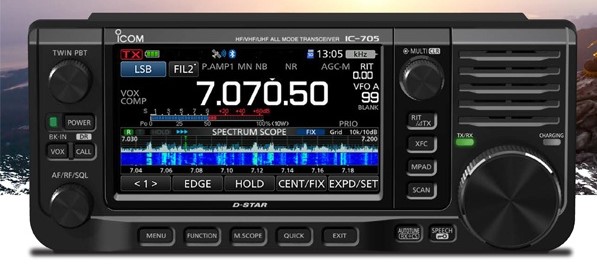
Icom IC-705 International Availability

(Icom Press Release)

Icom Inc. will begin to ship the IC-705, a new all mode portable transceiver covering HF, VHF and UHF, for the Japan domestic market from the middle of June 2020.

Shipments of the IC-705 for international markets will follow the release of the Japan domestic model.

Timing of availability depends on the schedule of type approvals in each region.

For the latest information about the availability in your country, please contact to your authorized dealer in your country.

Icom Inc. is continuing to effect delivery of the IC-705 in the soonest time possible under the current circumstances caused by COVID-19.

We thank you for your patience.

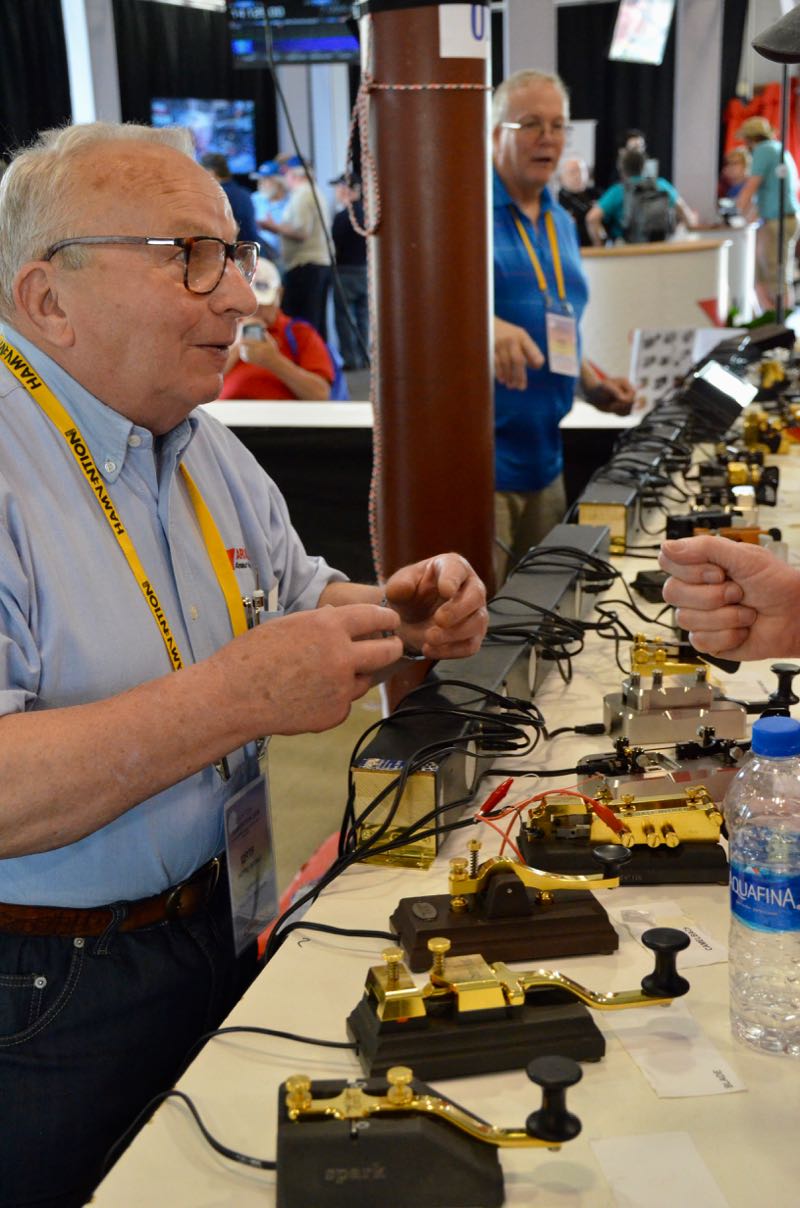
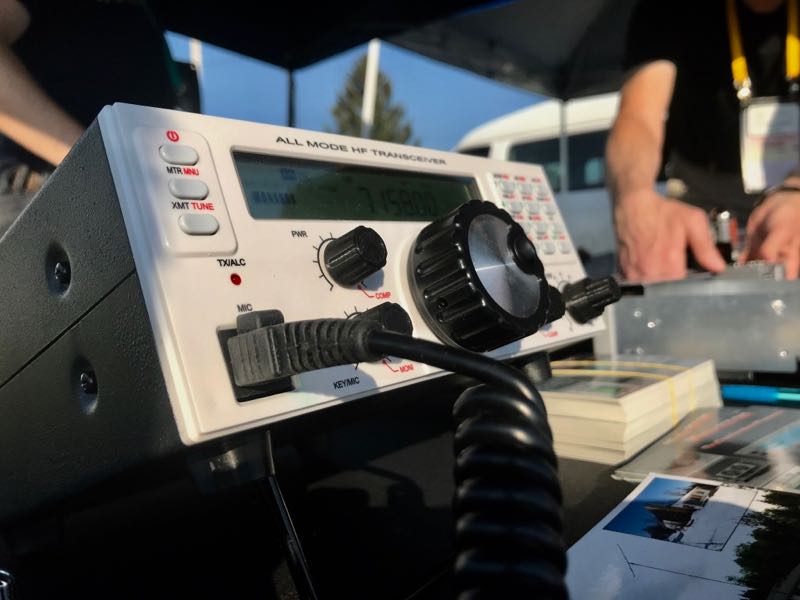
Missing Hamvention? Yeah, me too.

My friend Piero Begali (I2RTF) winner of the 2019 Hamvention Technical Achievement Award.

If we weren’t all in the midst of a global pandemic, today I would be at the first day of the 2020 Hamvenion in Xenia, OH.

Since I would not be hosting a table for ETOW this year, I was going to Hamvention for the first time on Press credentials. While I absolutely loved hosting the ETOW table with my friends and fellow volunteers, I was certainly looking forward to being a bit of a free agent this year and visiting vendors and friends with no time pressures. This would have also given me much more time to do live postings.

For me, Hamvention is first and foremost an excuse to hang with good friends I only typically see once a year. Between Hamvention and several other associated events like the QRPARCI’s Four Days In May, I connect with hundreds of people. It can be a bit daunting–even draining to this “socially adept” introvert–but I still love it and look forward to it every year.

One of my favorite things to do at Hamvention is to see what new innovations individuals and companies have introduced. As I’ve mentioned before, I love the “mom-and-pop” innovators in our radio community and Hamvention is certainly one of those places where they showcase their goods.

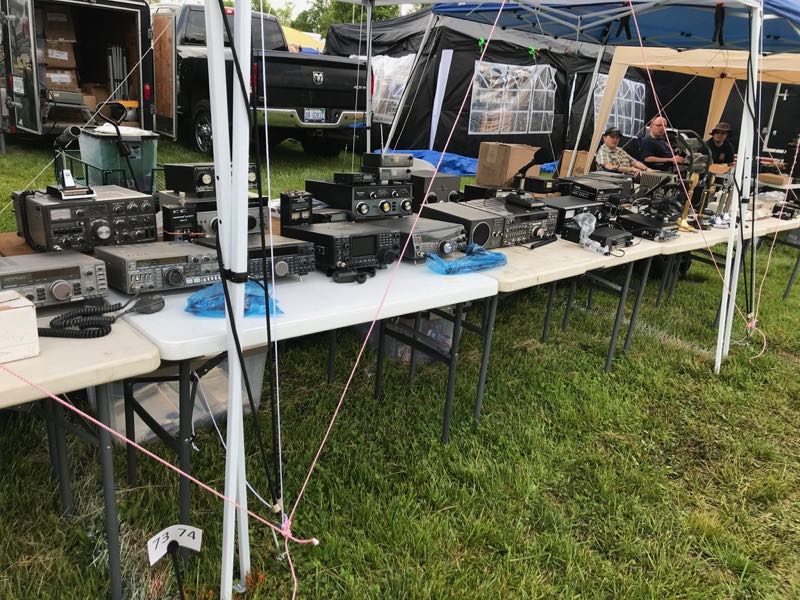
Of course, I love the Hamvention flea market–easily one of the largest outdoor hamfest flea markets in the world. Although I have found some outstanding deals at the Hamvention flea market in the past–like my BC-348-Q ($40) and Panasonic RF-2200 ($70)–I’m more likely to find that obscure rig or accessory I’ve been looking for rather than a proper bargain.

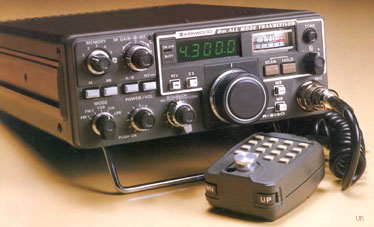
This year, I would have kept my eye out for a Kenwood TR-9000 or TR-9130 VHF transceiver.

The Kenwood “Trio” TR-9130

I’ve seen the TR-9000 and TR-9130 at past Hamvention flea markets–a near ideal place to locate vintage transceivers like these. (On that note, contact me if you have one you’d like to sell!) 🙂

I would have also been on the lookout for classic shortwave portables, of course, and accessories like enclosures, antennas, Powerpole connectors, coax, ladder line, and wire. Many of these I would only buy new.

2020 might not have been a great flea market year anyway. The weather forecast calls for quite a bit of rain and possibly thunder storms over the weekend. Likely, the flea market grounds would have been a bit wet and muddy thus less vendors would have shown up.

See you next year!

Calling off Hamvention made sense this year. Even if state restrictions would have allowed for a gathering of 30,000 people, I imagine turnout would have been anemic at best. The typical Hamvention attendee also happens to be the target demographic of the Coronavirus. Many would have not wanted to take the risk. I doubt there would have much of any international attendees or vendors there either.

You can bet I’ll be at Hamvention next year and you can bet I’ve already started my shopping list! If the pandemic is no longer an issue, I willing to bet Hamvention might have a record year in 2021. I look forward to finding out in person!

Post readers: Had anyone else planned to attend Hamvention this year?

Radio Waves: Radio Listeners Key to Economy, DXcamp Updates, Coronavirus Hospital Radio, and Hamvention QSO Party

Radio Waves:  Stories Making Waves in the World of Radio

Because I keep my ear to the waves, as well as receive many tips from others who do the same, I find myself privy to radio-related stories that might interest SWLing Post readers.  To that end: Welcome to the SWLing Post’s Radio Waves, a collection of links to interesting stories making waves in the world of radio. Enjoy!

Many thanks to SWLing Post contributors Dennis Dura, Martin Butera, and Dan Van Hoy for the following tips:


Nielsen: Heavy Radio Listeners Are Key To Restarting U.S. Economy. (Inside Radio)

With 39 states beginning to relax restrictions imposed to diminish the spread of the coronavirus, many Americans are ready to pick up the pieces and get back to their previous lifestyles. An online survey of 1,000 persons aged 18+, conducted from April 30-May 2, found nearly two thirds (63%) say they plan to resume normal activities next month. Conducted by Nielsen, the survey also shows heavy radio listeners are key to driving commerce and supporting the economy since they’re more likely to go out and shop once COVID-19 eases in their market.

Presenting the findings during a client webinar Friday afternoon, Tony Hereau, Nielsen VP of Cross-Platform Insights, summed up the top takeaway succinctly: “AM/FM radio is the soundtrack of America’s re-opening and reemergence.”[]

Marajo Dxcamp updates

Ivan Dias and Martin Butera inform us about their most recent update on the receptions of the last DXcamp on the Amazonian Island of Marajo, in the north of Brazil.

Interesting medium wave receptions from the following link
https://dxcamp-marajo2019.blogspot.com/p/only-log.html

Be sure to visit the official website of the Dxcamp, where you will find a lot of material about this important event
https://dxcamp-marajo2019.blogspot.com/

The Tiny Radio Stations That Lift Spirits in Hospitals (NY Times)

LONDON — Last Wednesday, Steve Coulby, a D.J. for Nottingham Hospitals Radio in England, read out a request from a patient battling Covid-19.

“Brian, you’ve given me an awesome responsibly, as you’ve asked for ‘any jazz,’” Mr. Coulby said. “I have to admit,” he added, “what I know about jazz is limited.”

Mr. Coulby then told his listeners he’d spent much of the day searching jazz tracks online, looking for one that might aid Brian’s recovery, or at least lift his mood. He decided on “Let Me Into Your Heart” by the British singer Isaac Waddington.

“I hope it’s good enough, Brian,” Mr. Coulby said, with a nervous laugh. “To be honest, it’s all you’re getting.”

Britain’s hospital radio stations are one of the less well-known features of its health system: tiny operations, staffed by volunteers, that you would never know existed unless you’d been a patient here.

Patients can normally listen to the shows, which are heavy on chart music and old hits, using headphones connected to an entertainment unit beside their beds. In some cases, the shows are even played out of speakers on the wards or in the emergency room waiting area.

The end of hospital radio has been declared many times over in Britain. Some hospital stations have struggled to raise funds, while the rise of smartphones filled with music and radio apps has meant patients have less need for them. But there are still over 200 such stations, according to the Hospital Broadcasting Association, and some claim they have found themselves more useful than ever during the pandemic, providing a human connections to patients who would otherwise be alone.[]

Hamvention QSO Party Saturday May 16! (Hamvention.org)

Let’s celebrate the many years we have all had at the Great Gathering we call Hamvention. We also want to remember Ron Moorefield W8ILC who never missed a Hamvention and contributed to our club until his recent death.Let’s light up the airwaves with our remembrances of Hamventions of the past! See you on the air! K3LR, Tim Duffy and W8CI, Michael Kalter.

Here is the deal: 12 hour event, 8 a.m. to 8 p.m. EDST on Saturday of Hamvention May 16, 2020.  Operate CW or SSB on 160, 80, 40, 20, 15 and 10 meters. The exchange is a signal report and first year you attended Hamvention. If you have never attended Hamvention you send 2020.

Send your score (number of QSOs) to 3830scores.com within 5 days of the event. You can print a certificate on line via www.HVQP.org. More details will appear on the Hamvention QSO Party web site being set up now.

Special bonus: W8BI, the club call of the Dayton Amateur Radio Association (DARA is the host of Hamvention) will be activated by designated DARA members from their home stations. You can add 10 points for each band/mode QSO with W8BI (12 available). So you can earn 120 bonus points (like having 120 additional QSOs).


Do you enjoy the SWLing Post?

Please consider supporting us via Patreon or our Coffee Fund!

Your support makes articles like this one possible. Thank you!
ARRL seeks clarification: Amended Amateur Service RF Safety Rules

Many thanks to SWLing Post contributor, Paul Evans (W4/VP9KF), who has been following the progress of new FCC RF exposure rules and writes:

“The ARRL has finally read the new RF Exposure rules and agrees with my thoughts that they are going to make quite a difference in the way the FCC sees amateur radio levels.”

(Source: ARRL News)

ARRL Seeks Clarification of Amended Amateur Service RF Safety Rules

ARRL has filed a Petition for Clarification addressing two issues arising from amended FCC RF safety rules that go into effect on June 1 for the Amateur Service and other FCC-regulated services. Licensees will have 2 years to determine if an RF safety evaluation is now required under the new rules and to perform an evaluation and implement any needed mitigation measures. Current rules already require amateur stations to meet RF exposure limits, but more radio amateurs will have to evaluate their stations under the new rules. The revised final rules, adopted last November, appeared in the April 1 edition of The Federal Register.

“For applicants and licensees in the Amateur Radio Service, we substitute our general exemption criteria for the specific exemption from routine evaluation based on power alone in §97.13(c)(1) and specify the use of occupational/controlled limits for amateurs where appropriate,” the FCC said. While radio amateurs have always had to comply with RF exposure limits, certain stations have been exempted from having to conduct evaluations based upon power and frequency.

On May 8, ARRL asked the FCC to clarify that using maximum permissible exposure (MPE) limits be permitted in the Amateur Service for required RF safety evaluations of 2200-meter operations, just as they are elsewhere in the amateur spectrum. Removal of the exemption for amateurs resulted in a requirement to use specific absorption rate (SAR) limits for amateur frequencies between 100 and 300 kHz.

“SAR evaluations are very complex to directly measure and, we believe, generally exceed the capability of most individual amateur operators,” ARRL argued in its petition, asserting that MPE limits correspond to conservative estimates of SAR.[…]

Continue reading the full article here.

Paul adds:

“You’ll note that they too were clearly caught out by there being no comment period as stated in December 2019, but the FINAL ruling appeared out of the blue in the Federal Register on April 1, 2020, which took me by surprise (having checked every day for over 90 days!).”

Thank you for following and sharing this development, Paul!

Lockdown Lunacy: QRP EME has now been added to the Social DX bucket list

When my buddy, Pete dives into a project that would have otherwise been placed on the backburner, had it not been for sheltering at home during the Covd-19 pandemic, he calls it an episode of “Lockdown Lunacy.”

Lockdown Lunancy

I don’t think there could be a better name for the bug that has bitten me.

Since my earliest days of reading ham radio magazines–well before I was licensed–I found the concept of EME (Earth-Moon-Earth) communications absolutely fascinating. I mean, communicating with someone across vast distances by bouncing signals off the freaking moon?!?

What’s not to love?

After becoming a ham, the reality set in about how much equipment and financial resources it would take to set up an EME station in 1997. I would need big X/Y/Z steerable antennas, big amplifiers, and very pricey transceivers. Even if I built half the system, I couldn’t imagine piecing it together for less than $3,000 US.

Plus, HF/shortwave signal work was what really pushed me into the world of ham radio.  Once I set up my first dipole and started making DX contacts with my Icom IC-735, I never really looked back…that is, until, I met Bill.

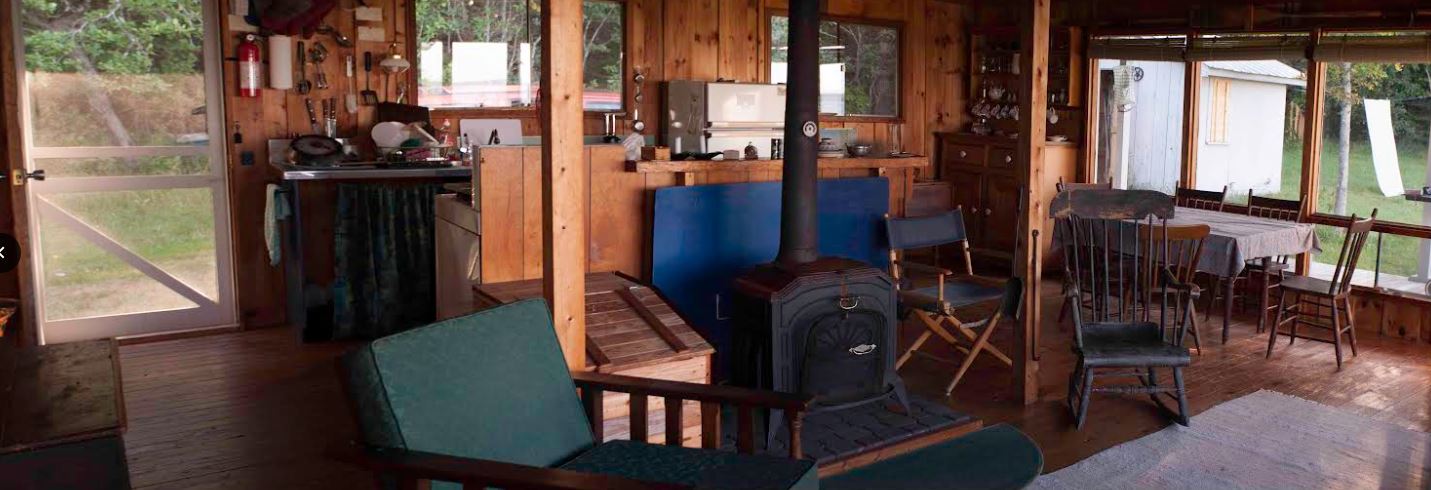
In 2016, my family spent yet another summer on the east coast of Prince Edward Island, Canada, in an off-grid cottage.

The cottage living area.

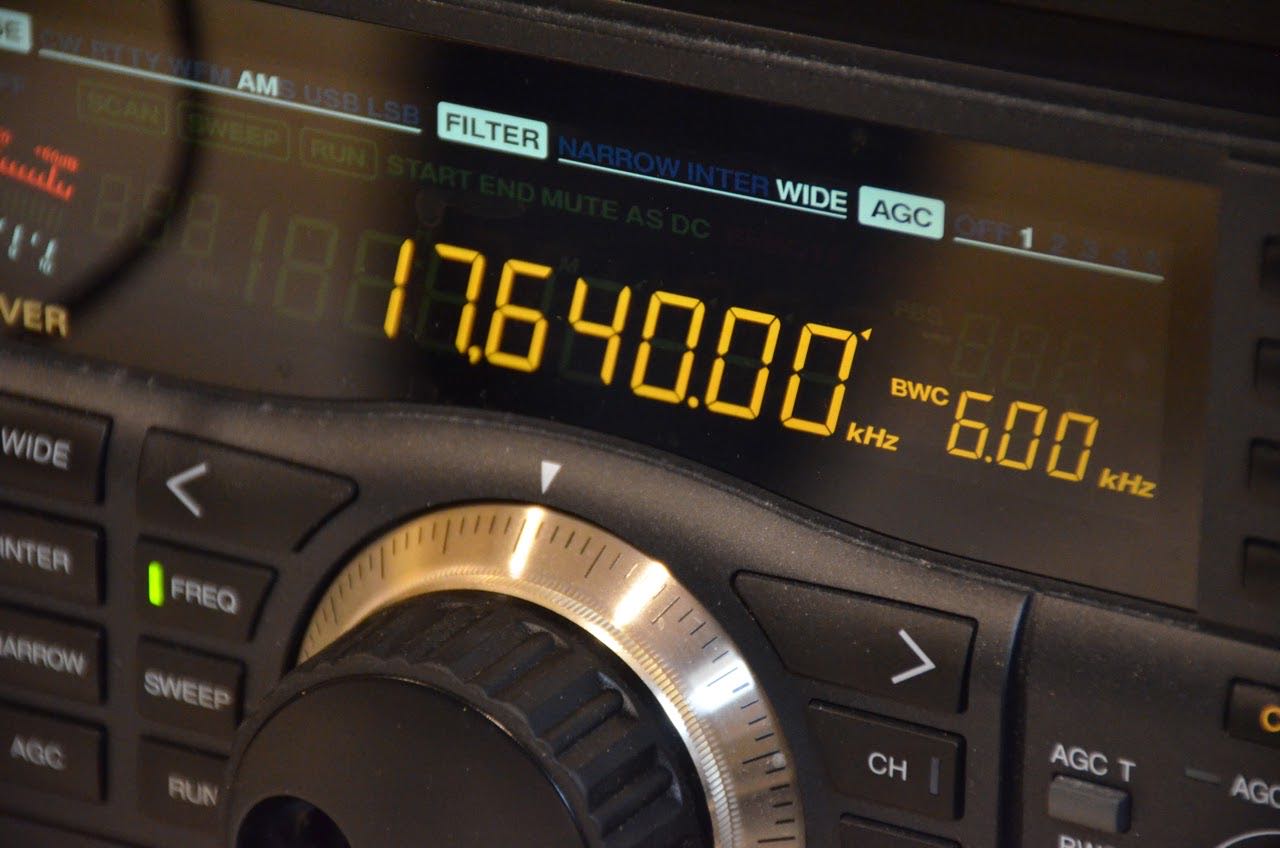
I brought along my Elecraft KX3, of course, with a LiFePo external battery and PV panel for charging One day, I hopped on the 17 meter band to work a little DX with a large dipole I’d set up in the trees behind the house. After turning on the rig, I heard a PEI amateur radio operator working another strong station in Europe. As he sent his 73s to the other station, I quickly interrupted and asked where he was located. Turns out, he was only 5 km way as the crow flies! After a quick chat, he invited me over for coffee the next morning and to talk radio.

That next morning I discovered two things about Bill (VY2WM / VY2EME):

Firstly, he’s a coffee snob…just like me. Best coffee I’d ever had on the island.

Secondly, the man had been bitten by the EME bug. Indeed, the mission to build a station to do moon bounce communications is really what energized him to play radio.  We spoke at length about EME and it was then I realized that QRP EME was an actual “thing.”

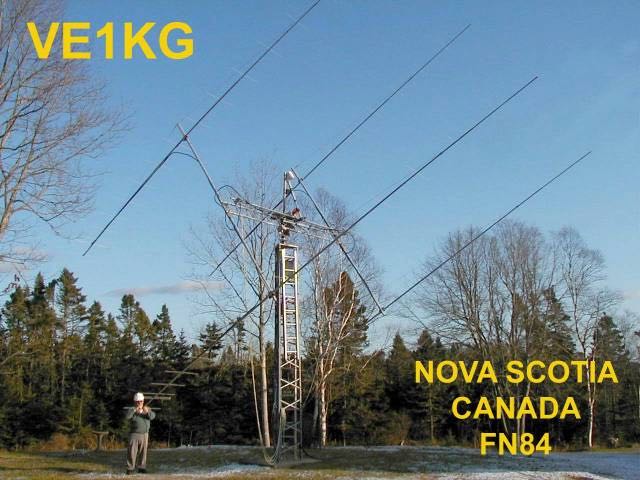
Bill informed me that, with the advent of weak-signal digital modes like JT-65, QRP EME contacts were possible for almost anyone and the investment in equipment, much more modest than in the past. I was truly impressed with how, over the course of a few years, Bill slowly and methodically built his station and started making contacts. Bill gave a lot of credit to his EME Elmer, Serge (VE1KG)–just check out Serge’s big gun station on his QSL card below:

Though Bill didn’t know it at the time, our little talk re-ignited my interest in EME.

Bill and I have kept in touch over the years and only last week, after talking EME a bit more via email, I realized it was time I start my own little QRP EME station.

One thing that pushed me to commit to EME is the fact that both of my daughters are studying for their Technician licenses at present. Both are into all things astronomy and space, so I thought it might be rather fun to give them a chance to play radio off the moon with their Tech licenses!

Like Bill, I plan to take time assembling my QRP EME station. I would like to have all of the components together by December and perhaps start building things like a long yagi and some sort of antenna support by next spring.

I’m facing a big learning curve here. Other than what I learned on my ham radio license prep, I know little to nothing about signals north of 30 MHz!

But that’s the thing about radio in general: I love learning new skills and exploring the world just a little outside my comfort zone!

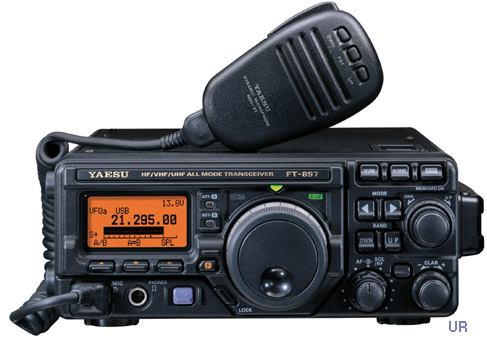
I’m already putting out feelers for a good transceiver (thinking a used Yaesu FT-897 or FT-100D).

Yaesu FT-897 via Universal Radio

How committed am I? A QRP EME station has been officially added to my Social DX bucket list. That’s pretty darn serious!

Post readers: Any EME enthusiasts in our community?  If so, please comment with any suggestions you may have as I dive deeper into the world of moon bounce!

Radio Waves: FCC Wipes Out Engineering Division, Last Nazi Message Decoded, Remembering Ronan O’Rahilly, and French Radio Society Free Publications

Radio Waves:  Stories Making Waves in the World of Radio

Because I keep my ear to the waves, as well as receive many tips from others who do the same, I find myself privy to radio-related stories that might interest SWLing Post readers.  To that end: Welcome to the SWLing Post’s Radio Waves, a collection of links to interesting stories making waves in the world of radio. Enjoy!

Many thanks to SWLing Post contributors Mike, Eric McFadden, and Paul Evans, and for the following tips:


FCC Eliminates Its Own Engineering Division (Radio World)

The Federal Communications Commission has elected to eliminate the Engineering Division at the organization in an effort to, as it says, “streamline the organization of the Media Bureau” as part of the public interest.

The commission plans to fold the work of the Engineering Division into the Media Bureau’s Industry Analysis Division (IAD) due to changes in the duties of the Engineering Division.

“By incorporating the work and staff of the Engineering Division into IAD, we can better ensure that the bureau’s technical expertise is integrated more fully into the bureau’s adjudicatory matters and policy proceedings,” the commission announced on April 29.

Back in 2002, the Engineering Division was established to conduct technical reviews of media-related matters, including overseeing technical compliance of TV and radio broadcast licenses, as well as things like cable regulatory filings and license transfers. But as the industry transitioned from analog to digital and from paper to electronic filing, the Engineering Division’s tasks have diminished.[]

Last Nazi message intercepted by Bletchley Park revealed (BBC News)

The last German military communications decoded at Bletchley Park in World War Two have been revealed to mark the 75th anniversary of VE Day.

They were broadcast on 7 May 1945 by a military radio network making its final stand in Cuxhaven on Germany’s North Sea coast.

The message reports the arrival of British troops and ends: “Closing down for ever – all the best – goodbye.”

After Germany surrendered, VE Day was declared the next day.

In 1944, this German military radio network, codenamed BROWN, had extended across Europe sending reports about the development of experimental weapons.

But a year later, as the Allies entered the town and closed in on his position, a radio operator at his post signed off to any colleagues who might still be listening.[]

Remembering ‘Radio Caroline’ Founder Ronan O’Rahilly, A Pioneer Of Pirate Radio (NPR)

NPR’s Scott Simon talks to U.K. broadcaster Johnnie Walker about Ronan O’Rahilly, the founder of the pirate Radio Caroline, who died on April 20 at the age of 79.[]

French Society makes Radio REF free for April and May

Paul Evans notes that two REF-Radio publications are now free to download via the REF website. If you know French, you’ll enjoy these quality radio publications:

Click here to download REF-Radio (PDFs) for:


Do you enjoy the SWLing Post?

Please consider supporting us via Patreon or our Coffee Fund!

Your support makes articles like this one possible. Thank you!