Category Archives: Ham Radio

DXtreme Station Log 14

Many thanks to SWLing Post sponsor, Bob Raymond with DXtreme Software, for sharing the following press release:


Product Announcement DXtreme Station Log 14
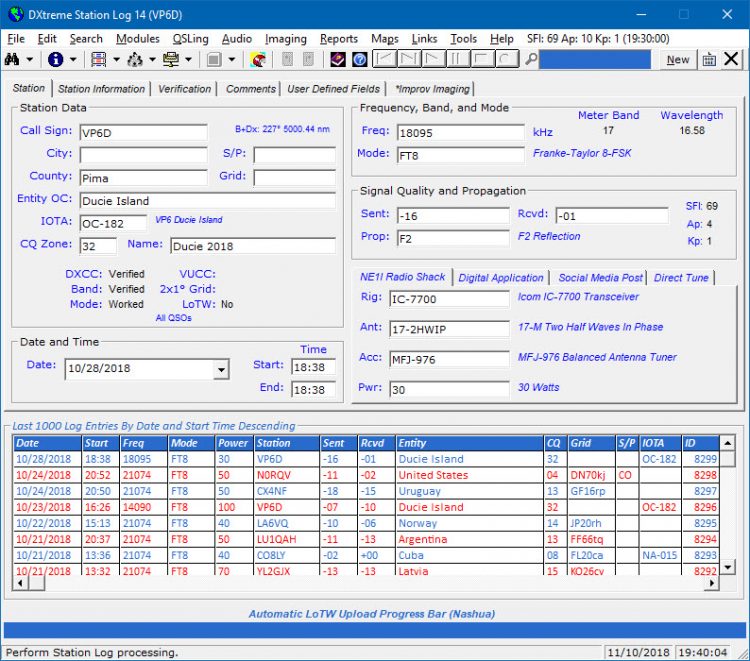
DXtreme SoftwareTM has released a new version of its popular logging program for Amateur Radio operators: DXtreme Station Log 14TM.

New Features in DXtreme Station Log 14

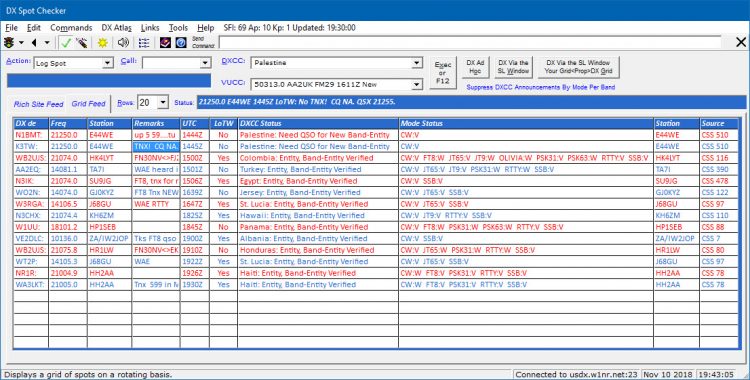
  •  DX Spot Checker Now Has Two Presentation Modes — Users can switch between Rich Site Feed and Grid Feed by clicking a tab on the window. The Rich Site Feed displays the actual, continuous feed from the Telnet server, and lets users interact with the server to set options like server-side filters and to perform queries. The new Grid Feed displays 10 to 50 rows (user’s choice) of DX spots in a structured, resizable, alternating-color grid. Grid-Feed spots can be displayed on a rotating basis (erase then continue) or by overwriting spots already displayed, as selected on the DX Spot Checker toolbar. Users can set fonts and colors for both feeds.
  •  Suppress Verified Spots by Mode Per Band — When activated in DX Spot Checker Options, this client-side filter lets users suppress the display of spots for modes already verified within band plans defined on the Modes-Per-Band Plans tab.
  •  JT Log Entry Processing — Users can have DXtreme Station Log 14 manage the pre- and post-log-entry population of the WSJT-X and JTDX log files, letting users perform all logging operations on the Station Log 14 window while keeping their eyes glued to the WSJT-X or JTDX interfaces for worked-before status indications. This feature is important when using quick modes like FT8.
  •  Digital Application Assignment — When users add a JT log entry via JT Log Entry Processing, the Digital Application Used field is populated automatically with either WSJT-X or JTDX as appropriate. When using other applications, users can edit this field manually. And they can assign digital applications to pre-existing log entries by mode globally, filtered or unfiltered by date and band.
  •  Club Log Record Creation — Users can create Club Log records in a special workfile automatically when adding or modifying log entries. The workfile can be viewed and edited, if needed, and uploaded via the Club Log web site. A Batch Upload to
    Club Log function is available when Club Log does not contain all log entries.

Standard Features in DXtreme Station Log 14
DXtreme Station Log 14 lets hams log their contacts and import ADIF files from other programs. It supports major call sign subscription services, and offers the following multimedia and advanced functions:

  •  DX Spot CheckerTM — Receives DX spots from Telnet-based servers and determines whether QSOs are needed for new or verified DXCC® entities, band-entities, mode- entities, or VUCC grids. Information displays on Rich Site Feed and Grid Feed tabs.
  •  Automatic LoTW Upload — Users can set Station Log 14 so it uploads each log entry to LoTW automatically when added, capturing and saving QSO Record Status from the LoTW server as part of the process. Modified log entries can be uploaded as well. If desired, users can disable automatic uploading and can upload log entries to LoTW semiautomatically and manually in batches whenever they want to.
  •  LoTW Reporting — Users can perform searches and run reports filtered by LoTW QSO Record Status, which indicates whether log entries are On, or Not On, the LoTW server following upload or QSL-updating. Users can also perform searches and run reports filtered by LoTW QSL Record Status, which indicates the date of each LoTW QSL record processed by DXtreme’s LoTW QSL Update Utility.
  •  DX Atlas Integration — Performs Afreet DX Atlas azimuth plots from the user’s location to that of a spotted or logged station. Also creates maps for reports.
  •  Rig Control — Tunes/retrieves frequencies and modes from supported rigs through integration with Afreet Omni-Rig.
  •  QSL Processing — Creates QSL and address labels for physical QSLs, and supports the ARRL’s LoTW facility, including capturing LoTW QSL records as digital images.
  •  QSL ImagingTM — Lets users scan and capture QSL cards and electronic QSLs into their log entries for browsing and viewing any time they want to.
  •  Improv ImagingTM — Lets users associate adhoc images with their log entries separate from our popular QSL ImagingTM facility. Users can capture, scan, or paste any image and save it as a single-page .jpg, or single- or multi-page .tif. Improv images popular with users include signals on a spectrum analyzer or waterfall, QSOs conducted on ATV and data applications, and equipment used during contacts.
  •  Audio Facility — Records and plays QSOs.
  •  Reports — Provides a wide range of performance and station reports to let users see how well they’re doing. Reports can be filtered and sorted. Includes DXCC® and WAS AnalyticsTM tools for analyzing and enhancing DXCC and WAS standing.Operating System and Requirements, Pricing and Support

DXtreme Station Log 14 runs in 32- and 64-bit versions of Microsoft® Windows® 10, Windows 8.1, Windows 8, Windows 7, Windows Vista®, and Windows XP. It retails for $89.99 USD worldwide for Internet distribution. Reduced pricing is available for upgrading users. All prices include product support by Internet e-mail.

About DXtreme Software

Based in Nashua, NH, DXtreme Software produces powerful and easy-to-use logging applications for all kinds of radio enthusiasts — from short-wave and medium-wave listeners and DXers to Amateur Radio operators. For more information about DXtreme Station Log 14, visit www.dxtreme.com or contact [email protected].

SSTV Special Event from the International Space Station on Saturday, October 27

(Source: ARRL News)

Amateur Radio on the International Space Station (ARISS) has scheduled a slow-scan television (SSTV) event to begin on Saturday, October 27, at about 1000 UTC. NASA’s Space Communications and Navigation (SCaN) Department will support the event. SCaN manages NASA’s three most important communications networks — The Space Network (SN), Near-Earth Network (NEN), and the Deep Space Network (DSN). Participants in the SSTV event can qualify for a special endorsement for NASA on the Air (NOTA), celebrating the space agency’s 60th anniversary.

As during past ARISS SSTV events, 12 images will be transmitted. Six will feature SCaN educational activities, while the other six images will commemorate  major NASA anniversaries, including the establishment of NASA and the moon landing. Transmissions are expected to take place on 145.800 MHz using PD-120 SSTV mode. Received images can be posted and viewed online. The event is dependent on other ISS activities, schedules, and crew responsibilities, and the schedule is subject to change at any time.

More information be posted to the AMSAT and ARISS websites as well as to the ARISS-BB, to the ARISS Facebook page, and via Twitter (@ARISS_status).

Click here to read the full article at the ARRL News.

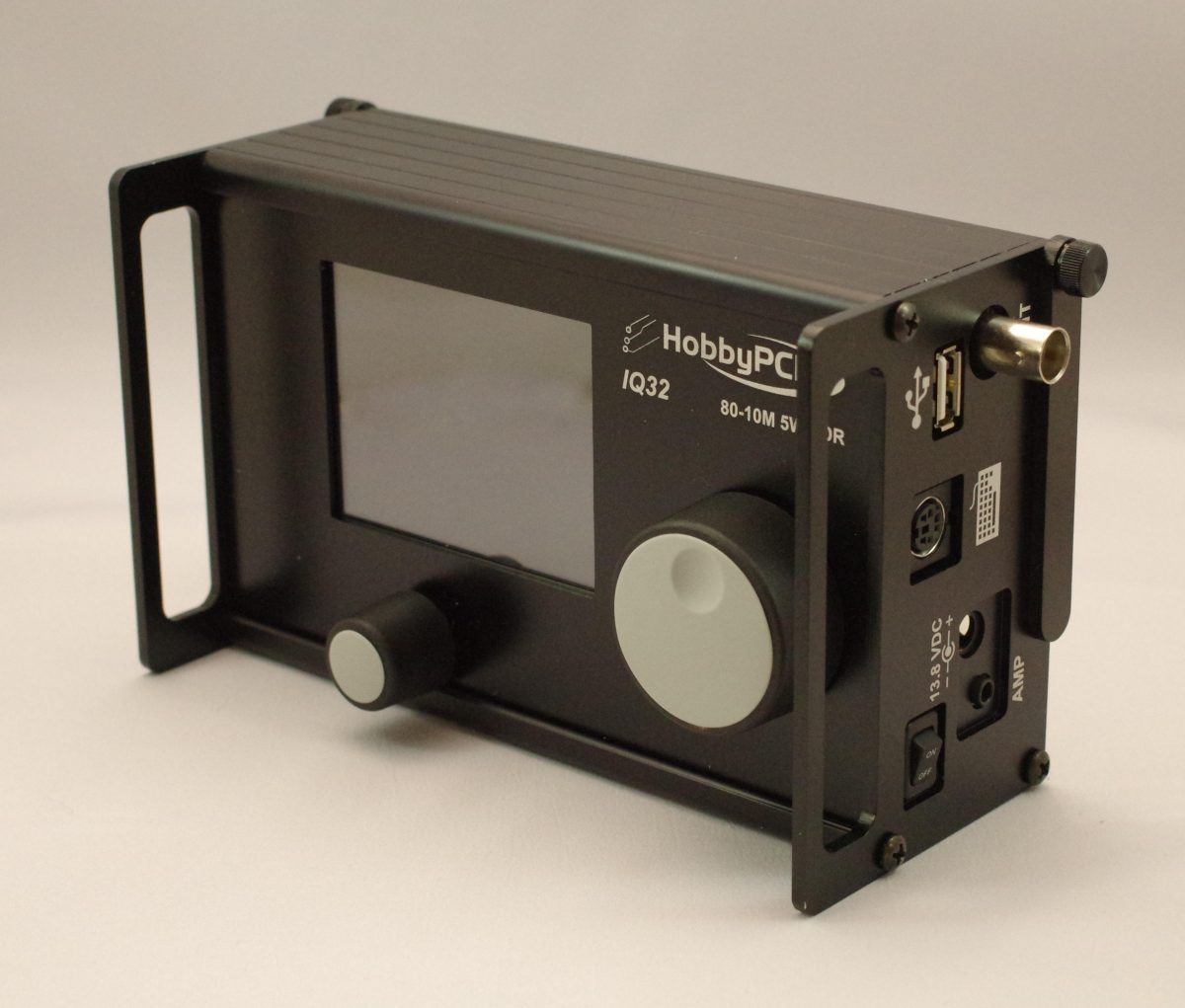
The HobbyPCB IQ-32: A general coverage portable QRP transceiver with color touch screen now shipping

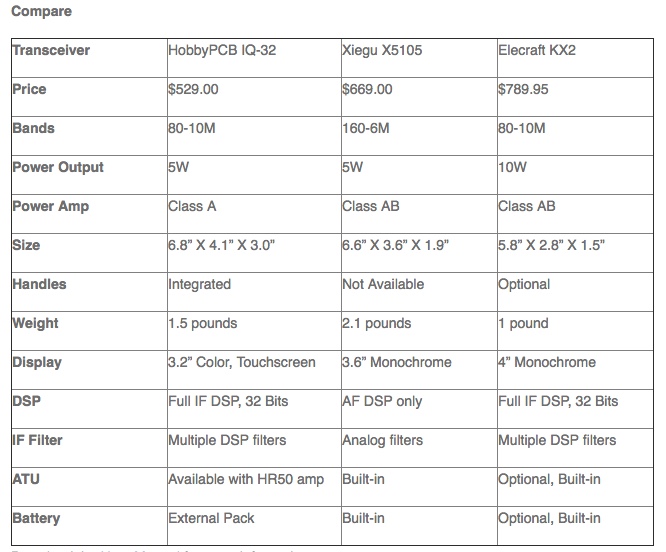
Many thanks to SWLing Post contributor, Pete (WB9FLW), who shares the following information regarding HobbyPCB’s much-anticipated portable transceiver which is now shipping.  The price is a competitive $529.00.

The following information comes from the HobbyPCB website:

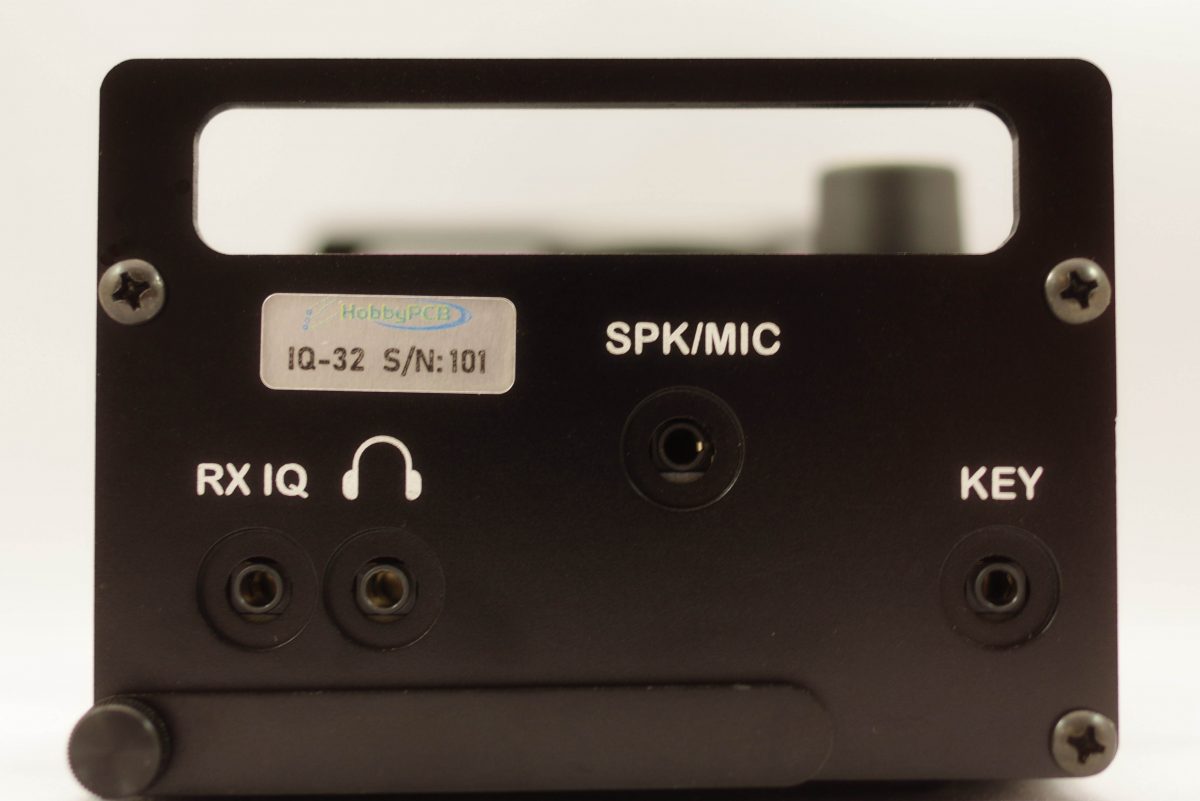
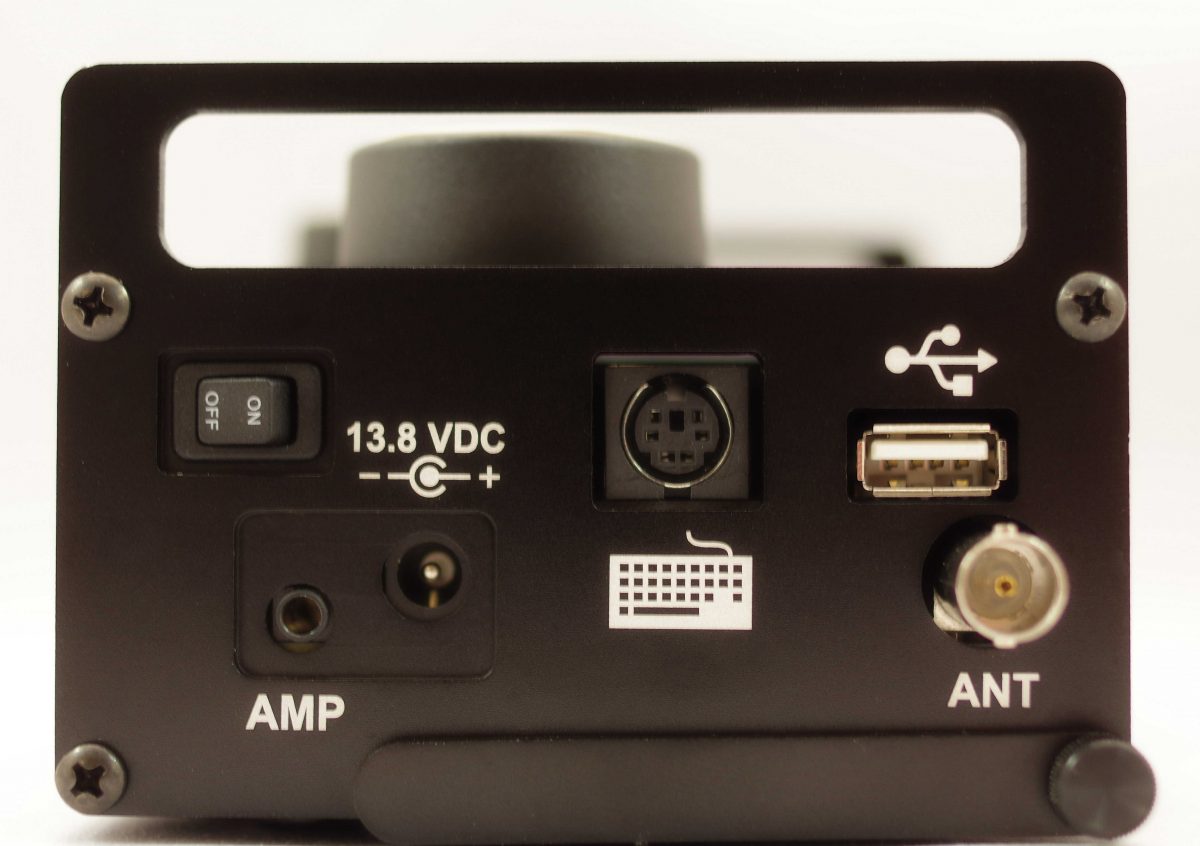
The IQ32 is 5W output, 80-10M Amateur Radio transceiver with powerful 32 bit processing providing high-end features at an entry level price. The IQ32’s 3.2″ color LCD touch-screen display and dual control knobs provide an enjoyable operating experience in a robust package.

Available for immediate delivery!

Introducing the HobbyPCB IQ32 HF transceiver, based on the high performance RS-HFIQ RF system, the receiver in the IQ32 consists of 5 band-pass filters to reject out-of-band signals, an LNA with frequency dependent gain and a conventional quadrature down-converter. The transmitter features a Class A, 5W power amplifier with individual low-pass filters for each band to exceed FCC requirements for spectral purity.

The IQ32 features a large, color, touch-screen display providing an enhanced user interface and informative spectrum and waterfall displays found on radios costing much more. With a powerful STM-32 DSP processor, the IQ32 transceiver has variable filtering, multi-mode AGC, memory functions, built-in PSK encode/decode with keyboard support.

5W not enough power? Add a HARDROCK-50 to your station to boost up to 50W. The IQ32 and HARDROCK-50 seamlessly integrate together for a powerful mobile/base station!

Simple upgradeable firmware, no connection to a computer required, no drivers, no cables. Simply insert a thumb-drive with the appropriate file and the IQ32 updates its own firmware.

Specifications

  • Frequency Range: 3-30MHz (performance guaranteed on 80/60/40/30/20/17/15/12/10M ham bands)
  • Sensitivity: MDS < -128 dBm on 80M dropping to < -135 on 10M
  • Noise Figure: < 8 dB
  • TX Power: 5W typical, 4W minimum
  • LO Feed-thru: < -50 dBc @ 5W output
  • Spurious and Harmonics: < -50 dBc typical
  • DC Power: 13.8VDC, 2 amp max
  • Size: 172mm x 105mm X 75mm
  • Weight: < 700 grams
  • Display: 3.2″ Color LCD Touchscreen
  • Modes: USB, LSB, CW, PSK 31
  • DSP Processor: STM-32, 32 Bit

Click here to download the manual.

Pete also notes:

If one already has the RS-HFIQ board fear not an upgrade kit is available:

https://hobbypcb.com/products/hf-radio/iq32-upgrade

Thank you for sharing this, Pete!

I may see about grabbing an IQ-32 to evaluate. I’m very curious how its receiver might stack up to the Elecraft KX2, the CommRadio CTX-10 and the LnR Precision LD-11. (Please note that these links lead to my other radio site, the SWLing Post.)

It doesn’t appear that the IQ-32 has an AM mode, but I would still like to see how it might handle broadcast listening on the shortwave meter bands using ECSS.

I love the portable form factor and the fact that it ships with stand-off handles to protect the front face of the radio.

Video:

Check out WA2EUJ’s IQ-32 presentation from the 2018 Hamvention on YouTube:

Click here to check out the IQ-32 product page at HobbyPCB.

Have any Post readers purchased the IQ-32?  Please comment!

Do you enjoy the SWLing Post?

Please consider supporting us via Patreon or our Coffee Fund!

Your support is greatly appreciated. Thank you!

Radio enthusiasts receive images from the Longjiang-2 in lunar orbit

Image received by astronomer Cees Bassa (@cgbassa) using the Dwingeloo Telescoop

Many thanks to SWLing Post contributor, Eric McFadden (WD8RIF) who shares the following story from The Planetary Society:

Earlier this week, on October 10, radio amateurs all around the world worked together to get the Chinese Longjiang-2 spacecraft to take an image of the Earth and the far side of the Moon. Radio commands were generated by MingChuan Wei in China, transmitted to the spacecraft by Reinhard Kuehn in Germany after which they were received by the spacecraft in lunar orbit. In turn, the spacecraft transmitted the image back to Earth, where it was picked up by radio amateurs in Germany, Latvia, North America and the Netherlands.

Since June this year, the Chinese Longjiang-2 (also known as DSLWP-B) microsatellite has been orbiting the Moon. The satellite is aimed at studying radio emissions from stars and galaxies at very long wavelength radio waves (wavelengths of 1 to 30 meters). These radio waves are otherwise blocked by the Earth’s atmosphere, while the lunar environment offers protection from Earth-based and human-made radio interference. Longjiang-2 was launched to the Moon together with an identical twin, Longjiang-1 (DSLWP-A), together acting as a radio interferometer to detect and study the very long wavelength radio waves by flying in formation in lunar orbit.

Besides the scientific instruments, both Longjiang satellites carry a VHF/UHF amateur radio transmitter and receiver (a transceiver) built and operated by the Harbin Institute of Technology (in Chinese). The Longjiang-2 transceiver also includes an onboard student camera, nicknamed the Inory Eye. The Harbin team built on experience gained with the Earth-orbiting LilacSat-1 and LilacSat-2 nanosatellites, which allow radio amateurs to receive satellite telemetry, relay messages and command and download images taken with an onboard camera.

While receiving signals from satellites in low Earth orbit requires only relatively simple antennas, doing so for satellites in orbit around the Moon (a thousand times more distant), is much harder. To this end Longjiang-1 and 2 transmit signals in two low data-rate, error-resistant, modes; one using digital modulation (GMSK) at 250 bits per second, while the other mode (JT4G) switches between four closely spaced frequencies to send 4.375 symbols per second. This latter mode was developed by Nobel-prize winning astrophysicist Joe Taylor and is designed for radio amateurs to relay messages at very low signal strengths, typically when bouncing them off the surface of the Moon.

[M]any radio amateurs have been able to receive transmissions from Longjiang-2. Usually, the transceiver is powered on for 2-hour sessions at a time, during which GMSK telemetry is transmitted in 16-second bursts every 5 minutes. After some testing sessions in early June, the JT4G mode was activated, with 50 second transmissions every 10 minutes.

Specialized open source software written by MingChuan Wei and the Harbin team enables radio amateurs to decode telemetry as well as image data and upload it to the Harbin website.

The JT4G mode has allowed radio amateurs with small yagi antennas to detect signals from Longjiang-2 (using custom software written by Daniel Estévez).[…]

Click here to read the full article at The Planetary Society.

This is fascinating, Eric!  Thank you for sharing. It would be amazing fun to grab one of these Lunar signals! Anyone up to the task?

Tommy (N1SPY) on monitoring airplane communications

Many thanks to SWLing Post contributor, Ivan (NO2CW), who writes:

If anyone is interested in monitoring aircraft communications across HF, VHF and UHF, Thomas, N1SPY put together a demo video of what you can hear and how:

Click here to view on YouTube.

Brilliant instructional video, Tommy! Like you, I love both radio and aviation so appreciate the effort you put behind this video.  Great primer!

Click here to check out other projects by N1SPY.

1917: First wireless transmission from New Zealand to London

(Source: New Zealand History via Andrea Borgnino)

First trans-global radio transmission to London

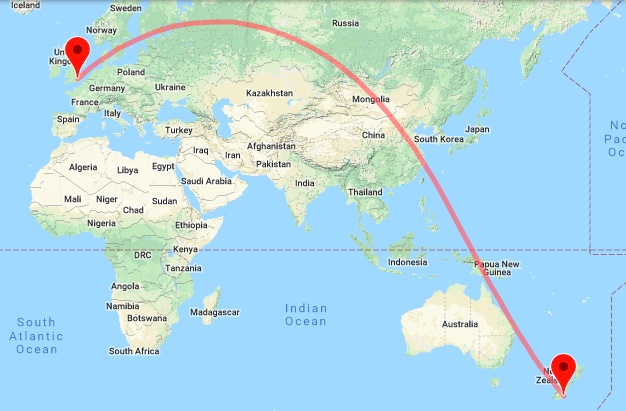
From the family sheep station in Shag Valley, East Otago, amateur radio operator Frank Bell sent a groundbreaking Morse code transmission received and replied to by London-based amateur operator Cecil Goyder.

Frank and his older sister Brenda were radio pioneers. Invalided home from the Western Front in 1917, Frank revived a boyhood interest in wireless communication while recuperating. He helped pioneer the use of short radio waves to communicate over long distances, initially through Morse-code telegraphy. He achieved a number of firsts, including New Zealand’s first overseas two-way radio contact with Australia and North America. But it was his radio conversation with London that made world headlines.

When Frank turned his attention to running the family farm, his sister Brenda took over the wireless station, becoming New Zealand’s first female amateur radio operator. In 1927 she was the first New Zealander to contact South Africa by radio. After the Second World War, Brenda Bell moved into professional radio as a writer and broadcaster for Dunedin station 4YA.

Click here to view this article and a photo of Frank Bell at New Zealand History.

Start of the fall term School Club Roundup!

Many thanks to Ken Reitz (KS4ZR) who reminds us that the School Club Roundup started today:

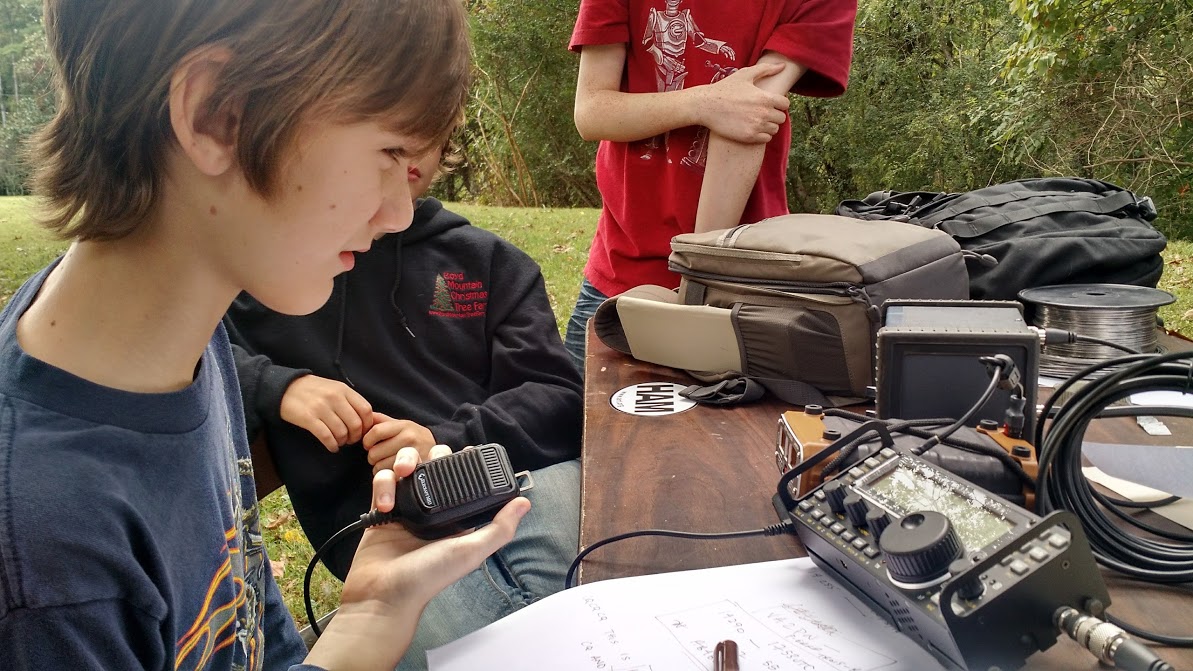
[T]his is it! The start of the fall term SCR is today. Challenge yourself to work as many school clubs as possible and see if you don’t feel optimistic about the future of amateur radio.

Here are the SCR rules: http://www.arrl.org/school-club-roundup

Thanks, Ken! I’ll try to put some of the participating schools in the log this week!