Category Archives: News

VOA Radiogram, 7-8 September 2013: Fldigi, Flmsg, Flamp, RSIDs, MFSK

VOARadioGram(Source: VOA Radiogram)

VOA Radiogram for the weekend of 7-8 September 2013 will include more experiments with RSIDs, the brief signals that automatically switch your decoding software to the correct mode.

For best results, please install Fldigi 3.21.75 from w1hkj.com. When you have 3.21.75 installed, go to Configure > ID > RsID, and adjust Errors to 0 (zero). This will prevent Fldigi from flipping to another mode while decoding our MFSK transmissions. For more information about this, seewww.w1hkj.com/FldigiHelp-3.21/ConfigID.html

Please also download the latest versions of Flmsg and Flamp (2.1.00) from w1hkj.com.

This weekend’s VOA Radiogram will include another transmission in MFSK128. This will be done mainly to see if the RSID works. However, to improve the chances for a successful decode of the very fast MFSK128, it will be in Flamp format. A paragraph will be divided into seven blocks of 64 characters each. And it will be transmitted three times, with the second and third passes filling in any blocks with incorrect checksums. Make sure Flamp is running before the MFSK128 transmission begins; it does not turn on automatically like Flmsg.

The foreign language for the weekend will be Spanish, with brief VOA news items in both plain text and Flmsg formatted. Please turn off and restart Fldigi before each of this weekend’s VOA Radiogram broadcasts to ensure the accented Spanish letters display correctly. You will need the UTF-8 character set. The adjustment can be found via Configure > Colors & Fonts.

In the Flmsg-formatted Spanish news story, you will see several html codes such as í for the accented characters. They might look like decoding errors, but the story should look OK when the web page renders.

To make Flmsg work with Fldigi, in Fldigi: Configure > Misc > NBEMS — Under Reception of flmsg files, check both boxes, and under that indicate where your Flmsg.exe file is located.

Here is the lineup for VOA Radiogram, 7-8 September 2013:

3:55  MFSK16: Program preview

2:09  MFSK32: VOA Spanish news re old iPhones

3:41  MFSK32/Flmsg: VOA Spanish news re new iPhone model

2:29  MFSK64: VOA News re Al Jazeera in Egypt

2:48  MFSK32: YouTube screen capture of Al Jazeera

:50  MFSK32: Introduction to MFSK128 item

1:30  MFSK128/Flamp: Brief description of VOA

:45  MFSK32: Introduction to MFSK64

2:55  MFSK64: VOA News re LADEE moon mission

2:56  MFSK32: Artist’s rendition of LADEE spacecraft

1:11  MFSK16: Closing announcements

:41  MFSK32: VOA Radiogram logo

:20  Surprise mode of the week

Please send reception reports to [email protected].

VOA Radiogram transmission schedule

(all days and times UTC)

Sat 1600-1630 17860 kHz

Sun 0230-0300 5745 kHz

Sun 1300-1330 6095 kHz

Sun 1930-2000 15670 kHz

All via the Edward R. Murrow transmitting station in North Carolina.

There will also be a minute of MFSK32 on The Mighty KBC, via Germany, Saturday at approximately 1130 UTC on 6095 kHz, and Sunday at approximately 0130 UTC on 7375 kHz (Saturday evening 9:30 pm EDT).

Also check out their post:  Base64 VOA logo via MFSK128: a few unexpected successes. Fascinating!

Shortwave Radio Recordings: Voice of Greece

greeceLately, the Voice of Greece has been playing very long sets of music; and not all of it Greek. I assume the break in format has to do with the reorganization of Greek national broadcasting.

I believe VoG could be cut without notice. With heavy budget cuts being dealt to national broadcasting, I doubt investment in shortwave radio will continue since they no longer even have an English language service. This is one of the reasons I’ve devoted a lot of recording time to VoG as of late. Admittedly, I certainly hope I’m wrong about my prediction.

On September 1st, I recorded over five hours of VoG, starting around 22:00 UTC. After about an hour of Greek commentary, you’ll hear music ranging from contemporary to classical.

Click here to download the full recording as an MP3, or simply listen via the embedded player below.

RTÉ Radio to broadcast GAA finals via shortwave radio

(Photo: RTE Radio)

(Photo: RTE Radio)

RTÉ Radio has announced that it will broadcast the GAA All Ireland Hurling Final on Sunday 8 September and the All Ireland Football Final on Sunday 22 September via multiple sources including shortwave radio (frequencies and times below).

RTÉ Radio explains:

“In Africa, where many Irish people live and work, often in relative isolation with poor communications, RTÉ is providing special transmissions on shortwave radio.

[…]These services are part of RTÉ’s continued commitment to Irish people overseas and, over the years, has proven especially popular with those in geographically or technically isolated areas.”

Of course, RTÉ will broadcast both finals via the Internet, local radio and television.

On shortwave, RTÉ will broadcast on multiple frequencies–attempting to target most regions of Africa–so there’s a very good chance you could hear one.

Shortwave frequencies for Africa–September 8 and 22, 2013

Both Finals throw in at 3:30 pm Irish Time (14:30 UTC)

  • Southern Africa – 7405 kHz (2pm to 6pm)
  • East Africa – 17725 kHz (2pm to 5pm)
  • East Africa -11620 kHz (5pm to 6pm)
  • West Africa – 7505 kHz (2pm to 6pm)

VOA Radiogram 31 August/1 September 2013 includes Vietnamese and Russian

VOARadioGram(Source: VOA Radiogram)

This weekend’s VOA Radiogram will include sample text in Vietnamese and Russian. Vietnamese has all sorts of diacritics, and Russian uses a Cyrillic alphabet, so this will be a real workout for your decoding software. Your character set should be UTF-8. In Fldigi, this adjustment is via Configure > Colors & Fonts.

The program will also attempt to improve the performance of RSID (Reed-Solomon Identification), the brief signal at the beginning of a digital mode transmission that automatically switches decoding software to the correct mode and audio frequency. I produced the program using Fldigi 3.21.74AB. You will need Fldigi 3.21.73 or newer for the MFSK64 and MFSK128 RSIDs to work correctly. If you have a previous version of Fldigi, or another decoding software, I have provided time for the mode to be changed manually.

Here is the lineup for VOA Radiogram, 31 August/September 1 2013:

2:55  MFSK16: Program preview

3:10  MFSK32: Vietnamese and Russian text samples

2:58  MFSK32: Discussion of RSIDs

1:50  MFSK64/Flmsg: VOA News re dung beetles*

:56  MFSK32: Image of dung beetle

3:07  MFSK128/Flmsg/Base64: VOA blue logo*

2:16  MFSK64: VOA News re China hack attack

2:38  MFSK32: VOA Khmer radio photo contest

2:31  MFSK32: Image of submitted radio photo

1:10  MFSK16: Closing announcements

:15  Surprise mode of the week

*To make Flmsg work with Fldigi, in Fldigi: Configure > Misc > NBEMS, under Reception of flmsg files, check both boxes, and under that indicate where your Flmsg.exe file is located.

VOA Radiogram transmission schedule

(all days and times UTC)

Sat 1600-1630 17860 kHz

Sun 0230-0300 5745 kHz

Sun 1300-1330 6095 kHz

Sun 1930-2000 15670 kHz

All via the Edward R. Murrow transmitting station in North Carolina.

Please send reception reports to radiogram (at) voanews.com

A great weekend to catch some pirate radio action

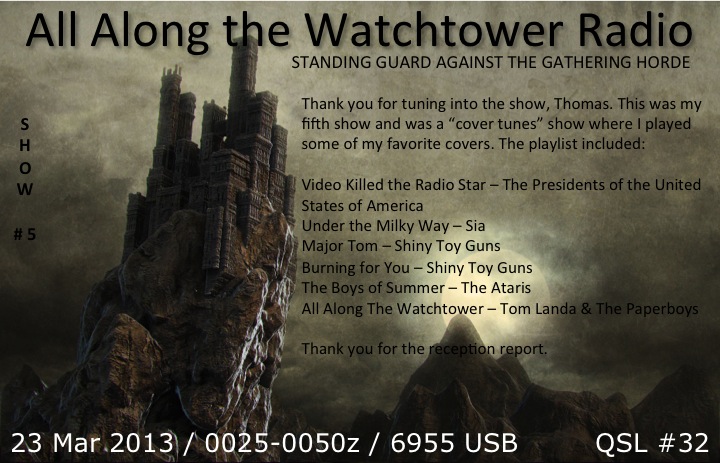
Most pirate radio stations will send you an electronic or paper QSL. This is one I received from All Along The Watchtower Radio. (Click to enlarge)

Most pirate radio stations will send you an electronic or paper QSL. This is one I received from All Along The Watchtower Radio. (Click to enlarge)

Monday, September 2nd, is Labor Day throughout most of North America; shortwave pirates love to operate on long holiday weekends (though you can hear them most any weekend for that matter).

So, if you’ve never heard a live pirate station on shortwave radio, this is a great opportunity to catch your first pirate!

Where to find pirate stations

In a nutshell: In North America, you can usually find pirate radio broadcasters in AM or upper side band (USB) between 6,920 – 6,970 kHz from early evening into the night. 6,925 kHz is one of the most popular frequencies. Pirates broadcast elsewhere–especially in Europe–but this is the best watering hole in North America.

Pirates transmit at much lower power than commercial broadcasters, so it takes a good ear and, sometimes, a little patience to hear them through the static.

Let us know if you hear any pirate stations this weekend! Weather permitting, I’ll be listening and even tweeting pirates/frequencies when I hear them. Also check the HF Underground forum for live pirate radio loggings.

Good luck and good listening!